
 Worksheets
Density
Total questions: 20
Worksheet time: 10mins
Name
Class
Date
1.
Why does ice float?
a)
Liquid water is less dense than solid water.
b)
Solid water is less dense than liquid water.
c)
Gaseous water is less dense than solid water.
d)
Liquid water is less dense than gaseous water.
2.
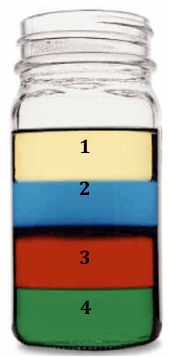
Put the liquids in order from most dense to least dense?
a)
4, 3, 2, 1
b)
1, 2, 3, 4
c)
3, 4, 2, 1,
d)
4, 3, 1, 2
3.
What is the formula for density?
a)
density = mass x volume
b)
density = mass / volume
c)
density = mass + volume
d)
density = mass - volume
4.
Frank has an eraser. It has a mass of 4g, and a volume of 2cm3. What is its density?
a)
8 g/cm3
b)
2 g/cm3
c)
1/2 g/cm3
d)
24 g/cm3
5.
Jack has a rock. The rock has a mass of 14g and a volume of 2cm3. What is the density of the rock?
a)
7 mL
b)
7 g/cm3
c)
28 g/cm3
d)
1/7 g/cm3
6.
Why do some substances float on water?
a)
they are warmer than water
b)
they are cooler than water
c)
they are more dense than water
d)
they are less dense than water
7.
Helium balloons rise on earth because
a)
helium is less dense than air
b)
helium is more dense than air
c)
helium is cooler than air
d)
helium is warmer than air
8.
What is the measuring unit for mass?
a)
centimeter
b)
millimeter
c)
grams
d)
pounds
9.
What units are used to measure Density?
a)
cm3/g
b)
g
c)
g/cm3
d)
cm3
10.
A crayon has a mass of 10g and volume of 5 mL. What is the density?
a)
30 g/mL
b)
15 g/mL
c)
1 g/mL
d)
2 g/mL
11.
An object with which of the following densities will float on water?
a)
0.7 g/cm3
b)
1.2 g/cm3
c)
3.5 g/cm3
d)
11.4 g/cm3
12.
Helium balloons rise on earth because
a)
helium is less dense than air
b)
helium is more dense than air
c)
helium is cooler than air
d)
helium is warmer than air
13.

Which box has a higher density?
a)
A
b)
B
c)
They are the same
14.
An object has a volume of 6 cm3 and a mass of 42 g. What's it's density?
a)
7 g/cm3
b)
48 g/cm3
c)
42 g/cm3
d)
6 g/cm3
15.

The amount of water displaced is the same as the volume of the object. What is the VOLUME of the object?
a)
40 mL
b)
65 mL
c)
20 mL
d)
25 mL
16.
An object is is placed into 45 mL of water. The water rises to 48 mL. What is the volume of the object?
a)
3 mL
b)
93mL
c)
8 mL
d)
83 mL
17.
There are 4 objects listed with their densities. Which of the following will float on water? (SELECT 2)
a)
Object A:
0.7 g/cm3
b)
Object B:
1.2 g/cm3
c)
Object C:
0.25 g/cm3
d)
Object D:
11.4 g/cm3
18.
If an object has a density of 6 g/mL and you put it into water, will it sink or float?
a)
sink
b)
float
19.
What two types of measurements make up DENSITY?
a)
Mass and Volume
b)
Temperature and Mass
c)
Grams and Centimeters
d)
Volume and Weight
20.
True or False: The density of a specific type of material never changes.
a)
True
b)
False
100 %

