
 Worksheets
D4 - Exploring the Universe - Test
Total questions: 34
Worksheet time: 17mins
Name
Class
Date
1.
1. A massive star that explodes
a)
A. main sequence
b)
B. nebula
c)
C. supernova
d)
D. nova
2.
2. A star that briefly becomes thousands of times brighter than normal
a)
A. main sequence
b)
B. nebula
c)
C. supernova
d)
D. nova
3.
3. Dark cloud of gases and dust in space
a)
A. main sequence
b)
B. nebula
c)
C. supernova
d)
D. nova
4.
4. Joining of the nuclei of atoms
a)
A. fusion
b)
B. gravity
c)
C. fiction
d)
D. brightness
5.
5. Type of star accounting for 90% of the stars on the H-R diagram
a)
A. nova
b)
B. nebula
c)
C. fusion
d)
D. main sequence
6.
6. A bright star may appear dimmer than a dim star because it is ________________.
a)
A. closer than the dim star
b)
B. farther away than the dim star
c)
C. hotter than the dim star
d)
D. smaller than the dim star
7.
7. The ________ of a star determines how much gas it has.
a)
A. volume
b)
B. inertia
c)
C. mass
d)
D. brightness
8.
8. The more mass a star has, the _________ it burns out.
a)
A. slower
b)
B. faster
c)
C. brighter
d)
D. dimmer
9.
9. __________ causes part of nebulas to come together, forming dense centers called protostars.
a)
A. Darkness
b)
B. Fusion
c)
C. Gravity
d)
D. Sunlight
10.
10. Absolute magnitude deals with _________.
a)
A. how bright the star appears to be
b)
B. the temperature of the star
c)
C. how far the star is from another star
d)
D. the actual brightness of the star
11.
11. The H-R diagram shows the _________ stars at the top and the ________ stars on the left.
a)
A. brightest, coldest
b)
B. brightest, dimmest
c)
C. brightest, hottest
d)
D. brightest, oldest
12.
12. What can happen after a medium-mass star becomes a white dwarf?
a)
.A. It can become a supernova.
b)
B. It can become a black hole.
c)
C. It can become a red giant.
d)
D. It can become a black dwarf
13.
13. Electromagnetic radiation is _________ released in waves in the form of radio waves, infrared rays, visible light, ultraviolet waves, x-rays, and gamma rays.
a)
A. energy
b)
B. nubulas
c)
C. heat
d)
D. color
14.
14. Which part of the electromagnetic spectrum can our eyes see?
a)
A. gamma rays
b)
B. X-rays
c)
C. visible light
d)
D. infrared light
15.
15. A black hole is so dense that even light can't escape its _________.
a)
A. darkness
b)
B. gravity
c)
C. coldness
d)
D. light
16.
16. Stages in the life cycle of a star:
a)
A. main sequence star, protostar, nebula, white dwarf
b)
B. nebula, main sequence star, white dwarf, protostar
c)
C. nebula, protostar, main sequence star, white dwarf
d)
D. white dwarf, protostar, nebula, main sequence star
17.
17. Stars in order as they appear HOTTEST to COOLEST:
a)
A. red, yellow, blue
b)
B. blue, yellow, red
c)
C. yellow, red, blue
d)
D. red, blue, yellow
18.
18. The Milky Way Galaxy is which kind of galaxy?
a)
A. barrred spiral
b)
B. spiral
c)
C. elliptical
d)
D. irregular
19.
19. In our solar system, the object with the greatest gravitational pull also has the greatest _________.
a)
A. temperature
b)
B. number of moons
c)
C. mass
d)
D. volume
20.
20. Large systems of stars, or __________, take many shapes.
a)
A. stars
b)
B. galaxies
c)
C. constellations
d)
D. comets
21.
21. Gravity gathers large systems of stars together in groups called ___________.
a)
A. stars
b)
B. comets
c)
C. constellations
d)
D. galactic clusters
22.
22. A __________ ___________ uses a glass lens to gather light and magnify objects.
a)
A. refracting telescope
b)
B. reflecting telescope
c)
C. microscope
d)
D. stethoscope
23.
23. Sharper images are seen with a ________ _________, which uses a large, curved mirror to reflect light.
a)
A. refracting telescope
b)
B. microscope
c)
C. reflecting telescope
d)
D. stethoscope
24.
24. First artificial satellite to orbit Earth
a)
A. Mariner 4
b)
B. Apollo 11
c)
C. Sputnik I
d)
D. Voyager I
25.
25. The first nation to put a man on the moon was _____________.
a)
A. Canada
b)
B. Russia
c)
C. United States
d)
D. China
26.
26. How are galaxies classified?
a)
A. by shape
b)
B. by age
c)
C. by size
d)
D. by the number of stars they contain
27.
27. What is the universe?
a)
A. a group of planets that orbit a star
b)
B. a large system of stars
c)
C. everything that exists
d)
D. a huge, dark cloud of gas and dust
28.
28. Which of the following is NOT a type of galaxy?
a)
A. spiral
b)
B. barred spiral
c)
C. irregular
d)
D. striped spiral
29.
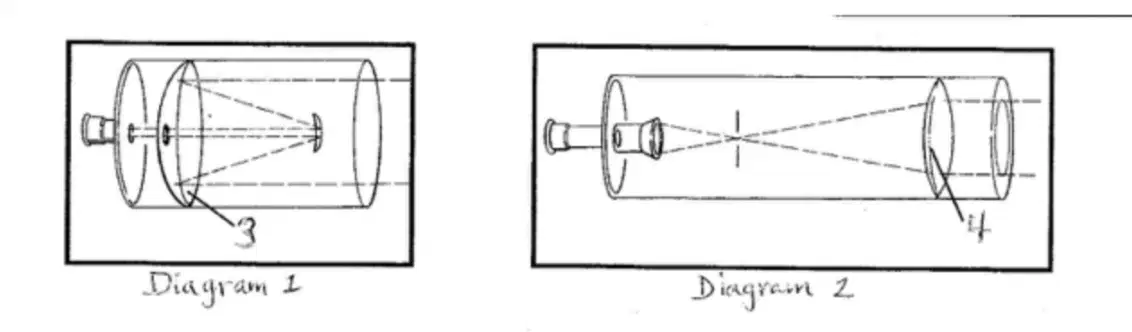
29. Diagram 1 is what kind of telescope?
a)
A. refracting telescope
b)
B. reflecting telescope
30.
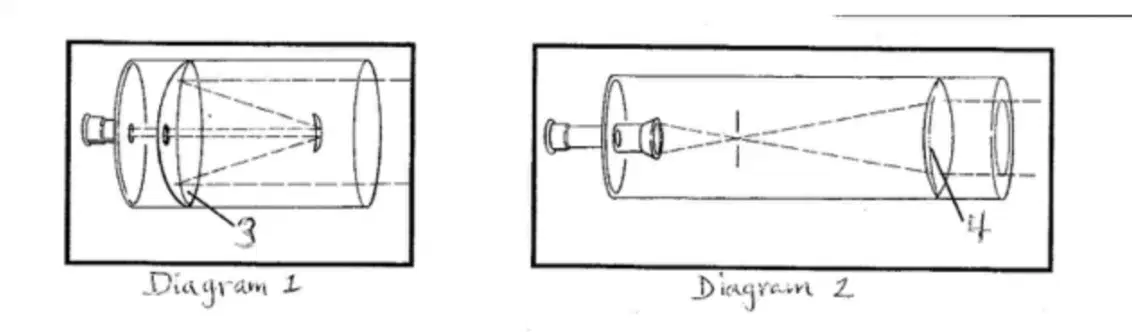
30. Diagram 2 is what kind of telescope?
a)
A. refracting telescope
b)
B. reflecting telescope
31.
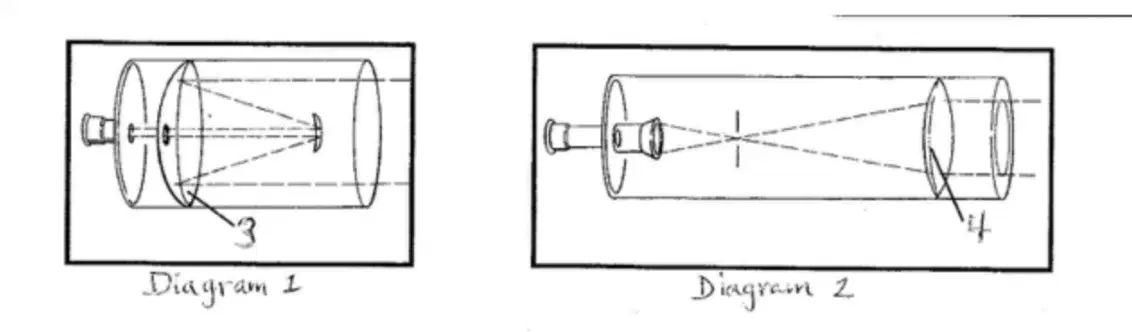
31. What does 3 in Diagram 1 represent?
a)
A. an objective
b)
B. a focal point
c)
C. a mirror
d)
D. a lens
32.
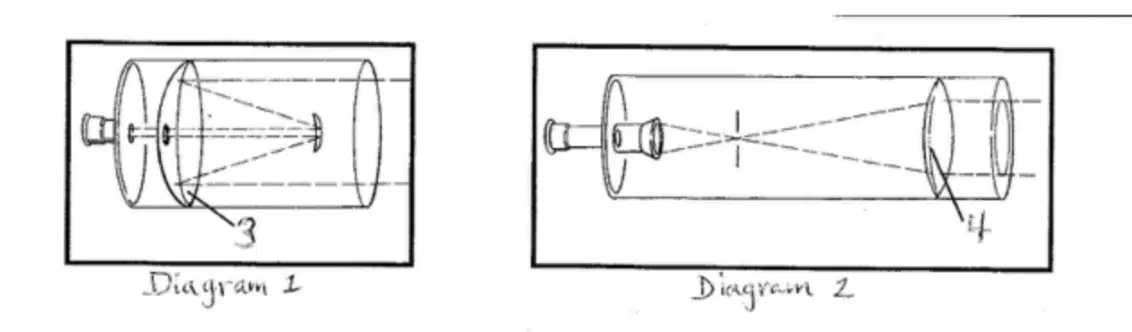
32. What does 4 in Diagram 2 represent?
a)
A. an objective
b)
B. a focal point
c)
C. a mirror
d)
D. a lens
33.
33. Who was the first person in SPACE?.
a)
A. Alan Shepard
b)
B. Yuri Gagarin
c)
C. Neil Armstrong
d)
D. Edwin "Buzz" Aldrin
34.
34 . The first man on the MOON was __________.
a)
A. Alan Shepard
b)
B. Edwin "Buzz" Aldrin
c)
C. Dr. Gray
d)
D. Neil Armstrong
100 %

