
 Worksheets
LS 1-3 Interacting Body Systems (2023)
Total questions: 16
Worksheet time: 8mins
Cells routinely release wastes as they perform their functions. In the human body, this waste is often released into the bloodstream. Which organ removes much of this waste from the bloodstream so that it can then also be removed from the body?
kidneys
lungs
heart
stomach
Which of the following life processes requires specialized cells in multicellular organisms?
respiration
circulation
digestion
all of these
Cells within multicellular organisms are specialized to perform specific tasks. What is one advantage of specialized cells?
Specialized cells use more energy than nonspecialized cells.
Specialized cells are able to perform a greater variety of tasks than nonspecialized cells.
Specialized cells are slower than nonspecialized cells.
Specialized cells are more efficient than nonspecialized cells.
What body systems interact and work to expel wastes from the body?
nervous and circulatory
digestive and excretory
digestive and circulatory
nervous and excretory
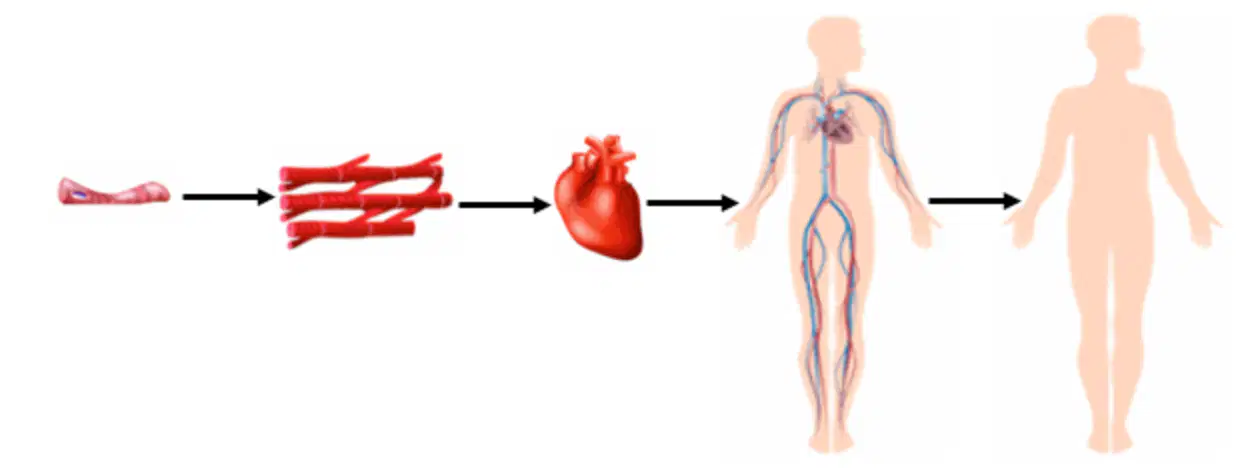
The human body is organized in a hierarchical arrangement, as shown. What structure is represented by the fourth image in the above series?
organism
tissue
cell
organ system
How does the respiratory system interact with the circulatory system?
The respiratory system brings in carbon dioxide so the circulatory system can transport it throughout the body.
The circulatory system removes oxygen from the body to make room for carbon dioxide in the respiratory system.
The circulatory system transports oxygen that the respiratory system brings into the body.
The respiratory system transports oxygen to the heart for the circulatory system.
Cells produce waste as part of their normal activities. Cellular waste is collected by blood in the circulatory system. The kidneys are organs that filter cellular waste from the blood. This waste is stored in the bladder until it can be excreted from the body. In this example, which system is the circulatory system interacting with?
nervous
digestive
respiratory
excretory
In the body, system X takes in and breaks down food. System Y then transports the raw materials throughout the body. What systems do X and Y represent?
System X is the excretory system and system Y is the nervous system.
System X is the respiratory system and system Y is the circulatory system.
System X is the digestive system and system Y is the respiratory system.
System X is the digestive system and system Y is the circulatory system.
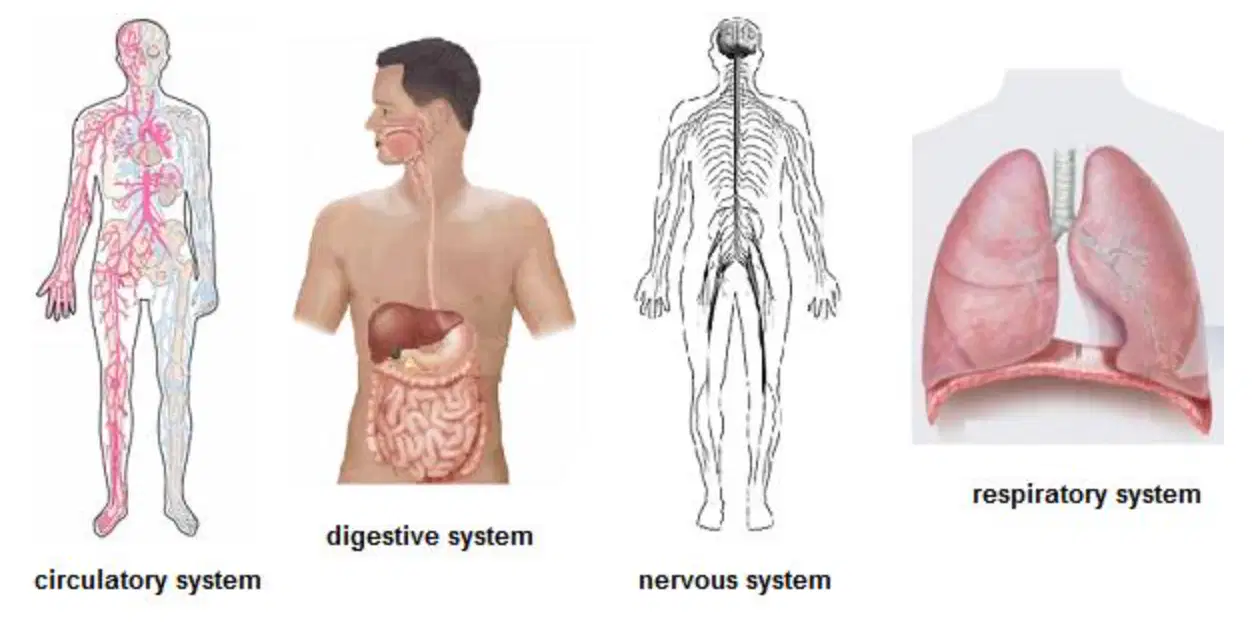
Which two body systems pictured interact with each other to break down and transport the nutrients found in food?
the digestive system and the nervous system
the respiratory system and the circulatory system
the circulatory system and the digestive system
the nervous system and the respiratory system
In a living organism, what is a tissue?
smallest unit that can carry on the activities of life
the shell or skin of an organism
a group of organs that regulates the body's responses to stimuli
a group of similar cells that perform a common function
Paulo is writing an email to Sara about a science class she missed. He tells her the class was about how different systems of the body work together. Which of the following statements should he include in his email?
The blood transports wastes to the kidney.
The muscles pull on bones during movement.
The lungs provide a place for oxygen to get into the blood.
All of the above statements can be included in the email.

Kevin does some research and discovers that the digestive system breaks down food in two ways. One way is mechanically, by grinding and mashing food to make smaller pieces. The other way is changing the food into other substances that can be absorbed using chemical reactions. Kevin makes a table of his notes. Which statement is supported by the evidence found by Kevin's research?
Mechanical breakdown of food requires all of the digestive system's organs.
Structures in the digestive system sometimes have more than one function.
The main function of the digestive system is to mechanically break down food.
Chemical breakdown of food is the most important function of the digestive system.
Which type of cell is most responsible for relaying information to the brain about external stimuli such as heat?
muscle cells
nerve cells
red blood cells
white blood cells
A father purchased a new singing toy for his baby daughter. When a button was pressed on the toy, a song began to play, and the baby smiled. What sensory process caused the baby’s behavior?
Sensory receptors in the baby’s eyes sent signal to the brain, which then sent a signal to her facial muscles, causing her to smile.
Sensory receptors in the baby’s eyes sent a signal directly to her facial muscles, causing her to smile.
Sensory receptors in the baby’s ears sent a signal directly to her facial muscles, causing her to smile.
Sensory receptors in the baby’s ears sent a signal to her brain, which then sent a signal to her facial muscles, causing her to smile.
Kate’s father gave her a set of plastic building blocks as a gift. She spent many days arranging the blocks into various shapes. One day at Kate's school, the teacher asked the class to build a robot using the same plastic building blocks. Kate was the first student to finish building the robot. How was Kate able to complete her robot so quickly?
Kate learned how to use the blocks in less time than the other students, which allowed her to build a robot quickly.
Kate has known how to build robots out of the blocks since birth, which allowed her build one quickly.
Kate's hands stored her past experiences with the blocks as memories, which allowed her to build a robot quickly.
Kate's brain stored her past experiences with the blocks as memories, which allowed her to build a robot quickly.
Shawn ordered some spicy food at a restaurant. When he tried to eat the food, it turned out to be too spicy for him to enjoy. Now, he avoids ordering spicy foods when he sees it on a menu. Which statement best explains Shawn's behavior?
Shawn’s brain receives a stored memory from his eyes, which then process the memory and causes him to avoid spicy food.
Shawn’s eyes send information directly to his stomach, causing spicy food to look unappetizing to him.
Shawn’s eyes send information to his brain, which then processes the information based on a stored memory and causes him to avoid spicy food.
Shawn’s brain sends information directly to his eyes, causing spicy food to look unappetizing to him.

