
NEW
Font size
S
M
L
XL
 Worksheets
Reconstruction Review
Total questions: 25
Worksheet time: 13mins
Name
Class
Date
1.
Which of the following is the best description of the Reconstruction Era?
a)
Southern states rejoining the Northern states
b)
Robert E. Lee surrendering to Ulysses S. Grant
c)
Lincoln allowing Congress to decide how the Southern states should be punished
2.
Which words most accurately reflect Lincoln’s plan for Reconstruction?
a)
“the government of the people, by the people, and for the people shall not perish”
b)
“revenge is the justice due upon our southern counterparts”
c)
“with malice towards none”
d)
“all Americans, Northerners and Southerners, are due the right to life, liberty, and the pursuit of happiness”
3.
Andrew Johnson’s plan for Reconstruction differed from that of Congress by -
a)
Congress wanting to quickly and easily allowing the Southern stats back into the Union
b)
Johnson wanting Southerners to be allowed to keep slaves
c)
Johnson wishing to allow Tennessee to have no punishment while the other Southern states receive harsh treatment
d)
Congress desiring to punish the South harshly for their actions during the Civil War
4.

What was another reason Congress passed this act in 1862?
a)
To promote settlement in the West
b)
To protect industry in the Northeast
c)
To improve transportation in the South
d)
To transport manufactured goods to the East
5.
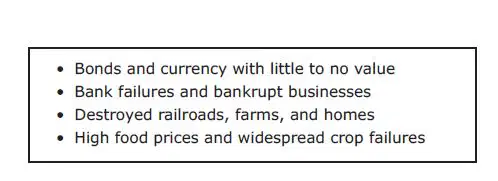
This list describes conditions found in -
a)
California following the Gold Rush
b)
Washington, D.C., during the War of 1812
c)
western territories after the U.S.-Mexican War
d)
southern states at the beginning of Reconstruction
6.
The purpose of the “Black Codes” were to -
a)
ensure rights of African Americans were protected
b)
make sure the African American population was accurately counted
c)
keep African Americans as slaves
d)
limit many rights of African Americans
7.
Which of the following is a specific example of how the Freedmen’s Bureau supported freedmen?
a)
Jobs were given to African Americans in the lumber industry
b)
Money was given to freemen to buy food and shelter
c)
Education was provided to freedmen
d)
Trains and wagons carried freedmen to the North to find jobs
8.
What was the significance of the 13th Amendment to the Constitution?
a)
African Americans were seen as equal citizens to whites
b)
Slavery was abolished from America
c)
Voting rights were not determined by race
d)
States were allowed to rule on the legality of slavery
9.
What is the significance of the 15th Amendment -
a)
African Americans were seen as equal citizens to whites
b)
Slavery was eradicated from America
c)
Voting rights were not determined by race
d)
States were allowed to rule on the legality of slavery
10.

This painting of a Missouri scene was completed in 1852. Such scenes would look dramatically different after the -
a)
ratification of the Fifteenth Amendment
b)
Second Great Awakening
c)
emergence of Manifest Destiny
d)
expansion of the factory system into the South
11.
What was the main cause of the impeachment of President Andrew Johnson in 1868?
a)
His opposition to the ratification of the Thirteenth Amendment
b)
His refusal to investigate reported criminal activity by the Union army during the Civil War
c)
His opposition to Radical Reconstruction policies for former Confederate states
d)
His refusal to use the Homestead Act to redistribute land to former slaves
12.
Southerners viewed “Carpetbaggers” as -
a)
Mean political leaders that forbid the practice
b)
A way to help the South rebuild its economy
c)
Kind people who came to the South to help them reconstruct buildings and houses
d)
People from the North who wanted to take advantage of the Southerners
13.
Hiram Rhodes Revels is significant to American history because he -
a)
Symbolized the end of the Civil War
b)
Helped grow the popularity of the Republican party in the South
c)
Was the first African American to serve as a member of the Senate
d)
Championed the rights of Hispanic Americans in state politics
14.
The Jim Crow Laws affected society in the South by -
a)
Helping freedmen find jobs
b)
Creating the sharecropping system that kept African Americans from making a lot of money
c)
Separating African Americans from white citizens in schools and businesses
d)
Requiring African Americans to give the government all their earnings to receive food and housing in return
15.
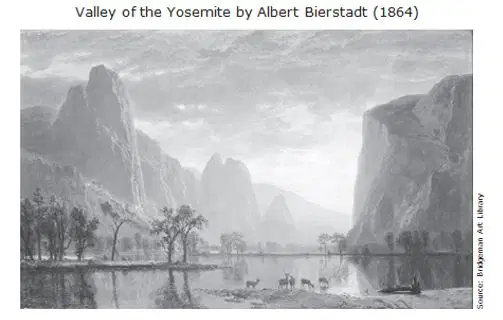
This painting was completed in 1864, just before the end of the Civil War. At that time, what idea did the western frontier represent to many Americans?
a)
The need to establish national parks
b)
The threat of industrial pollution
c)
The abundance of wildlife
d)
The promise of a new beginning for the nation
16.
Emancipation of slaves is to the 13th Amendment, as African American right to vote is to _______________
a)
15th Amendment
b)
Sectionalism
c)
Eli Whitney
d)
telegraph
17.
Which statement would most likely be said in response to the Homestead Act of 1862?
a)
"This law would make Horace Mann proud. He believed in this cause and now it looks like the government does too.”
b)
“I’m going to get as much land as I can and settle it."
c)
“Giving money to Universities is a waste. Our tax dollars should be going to build up our military.”
18.
Which statement would probably be made by a businessman in the North when talking about the transcontinental railroad?
a)
“It’s about time the railroad was built all the way out to the West coast. Now Americans economy can grow.”
b)
“This law would make Horace Mann proud. He believed in this cause and now it looks like the government does too.”
c)
“I’m going to get as much land as I can and sell it ten years from now for a higher profit.”
d)
“Giving money to Universities is a waste. Our tax dollars should be going to build up our military.”
19.
How did the Transcontinental Railroad impact America?
a)
People and goods traveled faster resulting in the economy improving
b)
Soldiers were able to be deployed faster resulting in American becoming safer
c)
Immigrants from Egypt and Russia came to work on the railroad resulting in American becoming more diverse
d)
Mexican immigrants contributed to major parts of American culture
20.
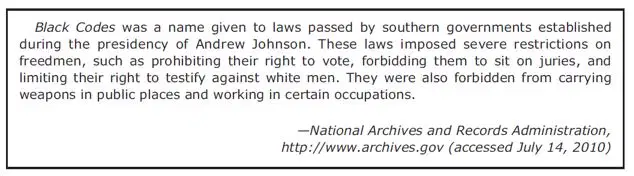
Southern states passed the codes described in this excerpt in order to -
a)
limit the effects of the Reconstruction Amendments
b)
increase the labor supply for factory jobs in the North
c)
decrease the number of northern representatives in Congress
d)
improve relations with the Democratic Party
21.
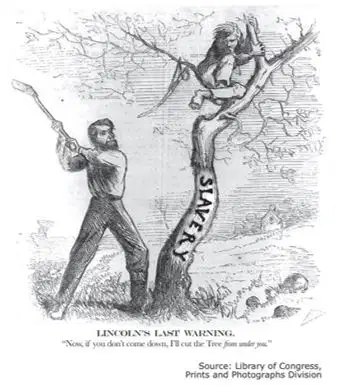
How did President Lincoln succeed in permanently abolishing the practice represented by the tree in this cartoon?
a)
By ordering the use of popular sovereignty to decide the issue of slavery
b)
By encouraging an armed rebellion of slaves in the South
c)
By promoting the passage and ratification of the Thirteenth Amendment
d)
By helping abolitionists fund the Underground Railroad
22.
After the Civil War, Indian Wars were the result of -
a)
Americans wanting more land to settle and benefit from economically
b)
Native Americans wanted to reclaim the land that was taken from them over the last century
c)
Native Americans and settlers disagreeing over how farm land in the west
d)
The Transcontinental Railroad ruining the way of life of Native Americans
23.
What was the major effect of the Bessemer process?
a)
Immigrants were able to become citizens easier, resulting in an increased population in America
b)
Steel was produced faster and cheaper, resulting in a Second Industrial Revolution
c)
African Americans were better able to apply for and keep good paying jobs
d)
Minorities were registered to vote, resulting in minorities voting in higher numbers than previous years
24.
How did the Freedmen's Bureau most assist in the reconstruction of the South?
a)
By dividing large plantations and redistributing the property to former slaves
b)
By creating a militia to help enforce the voting rights of former slaves
c)
By offering legal assistance and public schooling to former slaves
d)
By petitioning the government to offer money to former slaves
25.
Irish and Chinese immigrants are best remembered for performing which type of labor during the late nineteenth century?
a)
Building dams in the midwestern states
b)
Digging canals across northern states
c)
Building railroads in western territories
d)
Constructing bridges in southern states
Reset

