
Font size
 Worksheets
WH Review Post Day 24
Total questions: 70
Worksheet time: 56mins

What Pre-Columbian civilization lived in the shaded area of the map shown?
Maya
Inca
Olmec
Aztec

What was one major religious feature that was common to all 3 major pre-Columbian, native American civilizations?
monotheism
Catholicism
human sacrifice
baptism

For the image below, what does the building indicate about the civilization that built it?
The Aztecs had advanced mathematical knowledge for their time period.
The Egyptians influenced the Aztecs with their gods and food.
They were an agricultural society.
The Aztecs built the temples to attract rain and lightning for crops.
Why did Europe want to sponsor explorers to go to the Americas?
greater access to trade routes.
to discover new lands.
to obtain slaves for the slave trade.
To prove that the Earth is round.

Which of the following consequences of the Columbian Exchange most affected Amerindians in the sixteenth century?
diseases caused pandemics.
Newly introduced crops replaced indigenous American crops.
The influx of African slaves displaced Amerindians.
European livestock disrupted Amerindian agriculture.

What happened to Africa’s population because to the Columbian Exchange?
The population was reduced because of the Slave Trade.
The new foods increased population because they possessed more calories.
The population decreased because of wars between the Europeans.
The population increased because of climate and better trade.

How does this image best show a result of the Columbian Exchange?
It shows horses brought to the Americas from Europe being adapted by Native Americans.
It shows Native Americans stricken by diseases brought to the Americas by Europeans.
It shows Native Americans preparing for a voyage to Europe.
It shows weapons brought to the Americas from Europe being adapted by Native Americans.

Which phrase best explains the scene depicted in this image?
decks of slave ships with African captives
bodies of European explorers
illustration of the Columbian Exchange
survivors of Magellan's expedition
_________ is a policy by which a nation sought to export more than it imported in order to build its supply of gold and silver.
Mercantilism
Communism
Socialism
Capitalism

Epidemics to the Amerindians were the resulted in...
Columbian Exchange
Easier colonization by Europeans
Europeans coming in contact with other Europeans
Better technology
Put these EVENTS on East Africa.
1. Indian Ocean Maritime system begins to include East Africa
Mali, Ghana, and Songhai sell gold, salt, and slaves
Money begins to flow into the continent
Mansa Musa begins his travels donating his extreme wealth.
Put these events on the Crusade in order.
Urban II's speech
2. Crusaders invade the Middle East & set up kingdoms
Trade opens back up.
Greek & Roman knowledge flows back into Europe.
Put these events on the Crusade in order.
Urban II's speech
2. Crusaders invade the Middle East & set up kingdoms
Trade opens back up.
Greek & Roman knowledge flows back into Europe.
Put these RULERS OF CONSTANTINOPLE in Order.
1. Rome
Byzantines
Ottomans
4. Turkey

This group is on the bottom of medieval society

This group could be a vassal or be fighting as soldiers

This shows the Pope's power over kings

This system was used throughout Europe during the Middle Ages

Renaissance

Middle Ages

Byzantine Empire

Mongol Empire
Place these EVENTS for BLACK DEATH in Order
1. Mongols Conquer their empire
Trade expands along trade routes throughout the empire.
Merchants spread items, ideas, and diseases.
4. Black Death hits Europe
Put these in Order Highest Class on the Left on Europe.
YOU ARE PUTTING THESE THINGS IN ORDER FOR WHICH CLASS HAS THE MOST POWER
King
Nobles/Vassals
Knights
Serfs/Peasants
Put the earliest on the left on the Crusades.
YOU ARE PUTTING THESE THINGS IN ORDER.
The Byzantines ask for help against Muslim armies.
2. Pope Urban II's speech launches the Crusades
The 1st Crusade Captures Jerusalem and sets up Christian kingdoms in the Middle East.
During the 4th Crusade, Crusaders attack Byzantines signaling beginning of the end
Put the earliest on the left on the Byzantines.
Constantine founds Constantinople (Byzantium, Istanbul)
Western Roman empire collapses in 476 CE
3 Charlemagne is crowned Holy Roman Emperor in 800 by Pope
Byzantines upset because they believe themselves as Romans
Justinian established Justinian’s (a) , which rewrote old (b) and became the basis for law in (c) .
Constantinople is founded.
Western Roman Empire falls, leaving the Byzantines
Justinian becomes Emperor and passes Justinian's Code
The Byzantines are conquered by the Turks establishing the Ottoman Empire.
Constantinople is created.
The Silk Road brings in lots of money into the Byzantine Empire.
3. The Silk Road also brings in diseases and new technology into the Byzantine Empire.
YOU ARE PUTTING THESE THINGS IN ORDER.
Columbus sets sail to America
Colonizing America
French Revolution
4. Industrialization
1. Silk Road
Mongolian Trade
Columbian Exchange
Trains & Railroads
This is on wars in the 1700s and 1800s. Each war impacts the next. YOU ARE PUTTING THESE THINGS IN ORDER.
French & Indian War (7 Years War)
American Revolution
French Revolution
4. Napoleonic Wars
Put these DISEASE OUTBREAKS in Order. YOU ARE PUTTING THESE THINGS IN ORDER.
Justinian's Plague
Black Death
Smallpox (America)
Black Lung from mining for coal during the Industrial Rev.
Put these FRENCH RULERS in Order.
Louis XIII
Louis XIV
Louis XV
Louis XVI
Put the EVENTS in Order for French Revolution.
Peasants storm the Bastille & Versailles Louis XVI return
2. Robespierre seizes control & beheads entire royal family
After many are beheaded, Robespierre is executed
Napoleon seizes power & wages war against Europe.
Put Religious Events in Order.
The Great Schism between Orthodox and Catholics.
2. Protestant Reformation caused by Martin Luther.
Europe's religious wars breakout.
Put these EVENTS ABOUT SCIENTIFIC REVOLUTION.
Printing Press invented
books become cheaper & knowledge spreads
3. Scientific Revolution begins.
Enlightenment takes place.
Put these Industrial Revolution events in order.
Cotton Gin removes seeds, which lowers price of cotton.
2. Industrial Revolution begins in textiles by using cotton.
3. People move to cities looking for new jobs.
Cities face overcrowding, slums, and pollution.
Put these events on the French Revolution in order.
Horrible crop harvests cause starvation in France
King Louis XVI does nothing & peasants storm Versailles.
King is beheaded and Reign of Terror begins.
Napoleon seizes control of government.
Put these EVENTS on Haitian Revolution in order.
France declares Rights of Man and Citizen
2. Haitians wonder why does this not apply to them.
3. Black Haitians revolt against the French slaveholders.
Haitian Revolution becomes a successful slave revolt
Put these EVENTS on Columbian Exchange.
Columbus "discovers" America
Natives die of disease.
3. Europeans go to Africa to purchase slaves.
African populations are decimated thanks to the slave trade.
Put these in Order on Reformation.
1. Church charges money for indulgences
Martin Luther questions whether Pope can do this
Martin Luther is excommunicated
German nobles take sides and start a war
This is on European Renaissance.
Italian City-States bring in lots of money from trade
2. Families, rich from trade, hire artists to paint.
Cities begin to compete with works of art
Art flourishes in 14th century Italy
This is on the different types of economic systems.
Feudalism
2. Mercantilism
Capitalism
Socialism

Industrial Revolution

French Revolution

Feudalism

Genghis Khan

Columbian Exchange

________ is sometimes called the “father of modern Egypt.” He introduced a number of political and economic reforms, including improving tax collection, reorganizing the landholding system, and backing large irrigation projects to increase farm output.
Muhammad Ali
Shaka
Menelik II
Usman dan Fodio
“Influential in overthrowing the Qing dynasty (1911/12), he served as the first provisional president of the Republic of China (1911–12) and later as de facto ruler (1923–25)."
Sun Yixian
Shi Huangdi
Ci Xi
Guang Xu

The picture depicts a soldier rebellion that took place in India in 1857. The Indian soldiers are most likely to be fighting the _____.
British
Germans
Dutch
French
Who set up the “Meiji Restoration” described in the text?
“The young emperor began a long reign known as the Meiji Restoration. This period, which lasted from 1868 to 1912, was a major turning point in Japanese history. The Meiji reformers, who ruled in the emperor’s name, were determined to strengthen Japan. Their goal was summarized in their motto, 'A rich country, a strong military.' The emperor supported and embodied the reforms."
Mutsuhito
Sun Yixian
Fukuzawa Yukichi
Guang Xu

“The American continents are henceforth not to be considered as subjects for future colonization by any European powers.”
Monroe Doctrine
Roosevelt Corollary
Platt Amendment
Reformation Movement
Who is being described in the text?
He absorbed their young men and women into Zulu regiments. By encouraging rival groups to forget their differences, he cemented a growing pride in the Zulu kingdom. His conquests, however, set off mass migrations and wars, creating chaos across much of the region. Groups driven from their homelands by the Zulus then migrated north, conquering still other peoples and creating their own powerful states.
Shaka
Samori Touré
Usman dan Fodio
Nehanda
The genocide of the Armenians in the 1890s took place during the rule of the ________empire.
Ottoman
Mughal
Asante
Safavid
European imperialists redrew the map of Africa with little regard for ______.
ethnic boundaries
trade agreements
mining rights
the slave trade

Based on the map, what form of imperial rule did European powers use in China?
sphere of influence
protectorate
direct rule
indirect rule
During the Qing Dynasty, massive flooding, official corruption, and hardship led to ______.
the Boxer Rebellion
the Open Door Policy
the Taiping Rebellion
the Meiji Restoration

Which phrase correctly replaces the "?" in the chart?
conflict between Russia and Japan over control of Korea and Manchuria
conflict after Russia attempted invading Japan
conflict between Russia and Japan over the Korean March First Movement
conflict between Russia and Japan over trading rights

Which of the following statements best describes the Meiji Restoration?
The Meiji reformers refused to adapt Western ways
The Meiji Restoration worked to restore a rigid feudal order
The Meiji reformers adapted the German model of government and European technology
The Meiji constitution did not give the emperor absolute power.
How does nationalism and Social Darwinism relate to each other?
they both deal with the way counties control the taxes of the lower class.
they both show how one country should dominate another.
they both show how a nation should protect its elite social class.
they both show how each group needs to believe in the nation.
The British military advantage in the Opium War (1839 – 1860) against China was provided by
better politicians.
better technology including gun boats.
tanks and airplanes.
Large numbers of troops.
In Bismarck’s practice of Realpolitik, his political actions were guided by
The needs of the people.
Traditional morality.
The principle of divine right
The needs of the state.
Which of the following was a Social Darwinism argument in favor of western imperialism?
colonies would bring wealth and prestige to the home country
western nations needed outlets for their growing populations
western nations thought they had a duty to bring their civilization to inferior races
increased trade would benefit all peoples

How did the Suez Canal influence the spread of Western European imperialism?
By connecting, the Mediterranean Sea and Red Sea, the canal significantly reduced the sailing time from Europe to trading destinations the East.
The Suez Canal helped with the colonization of the Americas by creating an alternative route for the Mediterranean countries.
England was able to control Egypt, which allowed for England to abolish the Berlin Conference and control almost all of Africa.
Europe was able to control a smaller amount of land than before because of the fighting between the countries in Africa.

The argument that having a large navy & engaging in imperialism will improve our nation's defensive capability was made by:
Alfred T. Mahan
Theodore Roosevelt
Charles Darwin
Rudyard Kipling
Which of the following was NOT a reason why the United States government accepted the offer of American business owners to annex Hawaii?
desire to limit Russian influence in the Pacific
desire to establish a naval base there
desire to increase trade in the Pacific
desire to prevent Japanese expansion into Hawaii

What was the goal of the United States in establishing Open Door Policy?
to prevent a foreign monopoly on trade with China
to establish an American monopoly on Chinese trade
to avoid involvement in any foreign conflicts
to increase America's defensive capability
Which of the following highlight the impact that Islam had upon world history by 1300 CE?
It was the majority religion of most of the inhabitants of Southwest Asia.
It was integral in the growth and success of transregional trade.
Arabic became a widespread spoken language.
It had become one of the four major cultural spheres in the world of that era.
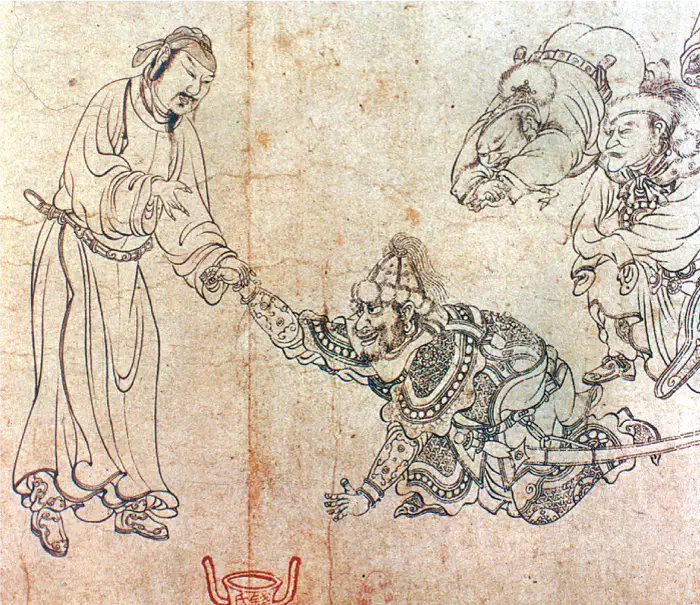
What is the relationship depicted in this image?
the Chinese and those they considered "barbarians"
the Chinese emperor and a European merchant
a Hindu sailor and a Mongol chief
a Shinto priest and a Sufi missionary
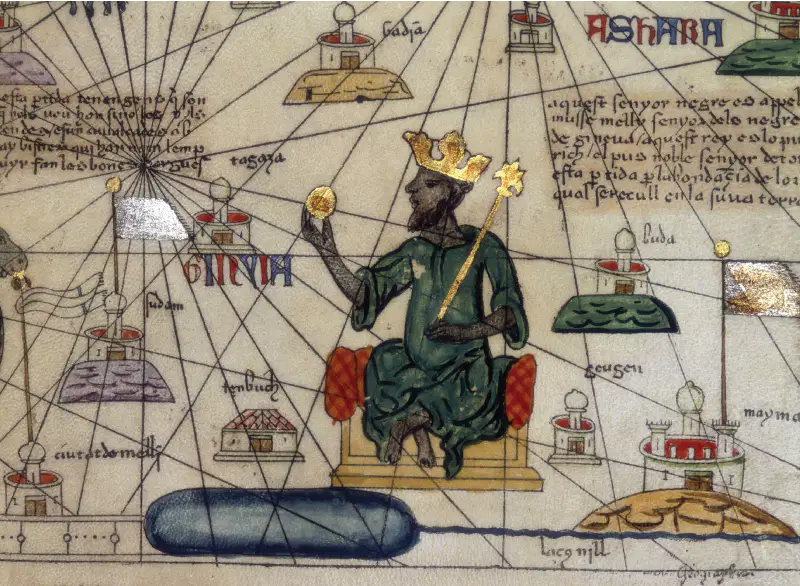
What do historians know about this man and this image? Select all that are correct.
central figure identified as King Mansa Musa
concerns a pilgrimage to Mecca
traveled with 100 camels each carrying sacks of gold
a European Crusader who profited from his adventures
a Chinese emperor rich from the silver trade
The Black Death caused a series of interconnected crises across Afro-Eurasia. Match each type of crisis to the sentence that describes it. Each type of crisis has only one correct description.
People had difficulty meeting their basic material needs because of food shortages, rising prices, and work stoppages.
economic crisis
People questioned the legitimacy, morality, and competence of their leaders.
political crisis
Regions lost so many people that basic functions like growing food, trading, and maintaining towns could not be carried out due to a lack of labor.
demographic crisis

