
Font size
 Worksheets
PE CHAPTER 4
Total questions: 161
Worksheet time: 8hrs 3mins
1. The two words most often used by economists are
a. prices and quantities.
b. resources and allocation.
c. supply and demand.
d. efficiency and equity.
a
b
c
d
1. The two words economists use most often are
a. inflation and trade.
b. supply and demand.
c. competition and prices.
d. markets and equilibrium.
a
b
c
d
1. The forces that make market economies work are
a. work and leisure.
b. politics and religion.
c. supply and demand.
d. taxes and government spending.
a
b
c
d
1. In a market economy, supply and demand determine
a. both the quantity of each good produced and the price at which it is sold.
b. the quantity of each good produced but not the price at which it is sold.
c. the price at which each good is sold but not the quantity of each good produced.
d. neither the quantity of each good produced nor the price at which it is sold.
a
b
c
d
1. In a market economy, supply and demand are important because they
a. play a critical role in the allocation of the economy’s scarce resources.
b. determine how much of each good gets produced.
c. can be used to predict the impact on the economy of various events and policies.
d. All of the above are correct.
a
b
c
d
1. In a market economy, supply and demand are important because they
a. are direct policy tools used by government agencies to regulate the economy.
b. illustrate when an market is in equilibrium, but they are not helpful when a market is out of equilibrium.
c. can be used to predict the impact on the economy of various events and policies.
d. All of the above are correct.
a
b
c
d
1. In a market economy,
a. supply determines demand and demand, in turn, determines prices.
b. demand determines supply and supply, in turn, determines prices.
c. the allocation of scarce resources determines prices and prices, in turn, determine supply and demand.
d. supply and demand determine prices and prices, in turn, allocate the economy’s scarce resources.
a
b
c
d
1. Which of the following statements is correct?
a. Buyers determine supply, and sellers determine demand.
b. Buyers determine demand, and sellers determine supply.
c. Buyers determine both demand and supply.
d. Sellers determine both demand and supply.
a
b
c
d
1. The demand for a good or service is determined by
a. those who buy the good or service.
b. the government.
c. those who sell the good or service.
d. both those who buy and those who sell the good or service.
a
b
c
d
1. The supply of a good or service is determined by
a. those who buy the good or service.
b. the government.
c. those who sell the good or service.
d. both those who buy and those who sell the good or service.
a
b
c
d
1. A group of buyers and sellers of a particular good or service is called a(n)
a. coalition.
b. economy.
c. market.
d. competition.
a
b
c
d
1. For a market for a good or service to exist, there must be a
a. group of buyers and sellers.
b. specific time and place at which the good or service is traded.
c. high degree of organization present.
d. All of the above are correct.
a
b
c
d
1. Which of the following is an example of a highly organized market?
a. the market for textbooks
b. the market for spa services
c. the market for soybeans
d. the market for ice cream
a
b
c
d
1. Which of the following is an example of a less-than-highly-organized market?
a. the market for U.S. Treasury bonds
b. the market for corn
c. the market for soybeans
d. the market for ice cream
a
b
c
d
1. Which of the following is an example of a market?
a. a gas station
b. a garage sale
c. a barber shop
d. All of the above are examples of markets.
a
b
c
d
1. The market for ice cream is a
a. monopolistic market.
b. highly competitive market.
c. highly organized market.
d. Both b and c are correct.
a
b
c
d
1. Most markets in the economy are
a. markets in which sellers, rather than buyers, control the price of the product.
b. markets in which buyers, rather than sellers, control the price of the product.
c. perfectly competitive.
d. highly competitive.
a
b
c
d
1. A market includes
a. buyers only.
b. sellers only.
c. both buyers and sellers.
d. the place where transactions occur but not the people involved.
a
b
c
d
1. Which of the following is not an example of a market?
a. A small town has only one seller of electricity.
b. In the United States, a sick person cannot legally purchase a kidney.
c. In Florida, there are many buyers and sellers of key lime pie.
d. The availability of Internet shopping has expanded the clothing choices for buyers who do not live near large cities.
a
b
c
d
1. In a competitive market, the price of a product
a. is determined by buyers, and the quantity of the product produced is determined by sellers.
b. is determined by sellers, and the quantity of the product produced is determined by buyers.
c. and the quantity of the product produced are both determined by sellers.
d. None of the above is correct.
a
b
c
d
1. A competitive market is a market in which
a. an auctioneer helps set prices and arrange sales.
b. there are only a few sellers.
c. the forces of supply and demand do not apply.
d. no individual buyer or seller has any significant impact on the market price.
a
b
c
d
1. A competitive market is one in which there
a. is only one seller, but there are many buyers.
b. are many sellers, and each seller has the ability to set the price of his product.
c. are many sellers, and they compete with one another in such a way that some sellers are always being forced out of the market.
d. are so many buyers and so many sellers that each has a negligible impact on the price of the product.
a
b
c
d
1. Assume Diana buys computers in a competitive market. It follows that
a. Diana has a limited number of sellers to turn to when she buys a computer.
b. Diana will find herself negotiating with sellers whenever she buys a computer.
c. if Diana buys a large number of computers, the price of computers will rise noticeably.
d. None of the above is correct.
a
b
c
d
1. Assume Leo buys coffee beans in a competitive market. It follows that
a. Leo has a limited number of sellers from which to buy coffee beans.
b. Leo will negotiate with sellers whenever he buys coffee beans.
c. Leo can influence the price of coffee beans if he buys a large quantity of them.
d. None of the above is correct.
a
b
c
d
1. In a competitive market, each seller has limited control over the price of his product because
a. other sellers are offering similar products.
b. buyers exert more control over the price than do sellers.
c. these markets are highly regulated by the government.
d. sellers usually agree to set a common price that will allow each seller to earn a comfortable profit.
a
b
c
d
1. For a competitive market,
a. a seller can always increase her profit by raising the price of her product.
b. if a seller charges more than the going price, buyers will go elsewhere to make their purchases.
c. a seller often charges less than the going price to increase sales and profit.
d. a single buyer can influence the price of the product but only when purchasing from several sellers in a short period of time.
a
b
c
d
1. If a seller in a competitive market chooses to charge more than the going price, then
a. the sellers’ profits must increase.
b. the owners of the raw materials used in production would raise the prices for the raw materials.
c. other sellers would also raise their prices.
d. buyers will make purchases from other sellers.
a
b
c
đ
1. In competitive markets, buyers
a. are price takers, but sellers are price setters.
b. are price setters, but sellers are price takers.
c. and sellers are price takers.
d. and sellers are price setters.
a
b
c
d
1. The term price takers refers to buyers and sellers in
a. perfectly competitive markets.
b. monopolistic markets.
c. markets that are regulated by the government.
d. markets in which buyers cannot buy all they want and/or sellers cannot sell all they want.
a
b
c
d
1. In competitive markets,
a. firms produce identical products.
b. no individual buyer can influence the market price.
c. no individual seller can influence the market price.
d. All of the above are correct.
a
b
c
d
1. In competitive markets, which of the following is not correct?
a. Firms produce identical products.
b. No individual buyer can influence the market price.
c. Some sellers can set prices.
d. Buyers are price takers.
a
b
c
d
1. In competitive markets,
a. firms produce identical products.
b. buyers can influence the market price more easily than sellers.
c. markets are more likely to be in equilibrium.
d. sellers are price setters.
a
b
c
d
1. The highest form of competition is called
a. absolute competition.
b. cutthroat competition.
c. perfect competition.
d. market competition.
a
b
c
d
1. The highest form of competition is called
a. arbitrage.
b. monopolistic competition.
c. equilibrium.
d. perfect competition.
a
b
c
d
1. Which of the following is not a characteristic of a perfectly competitive market?
a. Sellers set the price of the product.
b. There are many sellers.
c. Buyers must accept the price the market determines.
d. All of the above are characteristics of a perfectly competitive market.
a
b
c
d
1. Buyers and sellers who have no influence on market price are referred to as
a. market pawns.
b. monopolists.
c. price takers.
d. price setters.
a
b
c
d
1. In a perfectly competitive market, at the market price, buyers
a. cannot buy all they want, and sellers cannot sell all they want.
b. cannot buy all they want, but sellers can sell all they want.
c. can buy all they want, but sellers cannot sell all they want.
d. can buy all they want, and sellers can sell all they want.
a
b
c
d
1. An example of a perfectly competitive market would be the market for
a. tennis racquets.
b. pizza.
c. garbage collection.
d. wheat.
a
b
c
d
1. An example of a perfectly competitive market would be the market for
a. electricity.
b. soybeans.
c. coffee shops.
d. restaurants.
a
b
c
d
1. Which of the following characteristics is required for a perfectly competitive market?
a. The goods offered for sale are exactly the same.
b. There are so many buyers and sellers that no single buyer or seller has any influence over the market price.
c. It is difficult for new sellers to enter the market.
d. Both a and b are correct.
a
b
c
d
1. Assume the market for tennis balls is perfectly competitive. When one tennis ball producer exits the market,
a. the price of tennis balls increases.
b. the price of tennis balls decreases.
c. the price of tennis balls does not change.
d. there is no longer a market for tennis balls.
a
b
c
d
1. Which of the following is not a reason perfect competition is a useful simplification, despite the diversity of market types we find in the world?
a. Perfectly competitive markets are the easiest to analyze because everyone participating in the market takes the price as given by market conditions.
b. Some degree of competition is present in most markets.
c. There are many buyers and many sellers in all types of markets.
d. Many of the lessons that we learn by studying supply and demand under perfect competition apply in more complicated markets as well.
a
b
c
d
1. If a firm is a price taker, it operates in a
a. competitive market.
b. monopoly market.
c. oligopoly market.
d. monopolistically competitive market.
a
b
c
d
1. A monopoly is a market with one
a. seller, and that seller is a price taker.
b. seller, and that seller sets the price.
c. buyer, and that buyer is a price taker.
d. buyer, and that buyer sets the price.
a
b
c
d
1. Which of the following would most likely serve as an example of a monopoly?
a. a bakery in a large city
b. a bank in a large city
c. a local cable television company
d. a small group of corn farmers
a
b
c
d
1. The quantity demanded of a good is the amount that buyers are
a. willing to purchase.
b. willing and able to purchase.
c. willing, able, and need to purchase.
d. able to purchase.
a
b
c
d
1. An increase in quantity demanded
a. results in a movement downward and to the right along a demand curve.
b. results in a movement upward and to the left along a demand curve.
c. shifts the demand curve to the left.
d. shifts the demand curve to the right.
a
b
c
d
1. A decrease in quantity demanded
a. results in a movement downward and to the right along a demand curve.
b. results in a movement upward and to the left along a demand curve.
c. shifts the demand curve to the left.
d. shifts the demand curve to the right.
a
b
c
d
1. A movement downward and to the right along a demand curve is called a(n)
a. increase in demand.
b. decrease in demand.
c. decrease in quantity demanded.
d. increase in quantity demanded.
a
b
c
d
1. A decrease in the price of a good will
a. increase demand.
b. decrease demand.
c. increase quantity demanded.
d. decrease quantity demanded.
a
b
c
d
1. A decrease in the price of a good would
a. increase the supply of the good.
b. increase the quantity demanded of the good.
c. give producers an incentive to produce more to keep profits from falling.
d. shift the supply curve for the good to the left.
a
b
c
d
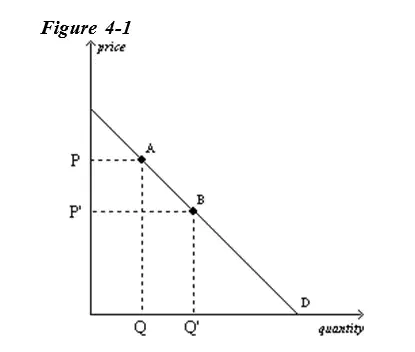
1. Refer to Figure 4-1. The movement from point A to point B on the graph shows a(n)
a. decrease in demand.
b. increase in demand.
c. decrease in quantity demanded.
d. increase in quantity demanded.
a
b
c
d
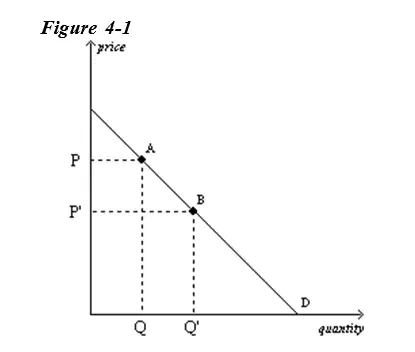
1. Refer to Figure 4-1. The movement from point A to point B on the graph is caused by a(n)
a. increase in price.
b. decrease in price.
c. decrease in the price of a substitute good.
d. increase in income.
a
b
c
d
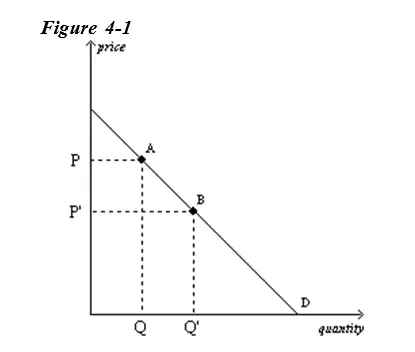
1. Refer to Figure 4-1. It is apparent from the figure that the
a. good is inferior.
b. demand for the good decreases as income increases.
c. demand for the good conforms to the law of demand.
d. All of the above are correct.
a
b
c
d
1. “Other things equal, when the price of a good rises, the quantity demanded of the good falls, and when the price falls, the quantity demanded rises.” This relationship between price and quantity demanded
a. applies to most goods in the economy.
b. is represented by a downward-sloping demand curve.
c. is referred to as the law of demand.
d. All of the above are correct.
a
b
c
d
1. “Other things equal, when the price of a good rises, the quantity demanded of the good falls, and when the price falls, the quantity demanded rises.” This relationship between price and quantity demanded is referred to as
a. equilibrium.
b. the law of demand.
c. the relationship between supply and demand.
d. the definition of an inferior good.
a
b
c
d
1. The law of demand states that, other things equal, when the price of a good
a. falls, the demand for the good rises.
b. rises, the quantity demanded of the good rises.
c. rises, the demand for the good falls.
d. falls, the quantity demanded of the good rises.
a
b
c
d
1. A downward-sloping demand curve illustrates
a. that demand decreases over time.
b. that prices fall over time.
c. the relationship between income and quantity demanded.
d. the law of demand.
a
b
c
d
1. Kari downloads 7 songs per month when the price is $1.29 per song and 10 songs per month when the price is $0.99 per song. Kari’s behavior demonstrates the law of
a. price.
b. supply.
c. demand.
d. income.
a
b
c
d

a. 0.
b. 100.
c. 200.
d. 400.
a
b
c
d
1. A table that shows the relationship between the price of a good and the quantity demanded of that good is called a
a. price-quantity schedule.
b. buyer schedule.
c. demand schedule.
d. demand curve.
a
b
c
d
1. A demand schedule is a table that shows the relationship between
a. quantity demanded and quantity supplied.
b. income and quantity demanded.
c. price and quantity demanded.
d. price and income.
a
b
c
d
1. The demand curve for a good is a line that relates
a. price and quantity demanded.
b. income and quantity demanded.
c. quantity demanded and quantity supplied.
d. price and income.
a
b
c
d
1. When drawing a demand curve,
a. demand is measured along the vertical axis, and price is measured along the horizontal axis.
b. quantity demanded is measured along the vertical axis, and price is measured along the horizontal axis.
c. price is measured along the vertical axis, and demand is measured along the horizontal axis.
d. price is measured along the vertical axis, and quantity demanded is measured along the horizontal axis.
a
b
c
d
1. If something happens to alter the quantity demanded at any given price, then
a. the demand curve becomes steeper.
b. the demand curve becomes flatter.
c. the demand curve shifts.
d. we move along the demand curve.
a
b
c
d
1. A market demand curve shows how the total quantity demanded of a good varies as
a. income varies.
b. price varies.
c. price of the nearest substitute good varies.
d. supply varies.
a
b
c
d
1. Which of the following is not an expression for the sum of all the individual demand curves for a product?
a. total demand
b. market demand
c. equilibrium demand
d. aggregate demand
a
b
c
d
1. If buyers today become more willing and able than before to purchase larger quantities of stand up paddle boards (SUPs) at each price of SUPs, then
a. we will observe a movement downward and to the right along the demand curve for SUPs.
b. we will observe a movement upward and to the left along the demand curve for SUPs.
c. the demand curve for SUPs will shift to the right.
d. the demand curve for SUPs will shift to the left.
a
b
c
d
1. Which of the following events would cause a movement upward and to the left along the demand curve for olives?
a. The number of people who purchase olives decreases.
b. Consumer income decreases, and olives are a normal good.
c. The price of pickles decreases, and pickles are a substitute for olives.
d. The price of olives rises.
a
b
c
d
1. Holding the nonprice determinants of demand constant, a change in price would
a. result in either a decrease in demand or an increase in demand.
b. result in a movement along a stationary demand curve.
c. result in a shift of supply.
d. have no effect on the quantity demanded.
a
b
c
d
1. The demand curve for coffee shifts
a. only when income changes.
b. when a determinant of the demand for coffee other than the price of coffee changes.
c. when the price of coffee changes.
d. Both b and c are correct.
a
b
c
d
1. If the demand for a good falls when income falls, then the good is called a(n)
a. normal good.
b. regular good.
c. luxury good.
d. inferior good.
a
b
c
d
1. Suppose that when income rises, the demand curve for doctor’s visits shifts to the right. In this case, we know doctor’s visits are
a. inferior goods.
b. normal goods.
c. perfectly competitive goods.
d. durable goods.
a
b
c
d
1. If a decrease in income increases the demand for a good, then the good is a(n)
a. substitute good.
b. complementary good.
c. normal good.
d. inferior good.
a
b
c
d
1. If a increase in income decreases the demand for a good, then the good is a(n)
a. substitute good.
b. complementary good.
c. normal good.
d. inferior good.
a
b
c
d
1. Two goods are substitutes when a decrease in the price of one good
a. decreases the demand for the other good.
b. decreases the quantity demanded of the other good.
c. increases the demand for the other good.
d. increases the quantity demanded of the other good.
a
b
c
d
1. A likely example of substitute goods for most people would be
a. tables and chairs.
b. bicycles and helmets.
c. apple juice and orange juice.
d. coffee and sugar.
a
b
c
d
1. You wear either shorts or sweatpants every day. You notice that sweatpants have gone on sale, so your demand for
a. sweatpants will increase.
b. sweatpants will decrease.
c. shorts will increase.
d. shorts will decrease.
a
b
c
d
1. Two goods are complements when a decrease in the price of one good
a. decreases the quantity demanded of the other good.
b. decreases the demand for the other good.
c. increases the quantity demanded of the other good.
d. increases the demand for the other good.
a
b
c
d
1. Which of the following might cause the demand curve for an inferior good to shift to the left?
a. a decrease in income
b. an increase in the price of a substitute
c. an increase in the price of a complement
d. None of the above is correct.
a
b
c
d
1. When it comes to people's tastes, economists generally believe that
a. tastes are based on forces that are well within the realm of economics.
b. tastes are based on historical and psychological forces that are beyond the realm of economics.
c. tastes can only be studied through well-constructed, real-life models.
d. because tastes do not directly affect demand, there is little need to explain people's tastes.
a
b
c
d
1. You watch a lot of HGTV during your summer vacation, and you notice that most housing buyers list granite countertops in their “must have” lists when buying a new or existing house. You expect the demand for
a. granite countertops to shift to the left.
b. granite countertops to shift to the right.
c. substitute products such as marble countertops to shift to the right.
d. substitute products such as marble countertops to be unaffected by buyers’ preferences for granite.
a
b
c
d
1. What will happen in the gasoline market now if buyers expect higher gasoline prices in the near future?
a. The demand for gasoline will increase.
b. The demand for gasoline will decrease.
c. The demand for gasoline will be unaffected.
d. The supply of gasoline will increase.
a
b
c
d
1. The quantity supplied of a good is the amount that
a. buyers are willing and able to purchase.
b. sellers are able to produce.
c. buyers and sellers agree will be brought to market.
d. sellers are willing and able to sell.
a
b
c
d
1. If the price of a good is low,
a. firms would increase profit by increasing output.
b. the quantity supplied of the good could be zero.
c. the supply curve for the good will shift to the left.
d. firms can and should raise the price of the product.
a
b
c
d
1. An increase in the price of a good will
a. increase supply.
b. decrease supply.
c. increase quantity supplied.
d. decrease quantity supplied.
a
b
c
d
1. Which of the following would cause a movement along the supply curve for cupcakes?
a. an improvement in technology for commercial mixers
b. a decrease in the price of cupcakes
c. an increase in the price of cake flour
d. All of the above are correct.
a
b
c
d
1. An increase in the price of blueberries would lead to a(n)
a. increased supply of blueberries.
b. a movement up and to the right along the supply curve for blueberries.
c. a movement down and to the left along the supply curve for blueberries.
d. Both a and b are correct.
a
b
c
d
1. An increase in quantity supplied
a. results in a movement downward and to the left along a fixed supply curve.
b. results in a movement upward and to the right along a fixed supply curve.
c. shifts the supply curve to the left.
d. shifts the supply curve to the right.
a
b
c
d
1. The law of supply states that, other things equal, when the price of a good
a. falls, the supply of the good rises.
b. rises, the quantity supplied of the good rises.
c. rises, the supply of the good falls.
d. falls, the quantity supplied of the good rises.
a
b
c
d
1. A supply curve slopes upward because
a. as more is produced, total cost of production falls.
b. an increase in input prices increases supply.
c. the quantity supplied of most goods and services increases over time.
d. an increase in price gives producers an incentive to supply a larger quantity.
a
b
c
d
1. A supply schedule is a table that shows the relationship between
a. price and quantity supplied.
b. input costs and quantity supplied.
c. quantity demanded and quantity supplied.
d. profit and quantity supplied.
a
b
c
d
1. The difference between a supply schedule and a supply curve is that a supply schedule
a. incorporates demand and a supply curve does not.
b. incorporates profit and a supply curve does not.
c. can shift, but a supply curve cannot shift.
d. is a table, and a supply curve is drawn on a graph.
a
b
c
d
1. If something happens to alter the quantity supplied at any given price, then
a. we move along the supply curve.
b. the supply curve shifts.
c. the supply curve becomes steeper.
d. the supply curve becomes flatter.
a
b
c
d
1. Which of the following would not shift the supply curve for mp3 players?
a. an increase in the price of mp3 players
b. a decrease in the number of sellers of mp3 players
c. an increase in the price of plastic, an input into the production of mp3 players
d. an improvement in the technology used to produce mp3 players
a
b
c
d
1. The market supply curve
a. is found by vertically adding the individual supply curves.
b. slopes downward.
c. represents the sum of the prices that all the sellers are willing to accept for a given quantity of the good.
d. represents the sum of the quantities supplied by all the sellers at each price of the good.
a
b
c
d
1. Suppose there are six bait and tackle shops that sell worms in a lakeside resort town in Minnesota. If we add the respective quantities that each shop would produce and sell at each of the six bait and tackle shops when the price of worms is $2 per bucket, $2.50 per bucket, and $3 per bucket, and so forth, we have found the
a. market demand curve.
b. market supply curve.
c. equilibrium curve.
d. surplus or shortage depending on market conditions.
a
b
c
d
1. Suppose there is an increase in the price of steel. We would expect the supply curve for steel beams to
a. shift rightward.
b. shift leftward.
c. become flatter.
d. remain unchanged.
a
b
c
d
1. Suppose an increase in the price of rubber coincides with an advance in the technology of tire production. As a result of these two events, the demand for tires
a. decreases, and the supply of tires increases.
b. is unaffected, and the supply of tires decreases.
c. is unaffected, and the supply of tires increases.
d. None of the above is necessarily correct.
a
b
c
d
1. Which of the following is a determinant of the market supply curve but not a determinant of an individual seller’s supply?
a. production technology
b. expectations
c. input prices
d. the number of sellers
a
b
c
d
1. The unique point at which the supply and demand curves intersect is called
a. market harmony.
b. coincidence.
c. equivalence.
d. equilibrium.
a
b
c
d
1. The dictionary defines equilibrium as a situation in which forces
a. are in balance.
b. are the same.
c. clash.
d. remain constant.
a
b
c
d
1. At the equilibrium price, the quantity of the good that buyers are willing and able to buy
a. is greater than the quantity that sellers are willing and able to sell.
b. exactly equals the quantity that sellers are willing and able to sell.
c. is less than the quantity that sellers are willing and able to sell.
d. Either a) or c) could be correct.
a
b
c
d
1. Another term for equilibrium price is
a. dynamic price.
b. market-clearing price.
c. quantity-defining price.
d. balance price.
a
b
c
d
1. In markets, prices move toward equilibrium because of
a. the actions of buyers and sellers.
b. government regulations placed on market participants.
c. increased competition among sellers.
d. buyers' ability to affect market outcomes.
a
b
c
d
1. Equilibrium price must decrease when demand
a. increases and supply does not change, when demand does not change and supply decreases, and when demand decreases and supply increases simultaneously.
b. increases and supply does not change, when demand does not change and supply decreases, and when demand increases and supply decreases simultaneously.
c. decreases and supply does not change, when demand does not change and supply increases, and when demand decreases and supply increases simultaneously.
d. decreases and supply does not change, when demand does not change and supply increases, and when demand increases and supply decreases simultaneously.
a
b
c
d
1. If the demand for a product decreases, then we would expect equilibrium price
a. to increase and equilibrium quantity to decrease.
b. to decrease and equilibrium quantity to increase.
c. and equilibrium quantity to both increase.
d. and equilibrium quantity to both decrease.
a
b
c
d
1. Suppose that demand for a good decreases and, at the same time, supply of the good decreases. What would happen in the market for the good?
a. Equilibrium price would decrease, but the impact on equilibrium quantity would be ambiguous.
b. Equilibrium price would increase, but the impact on equilibrium quantity would be ambiguous.
c. Equilibrium quantity would decrease, but the impact on equilibrium price would be ambiguous.
d. Equilibrium quantity would increase, but the impact on equilibrium price would be ambiguous.
a
b
c
d
1. If, at the current price, there is a surplus of a good, then
a. sellers are producing more than buyers wish to buy.
b. the market must be in equilibrium.
c. the price is below the equilibrium price.
d. quantity demanded equals quantity supplied.
a
b
c
d
1. The current price of blue jeans is $30 per pair, but the equilibrium price of blue jeans is $25 per pair. As a result,
a. the quantity supplied of blue jeans exceeds the quantity demanded of blue jeans at the $30 price.
b. the equilibrium quantity of blue jeans exceeds the quantity demanded at the $30 price.
c. there is a surplus of blue jeans at the $30 price.
d. All of the above are correct.
a
b
c
d
1. If, at the current price, there is a shortage of a good, then
a. sellers are producing more than buyers wish to buy.
b. the market must be in equilibrium.
c. the price is below the equilibrium price.
d. quantity demanded equals quantity supplied.
a
b
c
d
1. Suppose roses are currently selling for $20 per dozen, but the equilibrium price of roses is $30 per dozen. We would expect a
a. shortage to exist and the market price of roses to increase.
b. shortage to exist and the market price of roses to decrease.
c. surplus to exist and the market price of roses to increase.
d. surplus to exist and the market price of roses to decrease.
a
b
c
d

1. Refer to Table 4-11. The equilibrium price and quantity, respectively, are
a. $2 and 50 units.
b. $6 and 30 units.
c. $6 and 60 units.
d. $12 and 30 units.
a
b
c
d

1. Refer to Table 4-11. If the price were $8, a
a. shortage of 20 units would exist, and price would tend to rise.
b. surplus of 25 units would exist, and price would tend to fall.
c. shortage of 25 units would exist, and price would tend to rise.
d. surplus of 45 units would exist, and price would tend to fall.
a
b
c
d

1. Refer to Table 4-11. If the price were $4, a
a. surplus of 15 units would exist, and price would tend to fall.
b. shortage of 25 units would exist, and price would tend to rise.
c. surplus of 25 units would exist, and price would tend to fall.
d. shortage of 40 units would exist, and price would tend to rise.
a
b
c
d
1. Suppose buyers of coffee and sugar regard the two goods as complements. Then an increase in the price of coffee will cause a(n)
a. decrease in the demand for sugar and a decrease in the quantity supplied of sugar.
b. decrease in the supply of sugar and a decrease in the quantity demanded of sugar.
c. decrease in the equilibrium price of sugar and an increase in the equilibrium quantity of sugar.
d. increase in the equilibrium price of sugar and a decrease in the equilibrium quantity of sugar.
a
b
c
d
1. Which of the following would increase in response to a increase in the price of ironing boards?
a. the quantity of irons demanded at each possible price of irons
b. the equilibrium quantity of irons
c. the equilibrium price of irons
d. None of the above is correct.
a
b
c
d
1. Which of the following events would unambiguously cause a decrease in the equilibrium price of cotton shirts?
a. an increase in the price of wool shirts and a decrease in the price of raw cotton
b. a decrease in the price of wool shirts and a decrease in the price of raw cotton
c. an increase in the price of wool shirts and an increase in the price of raw cotton
d. a decrease in the price of wool shirts and an increase in the price of raw cotton
a
b
c
d
1. What would happen to the equilibrium price and quantity of lattés if the cost of producing steamed milk, which is used to make lattés, rises?
a. Both the equilibrium price and quantity would increase.
b. Both the equilibrium price and quantity would decrease.
c. The equilibrium price would increase, and the equilibrium quantity would decrease.
d. The equilibrium price would decrease, and the equilibrium quantity would increase.
a
b
c
d
1. In any economic system, scarce resources have to be allocated among competing uses. Market economies harness the forces of
a. government to allocate scarce resources.
b. supply and demand to allocate scarce resources.
c. credit cards to allocate scarce resources.
d. nature to allocate scarce resources.
a
b
c
d
1. The signals that guide the allocation of resources in a market economy are
a. surpluses and shortages.
b. quantities.
c. government policies.
d. prices.
a
b
c
d
1. Who gets scarce resources in a market economy?
a. the government
b. whoever the government decides gets them
c. whoever wants them
d. whoever is willing and able to pay the price
a
b
c
d
1. There is no shortage of scarce resources in a market economy because
a. the government makes shortages illegal.
b. resources are abundant in market economies.
c. prices adjust to eliminate shortages.
d. quantity supplied is always greater than quantity demanded in market economies.
a
b
c
d
1. In a market economy, who or what determines who produces each good and how much is produced?
a. the government
b. lawyers
c. lotteries
d. prices
a
b
c
d
1. Suppose the United States had a short-term shortage of farmers. Which mechanisms would adjust to remove the shortage?
a. The government would provide tax incentives to encourage people to become farmers.
b. The government would subsidize the production of food.
c. The prices of food and the wages of farmers would adjust.
d. There are no mechanisms to remove the shortage.
a
b
c
d
1. Adam Smith suggested that an invisible had guides market economies. In this analogy, what is the baton that the invisible hand uses to conduct the economic orchestra?
a. the government
b. prices
c. subsidies
d. the Federal Reserve
a
b
c
d
1. Prices allocate a market economy’s scarce resources.
a. True
b. False
a
b
1. In a market economy, supply and demand determine both the quantity of each good produced and the price at which it is sold.
a. True
b. False
a
b
1. A market is a group of buyers and sellers of a particular good or service.
a. True
b. False
a
b
1. Sellers as a group determine the demand for a product, and buyers as a group determine the supply of a product.
a. True
b. False
a
b
1. Most markets in the economy are highly competitive.
a. True
b. False
a
b
1. In a competitive market, there are so few buyers and so few sellers that each has a significant impact on the market price.
a. True
b. False
a
b
1. In a perfectly competitive market, buyers and sellers are price setters.
a. True
b. False
a
b
1. If a good or service has only one seller, then the seller is called a monopoly.
a. True
b. False
a
b
1. Local cable television companies frequently are monopolists.
a. True
b. False
a
b
1. The quantity demanded of a product is the amount that buyers are willing and able to purchase at a particular price.
a. True
b. False
a
b
1. The law of demand states that, other things equal, when the price of a good rises, the quantity demanded of the good rises, and when the price falls, the quantity demanded falls.
a. True
b. False
a
b
1. The law of demand states that, other things equal, when the price of a good rises, the quantity demanded of the good falls, and when the price falls, the quantity demanded rises.
a. True
b. False
a
b
1. The market demand curve shows how the total quantity demanded of a good varies as the income of buyers varies, while all the other factors that affect how much consumers want to buy are held constant.
a. True
b. False
a
b
1. If something happens to alter the quantity demanded at any given price, then the demand curve shifts.
a. True
b. False
a
b
1. A decrease in the price of a product and an increase in the number of buyers in the market affect the demand curve in the same general way.
a. True
b. False
â
b
1. If the demand for a good falls when income falls, then the good is called an inferior good.
a. True
b. False
a
b
1. When an increase in the price of one good lowers the demand for another good, the two goods are called complements.
a. True
b. False
a
b
1. Most studies have found that tobacco and marijuana are complements rather than substitutes.
a. True
b. False
a
b
1. The quantity supplied of a good or service is the amount that sellers are willing and able to sell at a particular price.
a. True
b. False
a
b
1. The law of supply states that, other things equal, when the price of a good rises, the quantity supplied of the good falls.
a. True
b. False
a
b
1. An increase in the price of a product and an increase in the number of sellers in the market affect the supply curve in the same general way.
a. True
b. False
a
b
1. A decrease in supply shifts the supply curve to the left.
a. True
b. False
a
b
1. A decrease in the price of sugar will shift the supply curve for cookies to the right.
a. True
b. False
a
b
1. The market supply curve shows how the total quantity supplied of a good varies as input prices vary, holding constant all the other factors that influence producers’ decisions about how much to sell.
a. True
b. False
a
b
1. If a company making frozen orange juice expects the price of its product to be higher next month, it will supply more to the market this month.
a. True
b. False
a
b
1. Supply and demand together determine the price and quantity of a good sold in a market.
a. True
b. False
a
b
1. At the equilibrium price, quantity demanded is equal to quantity supplied.
a. True
b. False
a
b
1. The actions of buyers and sellers naturally move markets toward equilibrium.
a. True
b. False
a
b
1. A surplus is the same as an excess demand.
a. True
b. False
a
b
1. When quantity supplied exceeds quantity demanded at the current market price, the market has a surplus, and market price will likely rise in the future to eliminate the surplus.
a. True
b. False
a
b
1. A shortage is the same as an excess demand.
a. True
b. False
a
b
1. When quantity demanded exceeds quantity supplied at the current market price, the market has a shortage, and market price will likely rise in the future to eliminate the shortage.
a. True
b. False
a
b
1. Supply refers to the position of the supply curve, whereas the quantity supplied refers to the amount suppliers wish to sell.
a. True
b. False
a
b
1. Suppose the demand for calendars increases in November. At the same time, the price of the ink used in the production of calendars increases. In the market for calendars, the equilibrium price rises, but the effect on the equilibrium quantity is ambiguous.
a. True
b. False
a
b
1. In a market economy, prices are the signals that guide the allocation of scarce resources.
a. True
b. False
a
b

