
NEW
Font size
 Worksheets
Development of the North and the South
Total questions: 20
Worksheet time: 10mins
Which section of the U.S. favored strong state rights?
The Western frontier
The industrialized North
The West Coast
The agrarian South
This Supreme Court case infuriated many Northerners denying due process to African Americans?
The Texas / New Mexican border dispute was fixed
California entered as a free state
The slave trade was banned in Washington D.C.
The Fugitive Slave Act
What was NOT a cause of the Civil War?
Racism only existed in the South
Sectionalism
State's rights vs. federal supremacy
Slavery
Which was NOT part of the Compromise of 1850?
The slave trade was banned in Washington D.C.
A line separating between free & slave states
A stronger fugitive slave law
California became a "free" state
The agrarian-based Southern economy relied on this for increased profits?
Socialism
Cotton Gin
Slavery
Manifest Destiny
Promoting the interest of a section or region (Such as the North and the South) instead of the entire country.
Civil war
Federalism
Regionalism
Sectionalism
How could the pre-war Northern economy be categorized?
Industrial
Socialist
Agrarian
Farming based
After Lincoln was elected this state became the first to secede from the Union?
Mississippi
South Carolina
Virgina
Alabama
Why were presidents reluctant to annex Texas? (Best Answer)
Because the land was bad
They were afraid of Mexico
They didn't think it was constitutional
It would upset the balance of free & slave states
This concept of extending across North America escalated the debate over spreading slavery?
Federalism
Manifest Destiny
Eastern Expansion
Imperialism
This is the concept in which the national and state governments share power?
Democracy
Socialism
Federalism
Communism
Read the following passage from Abraham Lincoln’s “House Divided” speech (1858) to answer the two questions below the reading.
"A house divided against itself cannot stand." I believe this government cannot endure, permanently half slave and half free. I do not expect the Union to be dissolved -- I do not expect the house to fall --but I do expect it will cease to be divided. It will become all one thing or all the other. Either the opponents of slavery, will arrest the further spread of it, and place it where the public mind shall rest in the belief that it is in the course of ultimate extinction; or its advocates will push it forward, till it shall become alike lawful in all the States, old as well as new -- North as well as South
The tone of this passage could be described as:
Angry
Concerned
Confused
Sad
"A house divided against itself cannot stand." I believe this government cannot endure, permanently half slave and half free. I do not expect the Union to be dissolved -- I do not expect the house to fall --but I do expect it will cease to be divided. It will become all one thing or all the other. Either the opponents of slavery, will arrest the further spread of it, and place it where the public mind shall rest in the belief that it is in the course of ultimate extinction; or its advocates will push it forward, till it shall become alike lawful in all the States, old as well as new -- North as well as South
In this passage from Abraham Lincoln’s “House Divided” speech (1858) what is it that divides the house?
Geography
The tariff
Family rivalries
Slavery

What two West Coast states voted Republican in the Election of 1860?
New Mexico and Utah Territory
California and Oregon
Minnesota and Iowa
Washington and Nebraska Territory
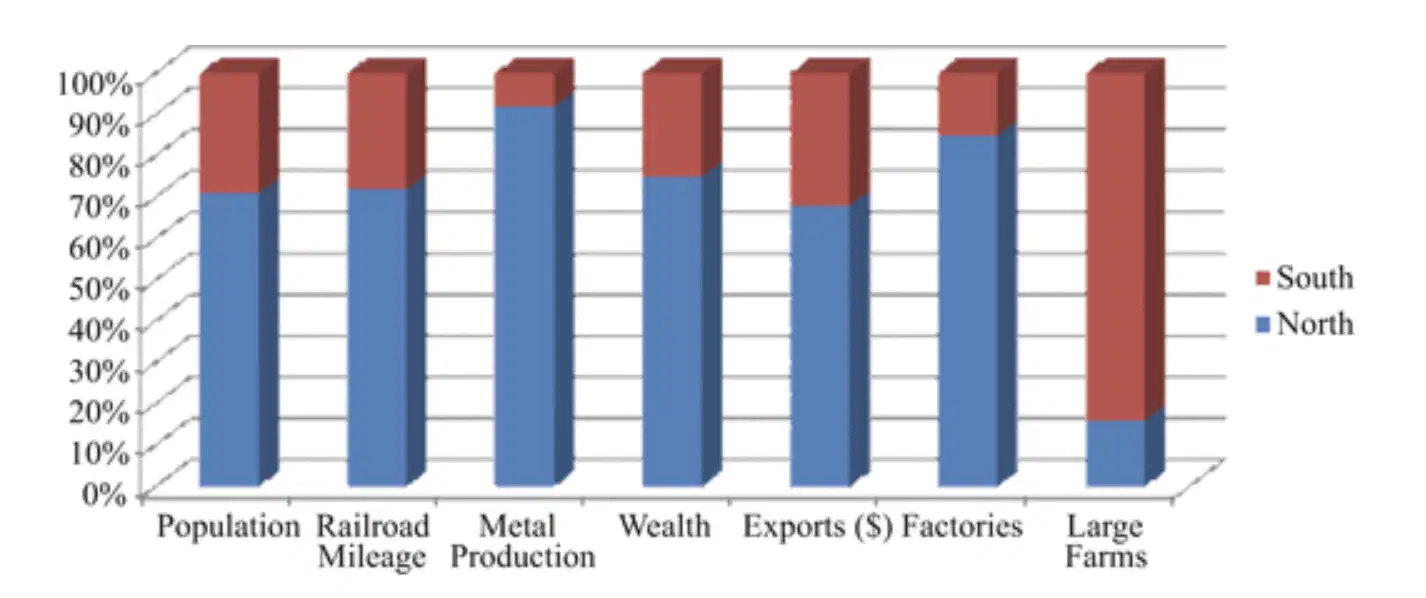
Which statement below is TRUE based on the Bar graph?
The North had less wealth than the South
The North had more large farms then the South
The South had a much larger population than the North
The North had about 80% of the factories
Match each definition with a Vocabulary word:
having to do with farming
Slavery
Agrarian
Abolition
Sectionalism
Industrialization
Match each definition with a Vocabulary word.
The movement to end slavery
Slavery
Agrarian
Abolition
Sectionalism
Industrialization
Match each definition with a Vocabulary word.*
to change an economy to rely more on manufacturing and less on farming
Slavery
Agrarian
Abolition
Sectionalism
Industrialization
Match each definition with a Vocabulary word:
the condition of being owned by another person and being made to work without wages
Slavery
Agrarian
Abolition
Sectionalism
Industrialization
Match each definition with a Vocabulary word:
Loyalty to one's own region of the country, rather than to the nation as a whole
Slavery
Agrarian
Abolition
Sectionalism
Industrialization

