
 Worksheets
water in plants
Total questions: 20
Worksheet time: 11mins
These are made up of group of specialised cells that conduct food, water and dissolved salts down or up the stem.
phloem
xylem
vascular bundles
roots
Where is xylem found in the plant (in correct order)?
leave -> roots -> stem
roots -> stem -> leaves
root hairs -> leaves -> stomata

This vascular tissue (tubes) is responsible for the transportation of water and minerals up from the roots to the stem then leaves
Stomata
Shoot
Phloem
Xylem

Leafy celery stalks were placed into coloured water in a beaker overnight. The following day, the students observed the color of the celery leaves changed from green to red. The students cut across the edge of the celery and observed the small tube openings are also red.
How do the plant systems work together to make the movement of the liquid possible?
The roots absorb the water and dissolved minerals and then move up the stem
The roots anchor the plant into the soil and the stem holds the leaves up.
The roots absorb carbon dioxide and move up the stem.
The roots and the stem lose water vapor to the soil.
What is the function of root hair?
it is a place to store the food and gas
it increases surface area to absorb more water
Which of these is TRUE?
Xylem carries water and dissolved minerals up the plant
Phloem carries water and dissolved minerals up the plant
Stomata carry water and dissolved minerals up the plant
When photosynthesis takes place during the day, stomata will...
open
close
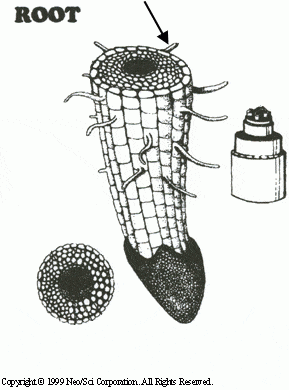
What is the name of the part of the root that allows water and minerals enter? (a)
Water and minerals move in which direction within the plant
Upward
Down
The roots of a plant have several functions, choose from the following EXCEPT:
The roots absorb the water and dissolved minerals to move up to the stem and then leaves.
The roots anchor the plant into the soil.
The roots absorb their own water and minerals.
The roots released their carbon dioxide into the soil particles.
Xylem can be found in the following parts of the plant:
Roots
Stem
Leaves
Flower
Fruit
Xylem can be found in the roots as the following:


Xylem can be found in the stem of a dicotyledon as the following:


Transport system in plants: xylem and phloem are known as
ground tissue
vascular bundle
dermal tissue
root system
Identify the force of attraction between two particles of the same substance.
Cohesion
Adehesion
Latent heat of vapourisation
Specific heat capacity
Which of the following does NOT contribute to the movement of water from the roots to the upper parts of the plants
Root pressure
Ground tissue
Transpiration
Capillarity
Irish scientists first described how water travels from the roots of a plant to the leaves were called
Joe Dixon and John Joly
John Dixon and Henry Joly
Henry Dixon and John Joly
James Joly and Harry Dixon
The model used to describe how water molecules travel from the root up to the leaves (a)

