
 Worksheets
Ag Econ Final Review
Total questions: 107
Worksheet time: 1hrs 1mins
Which statement best defines “Opportunity Costs”?
The cost of doing business
The costs associated with specialization
The costs of opportunities foregone
The costs associated with labor
Which is the best example of a “natural resource”?
Fertilizer, chemicals, and crop seed
Manufactured goods
Human Labor
Land
What type of economic system allows individuals to own resources like land?
Capitalism
Communism
Socialism
Mixed economic system
Which branch of economics would be concerned with the textbook costs for students at MJC?
Macroeconomics
Normative
Positive
Microeconomics
What branch of economics is concerned with inflation and the unemployment rate?
Microeconomics
Normative
Positive
Macroeconomics
Which type of economic system does the US have?
Capitalism
Socialism
Mixed
Communism
Would this example be “positive” or “normative” economics? An economist wants to study the effects of processing plant supply chain issues on consumer demand for beef.
Normative
Positive
The study of economics at the simplest level addresses the problem of over-coming
Scarcity
Adversity
Opportunity costs
Communism
When given a set of human and non-human resources, _______ of effort generally results in higher total output.
Positive economics
Specialization
Scarcity
Cooperation
Economic reasoning that is true for one individual but not for society as a whole is referred to as:
Fallacy of composition
Socialism
Opportunity costs
Communism
If the price index received by farmers for 2015 was .97. Which statement would be most accurate?
Relative to the base year, farm prices were 3% higher
Relative to the base year, farm prices were 97% higher
Relative to the base year, farm prices were 3% higher
Relative to the base year, prices were 3% lower in 2015
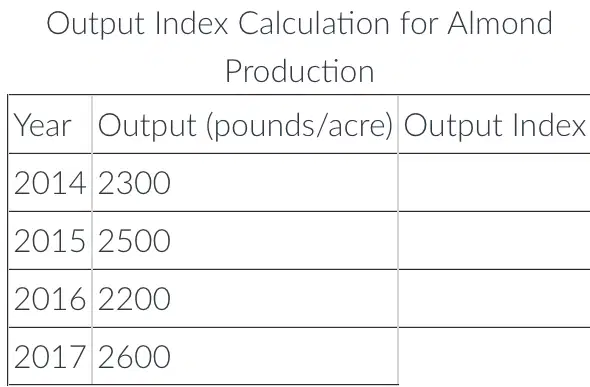
Assumed the base year is 2015, calculate the output index value for 2014.
1.02
.92
1.08
.97
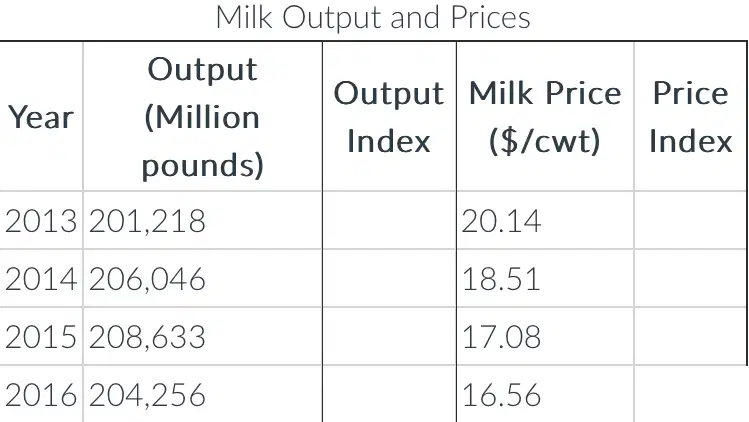
Calculate the price index for 2016 as indicated. The base year is 2015, round the nearest 100th.
.97
.92
1.03
1.07
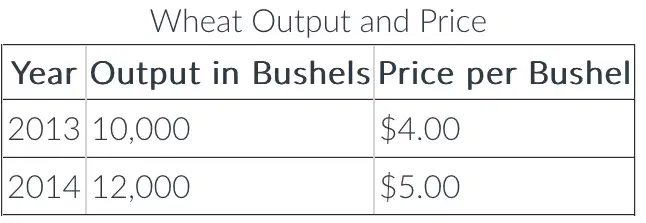
Given the table below, what is the price index for 2014 assuming the base year is 2013.
1.50
.50
1.25
.92
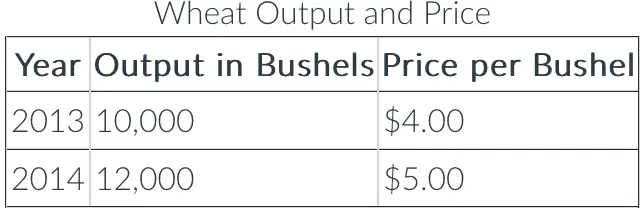
Given the following table, relative to 2013 (base year) the price of corn for 2014 was?
Higher by 25%
Higher by 20%
Lower by 20%
Lower by 25%
The base year is indicated by:
1.00
1.50
.90
1.10
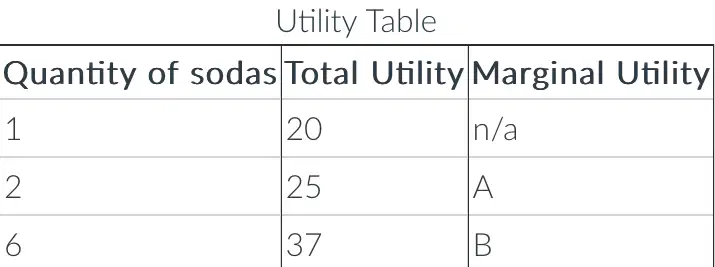
What is the marginal utility for A?
5
8
45
1
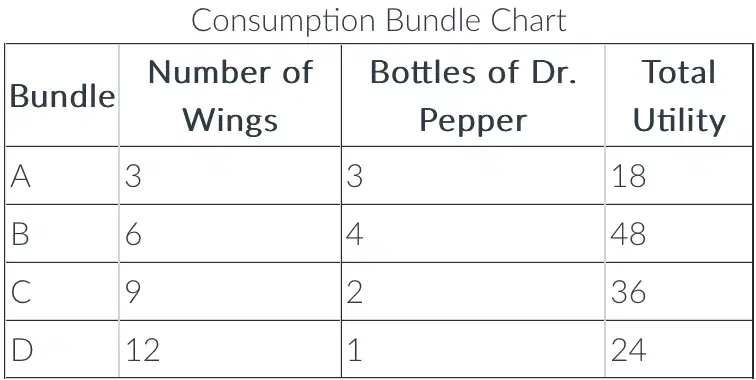
According to the following table, which of the “Consumption Bundles” is most preferred?
D
B
C
A
“I wanted to purchase a new laptop but I just couldn’t afford it.” This statement portrays that we are all faced with what economists call ______________.
The law of diminishing returns
the law of demand
The budget constraint
The consumer delimna
The marginal utility of a good such as ice cream declines with increases in consumption of that good. The phenomenon is referred to as the _______ (an economic law)
The law of diminishing marginal utility
Engel’s law
Supply and demand
Total utility
Engel’s law states:
As income rises, food expenditures increase exponentially
As income rises, the portion of the dollar spend on food rises
As income rises, the portion of the dollar we spend on food falls
Marginal utility declines as more of a good is consumed during a specific time period
For Herman, 4 wings and 3 bottles of Dr. Pepper generate the same utility as 6 wings and 2 bottles of Dr. Pepper. These combinations are called ______ _____. And form the basis for the calculation of marginal rate of substitution.
Consumer bundles
Combination bundles
Consumption bundles
In studying consumer behavior, we assume consumers are ______ and _____ their utility/satisfaction.
Rational-maximize
Irrational-minimize
Irresponsible-ruin
Open-minded- demand
Another name for an “isoutility curve” is an _______ ______
(a)
Which of the following statements is true?
As consumption increases, marginal utility increases
The marginal rate of substitution is always a positive number
The total utility curve has a negative slope
The marginal utility curve has a negative slope
The graph of alternative consumption bundles that provides a consumer with a given level of satisfaction is called a (n) _____________________ curve.
ISO-utility
Budget
Consumption bundles
Engel
In the example of an inferior good; as consumer income increases, demand for the good will
Increase
No answer provided
Remain unchanged
Decrease
The change in the economic welfare of the consumer can be approximated by the concept of “consumer surplus”
False
True
“Consumer Equilibrium” in economics refers to which of the following?
The demand line intersecting the supply line
The point where the iso-utility curve and the budget line are tangent
The point where consumers buy the maximum quantity
The point where price and demand are equal
Which of following is NOT a factor that affects consumer demand as we studied it in class?
consumer taste and preferences
Global politics
Price
Consumer income
Which of the following would be considered and “inferior” good?
Pizza
A t- bone steak
Cherry pie ala mode
Turkey hotdogs
Advertising and promotion can cause the demand curve to shift to the right.
True
False
A food safety scare such as an “E Coli” outbreak in beef would cause what type of immediate change on the demand change.
A shift to the left
An increase in price
A decrease in price
A shift to the right
The “law of demand” states that: “as price increases, demand decreases”
True
False
During the Covid 19 pandemic, the federal government has been pumping billions of dollars into the American economy. What immediate effect does this have on the demand curve?
Shifts the demand curve right
Makes consumer goods cheaper/more affordable
Shifts the demand curve left
makes consumer goods more expensive
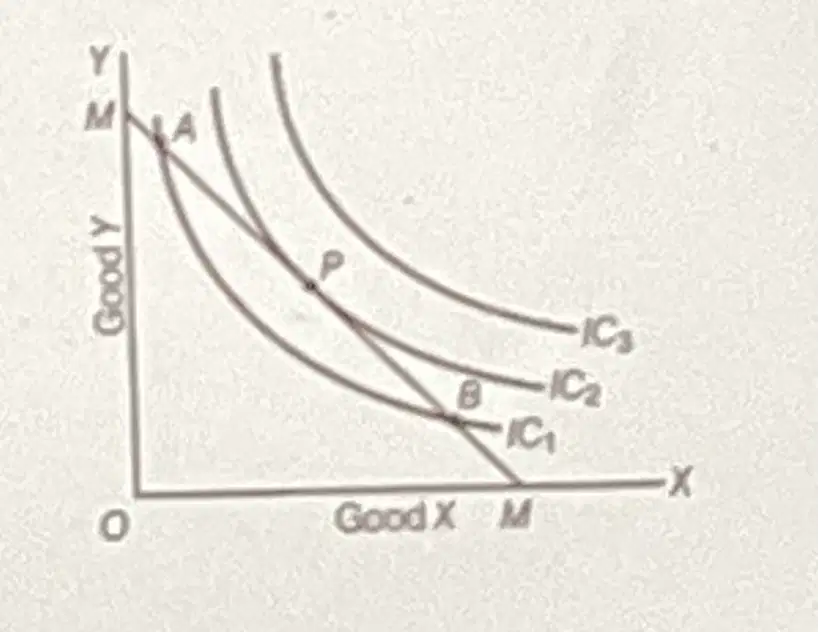
What does the point P represent
ISO-utility
Intersection of budget and iOS-utility
Consumer equilibrium
Market equilibrium
If goods are _____ that means the goods can replace each other so a change in the price of one good will have an impact on the demand of the other good. Example: If the price of beef goes up, the demand for chicken will increase.
elastic
Substitutes
Substitute
What is an economic characteristics of elastic goods?
Price has no effect on demand
They are necessities
They are unique
They have substitutes
What is an economic characteristic of an “inelastic” good?
It has substitutes
As your income increases you buy more
As your income increases you buy less
It is a necessity
The producer of an inelastic good would make more profit by raising the price of the good
True
False
Which of the following would be an “inferior” good
Steak
Lobster
Chicken hot dogs
Cabernet Sauvignon wine
Rack of lamb
Goods that are ____ are generally consumed together like peanut buttter and jelly
Compliments
Complement
___ goods are goods which show an increase in demand as a consumer’s income increase
Luxuary
Normal
(a) goods are goods which show a decrease in demand as consumer’s income increases.
A general property of demand curves is that short-run demand is more inelastic than long-run demand
True
False
The producer of an inelastic good would make more profit by raising the price of the good
True
False
Competitive markets work best when there are only a few sellers
True
False
“No entry barriers” refers to the fact that anyone can start a business of that type
True
False
An example of an “entry barrier” could be a patent or special licensing required to start a business
True
False
Which economic input class includes all services used in the production of a product with the exception of management
Labor
Capital
Land
Asset
Which stage of the production function does the “law of diminishing marginal returns” start
Stage I
Stage II
Stage III
Stage IIII
Which of the following would not fit the description of a “capital” input?
40 acres of walnuts
Almond shaker
50 gallons of round up
A free stall barn
_______ products are those which are undifferentiated in the market place and this prevent buyer preference. In agriculture, grades an standards enforced by the USDA make this a regular occurrence
Homogeneous
Same
Differentiated
Competitive markets work best when they are only a few sellers
True
False
“No entry barriers” refers to the fact that anyone can start a business of that type
True
False
An example of an “entry barrier” could be a patent or special licensing required to start a business
True
False
Which economic input class includes all services used in the production of a product with the exception of management
(a)
Which stage of the production function does the "Law of Diminishing Marginal Returns" start?
Stage I
Stage II
Stage III
Stage 0
Which of the following would not fit the description of a “capital” input?
40 acres of walnuts
Almond shaker
50 gallons of round up
A free stall barn
products are those which are undifferentiated in the market place and this prevents buyer preference. In agriculture, grades are standards enforced by the USDA make this regular occurrence.
(a)
Define what is a production function?
“Fixed resources” are those resources that (a) even as output increases (think of the pizza oven example in the video)
Which economic input class includes both renewable and nonrenewable resources.
(a)
______ _______ refers to the condition in perfect competition where all sellers of the product have access to information about prices, production costs and historical production data.
(a)
The input class requires leadership, organization, decision-making and profit maximization
(a)
Economic profit or _____ _______ is the economic return above the firm’s cost of production.
Producer surple
Opportunity cost
Short run profits
Producer profits
Which of the following markets is likely to most nearly reflect a perfectly competitive market?
The wheat market
The farm implement market
The textile market
The automobile market
According to a supply and demand curve, shortages occur when prices are too
High
Low
No answer provided
The slope of a supply curve is
Positive
Upward
Downward
Negative
A and b
Market price (market equilibrium) is determined by the producer
True
False
In a perfectly competitive market like agriculture producers must accept prices for products, they are called _____ ______
Price takers
Price makers
A supply decrease will shift the supply curve to the
Left
Right
Up
Down
The demand curve is determined by consumer’s decisions
True
False
Market price (market equilibrium) is determined by the interaction of supply and demand
True
False
A supply increase will shift the supply curve to the
Left
Right
The intersection of the supply and demand curves represents
Equilibium
Market equilibrium
Consumers
According to a supply and demand curve, surplus occurs when prices are too
High
Low
Neither
No answer
In general, oligopolies compete using the practice of
Collusion
Price takers
Non-competition
Product differentiation
Which of the following is the best example of an oligopoly?
US Farm Machinery
American corn farmers
Fast food restaurants
Utilities Companies
Which of the Anti-Trust Laws below was the first of its kind and is still playing a role in preventing the formation of monopolies in the USA?
Sherman Anti-Trust Act
Packer’s and Stockyard’s Act
Clayton Act
Capper Volstead Act
In the beef processing industry, three firms- Conagra, Excel and IBP - comprise roughly 85% of the buying side of the market. This situation characterizes a(n)
Monopoly
Oligopoly
Perfect competition
Monopolistic competition
A monopoly can consist of one or more businesses selling the same product
True
False
Which of the following types of market structure is most often accused of “collusion”
Oligopoly
Monopoly
Perfect competition
Imperfect competition
Which of the following would be a characteristic of an “imperfectly competitive” market?
Product differentiation
Few sellers
Perfect market information
Businesses can classed by: number of firms, product differentiation, market information and entry/exit barriers. What type of firm would be a business firm like Nutcher Milk?
Imperfect competition
Oligopoly
Perfect competition
Monopoly
Which of the following is an example of an Agricultural Cooperative operating in California?
Bel Koop Ag
Diamond Walnut
Associated Feed Mill
Blue Diamond
Which of the following legislative Acts exempted Agricultural Cooperatives from Anti-Trust Laws?
Capper-Volstead Act
Sherman Anti-Trust Act
Packer’s and Stockyards Act
Clayton Act
Which agricultural commodities generally do not receive agricultural subsidies?
Wheat
Dairy products
Livestock and Meat Products
Corn
A “bumper crop” in agriculture shifts the supple curve to the left
True
False
A “bumper crop” for a farmer generally results in _______ (lower or higher) prices?
Lower
Higher
The food and fiber industry is one of the most highly regulated industries in the United States
True
False
Because most farmers pay cash for their assets, they have=be the lowest capital invested per worker for any sector of the economy
True
False
One way to reduce agricultural surpluses is to provide food subsidies. List one example as given in your test of a “Food Subsidy” provided to needy Americans.
Food Stamp Program
Stamp
SNAP
Because farmers are typically engaged in purely competitive markets, they lack market power
True
False
Consumers in the United States spend approximately __% of their disposable income on food and rarely experience an interruption in the supply of food products
50%
15%
30%
5%
Which of the following is Not a form of “government intervention” in agriculture?
Foreign Trade Enhancements
Adjusting production to market demand
Price and income support paymets
Market price intervention
In general, demand for agricultural products (food & fiber) is
Elastic
No answer
Inelastic
No answer
During the “Great Recession” which was the financial crisis caused by the bankruptcy of major financial firms, the federal government utilized a nonconventional method to stimulate the economy. What is it called
Quantitive Easing
The New Deal
Deflationary Gap Stop
Expansionary Monetary Policy
Which of the following is the most liquid asset
Cash in savings account
A vehicle
A credit card bill
Condo
The “fiduciary monetary system” is what the US relies on to support its economy. It is the belief that a piece of paper (money) can be exchanged for goods and services.
True
False
What time period did the “Great Recession” occur in the US?
1914-16
1980-85
1929-32
2007-09
A branch location of the Federal Reserve is located in which city in California?
Modesto
Pablo Alto
Sacramento
San Fransico
Contractionary monetary policies drive up interest rates and depress investment expenditures by businesses and households
True
False
The Federal Reserve stores all of the gold used to back US dollars
True
False
Which US President established the Federal Reserve?
Theodore Roosevelt
Franklin D. Roosevelt
Abraham Lincoln
Woodrow Wilson
The Federal Reserve began operating in 1914 as the U.S. _____ ____
Central bank
Main bank
Wells fargo
Raising the “discount rate” would be an example of “expansionary” monetary policy
True
False

