
Font size
 Worksheets
HB Evolution Test Review- Speciation
Total questions: 21
Worksheet time: 11mins
Which best describes punctuated equilibrium?
Speciation occurs due to natural selection
Speciation occurs due to isolation
Speciation occurs slowly in geologic time, followed by long periods with very fast evolutionary change.
Speciation occurs suddenly and rapidly in geologic time, followed by long periods with little evolutionary change.
The large-scale events of speciation are called...
macroevolution
simplification
adaptation
microevolution
During microevolution, a(n) __________________ will become more or less common within a population.
species
allele
ribosome
fossil
Which of the following is required for a population to diverge into two separate species?
The two populations must have evolved different physical appearances.
The two populations must have mutated at least 10 times.
The two populations must have become reproductively isolated.
The two populations must have evolved analogous structures.

The palmarus longus tendon, pictured here, no longer serves a purpose in humans, but provides evidence of our species descendance from tree-dwelling ancestors. The palmarus longus tendon is an example of:
a vestigial structure
a homologous structure
bipedalism
convergent evolution
A new river forms and splits two populations, causing ______________ speciation
Sympatric
Allopatric
Extreme
Convergent
A speciation in which new species evolve from a single ancestral species while inhabiting the SAME geographic region.
Sympatric speciation
Allopatric speciation
Complex speciation
Divergent speciation
The emergence of new rivers or streams is a type of ____________ isolation.
Temporal
Mechanical
Behavioral
Geographic

Which are causes of speciation? Choose all that apply
Isolation caused by mountains, rivers and man-made structures
preference for different foods
change in environment
different mating behaviors
Speciation that caused by breeding occurring at different time of the day is called
behavioral isolation
temporal isolation
ecological isolation
habitat isolation

When populations no longer look the same
When populations no longer have the same frequency of alleles
When populations are living in different environments
When populations can no longer interbreed
Genetic diversity is decreased through this process.
Gene Flow
Genetic Drift
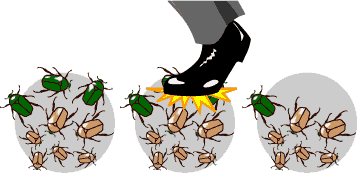
Someone steps on some bugs and randomly removes their alleles from the population. This is an example of
gene flow
genetic drift
speciation
allele frequency
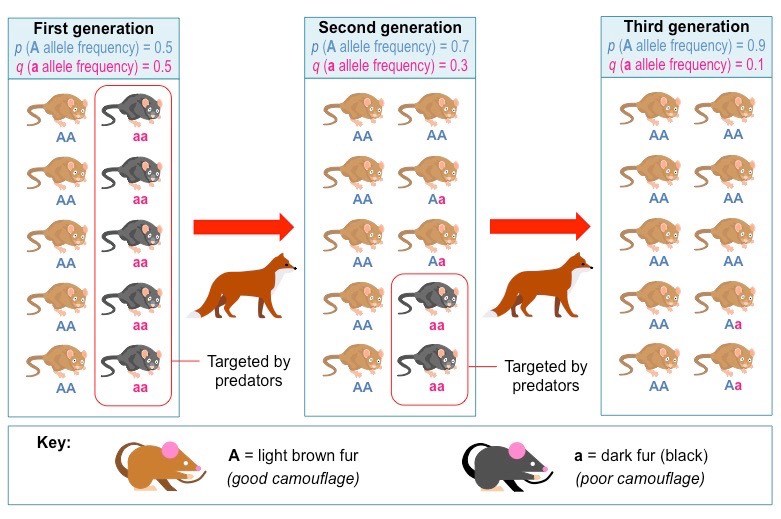
The allele frequencies of the mouse population in the picture are changing over time. Which is true?
The population is evolving.
The population is not evolving.
The population will go extinct.
The population's genetic variation is increasing.

