
 Worksheets
Quadratics Unit Review
Total questions: 196
Worksheet time: 49hrs 0mins
y=4(x+2)2−8
Convert the equation from vertex form to standard form.
y=4x2+16x+8
y=4x2+16x+16
y=16x2+64x−8
y=16x2+256x+8
y=4(x+2)2−8
Convert the equation from vertex form to standard form.
y=4x2+16x+8
y=4x2+16x+16
y=16x2+64x−8
y=16x2+256x+8
y=−3(x+5)2−4
Convert the equation from vertex form to standard form.
y = 9x2 - 15x + 21
y = -3x2 - 75x - 4
y = 9x2 + 90x + 221
y = -3x2 - 30x - 79
Convert to vertex form. y = -2x2 + 24x + 5
y=-2(x+12)2 + 77
y=-2(x-12)2 + 77
y=-2(x-6)2 + 77
y=-2(x+6)2 + 77

Convert to vertex form. f(x) = 4x2 - 32x +2
y=4(x+4)2 - 62
y=4(x-4)2 - 62
y=4(x-8)2 - 62
y=4(x+8)2 - 62
Convert the equation y= x2 + 4x + 11 into vertex form.
y = (x + 2)2 - 4
y = (x + 2)2 + 7
y = (x + 2)2
y = (x - 2)2 - 7
Convert to standard form: y=(x+5)2−15
y=x2+10
y=x2+10x +10
y=x2+25
y=x2+10x+25
Convert to standard form: y=−2(x−3)2+6
y=−2x2+12x−12
y=−2x2+6x+15
y=−2x2+12x−18
y = −2x2−12
Convert to standard form: y=51(x+10)2−12
y=51x2+8
y=x2+4x+8
y=51x2+4x+8
y=51x2+20

Convert to vertex form: y=2x2+8x+11
y=2(x+2)2+3
y=(x+4)2−6
y=y=2(x+4)2+3
y=2(x+2)2−5
Which of the following is Standard Form?
y=ax2+bx+c
y=a(x−p)(x−q)
y=a(x−h)2+k
Which of the following is Vertex Form?
y=ax2+bx+c
y=a(x−p)(x−q)
y=a(x−h)2+k
Which of the following is Factored Form?
y=ax2+bx+c
y=a(x−p)(x−q)
y=a(x−h)2+k
Convert to Vertex Form:
f(x) = x2 +8x +14
f(x) = (x - 4)2 + 2
f(x) = (x - 4)2 - 2
f(x) = (x + 4)2 + 2
f(x) = (x + 4)2 - 2
Convert to Standard Form:
f(x) = (x+7)(x-3)
f(x) = x2 +10x +21
f(x) = x2 -10x -21
f(x) = x2 +4x -21
f(x) = x2 +4x +21
Convert to Factored Form
(hint...take out the greatest common factor first)
2c2 + 2c - 84
(c-6)(2c+14)
(c+7)(2c-12)
(c-4)(2c+21)
2(c+7)(c-6)
What are the x-intercepts for the function?
f(x) = (x + 7)(x + 5)
(7 , 0) and (5 , 0)
(0 , 7) and (0 , 5)
(-7 , 0) and (-5 , 0)
(7 , 0) and (5 , 0)
Determine the vertex of the parabola y=5(x-2)2–7
(5, -7)
(-2, -7)
(2, -7)
(-7, -2)


y = -2x2 + 4x + 3
y = -2x2 + 4x + 3
f(x) = 2(x - 5)2 + 12
f(x) = x2 - 8x + 15.
y = 3x2 - 6x + 4
The root, x-intercept, and zero are all the same thing
f(x) = -x2 - 4x + 12.


f(x) = 2(x - 5)2 + 12
f(x) = -2x2 + 4x - 6


Match the following form to its correct name
y=ax2+bx+c
Standard Form
y=a(x−h)2+k
Vertex Form
y=a(x−p)(x−q)
Factor Form
What is the Axis of Symmetry for the equation: x2−2x−3
x = -1
y = -1
x = 1
y = 1

Determine what the vertex is AND determine what the vertex represents
-1, 3
Minimum
2, 0
Maximum
0, 8
Maximum
3, -1
Minimum
Graph the Equation:
f(x)=−x2+4x+1

Graph the Equation:
f(x)=21(x−1)2−2


Write the equation that models the function graphed
Not Possible
y=−(x−1)2−1
y=x2+2x
f(x)=−x2+2x−3
Does this parabola open up or down?
y = 4x2 - 3x - 9
up
down
Given the function y = x2 + 2x - 16; what is the value of y when x = -2
y = -16
y = -24
y = 0
y = 8
Given the equation y = -3x2 - 6x + 10, what is the value of y when x = -4
y = -15
y = 82
y = -14
y = 178
Given y = 6x + 7x2 - 20 what is the value of b
b = 6
b = 7
b = 2
b = -20
What is the graph of this function: y = x2 - 4x


What is the graph of y = -3x2 + 12x - 16


Is the graph shown above a max or min?
Maximum
Minimum

What is the domain of the graph shown above.
x=19
all real numbers
y=3
Maximum

What are the zeros of the graph shown above?
2 and 6
4 and 2
6 and 9
5 and 1
What is a axis of symmetry?
all real numbers
y=5
the line that divides the graph in equal halves
y=mx+b

Is the graph shown above a max or min?
Minimum
Maximum

What is the y-intercept of the graph shown above?
all real numbers
(0,6)
(0,2)
(0,-6)

What is the vertex of the graph shown above?
(7,6)
(-1,2)
(2,-1)
(5,0)
Graph the following equation:
y=x2-2x-3


A
B
C
D

A
B
C
D

A
B
C
D

A
B
C
D
2x² + 13x + 15
2x² -15x + 27
8x² + 22x + 5
10x² + 9x - 7
Find the 2 factors of 6x2+x−1
(3x+2)
(2x-1)
(6x-1)
(x+1
Find the 2 factors of 2x2+8x+8
(x+8)
(2x+4)
(2x+2)
(x+2)
Find the 2 factors of 4x2+13x-35
(4x+5)
(x+5)
(4x-7)
(x-7)
Find the 2 factors of 21x2-31x+4
(7x-1)
(7x+2)
(3x+2)
(3x-4)
Find the 2 factors of x2+x-56
(x-7)
(x+8)
(x+7)
(x-8)
Find the 2 factors of x2-x-6
(a)
Find the 2 factors of 8x2+23x-36
(a)
Find the 2 factors of 2x2-13x-45
(a)
Find the 2 factors of 4x2+12x+5
(a)
Find the 2 factors of 5x2-16x+3
(a)
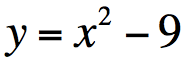


Which of the following is not quadratic equation?
I. 9𝑟 2 – 25 = 0
II. 𝑥 2 – 5𝑥 + 3 = 0
III. 8𝑘 – 3 = 12
IV. (2𝑥 + 5) (𝑥 – 1) = −6
I and II
III and IV
IV only
III only
A practical way to solve 𝑥 2 – 25 = 0.
factoring
completing the square
extracting the square root
quadratic formula
What are the roots of 𝑥 2 – 144 = 0?
± 13
± 24
± 11
± 12
Solve: 4𝑥 2 – 80 = 0 by extracting the square root.
± 5
±5√2
±2
±2√5
x2 - 4x + 4 = 20,
what goes in the blank?
(x - __ )2 = 20
k2 − 12k + 23 = 0
x2 +12x = 5
y2 + 10y = -9
n2 - 2n - 3 = 0
x2+ 6x - 4 = 36
x2 + 10x + ____
x2 + 14x + ____
x2 + 12x + ____
x2 + 6x = 5
x2 + 6x + ____
Complete the square for the equation:
x2+6x−4=0
(x+3)2=4
(x−3)2=4
(x+3)2=13
(x−3)2=13
Complete the square for the equation:
x2−10x+7=0
(x−5)2=18
(x+5)2=18
(x−5)2=−7
(x+5)2=−7
Complete the square for the equation:
x2−24x+23=0
(x+12)2=121
(x−12)2=121
(x+12)2=144
(x−12)2=144
Solve by completing the square.
x2−8x−20=0
x={−2, 10}
x={−10, 2}
x={−20, −8}
x={8, 20}
Solve by completing the square.
x2−12x+20=0
x={2, 10}
x={−10, −2}
x={−12, 20}
x={12, 20}
Solve by completing the square.
x2−4x−20=0
x={±62−2}
x={±62+2}
x={±26+2}
x={±26−2}
Solve by completing the square.
x2−6x−27=0
x={−9, −3}
x={−3, 9}
x={−9, 3}
x={3, 9}
Solve by completing the square.
x2−14x−15=0
x={1, 15}
x={−15, −1}
x={−15, 1}
x={−1, 15}
Solve by completing the square.
x2−6x−59=0
x={±217+3}
x={±172+3}
x={±217−3}
x={±172−3}
Solve by completing the square.
x2−4x−5=0
x={−5, 1}
x={−1, 5}
x={−5, −1}
x={1, 5}
Solve by completing the square.
x2−4x−21=0
x={−7, 3}
x={3, 7}
x={−3, 7}
x={−7, −3}
Solve by completing the square.
x2−16x+48=0
x={−12, 4}
x={−12, −4}
x={−4, 12}
x={4, 12}
Solve by completing the square.
x2−8x−14=0
x={±30+4}
x={±4+30}
x={30+4}
x={30−4}
Determine the vertex from the following equation: −3(x−4)2+1
Vertex: (4,1)
Vertex: (-4, -1)
Vertex: (4, -1)
Vertex: (-4, 1)
Determine the vertex from the following equation: −(x+1)2−1
Vertex: (1,-1)
Vertex: (-1, 1)
Vertex: (-1, -1)
Vertex: (1, 1)
Determine the vertex from the following equation: 21(x+4)2+1
Vertex: (-4, 1)
Vertex: (-4, -1)
Vertex: (4, 1)
Vertex: (4, -1)
Determine the axis of symmetry from the following equation: −(x−2)2+4
A. O. S: 2
A. O. S: 4
A. O. S: -2
A. O. S: -1
Determine the axis of symmetry of the following equation: −2(x+2)2+3
A. O. S: 3
A. O. S: -2
A. O. S: 2
A. O. S: 1
Determine the axis of symmetry of the following equation: (x−3)2+5
A. O. S: 1
A. O. S: -3
A. O. S: 3
A. O. S: 5
Determine if the following equation has a maximum or minimum: −(x−2)2+7
Maximum
Minimum
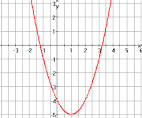

Which equation is graphed above?
y=−(x−1)2+4
y=(x−1)2+4
y=−(x−4)2+1
y=(x−4)2+1

Which equations matches the graph above?
h(x)= (x+1)2−4
h(x)=−(x+1)2−4
h(x)=(x+4)2−1
h(x)=−(x+4)2+1

Which equation matches the graph above?
r(x)=−(x+4)2−1
r(x)=(x+4)2−1
r(x)=−(x−4)2+1
r(x)=(x−4)2+1
f(x) = x2 + 12x - 2
written in vertex form?
f(x) = x2 - 8x + 1
written in vertex form?
y = x2 - 6x + 10?
x2-12x+40
into vertex form
Convert the equation y= x2 + 4x + 11 into vertex form.
y = (x + 2)2 - 4
y = (x + 2)2 + 7
y = (x + 2)2
y = (x - 2)2 - 7
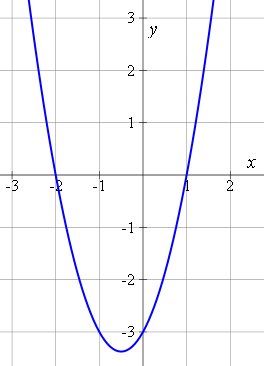
What are the x-intercepts of the parabola?
y = -3(x + 5)(x - 9)
(-5, 0) and (9, 0)
(5,0) and (-9, 0)
(5, 0) and (9, 0)
(-3, 0) and (5, 0)and (-9, 0)
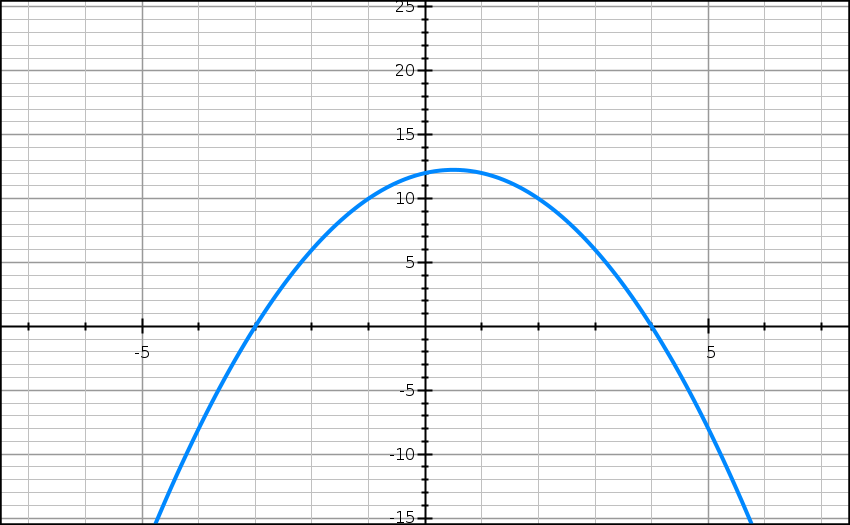
Write the equation of the graph in factored form.
(x-4)(x+3)=0
-(x+3)(x-4)=0
(x+4)(x-3)=0
-(x-3)(x+4)=0

y = a(x - p)(x - q)

y = a(x - p)(x - q)
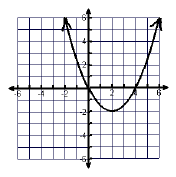
What are the x-intercepts for g(x) = (x + 8)(x + 2)
8 and 2
(8, 2)
-8 and - 2
(-8, -2)
Determine the vertex of j(x) = (x - 8)(x + 3)
(-8, 3)
(8, -3)
(2.5, -30.25)
(5, -24)

Write an equation of this graph in intercept (factored) form.
h(x) = (x - 1)(x + 3)
h(x) = (x + 1)(x - 3)

What is the quadratic function for the graph in intercept form?
y = (x - 2)(x - 6)
y = - (x - 2)(x - 6)
y = (x + 2)(x + 6)
y = (x + 4)(x - 4)
What is the vertex of y = −(x+7)(x+5) ?
What is the vertex of y=31(x−7)(x−1) ?
y=−(x+7)(x+3)
What is the vertex?
y=2(x−1)(x+1)
What is the vertex?
y=(x−7)(x−3)
What is the vertex?
y=(x+4)(x+2)
What is the vertex?
y=(x+3)(x+1)
What is the vertex?
y=21(x−2)(x+6)
What is the vertex?
y=−(x−5)(x−1)
What is the vertex?
y=2x(x−2)
What is the vertex?
y = (x - 8)(x + 2)

What is the vertex of the function?
(-3, -16)
(3, 20)
(-6, -7)
(0, -7)
In factored form you can see the ______ of the graph easily.
y-intercept
vertex
x-intercepts


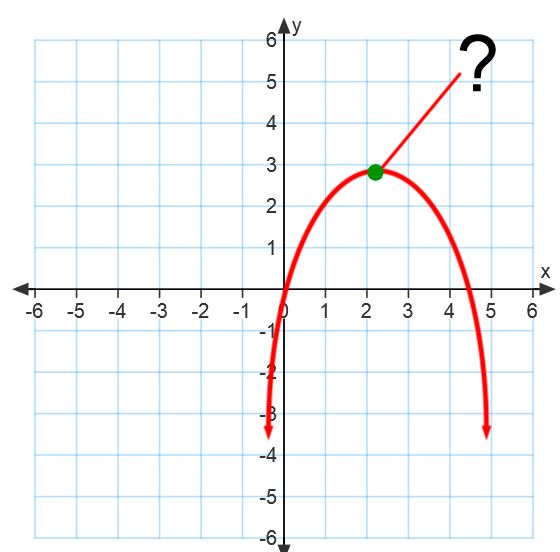
What is the green dot on the parabola called?
vertex
minumum
roots
zeros

Identify and classify the vertex.
(-6,5); minimum
(-6,5); maximum
(5,-6); minimum
(5,-6); maximum

What are the x-intercepts? Check all that apply.
-1
-7
1
7
-4
Match the form of the quadratic to the key feature that it represents best
Standard Form
y=ax2+bx+c
y-intercept
Factored Form
y=a(x−x1)(x−x2)
x-intercept(s)
Vertex Form
y=a(x−h)2+k
vertex
WITHOUT USING DESMOS, what is the vertex for the following quadratic?
2(x+4)2−1
(4,1)
(4,-1)
(-4,1)
(-4,-1)
WITHOUT USING DESMOS
x2+10x−25
What is the y intercept?
TYPE A FULL ORDERED PAIR
(a)
WITHOUT USING DESMOS
If the x intercepts are -3 and 5, which equation in intercept form would represent this?
y=(x+3)(x−5)
y=(x−3)(x−5)
y=(x−3)(x+5)
y=(x+3)(x+5)

WITHOUT USING DESMOS
If the factored form of the quadratic shown is
y=(x+4)(x−6) , what are the x-intercepts?
4 and -6
-4 and 6
4 and 6
-4 and -6

Factored Form y=(x−x1)(x−x2)
Given the graph, write the equation of the quadratic in factored form
(start with y=)

Vertex Form: y=(x−h)2+k
Given the graph, write the equation of the quadratic in vertex form.
(start with y=)
What are the root(s) for g(x) =3(x + 8)(x + 2)
(8,0) (2, 0)
(3, 0)
(-8,0) and (-2,0)
(0,-8) and (0,-2)
What are the root(s) for g(x) = (x -10)(x + 1)
(10,0) and (-1, 0)
(-10, 1)
(-10,0) and (-1,0)
(0,10) and (0,-1)
What point contains the minimum or maximum value of a parabola?
axis of symmetry
vertex
roots
y-intercept
Which equation is the intercept form of a quadratic function?
f(x) = mx + b
f(x) = a(x - p)(x -q)
f(x) = ax2 + bx + c
f(x) = a(x - h)2 + k
Which equation is the vertex form of a quadratic function?
f(x) = mx + b
f(x) = a(x - m)(x - n)
f(x) = ax2 + bx + c
f(x) = a(x - h)2 + k
Which equation is the standard form of a quadratic function?
f(x) = mx + b
f(x) = a(x - m)(x - n)
f(x) = ax2 + bx + c
f(x) = a(x - h)2 + k
What is the axis of symmetry for the quadratic
y=2(x−3)(x−2)x=5
x=5/2
x=-5
x=-5/2
What is the vertex for the quadratic
y=−(x−6)(x+4)(-1, 15)
(-1, -15)
(1, 25)
(1,-25)
What is the y-intercept for the equation
y=0.25(x+5)2−9
(a)
Which of the following quadratic equation has a vertex at (9, −2) . Select all that apply
y=3(x−9)2−2
y=5(x+9)2−2
y=−2(x−9)2−2
y=5(x+9)2−2
y=(x−9)(x+2)
y=−0.25(x−8)(x+4)
Determine the x-intercepts
(8,0) and (4,0)
(8,0) and (-4,0)
(-8,0) and (4,0)
(.25,0) (8,0) and (-4,0)

True or false: The y-intercept and vertex are the same
True they are both at (0,-4)
True they are both at (-2,0)
False the y-intercept is at (-2,0)
False the y-intercept is at (2,0)

How many roots does y=x2+2x+4 have?
one
two
none

How many roots does y=x2 - 8x + 16 have?
one
two
none

How many roots does y=x2 + 2x - 3 have?
one
two
none
Identify a, b, and c if y = +3x2 +5x - 8
a=3, b=5, c= - 8
A=3, B=-8, C=5
A=3x2, B=5x, C=-8
A=3x2 , B=-8, C=5x
y=ax2+bx+c
Select the answer that has a, b, and c correctly labeled:
a= 1, b= 2, c= -9
a= 2, b= -1, c= 9
a= -9, b= 2, c= -1
a= -1, b= 2, c= -9
What is the first step when factoring polynomials?
Find the GCF
List all the terms
Make the X and fill in the top and bottom
Multiply a and c
Factor using GCF or monomial factoring:
2n2-8n3
2n2(n-4n2)
2n2(1-4n)
2n3(10-8n2)
3n(1-4n)
What is the common monomial factor of 6x3+3x2−12x ?
3
2x
3x
3x2
Which of the following quadratics are in vertex form?
Check all that apply.
y=−(x+5)2−2
y=(x+1)2
y=x(x−9)
y=4x2+2x−9
y=(x−4)(x+2)
Which of the following quadratics are in intercept form?
Check all that apply.
y=−(x+5)2−2
y=(x+1)2
y=4x2+2x−9
y=(x−4)(x+2)
Convert the quadratic below to standard form:
What is the value of c?
answer should be ONE number with no spaces
(a)

