
Font size
 Worksheets
3rd Grade Review
Total questions: 54
Worksheet time: 21mins
What is step 1 to being successful on a reading passage?
Prove it!
Eliminate answers
Read the whole story!
Analyze the question
What is the only genre where every line is numbered?
Folktale
Poetry
Fairy Tale
Realistic Fiction
What is one thing you should ask yourself when eliminating answer choices?
Is this true/false
Do I like this answer
Have I heard of this before
Should I choose this
What is another thing you should ask yourself when eliminating answer choices?
Do I like this answer
Have I heard this before
Does this answer the question I am being asked
Should I choose this
What is a synonym?
A word that means that same thing as another word
A word that means the opposite of another word
The definition of a word
A text feature
What is an antonym?
A word that means the same thing as another word
A word that means the opposite of another word
The definition of a word
A text feature
How can you tell that you are looking at an editing or revising passage?
There is not that many words
It is centered in the middle of the page
Every sentence is numbered
It will tell you
When can you choose 'make no change'?
When you don't feel like checking the other choices
When you haven't chose it in a while
When you've chosen 'make no change' 5 times already
When you have successfully eliminated all other choices
When should you use text evidence to prove your answers?
When you feel like it
When it's easy
On every question
Sometimes
What should you think of when you see 'text features'?
Pictures
Words
Graphic features
The entire story
Which answer is NOT a graphic feature?
Map
Illustration
Graph
Subheading
Why are text and graphic features included?
Because they are pretty
To help you understand more about the story
To make the text longer
Because they have to be
Which of the following is NOT a type of figurative language?
Similes
Metaphors
Graphic Features
Idioms
Imagery includes all of the following EXCEPT
Climax
Imagine
Visualize
5 senses
Which sentence includes imagery?
The chart has examples.
I like them.
The kittens fur felt like velvet.
Text features are words.
How can you tell how a character feels?
Guess
Look at the pictures
Read the whole story
Look for feeling words
When a question says something like 'In paragraph 7, why does...' what is the first thing you should do?
Eliminate choices
Go reread paragraph 7
Prove it
Do not go back to the story
When the question looks like this -
What change should be made in Sentence 3?
A. Change see to go
B. Change I to we
C. Change went to go
D. Make no change
What is the way you can choose the correct answer?
Write sentence 3 on your paper.
Read answers A through D and choose the one you like.
Go back to sentence 3 and read each change in the sentence.
Read sentence 3 one time and then go choose your answer.
Why should you analyze the questions?
So you know what you are being asked.
So it looks good.
So you can use your highlighter.
So you can follow the rules.
What is a claim?
A statement telling you what to do.
The author's position, opinion, or belief on a subject.
A statement that answers the question.
What the author knows is true.
TRUE OR FALSE - An opinion can be proven true.
TRUE
FALSE
What is a fact?
The way someone feels about a topic.
A statement that can be proven.
A statement that cannot be verified.
What someone thinks.
What is the MOST important thing to do for a written response questions (essay or short)?
Plan your response out on notebook paper.
Provide at least one piece of evidence.
Spell words correctly and use punctuation.
Answer the question.
How long should your response be for a SHORT constructed response?
5 sentences
1 sentence
2 sentences
3 sentences
How long should your response be for an EXTENDED constructed response (ESSAY)?
5 sentences
2 sentences
1 sentence
4 sentences
What is ONE way your supporting evidence sentence could start?
My teacher told me...
I know that...
In the text it said...
Evidence 1...
What should you do when you are asked to revise a sentence by rewriting it in a clear and effective way?
Copy the sentence exactly how it is.
Add in better details.
Remove words you don't want in there.
Find what is wrong with the sentence.
Which of the following should you include in a summary?
Direct quotes from every paragraph
The main idea and key supporting details
Your personal opinion
Minor details and examples
Which sentence is written from the first-person point of view?
They were excited for the trip to begin.
You should always check your work before turning it in.
I couldn't believe how quickly the day went by.
He walked to the store and bought some milk.
What does 'point of view' mean in a story?
The perspective from which the story is told
The problem the characters face
The main idea of the story
The time and place where the story happens
Which pronoun is commonly used in third-person point of view?
We
He
You
I
What is a conflict in a story?
A description of the main character
The setting of the story
A funny event
A problem or struggle between characters or forces
Which of the following best describes a resolution in a story?
The place where the story happens
The part where the problem is solved or worked out
The introduction of the characters
The beginning of the conflict
Above all, what do you need to do on your STAAR?
Get every question right
Pass the test
Guess
Try your best
What should you do if you don't know what a word means?
Guess
Look in the thesaurus
Look in the dictionary
If you can't find a word in the dictionary, OR IT HAS A LOT OF DEFINITIONS, how else can you figure out the meaning?
Read the sentence it is in, the sentence before, and the sentence after.
Guess
Re-read the story
Make up a definition
What is figurative language?
Language that means exactly what it says
Language that only has one meaning
Language that means something different than what the words actually say
Language that is interesting
What term can you think of when you hear figurative language?
Figure of speech
Figure it out
Figures
It's language
Select ALL that are synonyms of 'conclude'. For example "What can we conclude about kitten?"
infer
figure out
like
tell
What is a section in a text?
A picture in the text
The title of the story
A single word in a sentence
A group of sentences that covers a specific topic
Why do authors divide texts into sections?
To confuse the reader
To make the text longer
To help readers understand and organize information
To add more pictures
Which of the following is usually used to show the start of a new section?
A question mark
A picture
A period
A subheading
Why might someone use a graph instead of just reading text?
To quickly see patterns or trends in data
To add more words
To make the page look colorful
To confuse the reader
Which of the following is something a graph can help you understand?
The order of events in a story
The relationship between two sets of information
The feelings of a character
The meaning of a difficult word
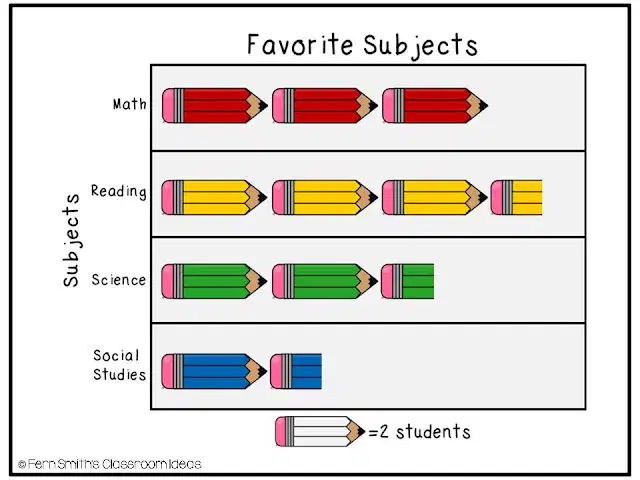
What does the graph "Favorite Subjects" help the reader understand?
The color that student's prefer.
Why some student's enjoy reading.
The subject that student's prefer.
How many students there are.
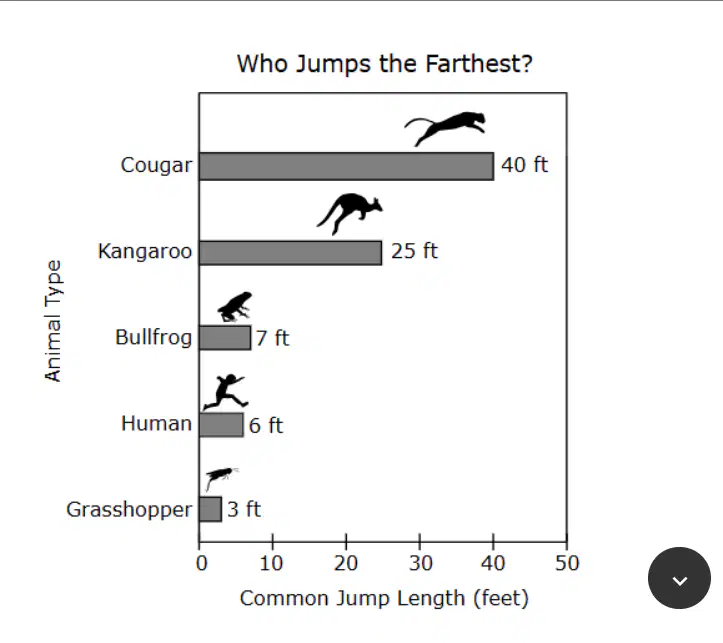
What does the graph “Who Jumps the Farthest?” help the reader understand?
The lengths different animals can jump
The ways jumping helps certain animals
How often different animals jump
Why some animals enjoy jumping far
What is the central idea of a text?
The main point or message the author wants to convey
The names of the characters
The setting of the story
The author's favorite color
Which of the following best helps you identify the central idea?
Reading only the first paragraph
Counting the number of paragraphs
Finding the longest sentence
Looking for repeated words or phrases
Which of the following best describes a cause and effect text structure?
Events are described in the order they happened
Problems are listed with their solutions
Similarities and differences are compared
One event leads to another event
What is the main purpose of using headings and subheadings in a text?
To confuse the reader
To add pictures to the text
To organize information and show structure
To make the text longer
Which of the following is the BEST reason to paraphrase information from a text?
To make the text longer
To change the meaning of the text
To show you understand the information
To avoid reading the original text
Which text structure is used when an author explains how to do something step by step?
Cause and effect
Compare and contrast
Sequence
Problem and solution
What does it mean to paraphrase a sentence?
To translate the sentence into another language
To add more details to the sentence
To rewrite the sentence in your own words
To copy the sentence word for word
When paraphrasing, what should you avoid?
Summarizing the main idea
Restating the information clearly
Using your own words
Changing the original meaning

