
NEW
Font size
 Worksheets
THIRD QUARTER G8 MATH
Total questions: 35
Worksheet time: 18mins
Which of the following best describes a mathematical system?
I. Axioms, Postulates and Theorems II. Undefined Terms III. Defined Terms IV. Shapes
I only
II only
I, II, and III
I, II, III, and IV
Perpendicular lines or segments intersects at what angle?
ACUTE
RIGHT
OBTUSE
STRAIGHT

Given: ∠Q ≅ ∠T and QT ≅ TR
Prove: PS ≅ SR
What is the reason for no. 3?
ASA
SAS
AAS
SSS
Which of the following figures show congruent triangles?


Given that ΔVAN ≅ ΔBUS, ∠V = 60° and ∠N = 70°, find ∠U.
50°
60°
70°
80°
Given ΔMAD, what is the included side between ∠𝑀 and ∠𝐷?
MA
MD
AD
AM
Use the congruency statement to answer the following: ΔEFI ≅ΔHGI
∠F≅____?
∠H
∠I
∠G
not congruent to another angle
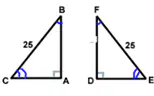
These two triangles are congruent. If ∠C is 40 o find the measure of ∠F.
40o
50o
90o
45o

Use the Exterior Angle Theorem to find the value of x.
117
94
149
31
What does CPCTC stand for?
Corresponding Parts of Congruent Triangles are Congruent
Congruent Parts of Congruent Triangles are Corresponding
Corresponding Parts of Canadian Triangles are Cool
Congruent Parts of Corresponding Parts are Corresponding
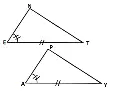
In the figures at the right, ∠𝐸≅∠𝐴, 𝐸𝑇≅𝐴𝑌. What additional data is needed to prove that Δ𝑁𝐸𝑇 ≅Δ𝑃𝐴𝑌 by SAS Congruence?
∠𝑁≅∠𝑃
𝑁𝐸≅𝑃𝐴
∠𝑇≅∠𝑌
𝑁𝑇≅𝑃𝑌
How can you tell which angles are congruent from Δ DEF ≅ Δ ZXY?
I can not tell without a diagram
I can not tell without measurements given
I looked at the letters in corresponding positions
The letters closer to the beginning of the alphabet match and the letters closer to the end of the alphabet match
If two angles and a non-included side of a triangle is congruent to two angles and a non-included side of another triangle, then the triangles are congruent by:
CPCTC
ASA
SAS
AAS

Name the postulate, if possible, that makes the triangles congruent.
SSS
SAS
AAS
NOT POSSIBLE
In each pair of triangles, parts are congruent as marked. Which pair of triangles is congruent ASA?


Which postulate best explain ΔABD ≅ΔCBD?
SAS
ASA
AAS
SSS

How are these two triangles congruent?
AAS
ASA
NOT ENOUGH INFORMATION
SAS

Which postulate will prove that ΔFDG ≅ΔFDB?
SAS
ASA
AAS
SSS
What are the three undefined terms?
Points, lines, and rays
Rays, segments, and planes
Planes, lines, and segments
Points, lines, and planes
___________ are terms that do not require a definition but can be described. These terms are used as a base to a define other terms, hence, these are the building blocks of mathematical terms such as definitions, axioms, and theorems.
Defined Terms
Theorems
Axioms and Postulates
Undefined Terms
A number is equal to itself (that is a=a)
Symmetric Property
Reflexive Property
Transitive Property
Commutative Property
5. Points that lie on the same line are ________________.
collinear
coplanar
non collinear
all of the above
_______ has no length, no width, and no thickness and is represented by a dot
line
line segment
plane
point
The following represents a point EXCEPT.
Tip of a needle
A dot
electric wire
grain of sugar
It has infinite set of points that extends in all direction
point
line
plane
all of the above
Which of these represents a plane?
strand of hair
corner of a table
a smart phone screen
tip of a pencil
Which theorem justifies the statement, “If two angles form a linear pair then, then their total measure is 180 o.
Linear Pair Theorem
Point-Line-Plane Theorem
Supplement Theorem
Vertical Angles Theorem
It is the point of concurrency of the angle bisectors of a triangle.
centroid
incenter
orthocenter
circumcenter

Which of the following points are coplanar
D,A,E
B,E,D
F,E,C
F,E,B

Given: ∠ABC ≅ _____.
∠MNP
∠MPN
∠NPM
∠PNM
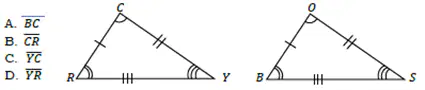
In the figure, 𝛥𝐶𝑅𝑌≅𝛥𝑂𝐵𝑆, what is the side corresponding to 𝑆𝐵̅̅̅̅ ?
B
C
A
D
Δ UVW ≅ Δ UEC, ∠W =?
∠E
∠C
∠CUE
UE
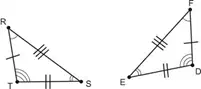
What is the correct congruence statement for these congruent triangles?
ΔRTS ≅ΔEFD
ΔRTS ≅ΔFDE
ΔRTS ≅ΔFED
ΔRTS ≅ΔDEF

Are these triangles congruent?
Yes – AAA
Yes – ASA
Yes – SAS
No - they are different
Given: ∠Q ≅ ∠T and QT ≅ TR
Prove: PS ≅ SR
What is the reason for no. 4?
SUBSTITUTION
REFLEXIVITY
VERTICAL ANGLE THEOREM
CPCTC

