
 Worksheets
Rica Subtest 2
Total questions: 111
Worksheet time: 56mins
.A sixth-grade teacher creates a written assessment in which the teacher leaves a word out of the sentence and asks students which of four nonsense words would be the most appropriate to use to complete the sentence. An example of this type of assessment is shown below.
George___________ a prize at the fair yesterday.
Twibly
Norfing
Lubbed
Vishes
Such a procedure would be especially useful for assessing whether a student:
Is familiar with common story structure
Intuitively make use of grammar when reading
Is able to analyze difficult sentence constructions.
Spontaneously chucks language into units when reading
A fifth grade teacher provides her students with an easier science article with easier vocabulary about the topic of asteroids before reading from the actual science textbook. What is the teacher trying to achieve? It says pre reading lesson.
Possible pre teaching/preloading information to familiarize students with content and vocabulary ______
Word has meaning
This passage is going to be about mammals being endothermic and reptiles are warm-blooded. Briefly describe the warm blooded aspect of mammals and we’ll also talk about snakes Part A- First question helps us understand that the child understands what exotherm is, he does not know what endotherm means. What would the teacher suggest or what would the teacher do to help assist the student?
context clues to recognize the meaning of words
To scan or skim the text to find the answer
Apply knowledge of suffixes Therm is a suffix
Use index and tables
This passage is going to be about mammals being endothermic and reptiles are warm-blooded. Briefly describe the warm blooded aspect of mammals and we’ll also talk about snakes. Part B - Third question: For this question you HAVE to know what non-restrictive clauses are.
ALL mammals are endothermic.
Snakes like to bask on warm rocks.”
There is a comprehension passage about a zoo animal where first grade students read about giraffes and why other animals did not like giraffes. This was a potential three-part question. Small group activity.
Part A: Which of the following discussion strategies about literature does the teacher demonstrate after reading the story, Gerard’s New Home?
Encouraging students to respond to each other’s ideas and details from the text.
a common pattern is article, adjective, noun
the teacher trying to teach an article, adjective, noun pattern
There is a comprehension passage about a zoo animal where first grade students read about giraffes and why other animals did not like giraffes. This was a potential three-part question. Small group activity Part B- The teacher asked the student why didn’t the other animals like giraffes? One student said she disagreed with her peers because “the book stated… Which of the following comprehension strategies does Student 3 refer to the text? and Which of the following comprehension strategies does Student 3 demonstrate?
enhancing knowledge from text and Referring to evidence from the text to clarify meaning
using evidence to refer to the text. The students supported the answer with text evidence. The student was using evidence from the passage to clear up information.
Small group activity
There is a comprehension passage about a zoo animal where first grade students read about giraffes and why other animals did not like giraffes. This was a potential three-part question. Small group activity.Part C- During the group discussion, how does the teacher increase comprehension? (not exact but very close)
Encouraging students to use evidence from the text to support answers
Encouraging students to respond to each other’s ideas and details from the text.
enhancing knowledge from text
A fourth grade teacher asked her students to break into groups and each student read a different passage from the same story in their respective group. The students are to discuss their passage in the group and then report the important elements back to the whole class. What is the primary reason or what is the teacher trying to achieve through this instructional technique?
The students gain a deeper understanding of the passage and have an opportunity to clarify by discussing it with peers.
Referring to evidence from the text to clarify meaning
Encouraging students to use evidence from the text to support answers
A fourth grade teacher selected a core literature book for her students to read. After her students have completed reading the book she asked them to go back to the text and find situations where the main character has experience that reminded the student of something in their own lives. The student uses a response log to record their ideas. The teacher might choose this strategy as a follow-up to reading the book because.
The teacher understands that helping her students connect real life experiences to those of character will deepen their understanding of the above and she can analyze their responses to plan future appropriate instruction.
The students gain a deeper understanding of the passage and have an opportunity to clarify by discussing it with peers.
Encouraging students to use evidence from the text to support answers
A middle school teacher designs an instructional activity in which students combine several sentences to form a single sentence, as illustrated below.
Combine
Matthew stood and waited for the bus.
The sun was blazing hot.
Matthew fanned himself with the newspaper.
Single sentence:
Waiting for the bus, Matthew stood in the blazing sun, fanning himself with the newspaper.
This activity is likely to be most effective in helping students
strengthen their ability to comprehend and write complex sentences.
apply literal comprehension skills to identify and write main idea statements.
improve their inferential comprehension skills.
use self-monitoring techniques to clarify the meaning of text.
A first-grade teacher plans to assess a student's comprehension of a short story through oral retelling. After the student silently reads the story, the teacher will prompt the student's retelling by asking open-ended questions. To prepare for this assessment, the teacher reads the story carefully and composes the questions. Which of the following additional steps would be most helpful for the teacher to take before the retelling activity begins?
Prompt the student to recall similar tasks the student has previously performed.
Prepare a checklist of the key elements that an effective retelling of this story should include.
Review grades earned by the student on recent tests and quizzes in language arts.
Remind the student to concentrate on recalling as many details as possible during the retelling.
8th grade teacher having trouble with her class connecting literary text too and not referring to the text at all. What strategies could she use to fix the problem?
The teacher needs to model for the student. The student needs to see examples of what is required. Paragraph frames are also appropriate.
A graphic organizer for the student to connect their answer to the text.
Another option included the teacher needs to give a set of questions the students have to discuss and answer
Having the teacher ask questions about the book and telling the students to use examples from the book in their answers.
A middle school teacher and the students are reading a narrative text. The students read it well, however, when they were asked questions, they were able to talk about it but would focus too much on their personal experiences and deviated from the theme of the book. What should the teacher do?
Provide explicit direction
Do an instructional lesson to help the students
Focus on the topic.
6th graders having a hard time staying on topic when discussing a text in literature groups and how can the teacher help to keep them engaged and on topic. What should the teacher do?
Explicitly teach them to stay on topic.
Ask them to pick their favorite passage, read to group and discuss
Teach them to ask and answer questions
Give them questions to share about why they think…something the teacher gives them to do and then discu be ss, I felt this would have them engage since they have to focus
EL student who can read fluently and can understand most of what she reads but she was struggling comprehending a chapter in social studies
For this question what made it tricky was that it said: What initial strategy would be most effective?
Teaching the student to read carefully and take notes/outline.
have the student use, headings, subtitles, and titles and write a summary for them
Question student to find out background knowledge on the chapter.
Provide student with a list of questions to answer as she reads
Showing her how to do roman numerals
Student made his own poem: Misha Masha Bisha Basha Boo. Teacher is going over poetry and one student in Kindergarten makes his own poem (ORALLY). Using this opportunity, what strategy should the teacher use to connect it to READING and language skills? To further the students oral language skills and something else, the teacher should........
Reciting to classmates the student’s poem to him with the initial letter of each word omitted (omitting beginning sound.)
Write the poem down on the board and read it aloud with all students to teach that words carry meaning/ written words signify spoken words
Suggesting that the student mimic the poems that have been read aloud by making all four lines of his poem rhyme.
Recite the poem and read everyday
What study guide would you use for Upper grade elementary students?
Taking notes
Work in small groups and quiz each other
Work in small groups and read aloud and then silently
Advanced students who don’t do as well on the standardized assessments, why could this be?
Important structural differences in narrative/literacy text
Educated guess
Not able to understand the meaning of justify and evaluate in the assessment
Second grade student said she was a "sweet-o-phile" and it asks what the student has learned based on that sentence,,,,Sweet O question. or
After a vocabulary lesson, a 6th grade teacher asks the students to make up new words based on their discussion. A student raised her hand and said, “I am a sweet-o-Phile, because I love sweets.
Morphemes have meaning (phile being the sound that has a meaning
Phoneme…along with something else
part of morphology
The teacher writes the following sentences with blank spaces and provides a list of 4 nonsense words for the students to fill in the blank (not exact example but same context). The cow_ over again to the table, plasse, lanked, jizzle pip). This activity identifies the student’s ability to
subconsciously using inferential grammar in reading- this one almost worded differently, but the nonsense words gave an impression of applying the right tense to the sentence given.
To recognize story structure (basically the activity was seeing if the student can put the correct form of the tense in the blank. In this case, the choice is ranked).
Teacher asking 8th grade students to take notes about a literary story. Students copy word for word from the book. The teacher asks the students open ended questions. How can the teacher help the student write better notes?
Model to the student how to write notes outline style (roman numerals, letters and subcategories)
Provide guiding questions (I think this could be correct if it says that the student answered the questions.
Teach the student how to do notes double entry style. With key terms/concepts on one side and a BRIEF summary on the other side.
5th grade teacher is using a BINGO game with synonyms, used with academic vocabulary and a synonym bee where students give synonyms to the word the teacher says. Teacher calls out a word and students are to find a word that is a synonym of the word on their card. What is this type of activity helping students with?
Contextual analysis of meaning of words.
Different words could have similar meanings.
Word morphology of meaning of words
Meaning of different words
The teacher asks students to predict what the book they are going to read is about
Predicting stimulates students' interest in books, encourages thinking and creates opportunities to share background knowledge.
Synonyms and Antonyms
how they connect to prefixes and suffixes
Mary stands waiting for the bus in the snow.
While in the snow, Mary waits for the bus.
Waiting for the bus, Marystand in the snow.
Introducing students to different writing styles
Word morphology of meaning of words
Meaning of different words
You will be given an image of a worksheet that focuses on prefixes (un-/ pre-) . The purpose of this worksheet is to focus on
Morphology/Morphologic
Predicting stimulates students' interest in books
A 4th or 5th grade teacher is teaching a unit on using atlas, periodicals, and other physical paper sources so students can use it for research and she wanted to assess whether they knew what sources to use for research before moving on to the next unit. Showing the students a full set of encyclopedias. Then, the teacher would present some sample entries and ask students to identify the volume where the entry would be located.
Students do a worksheet and match subjects/content to appropriate sources that you would need, and Teacher observations/Anecdotal Records
The teacher should provide questions that need to be answered using multiple sources.
Students write an essay using each of the sources for information (not exact wording but it definitely had to do with writing an essay)
The student is asked to read, retell, record his retelling, reread, listen to the retell recording, and discuss the retell with the teacher. A teacher is testing or assessing a student. The student reads a book or article. Then the teacher records the student, the student hears himself read as he reads the book again.Question was what is the purpose of this strategy?
students being able to monitor their own reading comprehension.
Use the gradual release of responsability.
Students write an essay using each of the sources for information
A 6th grade teacher gives students a list of statements about plants before reading a science text and asks them to mark true or false before they read. Students then have to check for accuracy of the facts when reading the chapter about plants. How does this support comprehension or what is the purpose of this activity?
To clarify main points; definitions and meanings and probe common misconceptions.
because they have to monitor their own reading
To read with Intentions/to know the purpose for reading text
Working with idioms/illustrations. Example It’s raining cats and dogs
Difficulty with figurative and having students draw pictures to represent the idiom working with a partner.
An idiom is a phrase with the following characteristics.
which of the following activities promote an 8th grade students with evaluative comprehension skills
analyze the author's point of view.. .
evaluative comprehension involves analyzing and weighing an event or an author’s intent, opinion, language, and style of presentation.
authors are biased.
A student scanning how/when would it be beneficial?
It was wordered more like looking for information from a resource for a research project
Looking for keywords and elements in a text (Answer if the question asked about skimming)
Something like taking notes while reading
A girl wrote a poem and used the word “softly” in every line but used in different ways
The wind was blowing softly
My mom asked me to do something softly
My cat did something softly
What is the purpose of the activity
student understands that words have different meanings
Help the student to support the reading
Vocabulary and adquisition
When creating lesson plans to promote specific reading skills the teacher?
target reading skills related to an appropriate instructional progression and reflect on the students needs
the student understands that words have different meanings
Fourth grade students disagreeing about the main idea of the passage. The teacher then decided to make groups to discuss the differences of the text and what the author may have meant. ( my question was not a disagreement, but said the students had trouble beginning and keeping the conversation going in their group (it used more technical terms, but I can’t remember them
grouping the students and have them discuss the exposition conflict and resolution or something like that
One answer said the teacher needs to teach them…
basic elements of the plot that support conflict, crisis, and resolution
The teacher supports reading logs and meetings with students. The teacher meets with the students to help them pick books that are between their instructional level and independent level.
Ensures that students are introduced to unfamiliar words at their reading level.
So students are appropriately challenged with unfamiliar words at their reading level
One of the other options stated so students pick challenging books when they’re not at school
An 8th grade student was struggling with note taking by summarizing and paraphrasing. She was writing everything down verbatim and it asked what would be the best way the teacher could help
Cornell notes: double-entry something with the requirement
Write definition on the right and short explanation on the left side 3/30
Write down new key vocab and definition and then summarize sections briefly. I chose this because her struggle was in paraphrasing.
Teacher Modeling
Students are reading about a girl who wants to be a pilot. I think it was reading on struggles and challenges to fly planes and stuff like that. This question referred to something along the lines of having the students create what is best to do before reading the story.
build on their background knowledge
students being introduced to the challenges and discussing obstacles female pilots face. (Prior knowledge) or build on their knowledge.
make the students create or write an ending to the story.
A fifth grade teacher has students write three sentences on the board. Such as “She is happy/ She is floating on air. What is this an example of?
Figurative language
Morphology
Figurative analogy
A fifth grade teacher provides her students with an easier science article with easier vocabulary… teacher trying to achieve that
Word has meaning
Grapheme maps
Something about lang.
5th grade lesson on “signal words” “therefore, since, because.” How does it promote comprehension and memory?
learn common text structure
Morphemes
New vocabulary
A group of 4th graders are reading a book. They are overheard arguing about what the conflict in the story is . The Teacher suggests that they meet together once a week to talk about the book. The teacher has suggested this because…
To help them review the plot and elements
basic elements of the plot that support conflict, crisis, and resolution
Students not understanding the author's point.
7th graders are learning about medieval society. They are introduced to similar terms like lords, vassals, and serfs showing they already have in-depth knowledge about medieval society. The students were able to have a good discussion on the topic but when the teacher did and students were reading the passage about it, they were not understanding the main point.The teacher wanted them to write definitions of the words. However, when they read the text explaining about “Feudalism”, they did not understand the whole concept/contents. Why are they struggling?
To help the students understand that similar words have different meanings.
The teacher provided the vocabulary in multiple texts in the content area
The excerpt of the passage was more complex sentences with complex vocabulary than the discussions they had been having
A question about teacher grouping students in small groups for content and language -English Learners and flexible grouping and its benefits on their development of academic language.
The teacher provided the vocabulary in multiple texts in the content area.
Students learn the content superficially.
it exposes the ELs to more oral academic language
A teacher does a multiple part lesson on 3 different types of lessons throughout the week to incorporate the word responsibility. The 1st was something about seeing the word, 2nd was writing about the word, and the third was writing an essay about the word. Three activities in the question that the teacher had the students do:
In a group, identify other words that are morphologically similar to “responsible” Have them read a narrative essay about being “responsible” Have them write an essay about how they are responsible at school or at home
What was the purpose of this?
****** check answers
making the word and definition easy to remember since it is connected to their real-life experiences or repeated experiences and would be meaningful or something like that.
A way for the word integration through repeated and thoughtful exposure
Multiple Exposure of the vocabulary word. through cross curriculum or different content. The main que for this is multiple exposure of the word.
Which is an essential component to promote a vocabulary program for elementary and middle school students?
to expose students to different unfamiliar words in the classroom.
explicit instruction in generalizable word learning strategies.
content area vocabulary
Question showed a worksheet for 5th graders that had the students add suffixes to words (ly, ed, etc.)
morphology
Vocabulary
Reading
Having an understanding of the different tier vocabulary words can help a teacher determine? What a teacher should with different tiers of vocabulary
Greek or Latin words this was an option as well on test choices
Whether the student is meeting grade level vocabulary knowledge
Which words from a text to teach (growing the student’s academic language)
Fourth grade teacher is going to start reading a passage and ask students to make predictions about the text to activate prior knowledge. What should be the next step?
Write responses on board and erase and see what they remember
Write responses on board and ask students to write sentences
Put the responses into categories
A third grader is taking a reading assessment and makes one mistake. They pause and self correct their mistakes. The sentence was Tea, is sweeter (sweet) than honey. Or it was “Honey is sweet than jam”, after reading she corrects herself and reads it correctly, Honey is sweeter than jam, This shows that the student has an understanding of……
This means the student understood what…
Multiple meaning words
phonemic awareness
English grammatical syntax use
Which of the following would be most effective for students to recall the text that they read in a chapter of a book?
Reading the text slowly and carefully and taking detailed notes as they read.
Working in small groups, reading aloud, reading silently, quizzing each other….
both
The teacher gives her students a chart after reading a chapter from a book. The chart looks something like this
First column title: summary
Second column: Thoughts on the chapter
Third column: What do you think will happen next?
Based on the chart, what is the teaching looking for?
Allows for the student to comprehend his understanding of the reading something
Provide evidence from a literary text
Describe and analyze story elements
Comprehend and make connections - inferential comprehension
How can teachers help students identify graphs?
Have students cut out newspaper graphs and put them on the walls as reference.
Help students create graphs using their favorite things like toys, candy and so on.(hobby)
Has students work in groups to create graphs on their own
What type of questions a teacher needs to ask to check for literal comprehension and analysis
Needing to help students to make connections and promote making inferences.
Need to be open ended questions to be answered by text evidence/open ended questions phrased in a way that doesn’t shape the student’s response
Questions to keep students focused on the task.(something like that) Students asking questions but waiting for students to respond - something like that
The teacher wrote on the board “The dog barked.” Then I wrote another sentence, “The dog barked.” Then wrote “The ugly dog barked__.” Students filled in loudly. How does this support ELL’s?
How to write complex sentences by moving around parts.
Helps them strengthen understanding of English sentence structure
both
There was a question about reading medieval stories and giving students 2 words that are related. They have to write one sentence that uses both words in a meaningful way.
How can support this activity to the students?
Helps them strengthen understanding of English sentence structure
Assessing their conceptual understanding of the vocabulary words
How to write complex sentences
A 5th grade teacher is writing questions for a literary comprehension assessment. What types of questions should they consider when creating questions?
ddress different levels of comprehension (e.g., literal, inferential).
Assessing their conceptual understanding of the vocabulary words
A 2nd grade class is reading a new book. Which strategy will help strengthen the oral language of ELL students to enhance comprehension and something?
Students discuss their predictions with a partner using the title and illustrations
The students look up vocabulary words that will appear in text
The teacher gives students a worksheet with questions they should consider when reading
As teachers analyze oral and written responses, they should see their students do each of the following:
Incorporate Literary Elements
Provide evidence from text
Have the students write a short paragraph
What mainly leads to the acquisition of vocabulary for students from grades 4th to 8th in that four year span?
Explicit classroom vocabulary instruction
Content area specific vocabulary instruction
Everyday knowledge from developed cognition
6th grade research skills, what would be an informal assessment?
****** check the answers
worksheet that has student match skill to content
Establishing a definite purpose for reading the chapter.
Lately, when choosing a book to read, a third grader who reads at grade level always selects books from a series that is written in a very formulaic style that does little to extend his conceptual or language development. The teacher’s best response to this behavior would be to:
Avoid interfering with the student’s selection of books as long as he finds his choices enjoyable
Provide the student with books with similar themes or on similar topics that are more challenging for him.
Point out to the student some of the major limitations of the books he is choosing to read and ask him not to read those books at school.
Which of the following is an idiom:
Big and huge
Add and ad
A flash in the pan
Bark and bark
A 3rd grade teacher uses a chapter in a basal reader and selects target vocabulary words to use. Then, the teacher uses the Contextual Redefinition to teach the new words. This instructional strategy works well because it:
makes use of the context surrounding the target word, and also uses independent practice
makes use of the context surrounding the target word, and also uses small-group collaboration
makes use of the reference texts that include the target word, and also uses small-group collaboration
makes use of students' background knowledge, and also uses small-group collaboration
A 1st grade teacher notices that a highly active student who is a native-English speaker is struggling to learn new vocabulary. This week's vocabulary words are action words. Based on the information given, which instructional strategy would be best to try with this student?
Use kinesthetic instruction by having the students pantomime the target words
Reteach vocabulary that has not yet been mastered
Focus on key vocabulary from past lessons
Use cognates to teach the meaning of this week's words
A 2nd grade student identifies an unfamiliar word and with some time, analyzes its root word, prefix and suffix in order to find the word's meaning. This student just used which of the following word-learning strategies:
Semantic map
Morphemic analysis
Contextual analysis
Reference book analysis
A 2nd grade teacher gives a monitoring of progress assessment of that week's vocabulary words to her students. She notices that many students are still struggling to correctly spell the word 'sandwich.' In order to find a way to connect the word in an interesting way, the teacher teaches her students that the word sandwich was actually created by 4th Earl of Sandwich, John Montagu, who loved to eat while playing cards. Using both hands to eat slowed down the card game, so he ordered his servants to put his meal between two pieces of bread. This became known as a sandwich. The teacher is using which instructional strategy to develop her students' word consciousness?
Synonyms
Etymology
Homophones
Idioms
A fourth grade teacher and her student read a story 1:1 together aloud. Once the story has been read, the teacher asks the student a question that requires the student to make a judgement about an important decision the main character made in the story. This question is more than likely what kind of comprehension checking question?
True/ false question
Literal comprehension question
Inferential comprehension question
Evaluative comprehension question
A student is looking at a diagram in his social studies textbook. There is a structure that exhibits an act based on the result of another act. The diagram is which kind of text structure?
Cause and effect
Problem and solution
Compare and contrast
Sequencing
A student who just moved from another country is asked by her teacher to write about the noticeable differences between the countries are. Which structure would best help the student complete this task?
Cause and effect
Problem and solution
Compare and contrast
A 5th grade student reads at a 2nd grade level. In order for the student to participate in the social studies post reading discussion, the teacher reads aloud the chapter to the struggling student. This is an example of:
Building word analysis skills to address the needs of an individual student
providing differentiated comprehension instruction to address the needs of an individual student
Reteaching key terms to address the needs of an individual student
Capitalize on transfer from the students' primary language
A first grade teacher introduces a new science unit about trees to her class using a KWL chart. This is a popular way to:
Help students classify the types of trees
help students connect graphic features to the topic of trees
help students organize associations with trees
help students activate their background knowledge about trees
A teacher completes a read aloud, and prompts the students with a activity called a text-to-self. This kind of post reading activity works well to:
generate question to learn more about the author's perspective
challenge students to find relationships among the story and their own experiences
find a student's independent reading level
systematically implement the alphabetic principle into storytelling
A teacher reads a story aloud and pauses during important parts of the story to ask the students comprehension-checking questions. By doing this, the teacher is mostly:
promoting students' development of social comprehension skills
promoting students' development of writing comprehension skills
promoting students' development of reading comprehension skills
promoting students' development of listening comprehension skills
A teacher instructs her students to write a summary of the chapter that the students are independently reading while they are in the middle of the chapter. This comprehension strategy mostly helps students:
monitor their own comprehension as they read
visualize the story better
collect new vocabulary terms used in the chapter
check their understanding with a reading partner
A teacher has a group of students who demonstrate through their work that they are highly visual learners. Which instructional strategy should the teacher use to show their knowledge of the elements of story grammar?
Cloze passage
Post-reading story discussion
Creating a story map
Think-pair-share
A teacher reads a story aloud to a small group of students. When the teacher reaches an important part of the story, she stops and asks the children a thought-provoking question. She instructs them to turn and discuss the question to a person sitting next to them. This oral language activity is called:
Think-pair-share
Literature circle
Topic-focus question
Yopp-Singer Assessment
A teacher will focus on teaching his students how to identify writing styles in a story. To do this, the teacher reads aloud the story, Beauty and The Beast. After the reading, the teacher highlights the parts of a story give human traits to inanimate objects. The teacher is more than likely teaching a lesson on which of the following:
Irony
Symbolism
Hyperbole
Personification
A story that includes the struggle between good and evil within a factitious setting is best categorized as:
Folktale
High fantasy
Science fiction
Couplet
A teacher notices a need for his students to improve they way they gather information for the purpose of previewing and reviewing a text. The teacher should create a lesson that will develop her students' ability to:
Skim texts
Scan texts
Research texts
Organize texts
A teacher wants to promote students' comprehension of informational texts using an approach that will provide feedback to each individual students' literal, inferential, and evaluative comprehension of the chapter that they will read. The best instructional strategy for this is:
Assign the students to complete a Venn diagram while reading the chapter
Assign the students to complete a data retrieval chart before reading the chapter
Assign the students to freely take notes about what they read, and then check their understanding
Assign the students to complete a three-level study guide that consists of a couple of questions for each type of comprehension
A fourth grade teacher wants to teach students how to recognize and use typographic features that help support comprehension of informational texts. To accomplish this instructional goal, the teacher should mostly focus on:
Features such as, table of contents, index, and glossary
Features such as, italics, boldfacing, underlining, color coding
Features such as, charts, maps, diagrams, illustrations
Features such as building a word tree and having a text-to-world discussion
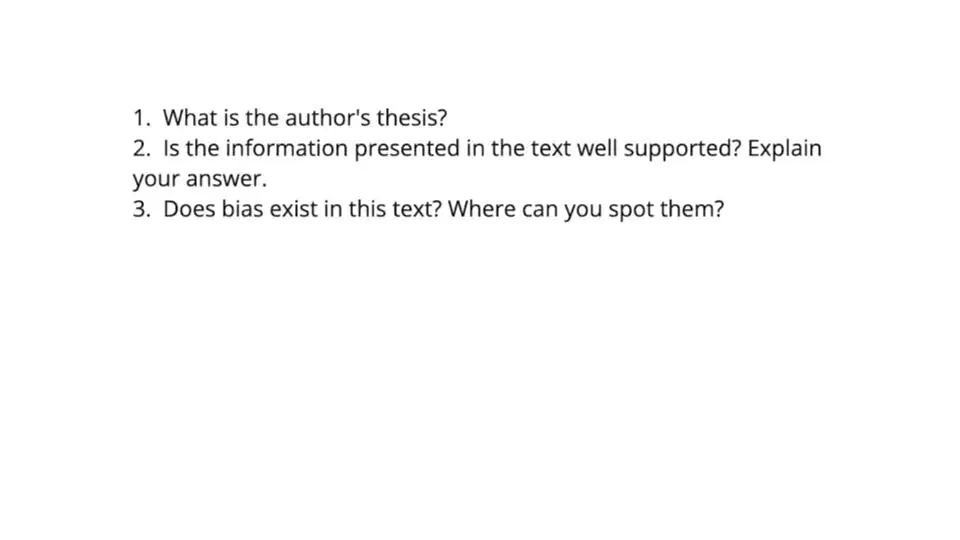
A teacher presents the students with an informational text to read and the questions below to answer. This activity actively promotes students' comprehension and analysis of expository texts primarily by:
Analyzing the development of an author's perspective
Generalizing the knowledge learned from texts to other areas of learning
Identifying similarities and differences between texts
Evaluating the structural patterns of a text
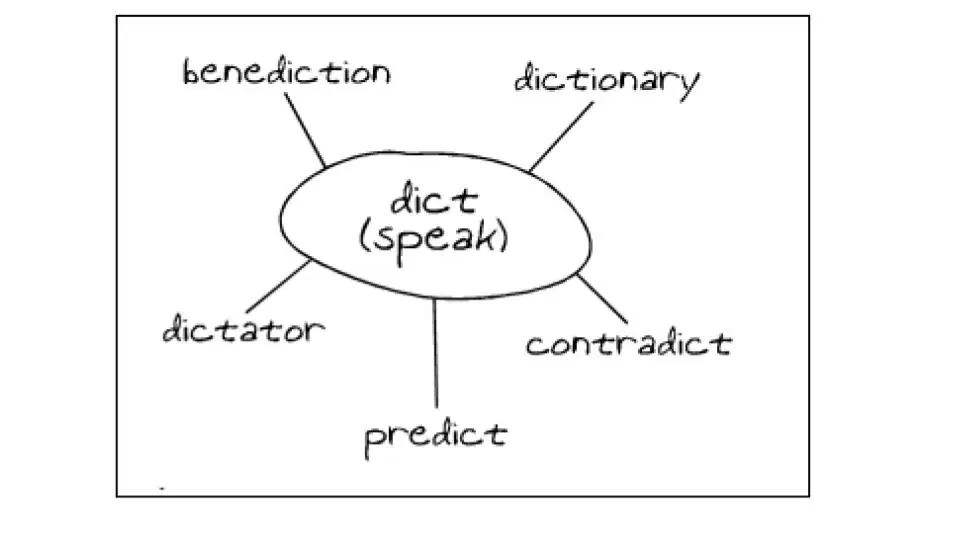
A middle school teacher writes the morpheme dict on the board, pronounces it, and explains that dict derives from the Latin word for "speak." The teacher then asks students if they can think of English words that start with or include dict. The teacher uses the students' suggestions to create the diagram shown below.
recognize common prefixes and suffixes.
learn the techniques of concept mapping.
apply knowledge of word roots as a word-learning strategy.
draw on a knowledge of phonics to unlock word meanings.
A teacher substitutes blank spaces for several nouns, verbs, adjectives, and adverbs in an appropriate level text and asks students to determine reasonable and logical words to complete each blank. This technique is useful as an informal assessment of students' understanding of English language structures primarily because it requires them to:
define various grammatical categories in their own words.
select appropriate words based on their grammatical function as well as on their meaning.
group words into grammatical categories to clarify their meaning.
draw on grammatical knowledge to identify the subjects and predicates of complex sentences.
A second-grade student has limited vocabulary knowledge, which hinders the student's word recognition and reading comprehension. The student's oral reading is slow and labored, and the student typically spends the majority of independent reading time browsing through books, making little effort to read the actual words on the page. Research has shown that which of the following is most likely to happen if this student receives no instructional intervention?
The student will remain approximately at a second-grade reading level and will not be able to progress beyond this level.
The student will begin to fall behind peers in reading development and will continue to fall further behind in later grades as texts include increasingly difficult vocabulary.
The student will naturally begin to show more interest and proficiency in reading as the student matures and will catch up with average-performing peers in third grade.
The student will always be behind average-performing peers but will achieve an adequate reading level to be academically successful.
Which of the following statements best explains an important limitation of teaching students to rely on context as their primary strategy for determining the meaning of unfamiliar words in texts?
Explicit context clues about a word's meaning are not very common in most texts, while implicit contextual clues often require students to apply background knowledge they lack.
Using context to determine the meaning of an unfamiliar word disrupts students' reading fluency more significantly than simply consulting a dictionary.
Overreliance on context as a word-learning strategy hinders students' vocabulary growth, since they should be learning most new words in direct vocabulary instruction.
A fifth-grade teacher gives students the following sentence:
Neither walking on the beach nor running around the track cheered Ahmed up.The teacher asks the students how the phrases that come just after neither and just after nor are similar. This exercise can promote students' reading comprehension by helping them:
distinguish between explicit and implied main ideas.
apply literal comprehension skills.
identify cause-and-effect relationships.
recognize parallel grammatical structures.
Structural analysis would be the most appropriate strategy for a student to use to determine the meaning of which of the following words?
impassable
elephant
interim
examine
A fourth-grade class is beginning a unit on deserts. The teacher starts the unit by having the students form small groups and list everything they know about deserts. Then the whole class meets to share their lists, and the teacher helps the students arrange their ideas into a web. The class's partially completed web is shown below.After giving each student a copy of the web developed by the class, the teacher could best help students make use of the web to learn and retain facts from their reading by asking them to:
add continuously to the web as they encounter and analyze new information in their reading.
memorize the information on the web before they begin their reading
review each category on the web to ensure that it is an appropriate one to have included.
compare the content of this web to the content of webs on other topics.
A fifth-grade teacher is teaching a unit on fiction. To begin, students read several simple fairy tales and discuss the moral or meaning of each one. The teacher then assigns a more complex story and leads a discussion about the moral of the story after students finish reading it. This instructional strategy is most likely to promote students' reading proficiency by:
guiding students to analyze the relationship between plot and character in a literary text.
enhancing students' ability to use self-monitoring strategies to clarify the meaning of a text.
fostering students' ability to distinguish an author's use of fact versus opinion in a text.
helping students identify and understand the theme of a literary text.
A sixth-grade teacher reads his students the nonsense poem "Jabberwocky" by Lewis Carroll. The first four lines of the poem are shown below.
'Twas brillig, and the slithy toves Did gyre and gimble in the wabe; All mimsy were the borogoves, And the mome raths outgrabe.
The teacher reads aloud the clause "All mimsy were the borogoves" and asks students what that might mean. One student responds, "It means that the borogoves were all mimsy!" This student's response demonstrates skill in which of the following reading comprehension strategies?
applying relevant content knowledge
interpreting unusual grammatical constructions
analyzing the use of figurative language
recognizing cause-and-effect relationships.
The teacher plans a variety of activities related to "Jabberwocky." Students will work in pairs to make up definitions for some of the nonsense words (e.g., slithy). They will read the poem aloud using tone of voice to express various moods. Finally, they will create their own nonsense poems and give oral readings of them. These activities are most likely to promote students' reading development by:
providing students with the opportunity for an in-depth analysis of a specific literary genre.
helping students make distinctions between serious and whimsical literature.
fostering students' enjoyment of playing with and thinking about language.
developing students' understanding of the differences between written and oral English.
The teacher asks the students if they can tell which of the nonsense words in the poem are nouns. One student says that toves is a noun. Another says that wabe and borogoves are nouns and adds that gyre and gimble are verbs. The class then discusses how students were able to draw these conclusions. This exercise would be especially useful for helping students understand that:
being familiar with conventions of capitalization and spelling can help a reader interpret a text.
recognizing the roots of words can help a reader decode the words.
being familiar with common language structures can help a reader interpret a text.
recognizing a text's genre can help a reader comprehend the text.
A sixth-grade class that includes several English Learners has been studying volcanoes. Step 1: The teacher leads a brief whole-class discussion reviewing key topics covered by the textbook chapter.
Step 2: Students form heterogeneous cooperative learning groups with three or four students in each group. Each of the students selects one of the key topics reviewed during the discussion.
Step 3: Individual students write one or two sentences about their topic on sentence strips.
Step 4: The members of the group then decide how to put the various sentences together, editing the sentences as necessary to form a comprehensible paragraph about the chapter and correcting any errors in grammar or spelling. After assessing the effectiveness of this activity, the teacher decides to include an additional step. For step 5, the teacher will guide students to develop topic sentences for the paragraphs they generated. This modification is most likely to promote students' reading development by
encouraging students to draw on prior knowledge to clarify their understanding as they read.
helping students recognize main ideas and how supporting details relate to main ideas.
encouraging students to apply vocabulary knowledge in new contexts.
helping students distinguish between facts and opinions as they read.
An eighth-grade class will be reading a drama that is a challenging grade-level text. The teacher is concerned that a student in the class who has a reading disability will have difficulty keeping up with and understanding the reading assignments. Which of the following strategies would be most effective for the teacher to use to promote the student's access to the text and his ability to participate fully in class discussions related to it?
assigning the student the play several weeks before his classmates are scheduled to begin reading it
providing the student with an audiorecording of the play to listen to in conjunction with his reading
assigning the student only selected portions of the play, such as a few key speeches and dialogues
providing the student with a narrative version of the play to read rather than the original, dramatic version
A vocabulary strategy that supports early vocabulary development for students is:
classifying and categorizing words.
semantic mapping.
According to research, most students learn vocabulary indirectly. An example of indirect vocabulary learning is:
students learn word meanings from listening to adults read to them and engage in conversations about new words encountered in the texts.
students learn vocabulary through multiple exposures to target vocabulary and participating in completing word webs and organizers.
In order to determine the vocabulary for direct instruction prior to reading a text, the teacher needs to consider:
the number of targeted words accessible in the glossary of the basal reader.
the interest-level the student will have for the targeted vocabulary.
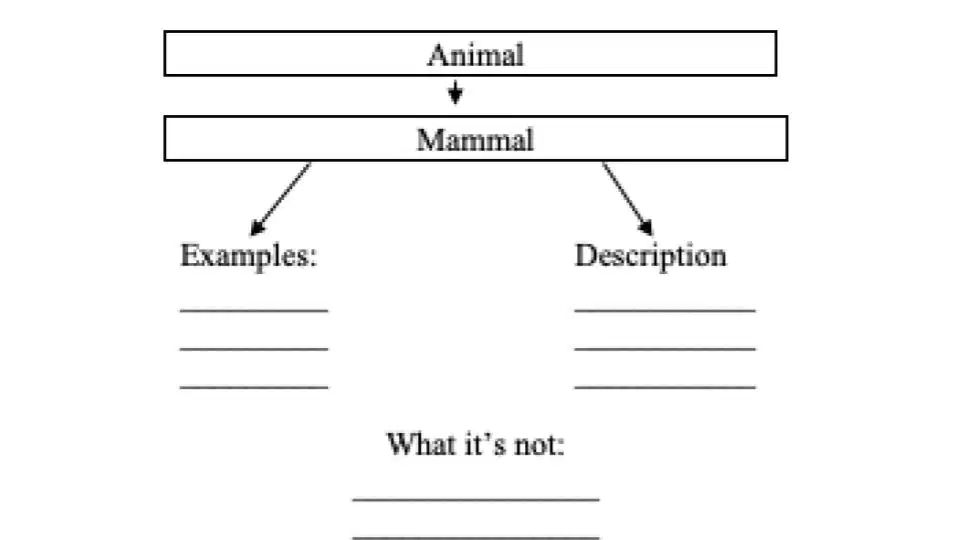
Prior to teaching a lesson on mammals, a third-grade teacher displayed the following graphic organizer on the board:
dictionary skills.
word learning strategies.
research techniques.
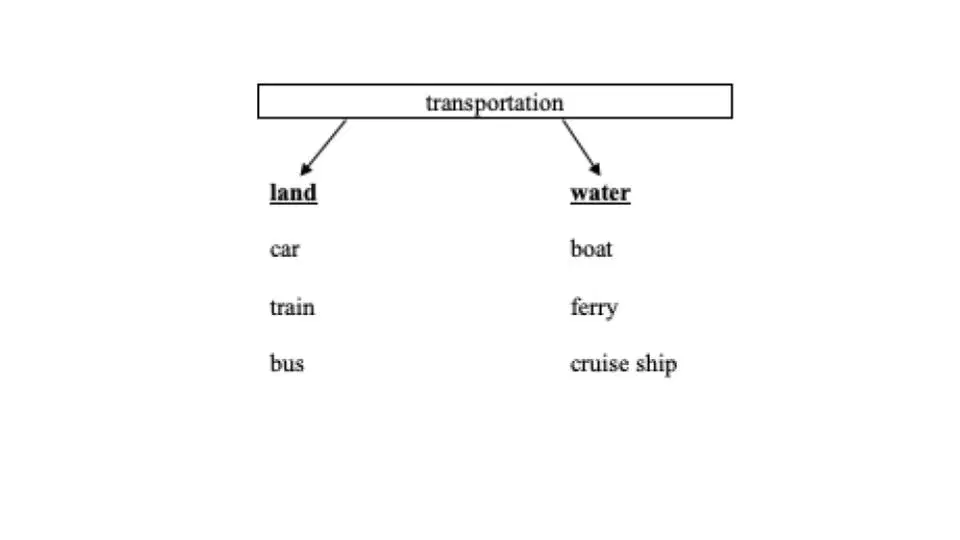
The graphic organizer above is an example of a:
semantic map.
context clues web.
definition map.
A fourth-grade teacher writes the following sentence on the board during a vocabulary lesson:
"The paleontologist, a dinosaur scientist, used a magnifying glass to determine the type of fossil found during an expedition in the desert."
In order to find the meaning of "paleontologist" using a word-learning strategy, the teacher is teaching a directed lesson on:
word parts.
semantics.
apposition.
A third-grade teacher implements a long-term vocabulary activity for her students called Word Wizard. The students will be provided with weekly vocabulary words. If they encounter any of the words outside of direct instruction, the students have to fill out an index card identifying the word, how it was used (conversation, television, magazine, etc.) and explain its meaning. The teacher will place these cards in the Word Wizard’s bucket. The student with the most words in the bucket at the end of the week receives a prize. The implementation of this vocabulary strategy promotes:
figurative language.
academic language.
morphology.
word consciousness.
An eighth-grade student completed a reading comprehension assessment that was designed as: Directions: Fill in the blanks with the appropriate word to complete the sentences.
A knight ordered his servant to hurry up with his food and drink. The servant 1__ scurried to the kitchen and filled his plate with food. The servant hurried because he did not want to be _____2___ to his master.
1. A) happily B) solemnly C) obediently
2. A) playful B) disrespectful C) hurtful
The format of the reading comprehension assessment can be described as:
opin sentences.
apposition sentences.
morphology sentences.
A fifth-grade student is taking a reading comprehension assessment and encounters the following test question:
Which sentence BEST describes what Marvin the Monkey learned in this selection?
1) You cannot please everyone. 2) Be careful what you ask for. 3) Slow and steady wins the prize.
This question is assessing the student’s knowledge of:
literal comprehension.
evaluative comprehension.
inferential comprehension.
The most common text structure for narrative stories is:
cause and effect.
story grammar.
An effective assessment for ensuring that students are progressing in text-based discussions is:
anecdotal notes.
peer observations.
written quizzes.

A middle school teacher provides her students with the following graphic organizer to complete after reading the text. This graphic organizer will support students with:
summarizing expository texts.
summarizing a narrative.
In order to promote independent reading, a sixth-grade teacher organizes her students into groups of six to form literature circles. Which of the following best describes the format of literature circles?
A group of students read the same book and meet together to discuss the book, using open-ended and high level questions to facilitate discussion.
A group of students sit in a circle and read aloud literature books.
The strategies that are commonly taught explicitly during reading are:
visualizing, clarifying, and self-questioning.
KWL charts, sharing background knowledge, and making connections.
retelling, sharing reactions, and creating visual representations of text meanings.
A monitoring assessment that can be used to assess students’ progress in reading comprehension is:
a completed learning log.
a graphic organizer modeled by the teacher.
a journal entry analyzing the text.
A pre-teaching support that can be used by a teacher to assist English Learners in comprehending narrative texts is to:
pre-teach content vocabulary.
translate events from English into the students’ primary language.