Wayground logo

Free Printable Worksheets

Font size

S
M
L
XL
Worksheets

Thermochemistry Learning Check

Total questions: 20

Worksheet time: 2hrs 39mins

Name
Class
Date
1.
How does heat flow?
a)
Always from cold to warm
b)
Always from warm to cold
c)
Both warm to cold & cold to warm
d)
It depends on the temperature
2.
The specific heat of aluminum is 0.21 cal/g°C.  How much heat(Q) is released when a 10 g piece of aluminum foil is taken out of the oven and cools from 100° to 50°?
a)
105 J
b)
10.5 J
c)
1.05 J
d)
50 J
3.
If I have 2 blocks of Aluminium (one of 1kg and one of 10 kg) and heat them up with 6,000 Joules of energy.
Which one will have the SMALLEST change in temperature?
a)
1 kg
b)
10 kg
c)
They both heat up  to the same temperature
d)
It depends on the temperature of the room
4.
20 g of water. specific heat of water is 4.18 J/g°C.  temperature changes from 25° C to 20° C, how much heat energy (Q) moves from the water to the surroundings?
a)
418 Joules
b)
209 J
c)
83 J
d)
4.18 J
5.
The specific heat(c) of copper is 0.39 J/g °C. What is the temperature change(∆t) when 100 Joules of heat(Q) is added to 20 grams of copper?
a)
12.82 °C
b)
24.12°C
c)
351 °C
6.
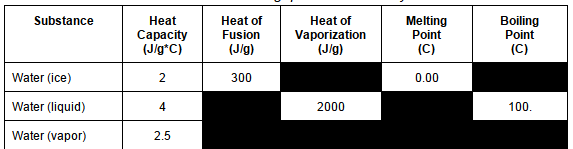
How many Joules of energy are required to change 10 gram of ice at -2 C to water at 20 C?
a)
440 J
b)
880 J
c)
10,140 J
d)
66,000 J
7.
How much liquid water can you change 20 C if you apply 20,000 J?
a)
500 g
b)
100,000 g
c)
250 g
d)
350 g
8.
ΔH value in an endothermic reaction is a positive number.
a)
True
b)
False
9.

How do you calculate Enthalpy of a reaction?

a)

ΔH = ΔHproducts - ΔHreactants

b)

ΔT = q / mC

c)

ΔG = ΔH -TΔS

d)

E = mc2

10.
Define 'Enthalpy'
a)
a) Energy stored in the movement of molecules in a substance
b)
b) The opposite of temperature
c)
c) The temperature of a molecule
d)
d) Energy stored in the chemical bonds in a substance
11.

A reaction that gives out energy to the surroundings causes the surroundings ....

a)

temperature to drop

b)

temperature to rise

c)

temperature to remain constant

d)

temperature to vary

12.
 _?_  is the amount of energy required to raise the temperature of 1 gram of any substance 1oC.
a)
Specific heat
b)
A calorie
c)
Thermal energy
d)
Conduction
13.

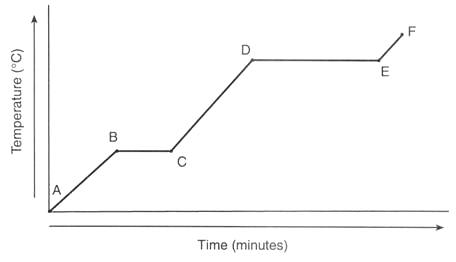
Between which points is the temperature of the substance remaining constant?

a)

A-B only

b)

A-B, C-D, and E-F

c)

B-C only

d)

B-C and D-E

14.

Which letter indicates where water is in both the solid and liquid phase at the same time?

a)

A

b)

B

c)

C

d)

D

e)

E

15.

A measure of the average kinetic energy of the particles in an object is called

a)

Heat

b)

Temperature

c)

Kinetic energy

d)

Enthalpy

16.

In which region(s) does temperature increase?

a)

Region C only

b)

Regions B and D

c)

Regions A, C, and E

d)

Regions A and B

17.

In which region(s) of the heating curve would water be a liquid and a gas at the same time?

a)

A

b)

B

c)

C

d)

D

e)

E

18.

The energy transferred between objects that are at different temperatures is called

a)

Heat

b)

Temperature

c)

Energy

d)

Friction

19.

NaCl was heated starting at an initial temperature of 0°C. The heating curve is shown in the picture. What is the melting point of this substance?

a)

0°C

b)

801°C

c)

1000°C

d)

1465°C

20.

Describe the substance at letters D.

a)

Gas

b)

Liquid

c)

Melting

d)

Evaporating