
 Worksheets
LEAP Review Stations Part 2
Total questions: 31
Worksheet time: 26mins
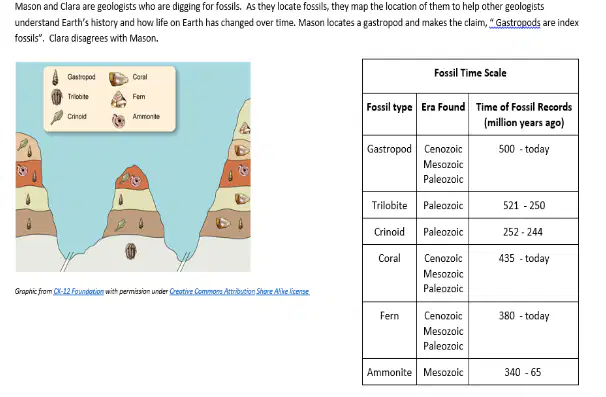
Which of the following best supports Clara's disagreement?
If a fossil is to be considered an index fossil, the organism must have lived only a short period of time. Since the Gastropod lived a long period of time it is not an index fossil.
To be an index fossil, the fossil of the organism must be found in many rock layers. Since the Gastropod is not found in every layer, it cannot be an index fossil.
An index fossil must be found over a wide area of the earth. Since the Gastropod is widely spread, it cannot be an index fossil.
To be classified an index fossil, the fossil must be unique. Since the Gastropod is not unique, it cannot be an index fossil.
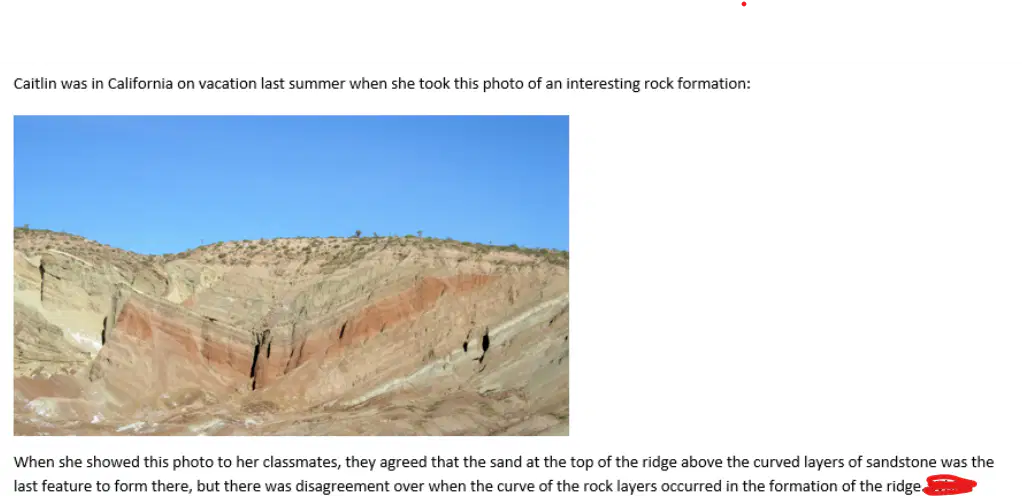
Which reasoning could Caitlin and her classmates use to correctly determine what happened?
The curve of the sandstone layers occurred after the sandstone was laid down because the curve was the result of glaciers in the region.
The sandstone layers were laid down in a curved formation first because they were at one time a channel for a large river that flowed here.
The curve of the sandstone layers occurred after they were laid down because rock layers are naturally laid down horizontally.
The sandstone layers were laid down after the curve because they were laid down on top of rocks that had collapsed due to a landslide.

Which of the following best explain how the Grand Canyon and Mushroom Rock changed over time? Choose TWO answers.?
Mushroom Rock and the Grand Canyon were both formed from different types of erosion that took millions of years.
The Grand Canyon took longer than the Mushroom Rock to form due to the fact that the metamorphic and igneous rocks are more resistant to weathering and erosion than sedimentary rock.
Since Mushroom Rock and the Grand Canyon are from the same type of biome, the rate of erosion was the same. This means that it took the same amount of time for both of them to form.
The Grand Canyon and Mushroom Rock were formed due to water erosion, therefore the rate of erosion is the same. This means it took the same amount of time for both of them to form.
For both The Grand Canyon and Mushroom Rock, most of the erosion occurred at the bottom of the structure.

Which of the following is the most likely reason that the land masses have changed over time?
Tectonic processes caused the movement of Earth’s plates and seafloor spreading 145 million years ago and continues to move today.
Large plates of Earth’s surface greatly moved 145 million years ago but do not move in the present day.
Earth’s plates have moved as far apart as possible, therefore they will not move any more.
Erosion and weathering over long periods of time have caused these large plates to drift apart.
Many scientists claim that the present day continents will continue to drift apart. Which evidence best support their claim? Select three correct answers.
A volcano erupted approximately 35 years ago at Mount Saint Helens.
Scientists know that the continents have come together and spread apart at least three times in the Earth’s history and this pattern will continue.
Areas along the San Andreas Fault experience earthquakes on a regular basis.
Louisiana’s coastline is disappearing at a rate of 75 km2 a year.
Hurricane Lane hit land in Hawaii on August 22, 2018.

What evidence best supports the claim that petroleum is a non-renewable resource? Select the two best answers.
Petroleum is formed by a geologic process rather than created in a laboratory.
Petroleum is made through geologic processes that take far longer than a human’s life-span.
Petroleum extraction is much faster than the geologic processes that create petroleum.
Louisiana has over 700 million barrels of petroleum stored in two of the four sites of the US Strategic Petroleum Stockpile.
Petroleum is continuously being formed because zooplankton and algae continue to die and be formed into petroleum.
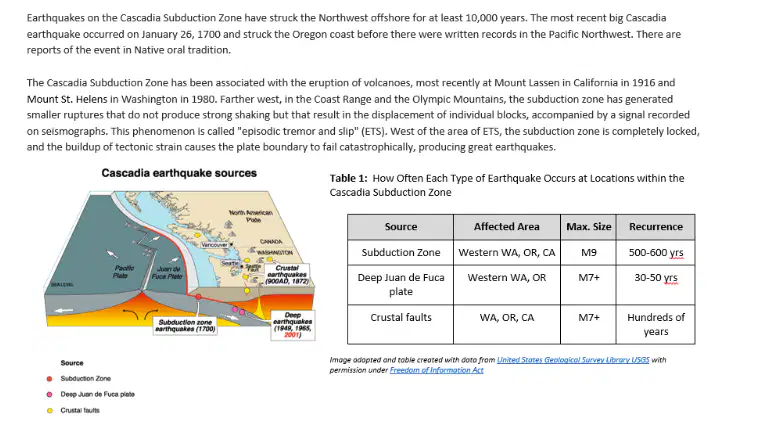
Based on the information provided, which location is most likely to experience earthquakes more often?
Vancouver because it is located closest to the Juan de Fuca plate boundary.
California (CA) because it had earthquakes of the greatest magnitude.
Oregon (OR) because it is affected by earthquakes from all three sources
Washington (WA) because it had recent volcanic activity at Mt. St. Helens.
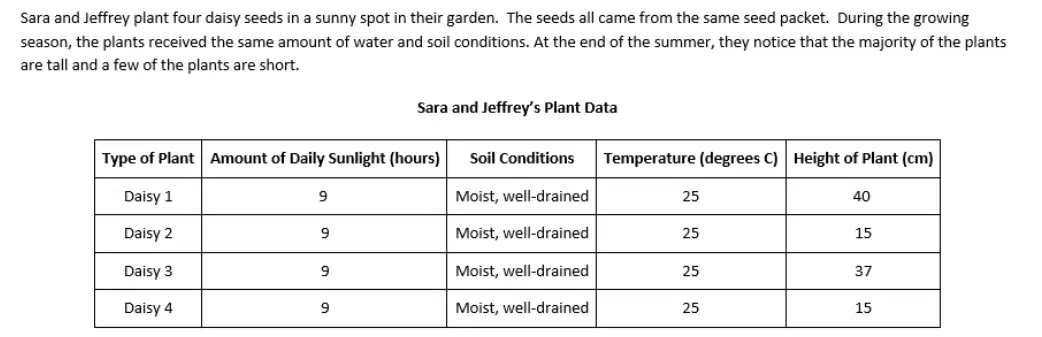
Which of the following statements best explains their results?
The temperature outside varied over the growing season which caused some plants to not grow as tall.
Since the shorter plants were in the shadows of the taller plants, they did not receive enough light to grow tall
The growing conditions of the plants were different; therefore, some of them did not get the same nutrients that they needed.
The plants had different genetic factors that caused some to grow tall and others to not grow as tall.
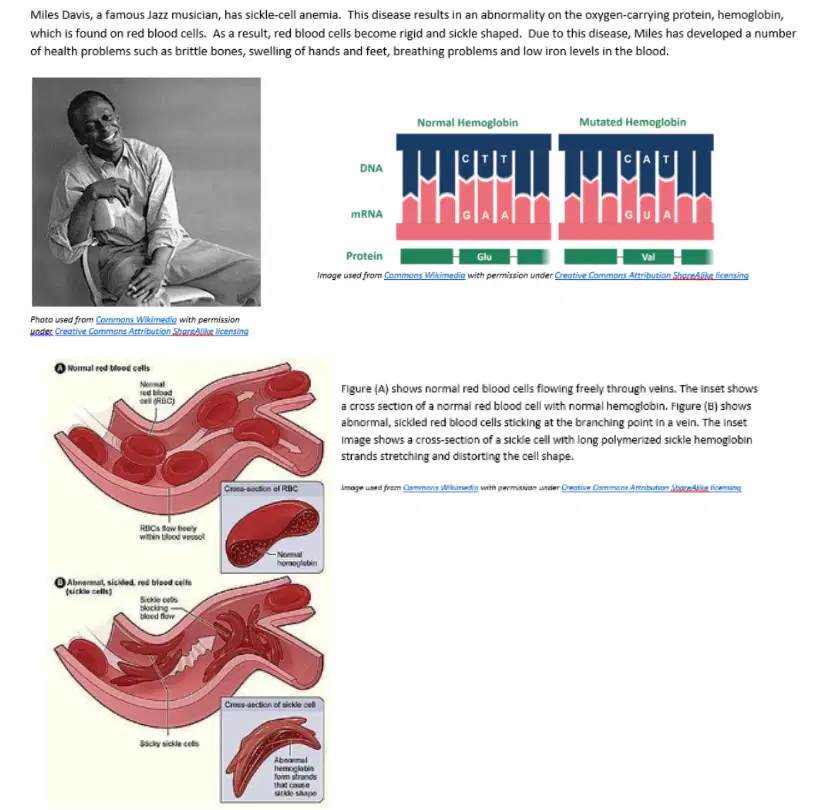
As a trumpet player, Miles Davis had to cancel several concert dates due to broken wrists and hips. What is the underlying cause of his injuries?
The protein that codes for hemoglobin has been altered.
The sickled red blood cells cannot carry enough oxygen for cells to function properly.
The shape of the sickled cells causes them to clump together.
The structure of mutated hemoglobin is different from normal hemoglobin.
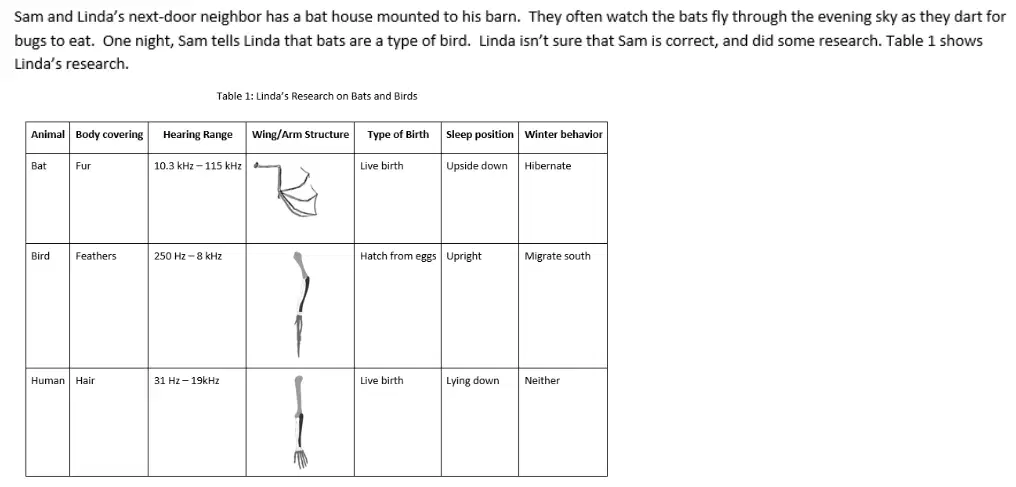
Which of the following conclusions should Linda make based on her research?
Birds are more likely to be successful predators than bats or birds.
Bird and human limbs serve a more-similar purpose than bird and bat limbs.
Bats and birds are more-closely related through evolution than they are to humans.
Bats and humans have the most-recent common ancestor and are most closely-related.
Linda concluded that bats and humans have the most-recent common ancestor and are most closely-related. Which evidence best supports the claim?
Both bats and birds have similar hearing ranges and neither of them hibernate
Both bats and humans have similar wing/arm structures
Both bats and birds have similar sleep positions and body coverings.
Both bats and humans have similar behaviors during winters.
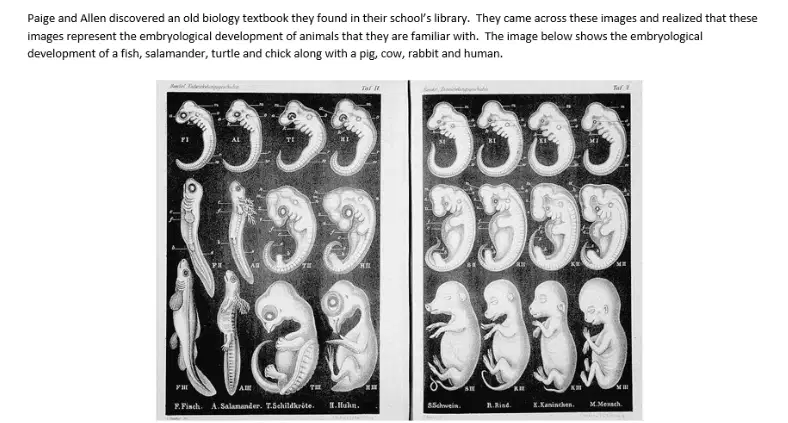
What three conclusions can be drawn from the embryological development of these organisms?
These organisms develop similarly which indicates that they are related.
Since these organisms begin with the same initial embryological stage, they have common DNA.
These embryological stages illustrate how vertebrates develop in a similar fashion.
These organisms all mutated at different rates to develop different traits.
These organisms have common ancestors because their initial stage of development is similar.
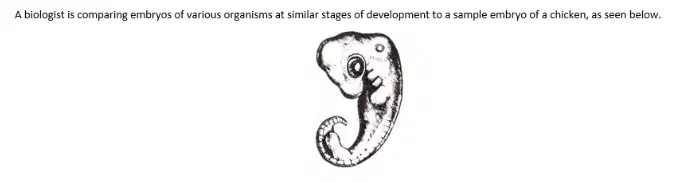
Based on what you know about evolutionary relationships, which of the following embryos is more closely related to the chicken?
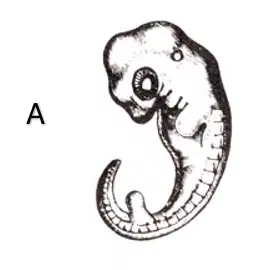
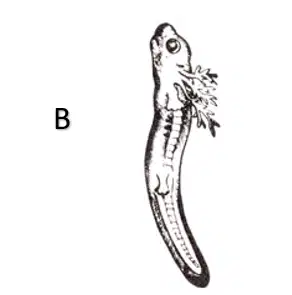
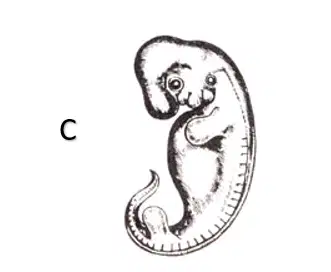
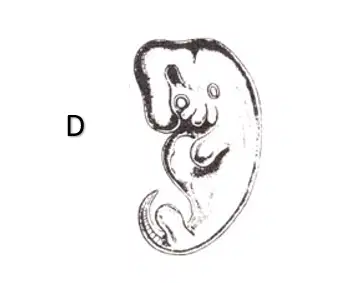

Based on what you know about evolutionary relationships, the embryo that is most closely related to the chicken is Embryo A. Which of the following statements best supports this conclusion?
Limbs in embryos are adapted initially for swimming before growing into their intended use once born.
Tails in vertebrate species only begin to grow in the embryo in later stages of their development.
Evolutionary relationships between species can be determined by observing matching features in an embryo.
The time it takes for an embryo to form is a reliable indicator of the evolutionary relationships between species.
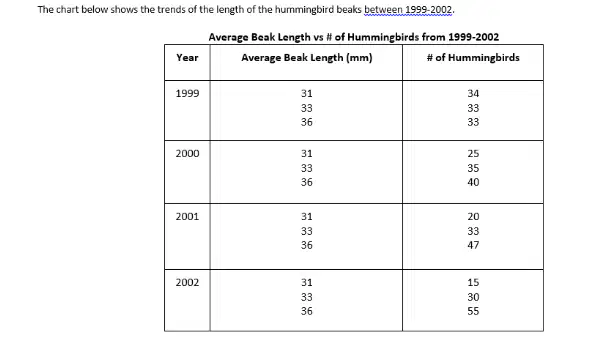
Predict what will happen to the average length of hummingbirds in 2003.
In 2003, fewer hummingbirds will have 31 mm beaks while more will have 36 mm beaks.
More hummingbirds will have 31 mm beaks while fewer will have 36 mm beaks when compared to previous years.
In 2003 more hummingbirds will have 33 mm beaks while fewer will have 31 mm beaks in 2003 than in previous years.
When compared to previous years, there will be fewer hummingbirds with 33 mm beaks and more will have 31 mm beaks.
In 2003, fewer hummingbirds will have 31 mm beaks while more will have 36 mm beaks. Which of the following pieces of evidence best explains the data?
The longer beaks are adaptations resulting from the amount of nectar available to them.
The longer beaks are indications that the hummingbird has lived longer.
The longer beaks are adaptations resulting from their ability to get nectar from flowers.
The longer beaks are adaptations resulting from their ability to drink from their water source.
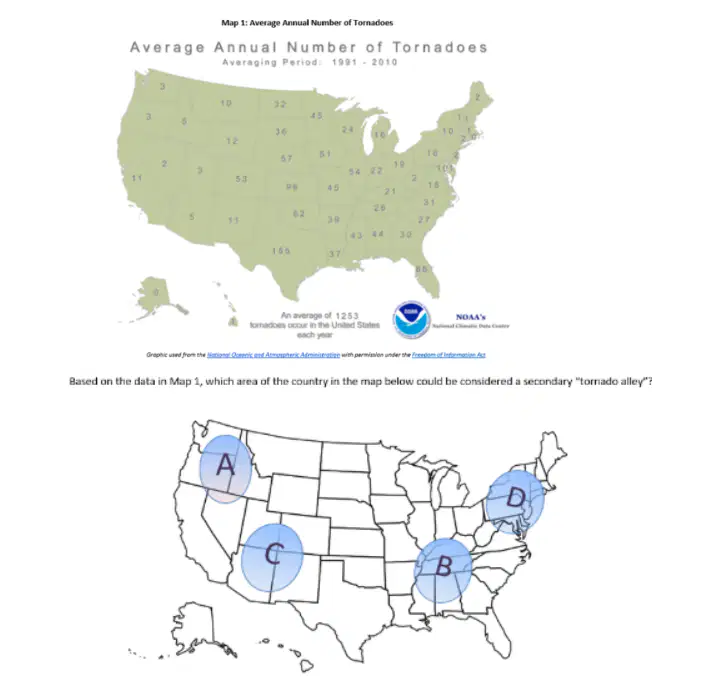
Based on the data in Map 1, which area of the country in the map below could be considered a secondary “tornado alley”? (a)
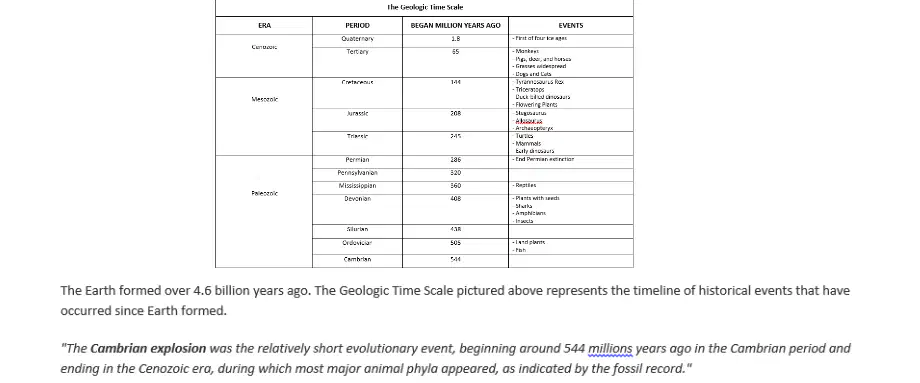
Which time period during the Cambrian Explosion introduced the most variation in DNA sequences? (a)
Which piece of evidence supports the claim that the Devonian time period during the Cambrian Explosion introduced the most variation in DNA sequences?
More organisms were introduced in this time period than any other time period.
The organisms introduced in this time period are larger than organisms in other time periods.
There is more physiological differences in the organisms introduced during this time period.
The organisms went from unicellular to multicellular during this time period.

According to the table, a fossil of a dinosaur would probably be from the (a) .
According to the table, which geologic period occurred more than 800 million years ago? (a)
According to the table, early ancestors of frogs would have appeared during the (a) .
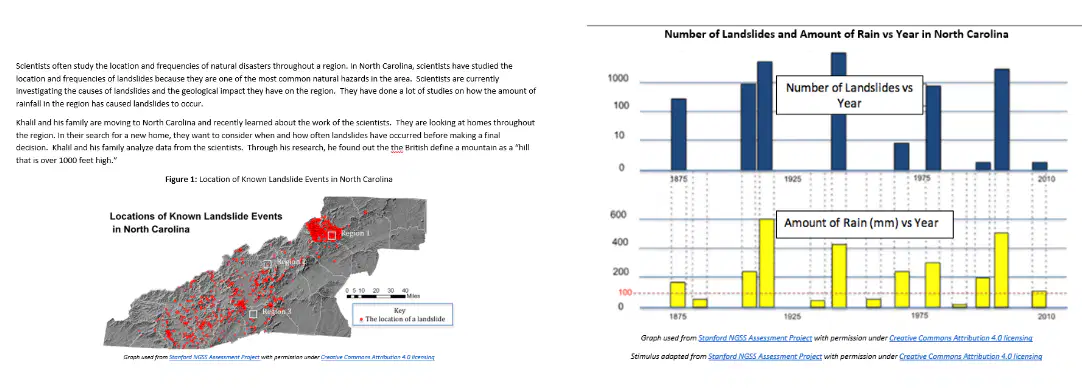
Which regions in Figure 1 have the highest and lowest risk of future landslides?
Region 1 has a higher risk of landslides than Regions 2 and 3.
Region 1 has a lower risk of landslides than Regions 2 and 3.
Region 2 has a moderate risk of landslides than Regions 1 and 3.
Regions 1, 2, and 3 have the same risk of landslides.
Which of the following correctly compares the relationship between the amount of rain and the number of landslides in North Carolina? Select the two correct choices.
The number of landslides is not affected by the amount of rain.
The higher the amount of rain in a year, the greater the number of landslides.
The higher the amount of rain in a year, the fewer the number of landslides.
When there is more than 100 mm of rain in a year, landslides occurred.
The lower the amount of rain in a year, the greater the number of landslides.
After reviewing all of the scientist’s data, Khalil makes the following claim: “The role of water in Earth’s geological processes contribute to the formation of landslides in North Carolina.” Do you agree or disagree with Khalil’s claim? Support your reasoning.
The average monthly rainfall in North Carolina directly correlates to the formation of landslides in the region.
As the average monthly rainfall increases, the rate of landslides increase.
Water causes weathering, erosion, and deposition.
Water causes weathering, erosion, and deposition. The average monthly rainfall in North Carolina directly correlates to the formation of landslides in the region. As the average monthly rainfall increases, the rate of landslides increase.
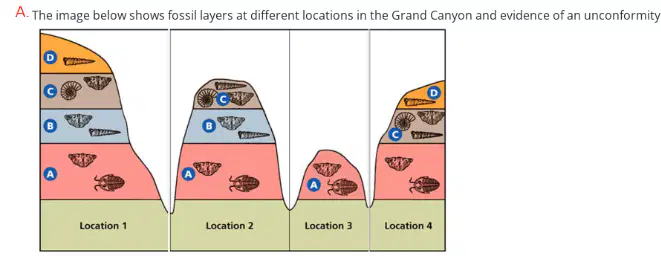
Based on the image and your understanding of rock layers, why is Layer B not present at Location 4?
Neither of these organisms lived at Location 4.
These organisms were soft bodies and were not preserved.
The layer was eroded by the environment.
The rock at Location 4 is newer than the rock at Locations 1 and 2.
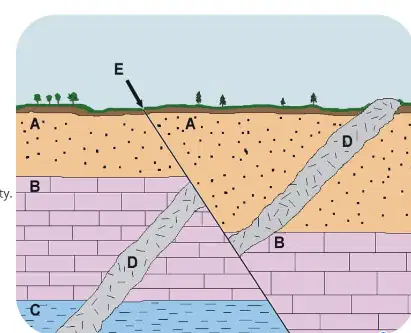
Order the layers of rock from oldest to youngest.
C
B
A
D
E

Two Part Question:
Part One: What is the cause and effect connection between an earthquake and a tsunami?
Part Two: What is the engineering solution for the future that could reduce damage to Japan's remaining nuclear power plants?


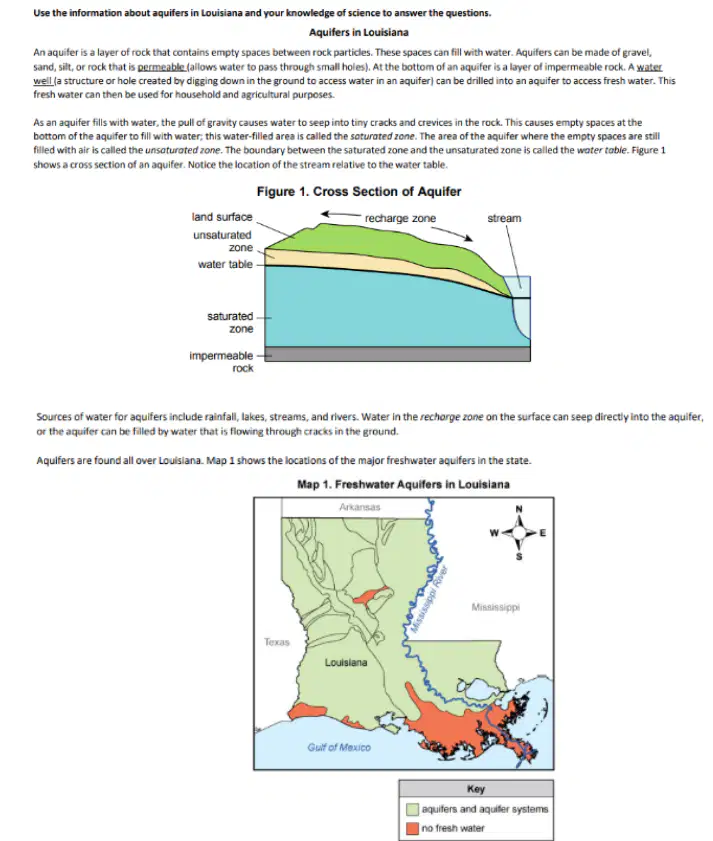
Map 1 shows that there is no fresh water in the Southern part of Louisiana. Which statement explains a possible cause for the lack of freshwater aquifers in this part of Louisiana?
There are too many water wells that have used all the freshwater in this area.
The aquifers in the area have been filled with saltwater from the Gulf of Mexico.
The land is covered with permeable rock that prevents water from collecting underground.
The land surface is covered with sediments that have been deposited from the Mississippi River.

Which of these BEST describes what is happening at arrow 1 in the water cycle?
Water is flowing into the ocean.
Water vapor is collecting to form clouds.
Water falling as rain is changing into clouds.
Water heated by the sun is changing to water vapor.

Which process is represented by Letter "F"? (a)

