
 Worksheets
PMA6 review
Total questions: 20
Worksheet time: 10mins
Students in Ms. Major’s class are currently learning about evolution and diversity of organisms. Her class is divided into two groups. Each group performs a different experiment. The table below describes the actions the students too
1. Which description best contrasts Experiment 1 and Experiment 2?
Experiment 1 did not measure an outcome variable. Experiment 2 did.
Experiment 1 focused on biology. Experiment 2 explored geology
Experiment 1 is an example of repetition. Experiment 2 is an example of replication.
Experiment 1 is an example of replication. Experiment 2 is an example of repetition.
A student set up an experiment to determine which type of plant is best adapted to thrive and grow based on the soil nutrient and content in his mom’s garden. He took careful measurements of the plants each day and compiled his data in a journal. The student decides to create a line graph to display the data from his table.
2. What is the independent (test) variable in this experiment?
The day
The type of plant
The height of the plant
The soil nutrients in the garden
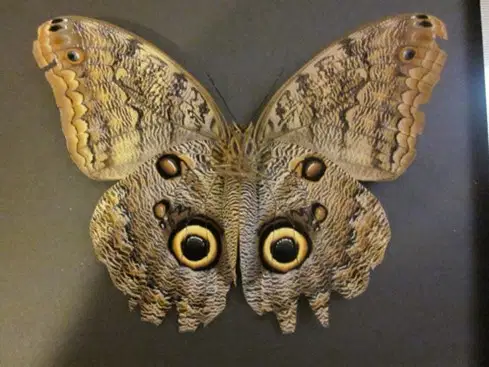
A group of students are conducting a scientific investigation on the number of butterfly species in the school yard as part of their unit on inherited traits and adaptations.
Which statement is NOT a possible inference about the data the students collected?
A. The number of butterfly species present in the school yard is decreasing over time.
The data is incorrect because a teacher once saw butterflies in February.
These butterfly species hibernate during the colder months in this climate
The number of butterfly species detected increases as temperature increases.
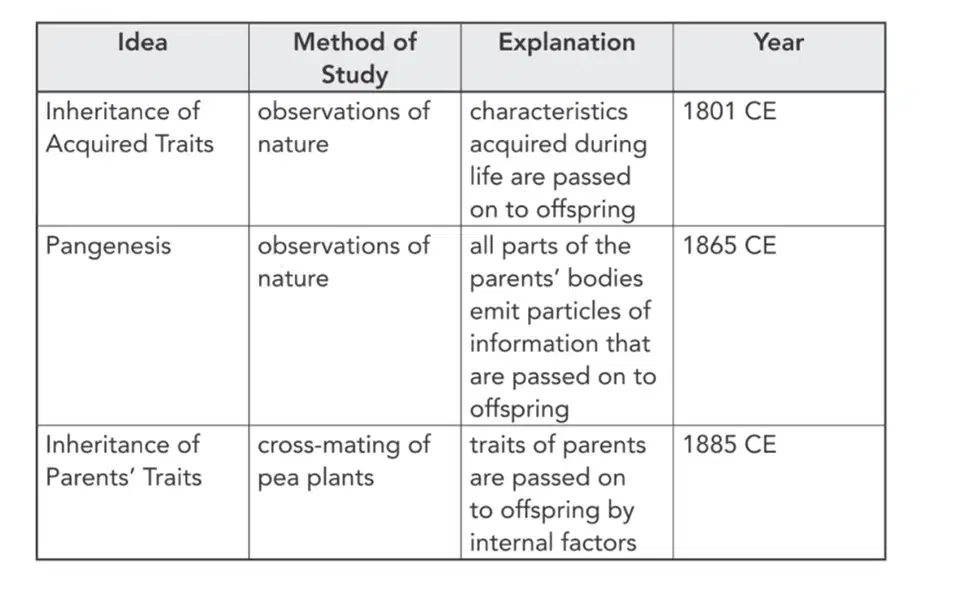
Toby is reading about the history of science and trying to understand how a changing Earth affects an organism’s ability to survive and change. He comes across a table shown below.
4. What best describes the chart Toby finds?
evidence that scientific facts constantly change to fit new theories
examples of how scientists’ opinions of hypotheses change over time
evidence that scientists’ observations do not change very much
examples of scientific knowledge changing when new evidence is discovered
An evolutionary biologist recently discovered fossils of a now extinct organism. She was very excited because these fossils were found on top of a mountain, several hundred feet above sea level. After she gathered all the fossils, she used complex computer software and constructed the following model based upon all the evidence she had.
. What is a limitation that all models have?
Models must be physical objects
Models must be three-dimensional
Models are never exactly like the real thing
. Models must be based on mathematical laws.

Isabelle and her class recently visited the Museum of Science and Industry (MOSI) as part of learning about the history of Earth. She learns how once living organisms can become fossilized and helps scientists learn about past life on Earth from millions of years ago.
6. Which of the following statements is true about the fossil record?
The fossil record shows no evidence of how organisms evolved.
The fossil record shows only animal life that has become extinct.
A. The fossil record shows patterns that are like data that can be analyzed.
A. The fossil record shows only evidence of traces of animals in rock
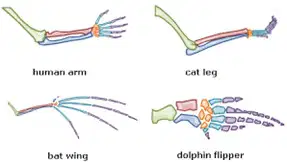
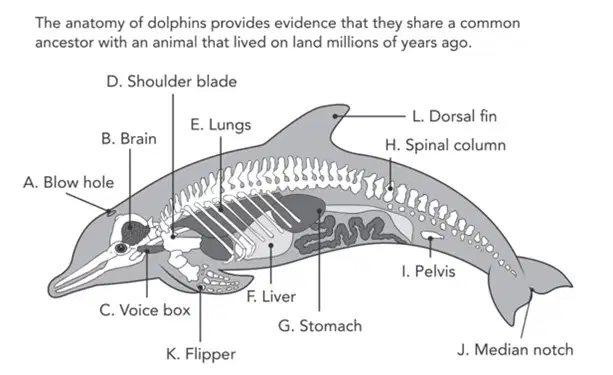
Luis goes to the Museum of Natural History and sees a display of bones from a dolphin's flipper and a cat's leg. They are very different, but the display shows that their bones have homologous structures in their limbs.
. What can you infer about these two organisms from their homologous structures?
They evolved at the same time.
. They evolved rapidly.
They evolved to live in similar environmental conditions.
A. They evolved, are related, and share a common ancestor
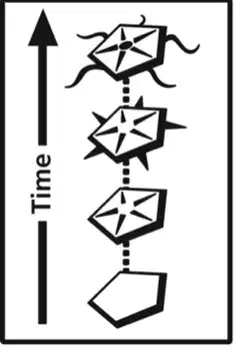
Look closely at the illustration. Assume that each drawing represents a fossil of a new species of organism.
8. What can you conclude from this illustration?
Species change over time.
Species do not change over time.
A. Species do not change over time but pass on acquired characteristics.
A. Species change very rapidly as depicted by the short timeline.
9. Scientists learn a great deal about past life forms by studying fossils. Which of the following does the fossil record support concerning the evolution of some forms of life
A. large body size à small body size
A. simple body plan à complex body plan
A. multicellular organism à unicellular organism
A. organized body plan à disorganized body plan

Roberta is a scientist studying the evolution of reptiles. She noticed that dinosaur fossils are found only in older layers of rock. New layers of rock have lizard fossils that look similar to species that are alive today
9. What is a general conclusion Roberta can make about how reptiles have changed over time?
A. Dinosaurs lived after lizards that share similarities with lizards that are alive today.
A. Dinosaurs lived before lizards that share similarities with lizards that are alive today.
A. Dinosaurs lived at the same time as lizards that share similarities with lizards that are alive
today
A. Roberta cannot make any conclusions about how reptiles have changed over time based on
the evidence mentioned above.
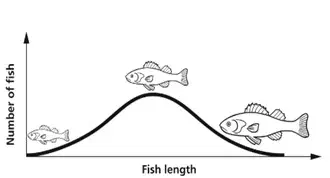
The process of natural selection is based on how organisms respond to changes in their environment. The graph below shows length in a population of fish.
LENGTH IN A POPULATION OF FISH
Which of the following conclusions is supported by the graph?
A. There is no variation among the members of the population.
A. There is an equal distribution of males and females in the population.
A. There is greater chance of survival for the larger members of the population.
A. There is a variation in the characteristics of the members of the population.

Lucy volunteers at an animal shelter, and she takes care of an orange tabby cat and her kittens. Some of the kittens have orange markings, while others have gray markings.
12. What units of genetic material determine what living things look like?
A. traits
A. genes
A. variations
A. mutations
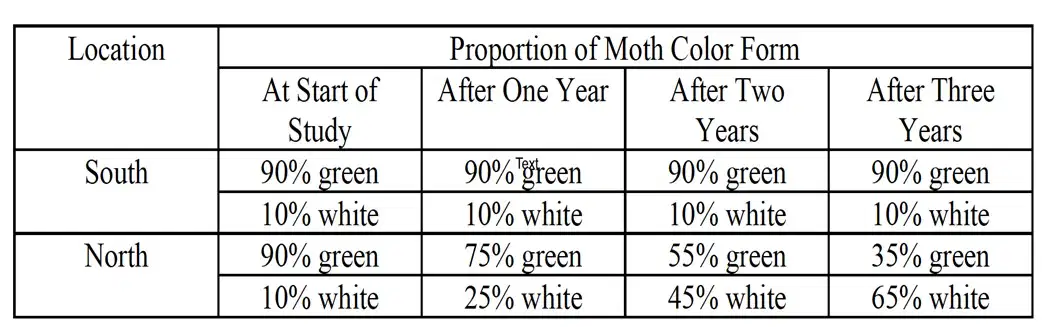
A moth species, found in the Americas, can be found in two forms: green and white. Moths in a southern region reproduce in the spring and usually take the green form. Young moths hide on new leaves on trees. This makes green moths difficult for predators to see. Several moths from the southern population are accidentally carried to another ecosystem much farther north, where winters are long. The table shows the survival of the two color forms of the moth in both locations.
Natural selection acts on which genetic trait in the moth species?
time of reproduction
geographic location
color form
habitat preference
In the north, what is the most likely reason that the proportions of green and white moths are
changing?
. The moths are hatching when it is too cold for them to survive and reproduce.
The white moths are better at finding food in the north than they were in the south.
The green moths are slow to reproduce in cold weather and are outcompeted by white moths.
The young green moths stand out on bare trees and are eaten, so they don’t live to reproduce.
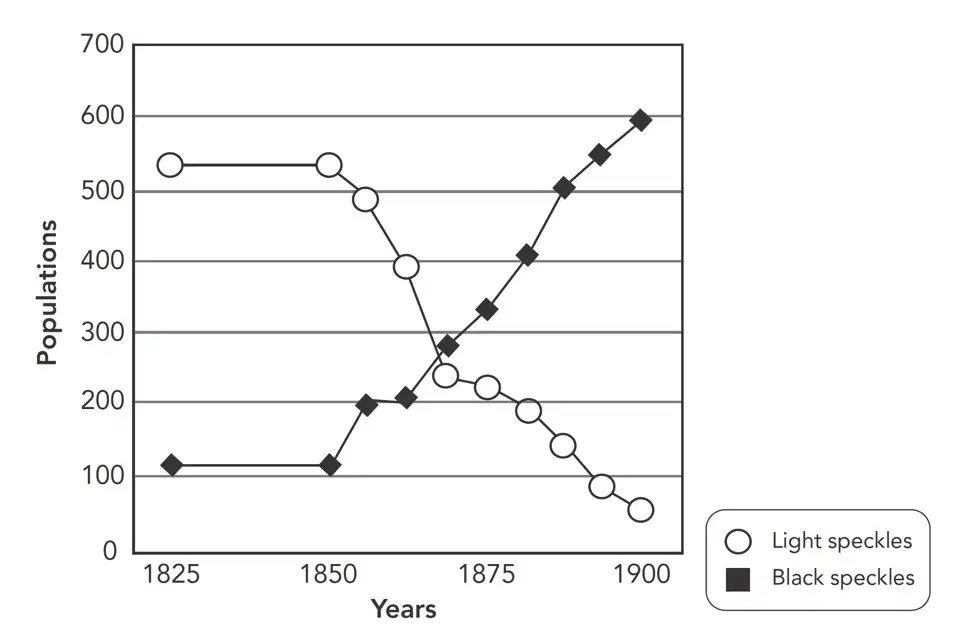
During the Industrial Revolution, coal was burned to run machines. The pollution from coal burning resulted in frequent, heavy fog and soot deposits on many surfaces.
There are two forms of the spotted lizard. One is white with black speckles. Another form, a mutant form, is black with light speckles. Populations of the two forms of this lizards are shown in the graph below.
15. Based on the data for 1850 to 1900, what inference can you make about the light speckled
lizard and the mutant black speckled lizard?
White lizards were easier for predators to see.
Black lizards were unable to find sources of food
White lizards were unable to absorb heat from sunlight.
Black lizards were less likely to migrate to other places.
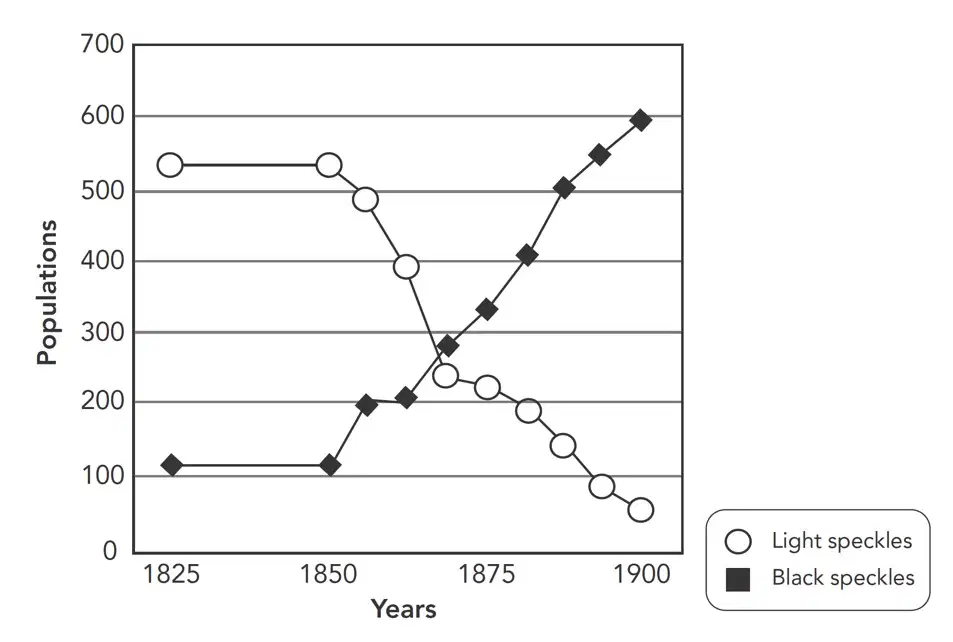
Based on the graph, how would you expect the populations of the speckled lizard’s
predators to change throughout the years
increase, because there are more black lizards to eat
decrease, because there are fewer white lizards to eat
stay the same, because the number of lizards was about the same
evolve, because the food source was changing

Recently, people are reporting seeing more of the light speckled lizard. What is the best
explanation for these observations?
Predatory birds have now discovered the black speckled lizards.
Climate change has made it easier for the light speckled lizards to survive.
The mutant allele that codes for black coloring is recessive.
Without soot deposits the light speckled lazards are better camouflaged.

Which statement best relates this scenario to Darwin’s theory of evolution by natural selection?
The population of sea turtles will not be affected as long as some of them reach the ocean.
The turtles that continue to follow the light source toward the ocean will have a better chance
of surviving to reproduce
Acquired traits will ensure that the turtles learn to avoid source B.
Natural selection will gradually eliminate baby turtles altogether.
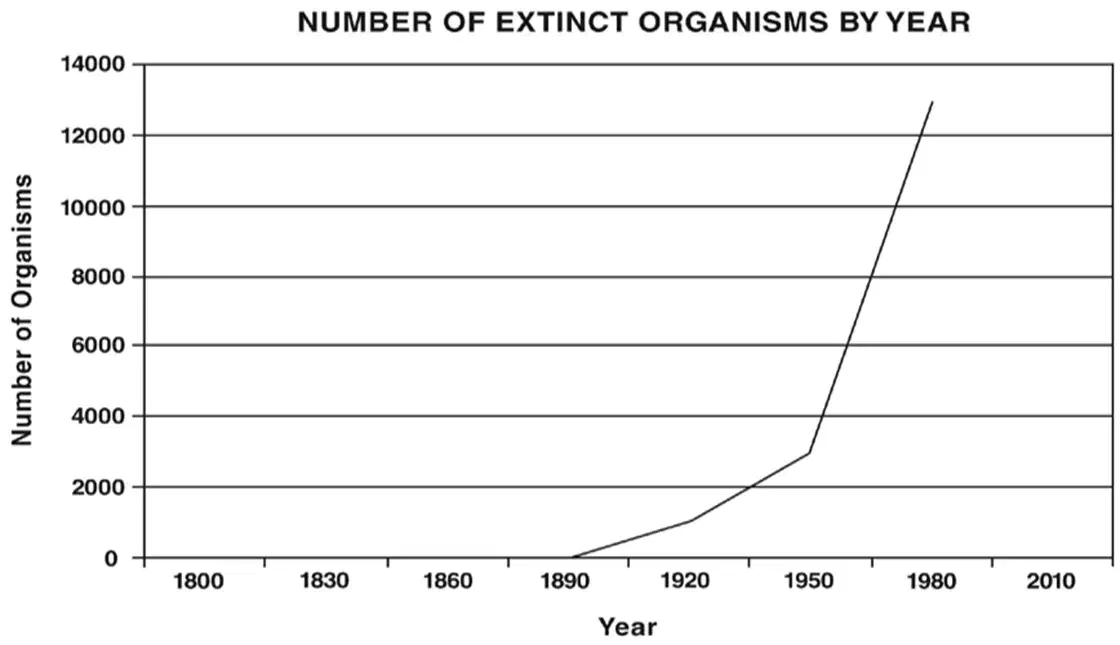
Which conclusion is supported by the graph?
Most organisms that have existed are now extinct.
The rate of extinction increased rapidly during the 1900s.
All organisms will eventually become extinct at some future point.
The rate of extinction gradually increased over the last 50 years.
How do fossils support evolution?
Organisms in the fossil record are identical to living organisms.
The fossil record provides evidence that all organisms developed at the same time.
The fossil record provides evidence that organisms have changed over time.
Individual species disappear and reappear in the fossil record over time.

