
 Worksheets
iGCSE Physics 3 - Properties of Waves
Total questions: 31
Worksheet time: 3hrs 35mins


Waves can transfer (a) but not (b) .
A (a) is a line where all the vibrations are in phase and the same distance from the source.
Match the following definitions to the words they describe.
Amplitude
The maximum displacement of a wave from its undisturbed (equilibrium) position.
Wavelength
The distance from one point on a wave to the same point on the next wave.
Frequency
The number of waves passing a given point in a second. It is the inverse of the wave’s time period.
Time Period
Time needed to make one complete wave or vibration.
Waves
Vibrations which carry or move energy.
Select all of the transverse waves listed below.
Light waves
Radio waves
Water waves
Sound waves
Vibrating guitar strings
(a) waves vibrate (b) to the movement of energy, but (c) waves, such as sound waves, vibrate (d) to the direction of movement of energy.
Match the following types of wave to their diagrams.

Longitudinal

Mexican

Transverse
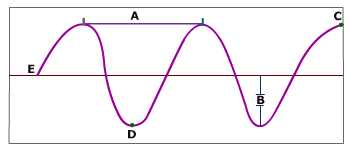
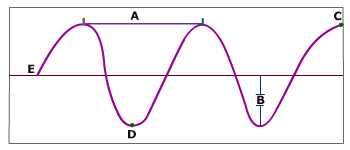
Add labels to the diagram.
When a wave moves through a substance, its particles will move from (a) . The maximum movement of particles from their resting position is called its (b) . The distance between a particular point on a wave and the same point on the next wave (for example, crest to crest) is called the (c) .
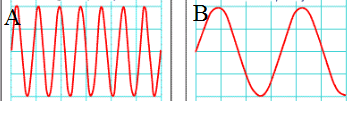
The number of waves produced by a source each second, or the number passing a particular point each second, is called the (d) of the wave (f). is measured in (e)

1) Refraction happens when light______
bends as it enters a new medium
bounces back when it hits a surface
by a substance

Which one of these describes a lens that causes light to come to together at a single point?
concave
opaque
convex
translucent

Identify the following image as refection or refraction.
Refraction
Reflection

Identify the following image as reflection or refraction.
Refraction
Reflection
Match the following descriptions of wave behaviour to the word which describes them.
Reflection
When waves bounce off the material which they hit.
Refraction
When waves bend as they enter a new medium.
Absorption
When waves are "taken in" by a material.
Which of these statements describes the "Law of Reflection"?
The angle of incidence equals the angle of reflection.
The angle of incidence is less than the angle of reflection.
The angle of incidence is greater than the angle of reflection.
None of these statements describe the Law of Reflection; it depends on the material the light hits.
When light in air enters the water, what happens to its speed?
It stays the same.
It speeds up.
It slows down.
Select all of the wave types which can be refracted.
Light waves
Water waves
Sound waves
Seismic Waves
What is the Doppler Effect?
A change in frequency due to the relative motion of a wave source and an observer
When a wave overlaps with another wave
When a wave bounces off of another object
When a wave bends due to traveling through a different medium
An ambulance is driving towards you as you stand on the sidewalk. What happens to the pitch of the siren as it comes towards you?
It increases
It decreases
You are driving in a car and honk the horn at a person standing in the street. As you approach the person, what happens to the pitch of the horn according to you in the car?
It increases
It decreases
It stays the same.
You are standing on the side of the road when a police car races past you with its siren on. After the police car passes you, what happens to the pitch of the siren?
It increases
It decreases
It turns red
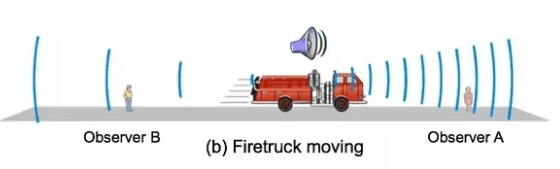
Look at the picture. Who is experiencing a higher pitched sound?
Observer A
Observer B
There's no difference



