
 Worksheets
NET1L - Lesson 6 (Data Link Layer)
Total questions: 69
Worksheet time: 39mins
Data Link Layer is responsible for ____________ to network interface card communications.
network interface card (NIC)
network internet control (NIC)
network international card (NIC)
The Data Link Layer allows Upper Layer Protocols to access the Physical Layer Media.
True
False
It encapsulates Layer 3 packets (IPv4 and IPv6) into Layer 2 Frames.
Layer 3 - Network
Layer 2 - Data Link
Physical Layer
Data Link Layer
Network Layer
Transport Layer
The Data Link Layer does not perform error detection and accepts corrupts frames.
True
False
IEEE 802 LAN/MAN standards are not specific to the type of network (Ethernet, WLAN, WPAN, etc).
True
False
These are Layer 2 Devices:
Network Interface Card (NIC)
Switch
Router
What is the size allowed for the frame to be accepted in the receiving node?
_____ to _____ bytes
64
18
1518
1618
The Data Link Layer consists of two sublayers:
Logical Link Control (LLC)
Media Access Control (MAC)
Internet Protocol (IP)
Logical Access Control (LAC)
Communicates between the networking software at the upper layers and the device hardware at the lower layers.
LLC Sublayer
MAC Sublayer
Is responsible for data encapsulation and media access control.
LLC Sublayer
MAC Sublayer
- Responsible in getting the packet from the Network Layer.
- It places information in the frame allowing multiple Layer 3 protocols to use the same network interface and media.
LLC Sublayer
MAC Sublayer
- Responsible in transferring from frame to bits in Layer 2.
LLC Sublayer
MAC Sublayer
_______ exchanged between nodes may experience numerous data link layers and media transitions.
Packets
Frames
Bits
At each hop along the path, a router performs four basic Layer 2 functions:
Accepts a frame from the network medium.
De-encapsulates the frame to expose the encapsulated packet.
Re-encapsulates the packet into a new frame.
Forwards the new frame on the medium of the next network segment.
Rejects the frame from the network medium.

Data link layer protocols are defined by engineering organizations:
Institute for Electrical and Electronic Engineers (IEEE)
International Telecommunications Union (ITU)
International Organizations for Standardization (ISO)
American National Standards Institute (ANSI)
Internet Engineering Task Force (IETF)
The __________ of a network is the arrangement and relationship of the network devices and the interconnections between them.
Topology
Stack
Structure
Collection
2 types of topologies used when describing networks:
Physical Topology
Logical Tophology
Network Tophology
Shows physical connections and how devices are interconnected.
Physical Topology
Logical Tophology
Identifies the virtual connections between devices using device interfaces and IP addressing schemes.
Physical Topology
Logical Tophology
3 Common Physical WAN Topologies:
Point-to-point
Hub and spoke
Mesh
Ring

The simplest and most common WAN topology.
Consists of a permanent link between two endpoints.
Point-to-point
Hub and spoke
Mesh
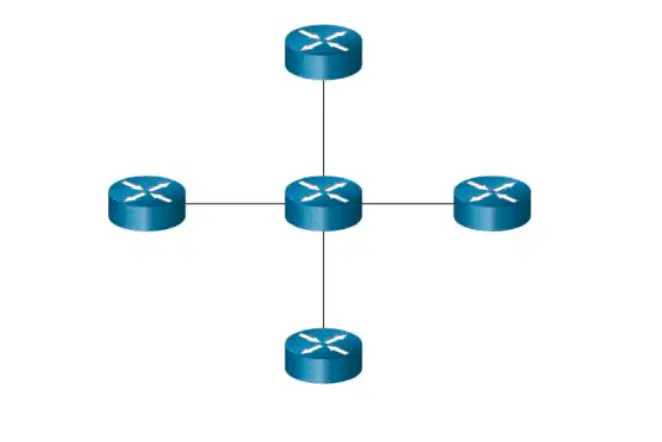
Similar to a star topology where a central site interconnects branch sites through point-to-point links.
Point-to-point
Hub and spoke
Mesh
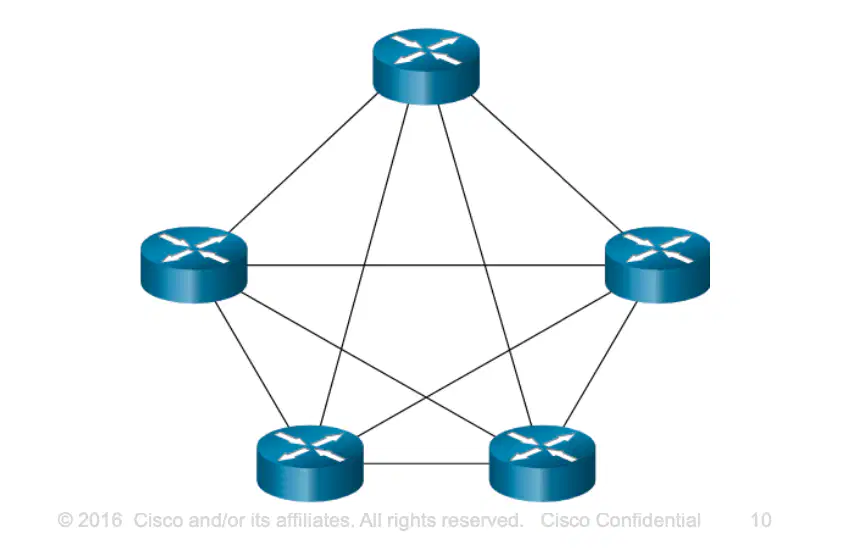
Provides high availability but requires every end system to be connected to every other end system.
Point-to-point
Hub and spoke
Mesh
Physical point-to-point topologies directly connect three nodes.
True
False
In Point-to-Point WAN Topology, the nodes may not share the media with other hosts.
True
False
Because all frames on the media can only travel to or from the two nodes, Point-to-Point WAN protocols can be very complex.
True
False

A source and destination node may be indirectly connected to each other over some geographical distance using multiple intermediary devices.
But, it is still Point-to-Point WAN Topology.
True
False
End devices on LANs are typically interconnected using __________________.
Star
Extended Star
Bus Topology
Ring Topology
Are easy to install, very scalable and easy to troubleshoot.
Star and Extended Star
Bus Topology
Ring Topology
Hybrid Topology
Early Ethernet and Legacy Token Ring technologies provide two additional topologies:
Star and Extended Star
Bus Topology
Ring Topology
Hybrid Topology

All end systems chained together and terminated on each end.
Star and Extended Star
Bus Topology
Ring Topology
Hybrid Topology
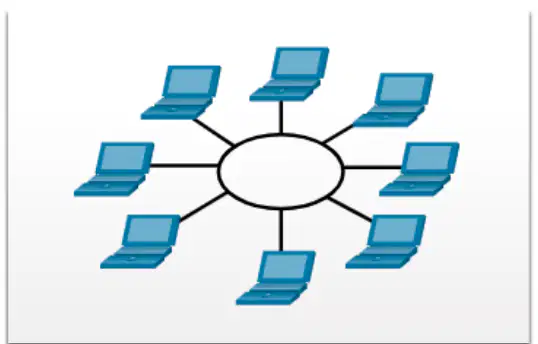
Each end system is connected to its respective neighbors to form a ring.
Star and Extended Star
Bus Topology
Ring Topology
Hybrid Topology

What is this topology?
Star Topology
Extended Star Topology
Ring Topology
Hybrid Topology

What is this topology?
Star Topology
Extended Star Topology
Ring Topology
Hybrid Topology
Only allows one device to send or receive at a time on a shared medium.
Half-duplex communication
Full-duplex communication
- Used on WLANs and legacy bus topologies with Ethernet hubs.
Half-duplex communication
Full-duplex communication
Allows both devices to simultaneously transmit and receive on a shared medium.
Half-duplex communication
Full-duplex communication
Ethernet switches operate in full-duplex mode.
True
False
What are the 2 Access Control Methods?
Contention-based access
Contention access
Controlled access
Contolled-based access
All nodes operating in half-duplex, competing for use of the medium.
- Shared medium
Contention-based access
Controlled access
Ex: CSMA/CD (Carrier sense multiple access with collision detection) and CSMA/CA (Carrier sense multiple access with collision avoidance)
Contention-based access
Controlled access
Used on legacy bus-topology Ethernet. (Ethernet 802.3)
Carrier sense multiple access with collision detection (CSMA/CD)
Carrier sense multiple access with collision avoidance (CSMA/CA)
Used on Wireless LANs. (Ethernet 802.11)
Carrier sense multiple access with collision detection (CSMA/CD)
Carrier sense multiple access with collision avoidance (CSMA/CA)
Deterministic access where each node has its own time on the medium.
Ex: Allotted time of 10 secs to send and the other medium as well.
Contention-based access
Controlled access
Ex: Used on legacy networks such as Token Ring and ARCNET.
Contention-based access
Controlled access
Used by legacy Ethernet LANs.
Carrier sense multiple access with collision detection (CSMA/CD)
Carrier sense multiple access with collision avoidance (CSMA/CA)
CSMA/CD collision detection process:
a. Devices wait a random period of time and retransmit data.
b. Devices detect the collision.
c. Devices transmitting simultaneously will result in a signal collision on the shared
media.
c, b, a
b, c, a
a, b, c
Used by IEEE 802.11 WLANs.
Carrier sense multiple access with collision detection (CSMA/CD)
Carrier sense multiple access with collision avoidance (CSMA/CA)
Both CSMA/CA and CSMA/CD:
- Operates in _________ mode where only one device sends or receives at a time.
- Uses a process to govern when a device can send and what happens if multiple devices send at the same time.
half-duplex
full-duplex
[CSMA/CA collision avoidance]
When transmitting, devices don't include the time duration needed for the
transmission.
True
False
[CSMA/CA collision avoidance]
Other devices on the shared medium receive the time duration information and know how long the medium will be unavailable.
True
False
Data is encapsulated by the data link layer with a ______ and a ______ to form a frame.
header
trailer
controller
encapsulator
A data link frame has three parts:
Header
Data
Trailer
User
[Data Link Frame]
The Header's encapsulated information include:
Frame Start
Addressing
Type
Control
Data
[Data Link Frame]
The Trailer's encapsulated information include:
Error Detection
Frame Stop
Frame Start
Addressing
Is the payload.
Header
Data
Trailer
The fields of the header and trailer do not vary according to data link layer protocol.
True
False
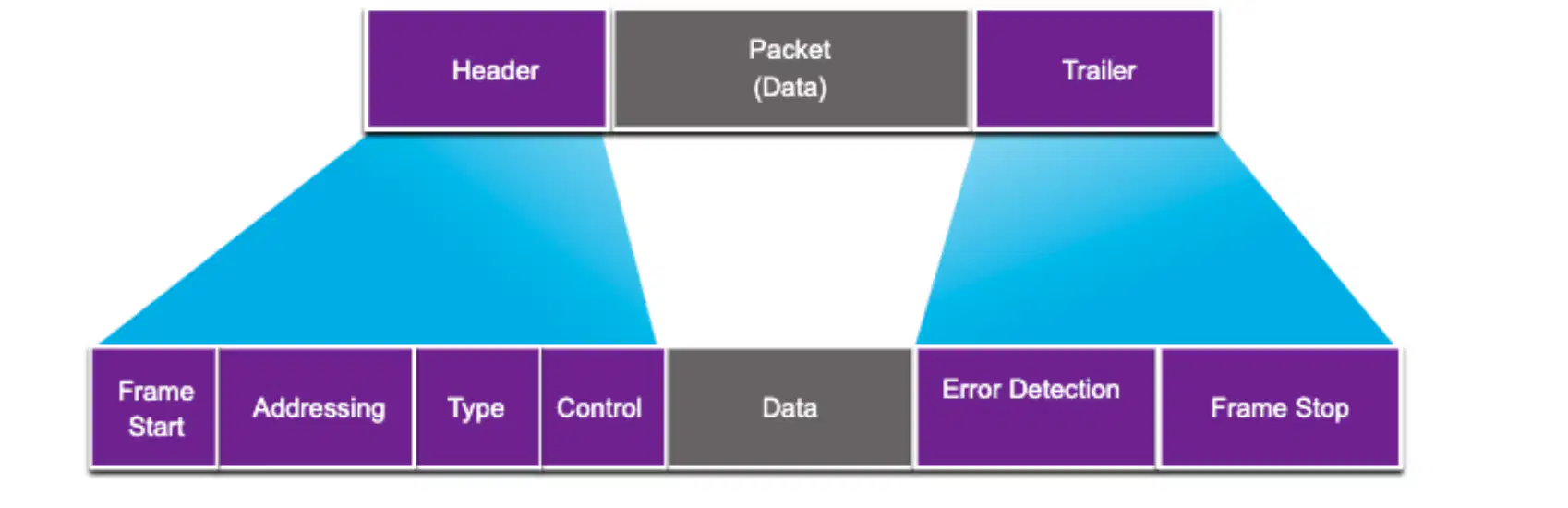
Identifies beginning and end of frame.
Frame Start and Stop
Addressing
Type
Control
Data
Indicates source and destination nodes.
(Done by the MAC Sublayer or the lower layer of the Data Link Layer)
Frame Start and Stop
Addressing
Type
Control
Data
Identifies encapsulated Layer 3 protocol.
(if IPV4 or IPv6 or both)
Frame Start and Stop
Addressing
Type
Control
Data
Identifies flow control services.
(Dependent on the type of data that is being delivered to the destination — if text, audio or voice)
Frame Start and Stop
Addressing
Type
Control
Data
Contains the frame payload.
Frame Start and Stop
Addressing
Type
Control
Data
Used for determine transmission errors.
(Is there tampering? etc. and will be discarded.
If size changed from source and destination, means it was tampered.)
Error Detection
Addressing
Type
Control
Data
What is the sequence of the frame fields in the Data Link Frame?
1. Frame Start
2. Addressing
3-4. ?????????????
5-6. ?????????????
7. Frame Stop
Type, Control
Control, Type
Data, Error Detection
Error Detection, Data
Also referred to as a physical address.
Layer 2 Address
Layer 3 Address
Layer 1 Address
The Layer 2 (Data Link) Address is contained in the frame header.
True
False
Layer 2 (Data Link) Addresses are used only for local delivery of a frame on the link.
True
False
The Layer 2 (Data Link) Addresses are not updated by each device that forwards the frame.
True
False
The logical topology and physical media - determine the data link protocol used:
Ethernet
802.11 Wireless
Point-to-Point (PPP)
High-Level Data Link Control (HDLC)
Frame-Relay

