
 Worksheets
Mr. Bradley’s plate boundaries
Total questions: 91
Worksheet time: 45mins

The diagram shows a cross section of a portion of the Earth. Which letter represents a mid-ocean ridge?
W
X
Y
Z

The diagram shows a landform on Earth. How did the movement of Earth’s plates form the landform?
Two oceanic plates slid past each other.
Two continental plates collided.
One continental plate slid past an oceanic plate.
One continental plate subducted beneath an oceanic plate.
Which diagram shows a plate boundary that is typical for the formation of volcanoes?


Use the diagram to answer the question. What results as the two oceanic plates converge?
formation of a deep sea trench and island volcanoes
earthquake activity and appearance of a transform fault
volcanic eruption along both oceanic plate edges
formation of a continental mountain range

Use the diagram to answer the question. What results when the two plates move in the direction indicated by the arrows?
formation of a deep sea trench and island volcanoes
earthquake activity and appearance of a transform fault
volcanic eruption along the edges of both plates
formation of a continental mountain range

The diagram below shows a cross section of a portion of the Earth. Which location represents a deep ocean trench?
A
B
C

What is occurring at the Nazca Plate?
Trasformation
Subduction
Lithification
Compaction


What kind of plate boundary is shown here?
Divergent
Convergent
Transform
Strike Slip

What kind of plate boundary is shown here?
Divergent
Convergent
Transform
Submergent

What kind of plate boundary is shown here?
Divergent
Convergent
Transform
Strike Slip
What geologic feature/event will most likely be found at a transform boundary?
Earthquakes
Volcanoes
Mountains
Rift Valleys

What geologic feature/event would most likely occur at a divergent boundary between two oceanic plates?
Rift Valley
Mid-Ocean Ridge
Island Arc
Flat Land
What geologic feature/event would most likely be found at a divergent boundary between two continental plates?
Mid-ocean Ridge
Rift Valley
Mountain
Island Arc
What geologic feature would most likely be found at a convergent boundary between two continental plates?
Volcano
Rift Valley
Mountain
Island Arc
A subduction zone is formed...
when a more dense plate sinks below a less dense plate
at EVERY type of convergent boundary
at EVERY type of divergent boundary
when a less dense plate sinks below a more dense plate

New oceanic crust (sea floor) is created at this boundary.
Convergent Oceanic
Divergent Oceanic
Divergent Continental
Transform

What two crustal features occur near every subduction zone?
Rift Valleys and Mid Ocean Ridges
Volcanoes and Rift Valleys
Mid Ocean Ridges and Trenches
Volcanoes and Trenches
A divergent boundary in the ocean creates what feature?
Rift Valley
Mid Ocean Ridge
Deep Ocean Trench
Subduction Zone
What is the "magic" that is happening in the mantle that helps move the lithospheric plates?
Convection
Radiation
Condensation
Conduction
Aside from Earthquakes, what is the only other thing you will find at transform boundaries?
Volcanoes
Subduction Zones
Folded Mountains
Fault Lines
The process that occurs at a divergent oceanic boundary that creates new crust (sea floor) is called?
Subduction
Seafloor Spreading
Continental Drift
Volcanism
The only type of crust that will subduct if two plates converge is...
Oceanic
Continental
What type of boundary forms a rift valley?
convergent
divergent
transform
What type of boundary forms a Volcanic Arc of islands?
convergent
divergent
transform
What type of boundary forms a mid-ocean ridge?
convergent
divergent
transform
What boundary forms folded mountains?
divergent
convergent
transform
What boundary forms a subduction zone, volcano, or deep ocean trench?
convergent
divergent
transform
What boundary forms a fault?
convergent
divergent
transform
What forms at a divergent, continental to continental boundary?
rift valley
mid-ocean ridge
mountain
fault
At what boundary will you find a fault?
convergent
divergent
transform
At what type of boundary will subduction occur?
convergent
divergent
transform
At what type of boundary will a trench or deep ocean trench form?
convergent
divergent
transform
What type of boundary is associated with oceanic to oceanic plates forming a mid-ocean ridge?
convergent
divergent
transform
What type of boundary is associated with an oceanic to oceanic plate boundary that forms a rift valley?
convergent
divergent
transform
At what type of boundary will a fault form?
convergent
divergent
transform
At what type of boundary do plates subduct forming a volcanic island?
convergent
divergent
transform


What type of boundary is this?
convergent
divergent
transform
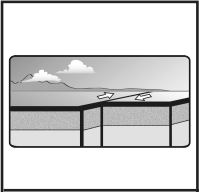
What type of boundary is this?
convergent
divergent
transform

What type of boundary is this?
convergent
divergent
transform
New crust forms along a(n)
subduction zone
divergent boundary
convergent boundary
transform boundary
___________, meaning "all land," is the name of the great landmass that existed millions of years ago.
lithosphere
Pangaea
subduction zone
tectonic
Wegener
A __________ plate is a large slab of crust and upper mantle that moves over the earth's surface.
lithosphere
Pangaea
subduction zone
tectonic
Wegener

What type of plate boundary is this?
Transform
Convergent
Divergent

Which color would be the mantel?
Outside on the earth
red
orange
yellow

What color would be the earth's crust?
Outside on the earth.
red
orange
yellow
What part of the earth makes up less than 1% of the earth?
The crust
The mantel
The outer core
The inner core
Which part of the earth, makes up 67% of the earth?
The crust
The mantel
The outer core
The inner core
Which is the outermost, rigid layer of the earth, made of the crust and the rigid upper part of the mantle.
Lithosphere
Asthenosphere
Mesosphere
Outer core
Inner core
Which is the soft layer of the mantel on which the tectonic plates move?
Lithosphere
Asthenosphere
Mesosphere
Outer core
Inner Core
Which is the strong lower part of the mantel?
Lithosphere
Asthenosphere
Mesosphere
Outer Core
Inner core
The earth's mantel is made up of which two parts?
Lithosphere
Asthenosphere
Mesosphere
Outer core
Inner core
Which part of the earth's core is liquid?
Outer core
Inner core
Which part of the earth's core is solid and dense?
Outer core
Inner core
A tectonic plate is a block of......
Lithosphere
Asthenosphere
Mesosphere
Convergent boundary
Where two tectonic plates collide
Where two tectonic plates separate
Where two tectonic plates slide past each other
Divergent boundary
Where two tectonic plates collide
Where two tectonic plates separate
Where two tectonic plates slide past each other
Transform Boundary
Where two tectonic plates collide
Where two tectonic plates separate
Where two tectonic plates slide past each other
Subduction is when
a yellow submarine
old ocean crust gets pushed up by continental crust
old ocean crust gets pushed down by continental crust.
a yellow submarine

What type of boundary?
convergent
divergent
transform

What type of boundary is this?
convergent
divergent
transform

What type of boundary is this?
convergent
divergent
transform