
 Worksheets
APES Unit 4 Review
Total questions: 127
Worksheet time: 2hrs 53mins
The SECOND most common gas in our atmosphere is ____.
N
O
Ne
Ar
The SECOND most common gas in our atmosphere is ____.
N
O
Ne
Ar
In which atmospheric layer do all the pressure, wind and precipitation changes occur?
Troposphere
Mesosphere
Thermosphere
Stratosphere
In which atmospheric layer do meteors burn up in?
Mesosphere
Exosphere
Stratosphere
Thermosphere
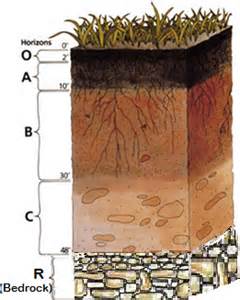
The layer of soil in which topsoil is found is the ___ layer.
O
A
B
C
The type of tectonic plate boundary that is NOT usually associated with volcanoes is _____.
Transform
Convergent
Divergent
Which of the following does NOT exert a major influence on Earth's overall climate?
The distribution of land masses and oceans, in combination with Earth's topography.
The daily rotation of Earth on its axis, along with its annual revolution around the sun.
The annual amount of solar radiation that reaches Earth's surface.
All of these can exert a major influence.

What layer of the atmosphere absorbs harmful ultraviolet radiation?
Troposphere
Stratosphere
Mesosphere
Thermosphere
Which of the following has the least permeability?
Sand
Silt
Clay
Loam
The Coriolis Effect is a result of the Earth's ____.
rotation
gravity
curvature
temperature
Which of the following changes in eastern Pacific Ocean food webs is typically associated with La Niña events?
Decreased populations of squid
Decreased populations of anchovies
Increased phytoplankton concentrations
Increased famine among sea lions and seals
This phenomenon occurs when a coastal mountain range blocks the passage of precipitation to the leeward side of the mountains.
thermal inversion.
Coriolis effect.
rain shadow effect.
urban heat island effect.
ENSO.
This air circulation pattern occurs between 0 degrees latitude and 30 degrees latitude.
Hadley cell
Ferrell cell
polar cell
Coriolis effect

The primary cause of Earth's seasons is the
constant tilt of Earth's rotational axis with respect to the plane of its orbit around the Sun
changing distance of Earth from the Sun at different times of the year
periodic wobbling of Earth on its axis of rotation
changing relative positions of Earth, its Moon, and the Sun
The Sun’s radiation provides the energy for all of the following EXCEPT
plant growth
ocean currents
hurricanes
plate tectonics
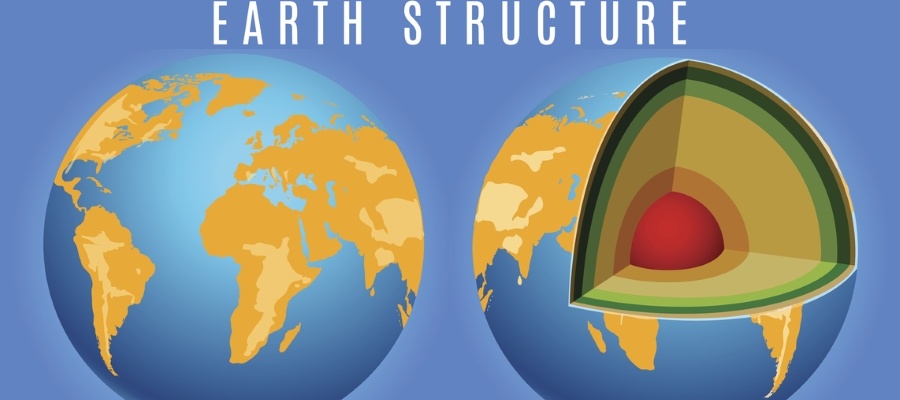
The surface of the earth, otherwise known as the ______, is broken into seven major pieces and sits atop a liquid layer called the _______
lithosphere, asthenosphere
astenosphere, mantle
crust, litosphere
asthenosphere, lithosphere
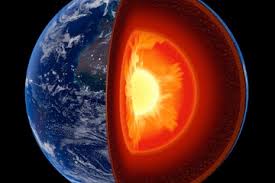
As you travel from the crust to the inner core, how would temperature and density of the material change?
The would all increase
The would all decrease.
They would stay the same.
Temperature would decrease, but pressure and density would increase.
Where the naturally occuring good ozone layer is located
troposphere
mesosphere
stratosphere
thermosphere
How are boundaries of a watershed determined?
The elevation of the surrounding area.
The size of the river.
Political determinations.
The size of the watershed.
A mountain ridge would be this part of a watershed.
Aquifer
Zone of aeration
Water table
Divide
Water that stands or flows across the Earth's surface is known as...
Ground water
Runoff
Divide
Aquifer
An underground layer of sediment or rock that holds water is known as...
Reservoir
Watershed
Aquifer
Runoff
What is one of the most important things that determines a watershed?
Vegetation type
Topography of the land
The amount of liquid
Soil types
What is a watershed?
The movement of water in the clouds and around the world.
Water in the form or rain, mist, sleet, hair, or snow.
The area under the ground where water is stored in rocks and soil.
The land area that drains into a body of water.
Why is gravity a factor in watersheds?
It causes water to transpire.
It causes water to flow away from the watershed.
It causes water to evaporate.
It causes water to flow down towards a watershed.
Which of the following pollutants are commonly found in the watershed.
Pet waste
Fertilizers/ Pesticides
Sediments from erosion.
All of the above
What describes the smaller streams and rivers that feed into the larger river of a watershed?
Lake
Tributary
Estuary
Sound
What describes an area where freshwater and saltwater mix?
Lake
Tributary
Estuary
Sound
Why do cities and suburbs have more runoff and pollution?
More people making pollutants
Pavement doesn't absorb water
Storm drain water not cleaned
All of the above
How does climate affect a watershed?
It determines the amount of water input and output in a watershed.
It determines if the watershed will absorb water or not.
It determines how fast water will be moved through a watershed.
It does not affect watersheds.

Look closely at the map of the watershed below. If water enters the watershed at the top of the mountain where the arrow is pointing, at which point will it stop draining?
Point A
Point B
Point C
Point D
it causes the water to flow down towards a watershed

The boundaries of a watershed are determined by ___________
Elevation
Soil type
The amount of water that flows
The kinds of organisms found in the area

Which of the following models BEST represents how water flows in a watershed?
A
B
C
D
Which factor does not affect the flow of water in a watershed?
amount of precipitation
elevation of land
amount of pollution in water
material on land surface


The rate at which water flows through the soil is called soil percolation or ______.
Groundwater
Permeability
Soil Pores
Porosity
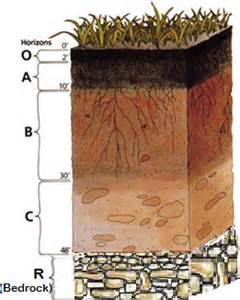
The layer(s) of soil in which most of the humus and soil organisms are contained:
1- leaf litter, horizon O
2- topsoil, horizon A
3- subsoil, horizons B and C
1 only
2 only
1 and 2 only
2 and 3 only
1, 2, and 3


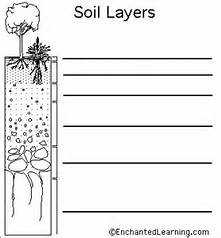
Which horizon contains clay, silt, and minerals, and is commonly referred to as subsoil?
Horizon A
Horizon B
Horizon C
Horizon D or R
Porosity is a measure of void space in a soil sample. Larger soil particles have larger void spaces. Smaller soil particles have smaller pore spaces, but a greater number of them, which leads to higher surface tension and higher % porosity. With this is mind, which statement is true:
Sandy soil has a higher porosity than clay soil
Sandy soil has a higher porosity than silty soil
Clay soil has a higher porosity than sandy soil
Porosity is directly proportional to soil particle size

I. Flood irrigation
II. Drip irrigation
III. Low-pressure central pivot irrigation

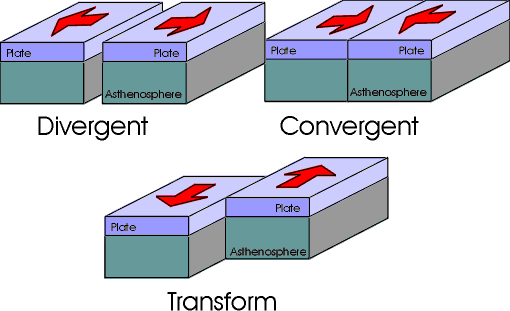
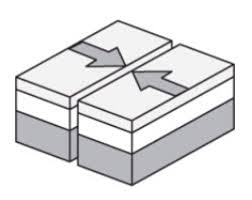
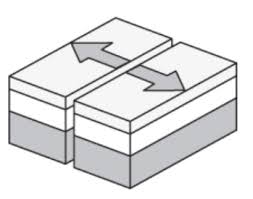
What type of boundary is shown in the picture
Convergent plate boundary
Divergent plate boundary
Transform plate boundary
Match the following as either Continental crust or Oceanic crust
Continental
crust
older
Continental
crust
less dense
Oceanic
crust
recycles
Oceanic
crust
basalt rock
Continental
crust
thicker
At which plate boundary is new crust formed?
divergent
convergent
continental
transform
What type of crusts are involved with one plate subducting beneath another?
continental and continental
Oceanic and continental
oceanic and divergent
continental and convergent
What types of landforms are formed at convergent boundaries?
PICK TWO
volcanoes
new crust
Trenches
rift valley
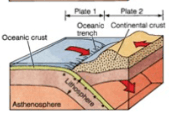
What is the WHOLE AREA called where the oceanic crust goes beneath the continental crust?
subtraction zone
section zone
secondary zone
subduction zone
The earth's plates, rigid slabs of rock, are part of the ___ .
asthenosphere
lithosphere
mantle
granitic rock

What happens often at transform boundaries?
Rain
Hurricanes
Volcanic activity
Earthquakes
What is common at convergent boundaries?
Valleys
Canyons
Mountains
Rivers


During a(n) ____ event, trade winds are much stronger than usual.
El Nino
La Nina
Normal
Partly sunny
Normally, atmospheric upwelling and rain occurs in the:
FAR Western Pacific
Central Pacific
Western Pacific
During an El Nino, it rains
in the central Pacific
in the FAR eastern Pacific
in the western Pacific
In all of the Pacific
Both El Nino and La Nina have this in common
Influence birds that migrate over the ocean
Influence rainy / dry weather world wide
The weather at the polar regions
The directions that ships travel in the oceans
During an El Nino, trade winds are typically...
about average
stronger
weaker

The image is of a(n):
El Nino event
La Nina event
Non-El Nino (normal conditions)

The picture below is of a(n) ____ event.
Non-El Nino (Normal)
El Nino
La Nina

The picture represents a(n) ___ event.
El Nino
La Nina
Non-El Nino (normal conditions)
Without question, ENSO events:
Are preventable
Eliminate sources of rain
Are really scary
Impact everyone on the planet somehow
La Niña is characterized by ______________ of the Western Pacific Ocean.
a warming
a cooling
average temperatures
El Niño ___________________ the trade winds causing the warm pool to move ___________.
weakens or reverses; west
intensifies; west
weakens or reverses; east
intensifies; east
Why do the fisherman of Peru and South America not welcome a strong El Nino?
El Nino poisons the fish
El Nino causes strong winds and currents which move fish westward
El Nino bring cold water to the surface which kills the base of the food chain
El Nino shuts off upwelling and nutrients needed for the marine food chain do not rise to the surface
Which of the following is an INCORRECT statement about El Niño and La Niña?
Both occur every 2-7 years
Both occur in the Atlantic Ocean
El Nino is a warming and La Nina is a cooling of the Pacific Ocean
Neither are considered "storms"
In El Nino, rain moves east with the warm pool causing rainy/stormy weather in California and less hurricanes in the Atlantic Ocean.
True
False
When La Nina and hurricanes pull cold water to the surface and bring nutrient rich sediments from the seafloor, this is called ___________________.
upwelling
downwelling
El zapato
La Gloria

Heat transfer by convection is caused by differences in what two things:
Thickness and material
Weight and electricity
Temperature and density
Select the word that is not part of the word Insolation.
Convection
Radiation
Solar
Incoming
La Nina would produce all of the following effects EXCEPT
more Atlantic hurricanes
warmer and drier winters in the southwestern and southeastern United States
decreased fish schools due to less upwelling
wetter winters in the Pacific Northwest region of the United States
Most of Earth’s deserts are approximately 30º north and south latitudes because these latitudes are characterized by
a slow moving jet stream
descending dry air currents
enhanced solar radiation
predominately low atmospheric pressure

Which of the following gives the correct order of events leading to the rain shadow effect shown below?
Warm, moisture-laden air from a body of water moves toward the mountain. As the air rises it cools and water vapor condenses, causing precipitation which removes water vapor from the air. The now dry air descends on the other side of the mountain, creating a desert climate.
Warm, moisture-laden air from over a body of water moves toward the mountain. As the air rises it cools and water vapor condenses, but since it does not fall a desert climate is produced.
Cool, moisture-laden air from over a body of water moves toward the mountain. As the air rises it warms and water vapor condenses, causing precipitation which removes water vapor from the air. The now dry air descends on the other side of the mountain, creating a desert climate.
Cool, moisture-laden air from over a body of water moves toward the mountain. As the air rises it warms and water vapor condenses, but since it doe not fall a desert climate is produced.

