
Font size
 Worksheets
Cladograms
Total questions: 20
Worksheet time: 43mins
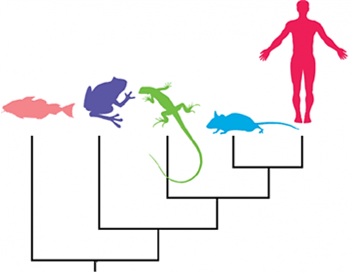
What is the human most closely related to?
Fish
mouse
Salamander
Human

Where is the alligator and T. rex's common ancestor?
Point A
Point B
Point C
Point D
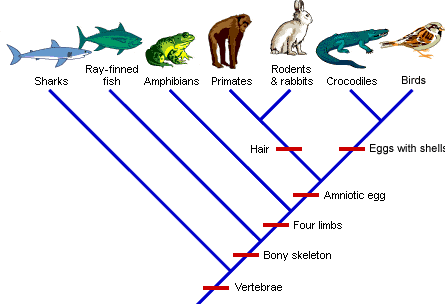
What is the purpose of a cladogram?
To map the ancestral relationships and shared traits of different organisms.
To trace the inherited traits of a single species over time.
To check the likelihood of an offspring having a particular trait.
To monitor mutations that arise among different populations.

What do both the squirrel and lion have in common that the other animals do not?
They are both vertebrates
They both have lungs
They are both mammals
They both lose their canine teeth.

What do amphibians, birds, prosimians and humans all have in common? Check all that apply.
Hair
Endothermic
Eukaryotic
Tetrapod
Vertebrate

Which letter represents the most recent common ancestor of sponges and mushrooms?
A
B
C
D
E

Which trait should go where A is on the cladogram?
eyes
feet
lips
hat

Which organism goes in the B position?


According to the diagram, what is the common ancestor of ALL organisms on the phylogenetic tree?
B
C
D
E

What is the common ancestor of Letters A, B, C, D, E?
1
2
3
4

Using the cladogram, which two organisms are more closely related Lizards and Newts OR Lamreys and Sharks
Newts and Lizards
Lampreys and Sharks

Which trait(s) do conifers have?
vascular tissue only
vascular tissue and seeds
vascular tissue, seeds and flowers
seeds only
How has technology helped us in understanding evolutionary relationships?
We can travel back in time to observe different organisms in their habitats.
We clone different organisms using DNA from fossils so we can bring them back and observe.
We can now compare the DNA of different organisms to help determine the relationships between them.
We can follow different organisms on Twitter to look for similar traits and characteristics.
How can a cladogram be used to show how closely related two organisms are?
The further apart two organisms are on a cladogram the more they have in common.
If two organisms are next to each other on a cladogram then they must be the same species.
All organisms share a common ancestor.
You can use a cladogram to see how many traits two organisms have in common. The more in common, the more closely related they are.
Which of the following pictures is an example of a cladogram?


According to the tree, who is the closest relative to the human?
Yeast
Pine
Giardia
Fern

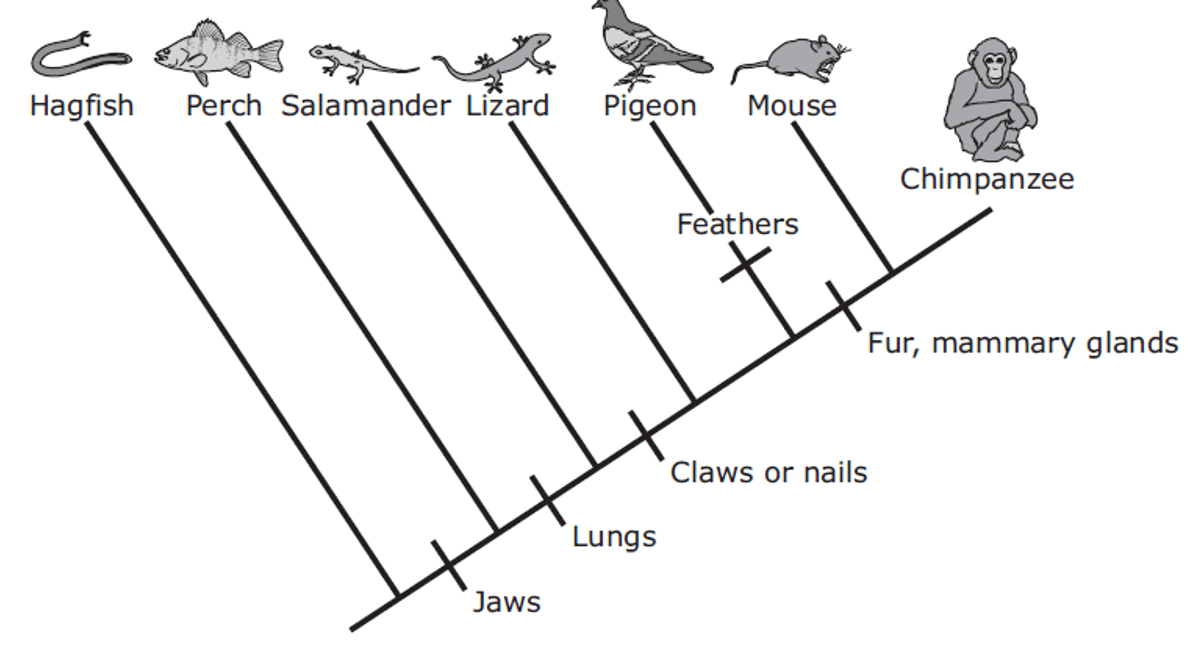
Based on the cladogram, what trait was last developed?
Opposable thumbs
lungs
claws / nails
fur / mammory glands

Which organisms lack tissues?
Roundworms
Flatworms
Cnidarians
Sponges

