
 Worksheets
Art History Final
Total questions: 101
Worksheet time: 53mins

What do the cave art images tell us about the people that made them?
They were likely hunters.
They weren't very creative people.
They were likely farmers.

For what purpose did prehistoric people make art?
To connect with and have power over the animals they hunt
To tell stories of their great hunts to tribesmen
To practice art for fun
To remember the dead animals slain in the hunt


The largest Pyramid was made for which Pharaoh?
Khufu
Khafre
Sphinx
Tutankhamun

Most of the Ancient Egyptian Art we have in museums today is because they were discovered in tombs. True or False?
False
True

Hieroglyphs carved in stone are examples of:
Relief Sculpture
Sculpture in the round

Is this an example of High Relief, Low Relief, or Sculpture in the Round?
High Relief
Low Relief
Sculpture in the Round

Is this an example of High Relief, Low Relief, or Sculpture in the Round?
High Relief
Low Relief
Sculpture in the Round

Is this an example of High Relief, Low Relief, or Sculpture in the Round?
High Relief
Low Relief
Sculpture in the Round

Archaic period, Intermediate period, New Kingdom
Old Kingdom, Intermediate Period, New Kingdom

What is the title of the Egyptian masterwork?
Nebamun Wanders the Marshes
Nebamun Guiding His Family
Nebumun Beats Crane with Snake
Nebamun Hunting In The Marshes
The Greek developed three architectural systems called orders:
the Doric, Composite, and Spartan
the Doric, Ionic, and Corinthian
the Doric, Spartan, and Composite
the Tuscan, Ionic, and Tuscan

The Temple of Zeus
The Pantheon

Kritos
Contraposto
Chiaroscuro

Identify this column
Ionic
Doric
Corinthian

Identify this column
Doric
Ionian
Corinthian

Identify this column
Doric
Ionic
Corinthian

What type of column is shown in the photo from the Greek era?
Doric
Ionic
Corinthian
Where is the Acropolis placed?
On top of a hill/mountain in Athens
On the coast of Athens
At the center of Athens
By the Temple of Zeus
What are the three major periods of ancient Greece?
Classical, Hellenic, and Hellenistic
Geometric, Oriental, and Classical
Archaic, Classical, and Hellenistic
Archaic, Geometric, and Classical

What Greek period is this sculpture from?
Archaic
Macedonian
Hellenistic
Classical

What Greek period is this sculpture from?
Archaic
Macedonian
Hellenistic
Classical

What Greek period is this sculpture from?
Archaic
Macedonian
Hellenistic
Classical
List one or more of the three principles/ideas that Greek culture was founded on
(a)

Name the technique shown here using small peices of glass tesserae.
Mosaic
Mondrian
Moniped
Mindset
Mt. Vesuvius erupted in 79 AD and buried these two cities in volcanic ash.
Helena and Athens
Naples and Rome
Pompeii and Herculaneum
Florence and Caprese

What is the name of this structure built to honor all the Roman gods?
The Portcullis
The Parthenon
The Pantheon
The Panetone


Which image best represents an oculus?


These two cultures greatly influenced Roman culture.
Greek and Macedonean
Persia and Egyptian
Etruscan and Greek
Greek and Egyptian

Name this monument
Arch of Constantine
Arch of Titus
Arc de Triomphe
Arch of Hadrian
The Silk Road did what for China?
Boosted its export of consumable goods and allowed for the economy to flourish
Allowed foreigners in, weakening the Chinese culture
Led to Buddhism infiltrating China
Hurt the Chinese economy because they traded more valuable resources for gold and silver
Most Chinese painters were...
Full time craftsmen
poor men who painted in the night so the emperor didn't have to see them
Scholars who were expected to be proficient in several arts
Priests

In the Han Dyansty, most paintings were done on. . .
scrolls
paper
canvas
glass
Chinese Scholars and Magistrates were expected to master what three arts?
Calligraphy
Sculptng
Poetry
Poetry
Qin playing
Painting
Calligraphy
Painting
Poetry
Painting
Opera
Qin Playing

What is the name for a fine, white glassy clay?
greenware
Earthenware
Stoneware
Porcelain

In the Han Dynasty, which religion became popular?
Christianity
Buddhism
Hinduism
Judhaism
The earliest example of christian art is found in _______ painted on the walls
The colosseum
Greek temples
Roman catacombs
The forum of Trajan
Early Christian churches were based on ______________.
Roman temples
Egyptian temples
Roman villas
Roman basilicas
Who legalized Christianity in the Roman empire?
Nero
Constantine
Augustus
Julius Caesar
The term "Pagan art" refers to _____________.
a portrait of Jesus that portrayed him without a beard
a work of art that depicted worship of the devil
statues of Hebrew prophets
any work of art created by a non-Christian culture
The Renaissance was marked by a renewed interest in ____?
Science
Ancient Greek and Roman culture
classical systems of government
Pagan belief
Humanism, which was intellectually what The Renaissance was based on, was all about __________.
the value of human beings and their capacities
Focusing on a religious theology that was more concerned with humanity
Believing all things started in the mind of man
Humanity being the most important species on earth
What was the theme of most early Renaissance art?
Anatomical images
Secular images
Christian images
Mystical Images
Which cities in Italy were the center of Renaissance artistic production?
Rome, Milan, Naples, and Verona
Venice, Milan, Naples, and Palermo
Venice, Milan, Siena, and Florence
Florence, Venice, Rome, and Palermo
Why was the emergence of oil paint as a medium significant to the Renaissance?
Slow drying time, richer colors, and the ability to work in layered glazes
Fast drying time, muted colors, and the ability to work in layered glazes.
Slow drying time, muted colors, and the ability to work in layered glazes
Fast drying time, richer colors, and the ability to work in layered glazes
True or false: Naturalism influenced Renaissance art.
True
False

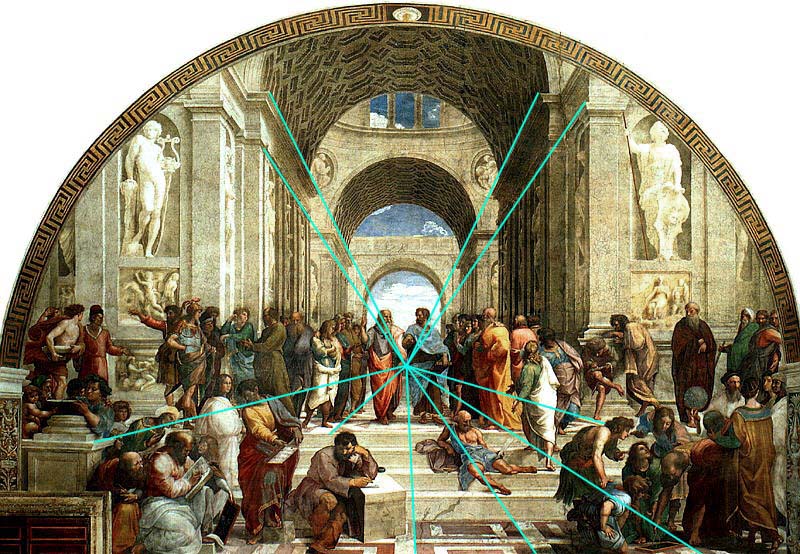
This fresco is located in the Sistine Chapel, Vatican City.
Raphael's "School of Athens"
Michelangelo's "Creation of Adam"
Ghirlandaio's "Confirmation of the Franciscan Rule"
Botticelli's "Primavera"
Which family was famous for their patronage during the Italian Renaissance?
The House of Massimo
The Orsinis
The Medicis
The Sforza
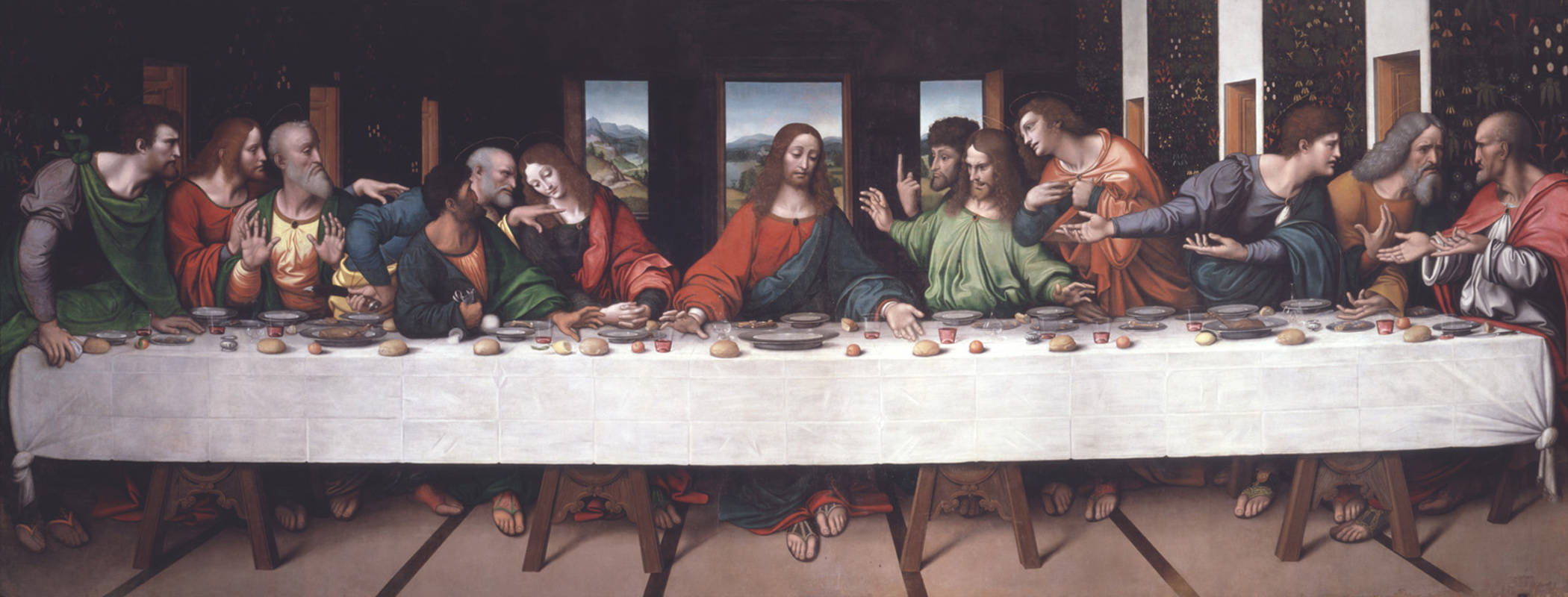
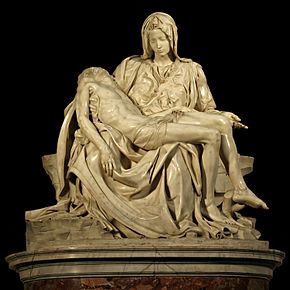

Which artist sculpted the following bronze sculpture depicting "David"?
Donatello
Leonardo da Vinci
Michelangelo
Raphael
After Charles VIII invaded Florence, which city became the hub of artistic production during the High Renaissance
Rome
Venice
Paris
Palermo

Which artists is known as the "Renaissance Man", because he was so well-rounded in many studies of the Renaissance?
Donatello
Leonardo da Vinci
Michelangelo
Raphael

Who painted the masterwork the Primavera
Madonna
Giotto
Masolino
Botticelli
Which oil painting technique did Leonardo Da Vinci invent that meant "in the manner of smoke" that blurred edges and smoothed contours?
Sfumato
Scumbling
Alla Prima
Chiaroscuro


Las Meninas
Judith beheading Holorferness (Artemisia)
Judith beheading Holorferness (Caravaggio)
The Night Watch

Which Greek art movement is baroque most similar to?
Classical
Geometric
Archaic
Hellenistic
Baroque art is a reject of the __________ of Renaissance art
Grandeur and Spectacle
Intellect and Curiosity
Restraint and Balance
Seriousness and Realism

Which period is this painting from?
Renaissance
Baroque
Rococo

Which period is this painting from?
Renaissance
Baroque
Rococo

Which period is this painting from?
Renaissance
Baroque
Rococo

Which period is this painting from?
Renaissance
Baroque
Rococo
describes a style of painting characterized by deep shadows and a distinct contrast between light and dark areas (which are kept completely black).
Chiaroscuro
Tenebrism
Impasto
Rocaille
Describes the prominent contrast of light and shade in a painting, drawing or print, to create the illusion of three-dimensional forms.
Chiaroscuro
Tenebrism
Impasto
Rocaille

David with Head of Goliath was painted by what Italian artist?
Masaccio
Caravaggio
Bernini
Rubens

Who sculpted this rendition of David in motion?
Michelangelo
Donatello
Vivaldi
Bernini
The new European art style which was popular in the late 1700s, and was characterized by simple and elegant designs inspired by ancient Rome and Greece is called...
Baroque
Classical
Neoclassical
Artisan
_______ was a teacher and the most famous neoclassical artist during this time period.
Caravaggio
Michelangelo
Jacques-Louis David
Vincent Van Gogh
Check all correct statements
The Enlightenment was a period of big historical change
The Enlightenment happened in Eastern Europe and the Americas
The Enlightenment was a period of strength for the church
The Enlightenment was a period of reason
The Enlightenment was about equality
Which was NOT a subject of this Neoclassicism:
Religious scenes
Mythological scenes
Historical events
Current events
This was important because it made art available to everyone:
Archeological discoveries
New Museums
Touring and travelling
This inspired the spread of antiquarianism
Archeological discoveries
Museums
The grand tour
Brushstrokes
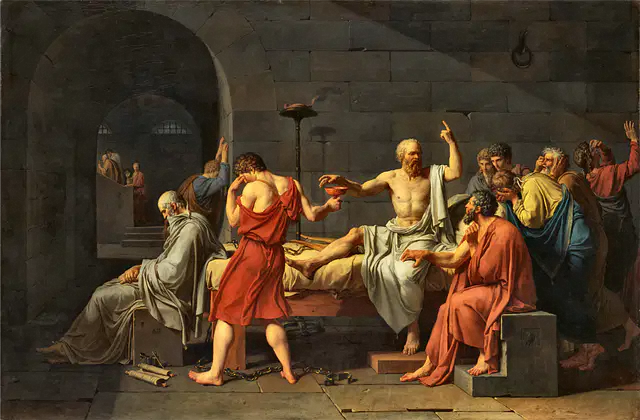
Which of the following artworks shows the final stance of a greek intellectual hero before he drank a cup of poisonous hemlock?
The Death of Socrates
The Apotheosis of Homer
Napoleon I on His Imperial Throne
The Death of Marat

His death signaled the end of Neoclassicism.
Jean-Auguste-Dominique Ingres
Jacques-Louis David

The patriotic three sons on the left firmly saluted in the gestures of a gladiator who is ready to die.
Oedipus and the Sphinx
The Death of Socrates
Napoleon I on his Imperial Throne
The Oath of the Horatii
What is the time period for the Romantic Era?
1820-1910
1850-1950
1750-1820
1810-1920
He is considered the first modern artist.
Theodore Gericault
Eugene Delacroix
Francisco Goya
Jean-Baptiste-Camille Corot
His intense desire for realism in his work led him to studying the dead and insane
Theodore Gericault
Eugene Delacroix
Francisco Goya
Jean-Baptiste-Camille Corot
He often uses his art to express his thoughts on the government, social injustice, his frustrations, physical and mental despair.
Theodore Gericault
Eugene Delacroix
Francisco Goya
Jean-Baptiste-Camille Corot
Which of the following are Romantic painters?
Eugene Delacroix
Antonio Canova
Francisco de Goya
Michelangelo
Which of the following are examples of Romantic Art?
Raft of Medusa
Saturn Devouring His Son
Liberty Leading the People
Death of Socrates
True or False: Romanticism is a style that emphasizes the imagination, emotions, and creativity.
True
False

What tenet of Romanticism is being shown in the above picture?
The role of community duty
The idealization of children
The sublime aspect of nature
Realistic views of humankind

What tenet of Romanticism is being depicted here?
Mans struggle for freedom
The idealness of children
The sublime aspect of nature
The realistic views of humankind
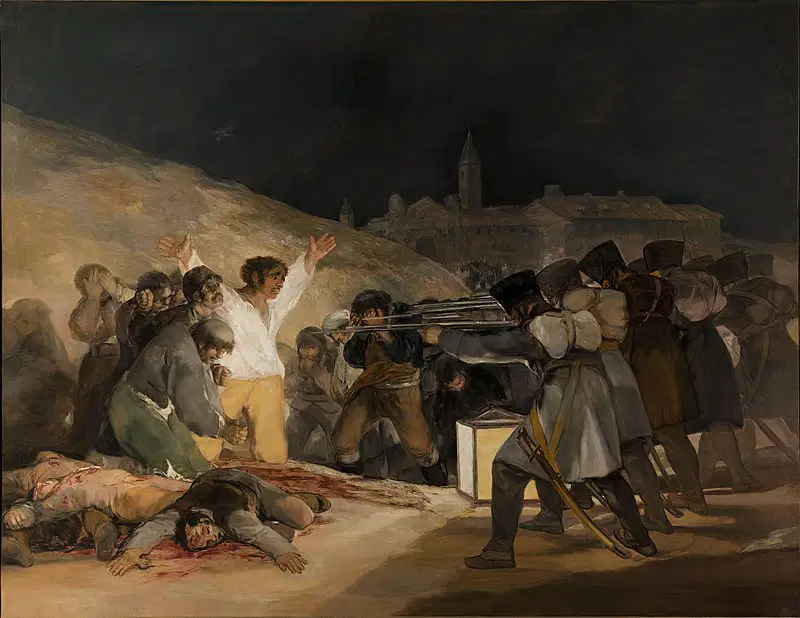
Which types of subject matter were elevated during the romantic movement?
Landscape and History
History And Portrait
Landscape and Genre
History and Genre

Which is a series of paintings completed by American artist Thomas Cole that showed the rise and fall of civilization contrasted by the enduring majesty of nature?
The Architect's Dream
Civilization
The Course of Empire
Empire: Destruction
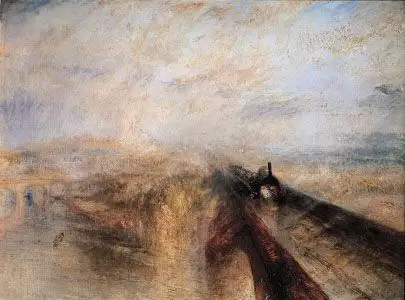
Who is the child prodigy that brought abstraction and the blurring of scenes to popularity in London?
Eugene Delacroix
Francisco Goya
James Turner
John Constanble
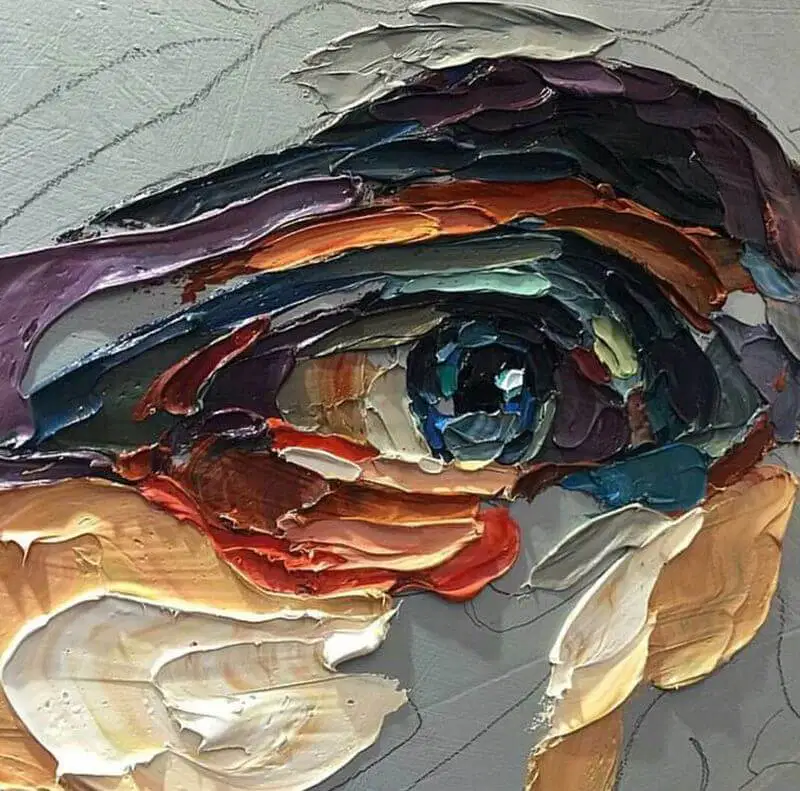
What is the name of the artistic technique where paint is applied heavily to add a sense of textrue
Spattering
A Wash
Impasto
A Glaze
And last but not least.... which is the correct order of artistic movement we have studied this year?
Prehistoric
Egyptian
Greek
Roman
Medieval
Renaissance
Rococo
Baroque
Neoclassicism
Romanticism
Prehistoric
Egyptian
Greek
Roman
Medieval
Baroque
Renaissance
Rococo
Neoclassicism
Romanticism
Prehistoric
Egyptian
Greek
Roman
Medieval
Neoclassicism
Baroque
Rococo
Renaissance
Romanticism
Prehistoric
Egyptian
Greek
Roman
Medieval
Renaissance
Baroque
Rococo
Neoclassicism
Romanticism

