Wayground logo

Free Printable Worksheets

Font size

S
M
L
XL
Worksheets

Exponential Graphs

Total questions: 40

Worksheet time: 2hrs 30mins
Name
Class
Date
1.

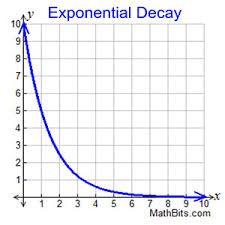
Is the pictured graph growth, decay, or linear or none?

a)

Exponential Growth

b)

Exponential Decay

c)

Linear

d)

None

2.
Is the pictured graph growth, decay, or linear or none?  
a)
Growth
b)
Decay
c)
Linear
d)
None
3.
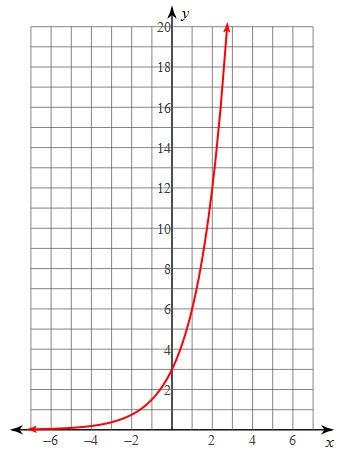
What is the y-intercept of the function?
a)
2
b)
3
c)
1
d)
-2
4.

Which graph shows a reflection of 

f(x)=3xf\left(x\right)=3^x  over the x-axis?

a)
b)
5.
Is the equation linear, exponential, or quadratic?
y = 2x+ 4
a)
Linear
b)
Exponential
c)
Quadratic
d)
None of the above
6.
Is the equation linear, exponential, or quadratic?
y = 2x
a)
Linear
b)
Exponential
c)
Quadratic
d)
None of the above
7.
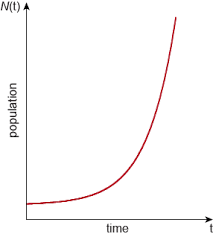
This graph represents:
a)
Exponential Growth
b)
Exponential Decay
c)
Direct Variation
d)
None of the above
8.
Is the pictured graph growth, decay, or linear?  
a)
Exponential Growth
b)
Exponential Decay
c)
Linear
d)
None of the above
9.
What type of function is y = 7(5/4)x?
a)
Exponential Growth
b)
Exponential Decay
c)
Linear
d)
None of the above
10.
What type of function is f(x)=2(1/7)x ?
a)
Exponential Growth
b)
Linear
c)
Exponential Decay
d)
None of the Above
11.
Is the graph linear, exponential or neither?
a)
Linear
b)
Exponential
c)
Neither
12.
What is the y-intercept of the function?
a)
(0,2)
b)
(0,3)
c)
(0,1)
d)
(0,-2)
13.
a)
A.
b)
B.
c)
C.
d)
D.
14.
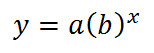
In an exponential function, what does the 'a' represent? 
a)

BASE

b)
RATE OF CHANGE
c)
INITIAL AMOUNT
d)
GROWTH OR DECAY FACTOR
15.

What is the y-intercept of f(x)=2(3)x ?

a)

(0, 2)

b)

(0, 1)

c)

(0, 0)

d)

(2, 0)

e)

(1, 0)

16.

What type of function is  f(x)=2(14)xf\left(x\right)=2\left(\frac{1}{4}\right)^x  ?

a)

exponential growth (increasing)

b)

exponential decay (decreasing)

c)

both growth and decay

17.

Pick the equation that represents exponential growth (is increasing).

a)

y=2(0.5)x

b)

y = 0.5(2)x

18.

Which the following graphs represents an exponential decay function?

a)
b)
c)
d)
19.

Does the equation represent an exponential function?

a)

Yes

b)

No

20.

Does the equation represent an exponential function?

a)

Yes

b)

No

21.

Does the equation represent an exponential function?

a)

Yes

b)

No

22.

Which equation is representative of the graph?

a)

y=2(3)x

b)

y=3(2)x

c)

y=2(6)x

23.

Which equation is representative of the graph?

a)

y=4(1/2)x

b)

y=1/2(4)x

c)

y=4(2)x

d)

y=8(1/2)x

24.

Which graph is representative of the equation?

a)
b)
c)
d)
25.

Which graph is representative of the equation?

a)
b)
c)
d)
26.

What does the a represent in the equation

f(x)=a(b)xf\left(x\right)=a\left(b\right)^x  

a)

Slope

b)

Y-intercept

c)

Rate of Change

d)

Common ratio

27.

Given the equation below determine the y-intercept.

y=3xy=3^x  

a)

(0, 1)

b)

(0, 3)

c)

x= 0

d)

y = 0

28.
Use the function, N = 14,000(.96)t.
What is the Initial Amount?
a)
14,000
b)
4%
c)
.96
d)
t
29.
Use the function, N = 14,000(.96)t.
Is the function INCREASING or DECREASING?
a)
Increasing
b)
Decreasing
30.
Use the function, M=.05(2)t, where M is the amount of money you have after t days.
What is the y-intercept?
a)
(0, .05)
b)
(0,2)
c)
(0, .1)
d)
(0,0)
31.
Use the function, M=.05(2)t, where M is the amount of money you have after t days.
Will the function be INCREASING or DECREASING?
a)
Increasing
b)
Decreasing
32.
Use the function, N = 14,000(.96)t. Where N is the number of employees and t is the number of years.
How many employees will there be after 3 years?
a)
14,000 employees
b)
12,386 employees
c)
40,360 employees
d)
15,748 employees
33.
Use the function, M=.05(2)t, where M is the amount of money you have after t days.
How much money will you have after 14 days?
a)
$ 819.20
b)
$ 8,192.00
c)
$ 1.40
d)
$ 819.02
34.

Which function has the greatest y-intercept?

a)

y=3⋅4xy=3\cdot4^x

b)

y=4⋅3xy=4\cdot3^x

c)

y=1⋅5xy=1\cdot5^x

d)

y=5⋅2xy=5\cdot2^x

35.

What is the equation that represents the exponential function in the image below?

a)

y=3(½)x

b)

y=3(2)x

c)

y=(2)x

d)

y=2(3)x

e)

y=(2)x+3

36.

Which equation is representative of the graph?

a)

y=2(3)x

b)

y=3(2)x

c)

y=2(6)x

37.

Which equation is representative of the graph?

a)

y=4(1/2)x

b)

y=1/2(4)x

c)

y=4(2)x

d)

y=8(1/2)x

38.
Which equation matches the graph?
a)
y=2(2)x
b)
y=2(1/2)x
c)
y=2x
d)
y=1/2(2)x
39.
Write an equation that models the following situation:
Samantha's hair was known to grow very rapidly. It began at a length of 6 in and grew at a rate of 14% a week.

a)
y=6(0.14)x
b)
y=6(1+14)x
c)
y=6(1.14)x
d)
y=6(0.86)x
40.
Which of the following functions shows an initial amount of $15 and an increase of 35% each year?
a)
y = 15(35)x
b)
y = 15(1.35)x
c)
y = 15(0.35)x
d)
y = 35(1.15)x