
 Worksheets
MAAP Review- WF
Total questions: 12
Worksheet time: 6mins
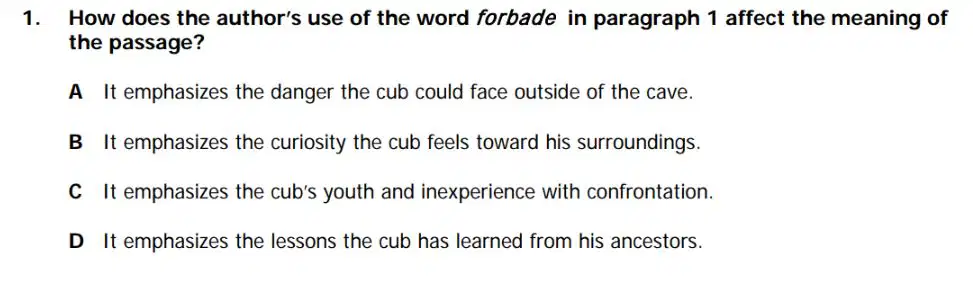
#1
A
B
C
D
Read these sentences from paragraph 6.
The hair bristled upon the grey cub’s back, but it bristled silently. How was he to
know that this thing that sniffed was a thing at which to bristle?
How do these sentences impact the plot of the passage?
A They foreshadow the trouble the cub will have navigating the wilderness.
B They foreshadow the return of the cub’s mother to the cave.
C They highlight the internal struggle the cub has with his own fear.
D They highlight the rapid change in the cub’s natural impulses.
3. Which quotation best illustrates the development of the points of view of the mother and the cub?
A “Not only had this law been forcibly and many times impressed on him by his mother’s nose
and paw, but in him the instinct of fear was developing. Never, in his brief cave-life, had he
encountered anything of which to be afraid.” (paragraph 1)
B “The hard obstruction of the cave-wall, the sharp nudge of his mother’s nose, the smashing stroke of her paw, the hunger unappeased of several famines, had borne in upon him that all
was not freedom in the world; that to life there was limitations and restraints. These
limitations and restraints were laws.” (paragraph 2)
C “Thus it was that in obedience to the law laid down by his mother, and in obedience to the
law of that unknown and nameless thing, fear, he kept away from the mouth of the cave. It remained to him a white wall of light.” (paragraph 4)
D “The cub was in a frenzy of terror, yet he lay without movement or sound, frozen, petrified into immobility, to all appearances dead. His mother, coming home, growled as she smelt the
wolverine’s track, and bounded into the cave and licked and nuzzled him with undue vehemence of affection. And the cub felt that somehow he had escaped a great hurt.” (paragraph 6)
4. How does paragraph 7 affect the development of the passage?
A It shows that when the cub leaves the cave, he is aware of the level of maturity he has
reached in knowing that he has to protect his mother.
B It shows that when the cub leaves the cave, he can no longer resist the curiosity that will help
him refine his natural instincts.
C It shows that when the cub leaves the cave, he is excited to test his limits and disobey his
mother.
D It shows that when the cub leaves the cave, he is inexperienced in preparing for a journey
away from the safety of his home
5. Read this sentence from paragraph 8.
Unlike any other wall with which he had had experience, this wall seemed to recede
from him as he approached.
What is the meaning of the word recede as it is used in this sentence?
A diminish
B flicker
C spread
D withdraw
6. Which quotation from the passage illustrates the effect of the mental development of
the cub?
A “It was a heritage he had received directly from One Eye and the she-wolf; but to them, in
turn, it had been passed down through all the generations of wolves that had gone before.”
(paragraph 1)
B “For he had already learned that there were such restrictions. Hunger he had known; and
when he could not appease his hunger he had felt restriction.” (paragraph 2)
C “Also, he forgot to be afraid. For the time, fear had been routed by growth, while growth had
assumed the guise of curiosity.” (paragraph 11)
D “Now the grey cub had lived all his days on a level floor. He had never experienced the hurt of
a fall. He did not know what a fall was. So he stepped boldly out upon the air.”
(paragraph 12
Read this sentence from paragraph 13.
The unknown bore him on he knew not to what frightful hurt, and he yelped and
ki-yi’d unceasingly.
Based on your knowledge of the prefix un— and the root cease, what is the meaning
of the word unceasingly as it is used in this sentence?
A at full volume
B once in a while
C with momentum
D without stopping
Part A
8. Which is a theme of the passage?
A One must trust gut reactions and take risks in order to grow.
B Rules and laws encourage natural curiosity.
C Overconfidence can lead one into dangerous situations.
D New experiences create false senses of security.
Part B
9. Which quotation develops the theme from Part A?
A “So the grey cub knew fear, though he knew not the stuff of which fear was made. Possibly
he accepted it as one of the restrictions of life. For he had already learned that there were
such restrictions.” (paragraph 2)
B “So there was no damming up the tide of life that was rising within him—rising with every
mouthful of meat he swallowed, with every breath he drew. In the end, one day, fear and
obedience were swept away by the rush of life, and the cub straddled and sprawled toward
the entrance.” (paragraph 7)
C “The light had become painfully bright. He was dazzled by it. Likewise he was made dizzy by
this abrupt and tremendous extension of space. Automatically, his eyes were adjusting
themselves to the brightness, focusing themselves to meet the increased distance of objects.”
(paragraph 9)
D “This was a different proposition from crouching in frozen fear while the unknown lurked just
alongside. Now the unknown had caught tight hold of him. Silence would do no good.”
(paragraph 13)
11. Which three quotations illustrate the effects of the setting on the cub?
A “Never, in his brief cave-life, had he encountered anything of which to be afraid.”
(paragraph 1)
B “Once, lying awake, he heard a strange sound in the white wall. He did not know that it was a
wolverine, standing outside, all a-trembling with its own daring, and cautiously scenting out
the contents of the cave.” (paragraph 5)
D “A great fear came upon him. This was more of the terrible unknown. He crouched down on
the lip of the cave and gazed out on the world. He was very much afraid. Because it was
unknown, it was hostile to him.” (paragraph 10)
E “He began to notice near objects—an open portion of the stream that flashed in the sun, the
blasted pine-tree that stood at the base of the slope, and the slope itself, that ran right up to
him and ceased two feet beneath the lip of the cave on which he crouched.” (paragraph 11)
F “His hind-legs still rested on the cave-lip, so he fell forward head downward.”
(paragraph 12)
10. Read the incomplete summary of the passage from White Fang.
A young cub, just beginning to be left alone while his mother hunts for food, starts to
test his limits by venturing past the boundaries set by his mother. At first, he is
uncertain and cautious, but as time passes, he pushes past the fear to follow his
desire to explore outside of the cave. The cub is overwhelmed by the brightness and
size of his new surroundings but does not retreat to the safety of the cave.
Which sentence should be added to make a complete and accurate summary?
A He soon becomes comfortable enough to explore the wilderness as he is introduced to the
sights and smells that the world has to offer.
B He soon realizes his mistake when he is caught off guard by a predator that grabs hold of him
and will not let go.
C As he starts to become more courageous, the cub steps off of a ledge, falls down the hill, and
cries out in pain and fear about his unfortunate situation.
D After he pauses to get his bearings, the cub panics when he realizes how many of his mother’s
rules he has broken.
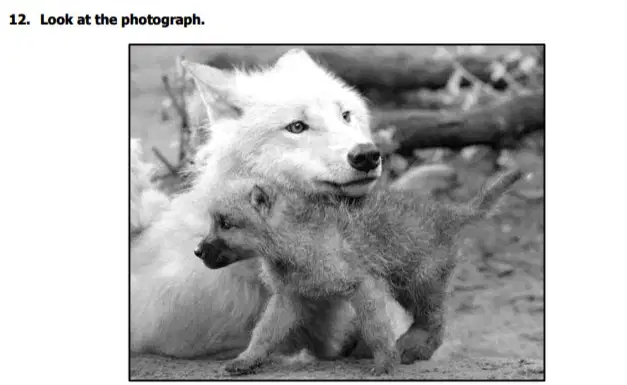
To which idea in the passage does the photograph contribute?
A the cub’s insistence on trying to escape the cave
B the cub’s darker colored fur in comparison to his mother
C the mother’s purpose to protect and nurture her cub
D the mother’s vigilance in watching for predators

