
 Worksheets
CBA 02 Review Spg 23
Total questions: 65
Worksheet time: 2hrs 37mins
The vertical (up and down) columns in the Periodic Table are called
groups
towers
periods
atomic numbers
Which group of the periodic table is composed of inert (not reactive) gases?
alkali metals
alkaline earth metals
halogens
noble gases
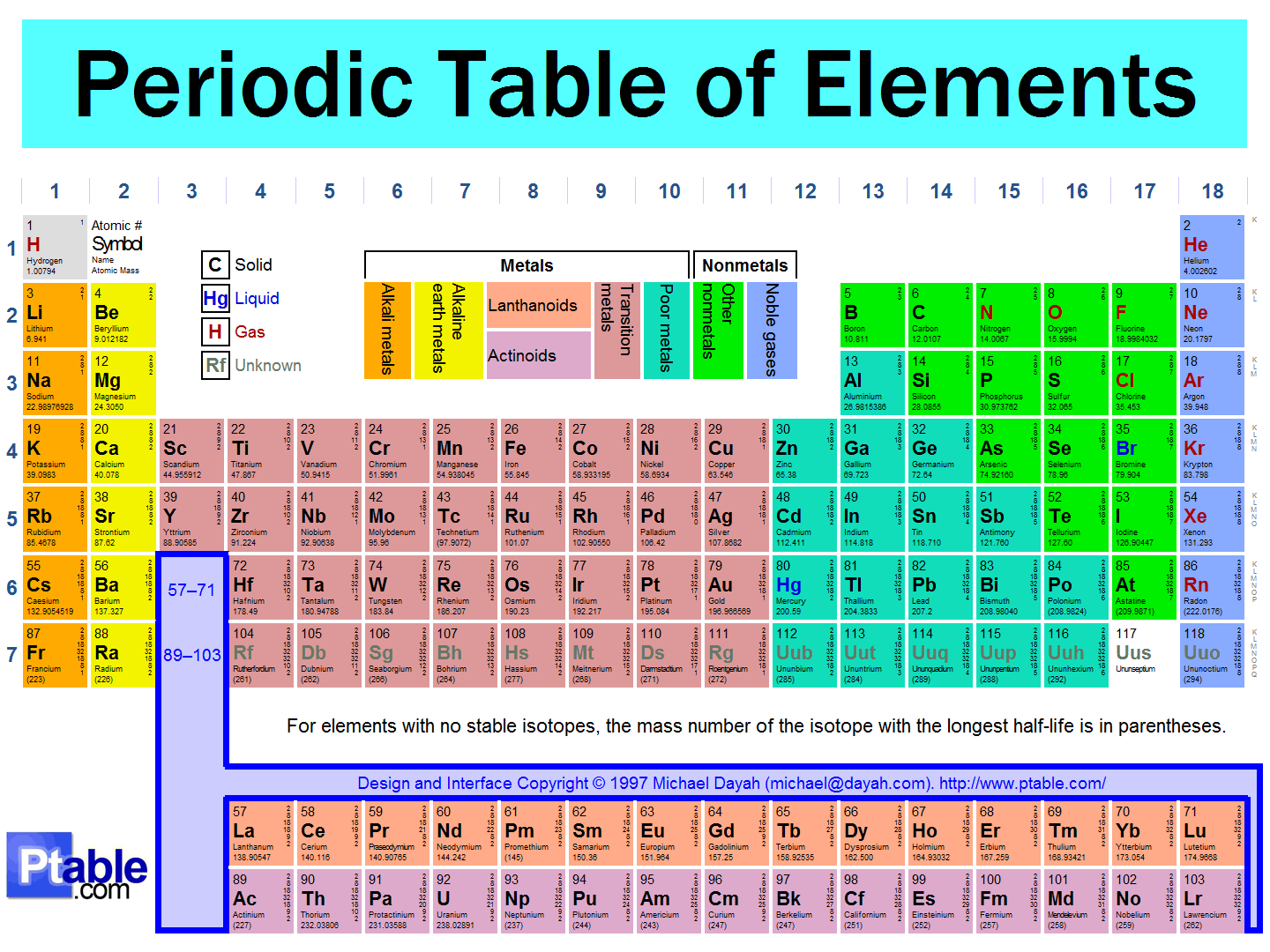


Mendeleev was the first person to arrange the elements into a table. How did he arrange the rows?
Which of the following will have similar properties?
O, S, Se
O, F, Ne
N, Ne, Na
H, K, P
Moseley arranged what we know as the "modern periodic table". How did he arrange it?
atomic mass
atomic number
valence electrons
number of isotopes
Reorder the following from earliest to latest:
Democritus
Dalton
Thomson
Rutherford
Bohr
What is the charge of a proton?
Negative
Positive
Neutral
Which of the following make up parts of an atom?
neutron
proton
electron
ultron
What measure does the Atomic Number show?
(a)
Match the Following
Element
A substance that cannot be broken down into simpler substances by chemical means.
Atom
The smallest unit of an element that keeps the element’s chemical properties.
Nucleus
The dense center of an atom containing protons and neutrons.
Proton
Positively charged particles found in the nucleus of an atom.
Neutron
Particles with a neutral charge found in the nucleus of an atom.
Metalloid
An element that has properties that fall between metals and nonmetals.
Nonmetal
Elements that are brittle, poor conductors, and have low melting and boiling points.
Noble Gas
Elements in group 18 that have very low reactivity.
Using a periodic table order the following elements by mass number, least to greatest.
Hydrogen
Boron
Gallium
Thallium
Radon

Which term means the distance from the crest of one wave to the next crest?
Amplitude
Frequency
Wavelength

A wave with a large wavelength will have...
Low Frequency & Low Energy
High Frequency & High Energy
High Frequency & Low Energy
Low Frequency & High Energy

Which has the LONGEST wavelength and therefore the lowest frequency/energy? These waves are used in broadcasting, wifi, and texting.
Gamma rays
Visible light
Radio waves
Infrared rays

Which section of the electromagnetic spectrum is the ONLY part humans can see?
X-Rays
Gamma Rays
Visible Light
Ultraviolet Rays

Which wave has a high frequency, a short wavelength, and high energy?
A
B
Not enough information to determine
Isotopes of an element have a different number of...
Protons
Neutrons
Electrons
Mass

Nickel-59 has how many neutrons?
30
31
32
33
Rubidium has two common isotopes, 85Rb and 87Rb. If the abundance of 85Rb is 72.2% and the abundance of 87Rb is 27.8%, what is the average atomic mass of rubidium?
85.468 amu
37 amu
85.6 amu
86.4 amu
There are two primary isotopes found in any sample of copper: copper-63 and copper-65. The isotope 65Cu composes 69.2% of the sample and 63Cu comprises the other 30.8%. Based on this data, what is the atomic mass of copper?
29 amu
63.546 amu
64.4 amu
63.6 amu


Name this compound.
KNO3
(a)
Name this compound.
Na3N
(a)
How many molecules are in 2.00 moles of H2O?
124x1024 molecules of H2O
1.20x10²³ molecules of H2O
12.04 x10²³ molecules H2O
124
88.0 grams of CO2 is about _____________. [Select 2 answers.]
1 mole of CO2
2 moles of CO2
6.02 x 10²³ molecules of CO2
two times 6.02 x 1023 molecules of CO2
What percentage of the total atomic mass of carbon monoxide (CO) is composed of carbon?
29%
43%
57%
73%
What percentage of the total atomic mass of magnesium bromide (MgBr2) is composed of magnesium?
13%
43%
63%
87%
What percentage of the total atomic mass of lithium phosphide (Li3P) is composed of lithium?
13%
29%
40%
60%
A chemical formula that shows the actual # and kinds of atoms present in one molecule of a compound is called_________
ionic formula
covalent formula
empirical formula
molecular formula
Which of the following compounds are both an empirical AND molecular formula (Select 2 answers)
C6H12O6
C12H22O11
H2O2
S2O4
H2O
24 grams of CH4 was added to the above reaction. Calculate the theoretical yield of CO2.
When reacting Na with Cl2, we calculated that the theoretical yield should be 13 grams. Our actual yield was 12.5 grams. What is the percent yield?
90.4%
104%
96.15%
1.04%
How many moles of hydrogen are needed to react with 2 moles of nitrogen?
How many grams of potassium chloride (KCl) can be produced from 356 g of potassium bromide (KBr)?
How many moles of carbon dioxide are produced from the combustion of 110 g of CH4?
This is what you call a reactant that you have enough of. The one that DOES NOT run out.
Limiting Reactant
Excess Reactant
Highly Reactant
Super Reactant
4NH3+6NO --> 5N2 + 6H2O

