
Font size
 Worksheets
Electricity (PS M6 Review)
Total questions: 27
Worksheet time: 16mins
Resistance is measured in a unit called the ____.
ampere
coulomb
ohm
volt
The statement that current is equal to the voltage difference divided by the resistance is known as ____.
Einstein's equation
Faraday's law
Newton's law
Ohm's law
A path that allows only one route for an electric current is called a ____.
parallel circuit
parallel current
series circuit
series current
Electric charge that has accumulated on an object is referred to as ____.
circuit electricity
current circuit
current electricity
static electricity
A circuit that has two or more branches for electrons to follow is a(n) ____.
circuit diagram
electron circuit
parallel circuit
series circuit
The rate at which an electrical device converts energy from one form to another is called ____.
electrical energy
electrical power
electrical resistance
voltage regulation
A material through which electrons do NOT easily flow is a(n) ____.
conductor
fuse
insulator
transformer
If the leaves of an electroscope spread apart, it indicates that ____.
the leaves of the electroscope are neutral
the leaves of the electroscope have received a charge
no charge is moving through the electroscope
there is static electricity in the electroscope
Lightning is ____.
a buildup of neutrons
harmless
a high-voltage electric current
a large discharge of static electricity
One source of constant electric current is a ____.
coulomb
dry cell
switch
transformer
Which of the following statements is true about electric forces?
Electric forces cause objects to only attract each other.
Electric forces cause objects to only repel each other.
Electric forces cause objects to repel or attract each other.
Electric forces have no effect on each other.
When two bodies are charged, the total charge before and after charging remains the same because of:
quantization of charges
conservation of charges
law of induction
Coulomb's law
Charging by _____ charges a neutral body by touching it with a charged body; whereas charging by _____ charges an object without touching it with a charged body.
conduction, induction
induction, conduction
force, conduction
force, induction
_____charges repel, whereas _____ charges attract.
Like, opposite
Opposite, like
Positive, negative
Negative, positive
_____ forces between charges are enormous in comparison to _____ forces.
Electrical, gravitational
Gravitational, electrical
Positive, negative
Negative, positive
An area with excess electrons has a net _____ charge; an area with a deficit of electrons has a net _____ charge.
negative, positive
positive, negative
positive, neutral
negative, neutral
One example of a good conductor is ____.
copper
wood
glass
rubber
The rate at which an electrical device converts energy from one form to another is called ____.
electrical energy
electrical power
electrical resistance
voltage regulation
Electric companies usually sell electrical energy in units of ____.
watts
amperes
volts
kilowatt-hours
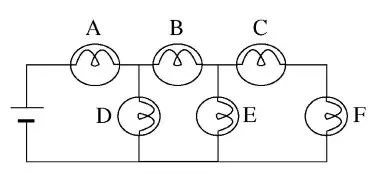
In the circuit shown below, which bulb, when burned out, will cause all other bulbs to stop glowing?
A
B
C
D
A/An _____ is described as the flow of charged particles.
electric field
electric potential difference
electric current
gravitational force
contains a piece of metal that melts if the current become to high
fuse
allows electrons to move through it easily
conductor
contains a piece of metal that bends when it gets hot
circuit breaker
detects the presence of electric charges
electroscope
does not allow electrons to move through it easily
insulator
charging a neutral body by NOT touching it with a charged body
charging by induction
the standard unit of charge
coulomb
charging a neutral body by touching it with a charged body
charging by conduction
the process of connecting a body to Earth to eliminate excess charge
grounding
consists of a metal knob connected by a metal stem to two thin leaves
electroscope
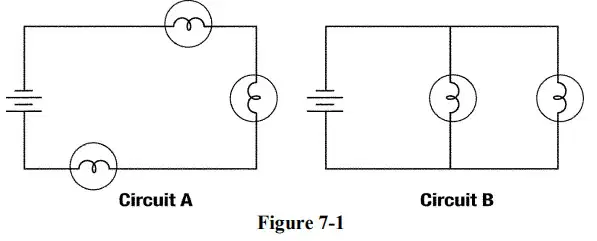
In Figure 7-1, circuit ____________________ is wired in series.
A
B
In Figure 7-1, circuit ____________________ is wired in parallel.
A
B
In Figure 7-1, circuit ____________________ represents the way that homes are usually wired.
A
B
In Figure 7-1, circuit ____________________ is the type of circuit that causes an entire string of decorative lights to go out when one of the bulbs burns out.
A
B

