
 Worksheets
Evolution Test Review Quizizz
Total questions: 25
Worksheet time: 25mins
Which is a characteristic of a virus but NOT a bacterium?
Causes illness
DNA is protected by a capsid
Damages the cells in a body
Transmitted in food and drink
According to the theory of ________, mitochondria in cells today are the descendants of aerobic prokaryotes that used oxygen to generate energy.
mutualism
ingestion
parasitism
endosymbiosis
In natural ecosystems, the presence of predators lessens the effects of ______ among the prey.
parasitism
competition
infestation
mutualism
Scientists want to determine how closely related chimpanzees are to humans. Which data would give the MOST accurate comparison?
Their niches
Their physical characteristics
Their DNA sequences
Their behavioral characteristics
The genetic information in human and chimpanzee DNA shows a high degree of similarity, as humans share about 96-99% of their DNA code with chimpanzees. What is an explanation for this similarity?
They evolved from a common ancestor
Their evolution is nearly complete
They evolved at the same time
They evolved from each other
A population of bacteria is treated with an antibiotic. Because of variation in the population of bacteria, what is a possible outcome of the treatment?
Some of the bacteria may be resistant to the antibiotic and survive.
All of the bacteria will be resistant to the antibiotic.
The population will increase rapidly.
The population will be better able to obtain a food source.
All bony fish have common ancestors. Their fins develop from similar structures and usually have the same number of bones. Because of this, all bony fish would share _________ structures.
Analagous
Vestigial
Evolutionary
Homologous
Bees can see yellow, blue and UV light but they can't see red. Bee-pollinated flowers are mostly yellow or blue with UV nectar guides to guide the bees to the food source. Once inside the flower, the bees inadvertently pollinate the plant. This is an example of:
Coevolution
Convergent Evolution
Divergent Evolution
In a population of beetles, there are green and brown colorations that occur with equal frequency. After a forest fire, only 20 beetles remain. 18 of them are green and 2 of them are brown. What describes this change in frequencies?
Gene flow occurred, as the 20 beetles migrated from a distant location.
Natural Selection selected for phenotypes that blended with green leaves, which did not burn.
A population bottleneck occurred, altering the resulting allele frequencies.
Founder effect provided a new distribution of phenotype frequencies.
Scientists estimate that the Earth formed some 4.6 billion years ago with the first forms of life appearing around 3.5 billion years ago. These first forms of life were simple prokaryotes. Later, the first photosynthetic organisms resulted in more ______ in the atmosphere. This allowed for more higher level organisms to appear on Earth.
oxygen
carbon
sulfur
nitrogen
The foundation for biological evolution or "descent through modification" is...
mutation, migration, genetic drift, and natural selection cause biological evolution
Changes in gene frequency in a population occur from 1 generation to the next.
All living things are made of 1 or more cells.
Organisms adapt to changes in their environment.
Before organisms with nuclei evolved, life on earth consisted only of unicellular...
protists
prokaryotes
fungi
eukaryotes
Once cells with nuclei developed, organisms were able to become more complex, which allowed them to adapt to the conditions in more habitats. By which process do organisms adapt and evolve?
Mutation
Natural Selection
Mitosis
Behavior
Penicillin is an antibiotic that was discovered in 1928. Today, many species of bacteria have acquired resistance to penicillin. This adaptation occurred as the result of...
Genetic mutation
Mutualism
Symbiosis
Divergent evolution
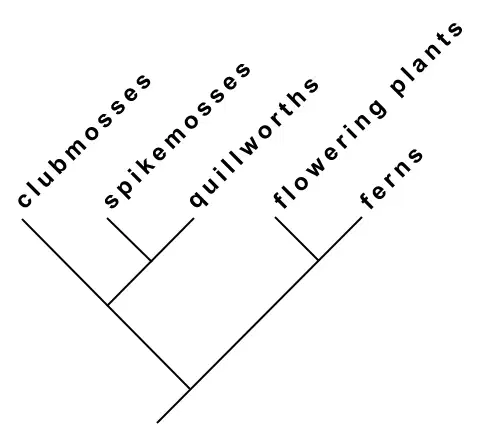
Flowering plants are also vascular plants. Based on the cladogram, what other members of the kingdom Plantae also have vascular tissue?
Clubmosses
Quillworths
Spikemosses
Ferns
According to the Cell Theory, where do cells come from?
Cells can only come from other, pre-existing cells
Cells are formed from the semi-conservative replication of DNA
Cells come from other cells and, on rare occasions, from the spontaneous action of inorganic enzymes.
Cells can only arise from the complex chemical environment found in organic solutions.
According to Darwin's theory of evolution, which organisms are BEST able to survive in nature?
Organisms that possess overall characteristics best suited to their environment.
Organisms that possess the greatest number of mutations.
Those that possess characteristics acquired during their lifetime.
Those with the best camoflage and coloration.
Which type of reproduction is MOST advantageous for the production of a wide variety of organisms in an individual species?
Sexual reproduction
Budding
Fragmentation
Binary fission
Which statement BEST describes how mutations are related to evolution?
They're changes in DNA that produce weaker organisms that die
They lead to new genes, which may have an advantage over old forms, causing the species to evolve
Natural selection causes evolution, which causes more mutations to appear in the DNA of the species
There is not a strong relationship between mutations and evolution.
The leopard frog and the pickerel frog are 2 closely related species. In areas where their ranges overlap, the frogs will remain separate species if they --
reproduce at different times of the year
eat different types of insects and crustaceans
occupy burrows in different parts of a creek
maintain different colored markings on their skin
Hummingbirds have a beak just the right length to reach the nectar in a cardinal flower and as they feed, they touch the pollen structure, transferring pollen from 1 flower to another. This is an example of:
Coevolution
Convergent Evolution
Divergent Evolution
Bats, birds, and even the pterodactyl originally had similar boney forelimbs that, over time, evolved into wings. This is an example of:
Coevolution
Convergent Evolution
Divergent Evolution
Whales, sharks and penguins, all in different classes of animals, have streamlined bodies with fins or flippers for efficient movement in water. This is an example of:
Coevolution
Convergent Evolution
Divergent Evolution
A kit fox lives in the desert and has large ears with greater surface area to prevent overheating. The red fox lives in the forest and has a red coat for camouflage. This is an example of:
Coevolution
Convergent Evolution
Divergent Evolution
The Galapagos tortoises share a common ancestor, but have shells of different shapes and necks of different lengths to reach the food they eat specific to their environment. This is an example of:
Coevolution
Convergent Evolution
Divergent Evolution

