
NEW
Font size
 Worksheets
American Revolution Review
Total questions: 16
Worksheet time: 12mins
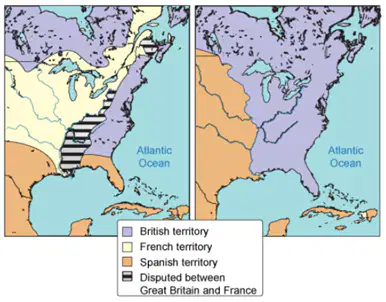
What is the relationship between these two maps?
North America before and after the American Civil War
North America before and after the American Revolution
North America before and after the founding of Jamestown
North America before and after the French and Indian War

After which event would this newspaper headline MOST LIKELY have appeared in colonial newspapers?
The Boston Tea Party
The Battle of Saratoga
The Battle of Bunker Hill
The French and Indian War
Which statement is MOSTLY true about the colonies after the French and Indian War?
Most colonists wanted to return to England after the war.
Most colonists agreed with the new taxes to pay for the war.
Most colonists disagreed with the new taxes to pay for the war.
Most colonists lost interest in gaining independence after the war.

Which of the following happened next in the American Revolution?
Colonists boycotted British tea
The Stamp Act was passed by Great Britain.
Colonists armed themselves to fight the British.
The Boston Massacre was reported in newspapers.
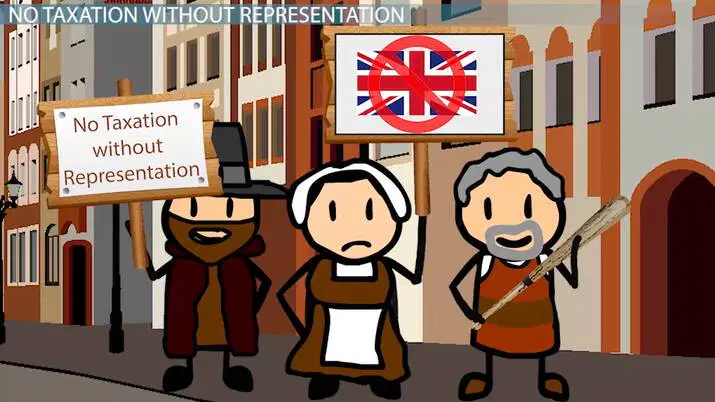
Which of the following BEST explains the phrase “No taxation without representation?”
Colonists did not like being taxed without collecting more stamps for official documents.
Colonists did not like being taxed without having a representative in the British government.
Colonists did not like being taxed without gaining more lands west of the Appalachian Mountains.
Colonists did not like being taxed without receiving military protection from the British government.
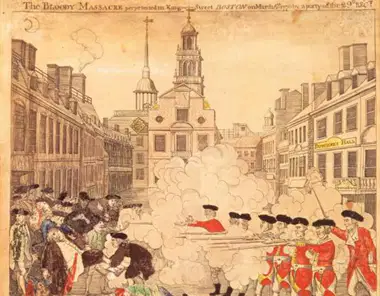
Why did Paul Revere share his image of the Boston Massacre so soon after it happened?
to show everyone that taxes are important
to convince people to turn against Great Britain
to convince people to stay loyal to Great Britain
to show everyone the colonists were aggressive
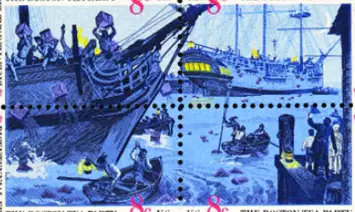
What event from the American Revolution is drawn on these stamps?
The Boston Tea Party
The Boston Massacre
The French and Indian War
The Declaration of Independence
Why was Thomas Jefferson so important to the success of the American Revolution?
His many inventions helped the Continental Army defeat the British troops in battle.
He was a strong military leader and led the Continental soldiers in many battles.
His writing and speaking skills helped him convince colonists to fight against Britain.
He wrote a musical about Alexander Hamilton to convince France to help the colonies.
Which colonist is famous for saying, “Give me liberty, or give me death?
Paul Revere
Patrick Henry
Benjamin Franklin
George Washington
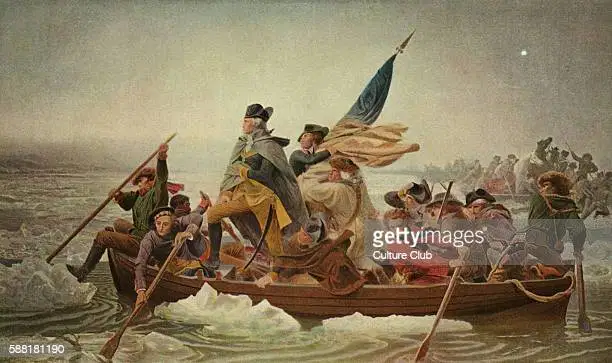
What was one of George Washington’s toughest challenges as a leader during the American Revolution?
to set an example for future presidents to follow
to create a skillful army from small, state militias
to stop the fighting between the large states and small states
to try to add to the Declaration of Independence from the battlefield
How did geography help the Continental Army defeat the British many times?
Colonists built the battlefields before each battle.
Colonists decided the locations of the battles for the British.
Colonists were more familiar with the land than the British soldiers.
Colonists used a secret code about hills and valleys to beat the British.
In the Battle of Lexington and Concord, how did the colonists use geography to their advantage?
They hid behind small hills and under bridges.
They destroyed bridges and burned the forest.
They surrounded the British who were fighting from ships.
They used the tallest mountain in the area to fire on the British.
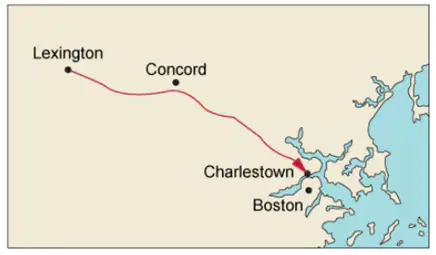
What does the arrow on the map show following the Battles of Lexington and Concord?
French soldiers marching to help the colonists against the British.
Colonists with guns running to Boston to get away from the British.
American Indians marching to help the British against the colonists.
British soldiers marching to Boston after they were defeated by the colonists.
At what battle did the Continental Army surround the British forcing them to surrender and end the war?
Saratoga
Yorktown
Valley Forge
Lexington and Concord
Who was the primary author of the Declaration of Independence?
Paul Revere
Patrick Henry
Thomas Jefferson
George Washington
In what city was the Declaration of Independence written?
Philadelphia, Pennsylvania
Boston, Massachusetts
New York, New York
Washington, DC

