
 Worksheets
3rd grade review 4/20
Total questions: 20
Worksheet time: 41mins
"Life's Greatest Treasure"
2. Which word is a synonym of tricky in line 12?
sly
honest
serious
boring
"Life's Greatest Treasure"
4. The title of the poem, along with the last 2 lines, help the reader understand-
the best kind of treasure is gold
children are happier than adults
a trip to the beach will be remembered forever
the most valuable things in life are happy moments
"Life's Greatest Treasure"
5. According to the poem, aunts and uncles-
are playful and loving
are older relatives who visit on weekends
help children learn to read and count
enjoy playing in puddles
"Fox and Crane"
1. What was Crane doing when he first saw fox?
Eating dinner
Cleaning his den
Walking in the forest
Cooking a pot of soup
"Life's Greatest Treasure"
8. The author includes the image of a shark in line 18 to show that -
taking a bath is sometimes dangerous
sharks can breathe under water
children enjoy pretending
some children are afraid of water
"Fox and Crane"
9. In the future, Fox will probably-
not enjoy eating soup
cook larger pots of soup
treat his guests with more respect
refuse to invite guests to dinner
"Fox and Crane"
10. What lesson does Crane try to teach Fox?
He should not invite Crane to dinner.
He should treat others like he wants to be treated himself.
Crane doesn't like the soup he makes.
Foxes can't drink out of tall pitchers.
"Fox and Crane"
11. What did fox do at the end of the story?
he left Crane's house still hungry
he enjoyed eating Crane's soup
he taught Crane an important lesson
he invited Crane to join him for lunch
"Matter and Energy"
1. Which words from paragraph 2 help you understand the meaning of the word consume?
heat and light
eating and eat
things and matter
moving and grow
"Matter and Energy"
2. Which section of the article is most likely to explain what happens when energy is added to liqui?
Got Gas?
Liquid Motion
Do Solids Move?
What are Energy and Matter?
"Matter and Energy"
3. What is paragraph 4 mainly about?
Sunlight is a form of energy for plants and animals.
Wood is a solid, but it can be broken.
Heat can cause solids to change.
The particles in solids are locked together.
"Matter and Energy"
4. From the selection, the reader can tell that-
energy changes matter
it is fun to learn about science
liquid has more energy than gas
water in a bathtub is in the shape of a cup
Reorder the following RUBIES Strategies
Read the questions first
Underline the title
Box important words
Inspect the text features including captions
Eliminate wrong answers. Explain why and justify
(a) names the topic of each section of text.
(a) tell about a picture.
Reorder the following POETS Strategies
Preview
Occasion
Emotion
Theme
Speaker
Match the following forms of poetry to their definition
Free Verse
A poem that has no set rhyme
Lyrical
A poem that is like a song
Narrative
A poem that is like a like a story
Humorous
A funny or silly poem
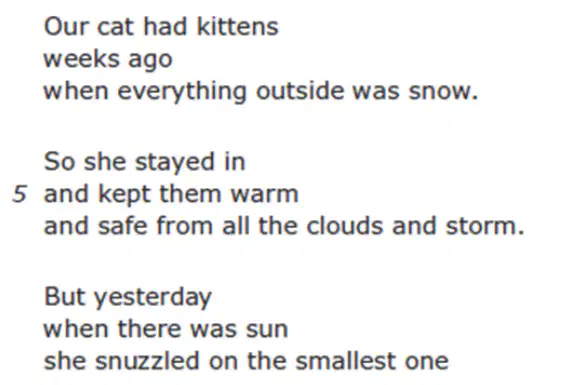
Which lines from the text rhyme? Choose all correct answer choices.
lines 8 and 9
lines 3 and 4
lines 5 and 6
lines 1 and 2
Name at least 2 elements of drama.
Match the following elements of drama to their definitions.
Setting
The time and place in a play.
Stage Directions
Written instructions telling the actors what to do.
Scene
The action that takes place in a single setting.
Cast
All of the characters, usually portrayed by actors.
Act
A chapter in a play that contains more than one scene.

