wayground logo

Free Printable Worksheets

Font size

S
M
L
XL
Worksheets

US History LEAP 2025 - Unit 3 Review

Total questions: 96

Worksheet time: 1hrs 3mins

Name
Class
Date
1.

Belief that no immigrants should be allowed into the country is called

a)

nativism

b)

racism

c)

Prohibition

d)

welfare

2.

Scandal where people accepted bribes to drill for oil in Wyoming is called

a)

Teapot Dome

b)

Great Migration

c)

Harlem Renaissance

d)

Black Tuesday

3.

This made war illegal, signed by 60 countries

a)

Kellogg-Briand Pact

b)

New Deal

c)

Bonus Army

d)

Great Migration

4.

A way to buy something by paying some now and then the rest later

a)

installment plan

b)

stock exchange

c)

Public Works

d)

welfare

5.

A period of time of great economic growth and widespread well being for America after World War I

a)

Roaring Twenties

b)

Great Migration

c)

Harlem Renaissance

d)

Dust Bowl

6.

Name given to movement of African Americans from the South to the North in order to get better jobs and find a better way of life

a)

Great Migration

b)

Harlem Renaissance

c)

New Deal

d)

Bonus Army

7.

A movement of artistic and intellectual development of African Americans in New York City during the 1920s

a)

Harlem Renaissance

b)

Great Migration

c)

Depression

d)

installment plan

8.

A ban on alcohol in America during the 1920s that created organized crime

a)

Prohibition

b)

Depression

c)

Escapism

d)

Black Tuesday

9.

A market where companies exchange shares

a)

stock exchange

b)

Public Works

c)

installment plan

d)

shanty towns

10.
_______________ are people who oppose all forms of government.
a)
Radicals
b)
Anarchists
c)
Nativists
d)
Strikebreakers
11.

Which cities did Lindbergh take off from and land in for his flight across the Atlantic Ocean?

a)

From Paris to Americus

b)

From New York to Paris

c)

From Americus to Paris

d)

From Americus to New York

12.

What is the "Spirit of St. Louis?"

a)

The name of the city Lindbergh grew up in

b)

The name of the plane Lindbergh flew across the Atlantic Ocean

c)

The name of the high school Lindbergh graduated from

d)

The name of the first plane Lindbergh flew

13.

Which of these helped create popular culture throughout the United States?

a)

the radio

b)

prohibition

c)

women's suffrage

d)

the KKK

14.

How did Prohibition contribute to the growth of organized crime?

a)

by making it easier for bootleggers to branch into other types of illegal activity

b)

by forcing police to enforce anti liquor laws

c)

by forcing farmers to grow grain for the production of alcohol

d)

by strengthening respect for the law

15.

At its heart, the Scopes Trial was a clash between

a)

religion and science

b)

biology and science

c)

evolution and science

d)

education and science

16.

Which of these best describes the "New Woman" of the 1920s?

a)

They wore shorter skirts, bobbed their hair, and went to speakeasies

b)

They stayed home and cooked and cleaned

c)

They rejected the idea of suffrage

d)

They preferred the same fashions as their parents

17.

Change in the constitution which prohibited the making, selling and transportation of alcohol.

a)

18th Amend.

b)

19th Amend.

c)

21st Amend.

d)

1st Amend.

18.

Change in the constitution which gave women the right to vote.

a)

19th Amend

b)

18th Amed

c)

21st Amend

d)

1st Amed

19.

Italians convicted of murder mainly because they were foreigners.

a)

Sacco & Vanzetti

b)

Scopes & Darrow

c)

Bryan & Darrow

d)

Mario & Luigi

20.

Period in the 1920s when suspected communists and other radicals were arrested due to the fear of the spread of communism.

a)

Red Scare

b)

Teapot Dome Scandal

c)

Scopes Trial

d)

KKK

21.

Secret organization that hated African Americans, Jews, Catholics, and immigrants.

a)

Ku Klux Klan

b)

Kool Kids Klub

c)

Kit Kat Kandy

d)

Anti-Defamation League

22.
Who was the President of the United States when the Stock Market crashed?
a)
Franklin D. Roosevelt
b)
Herbert Hoover
c)
Woodrow Wilson
d)
Theodore Roosevelt
23.
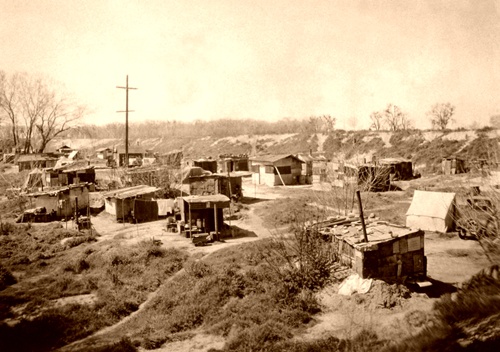
What was the main reason for the emergence of “Hoovervilles” like the one shown in the photograph?
a)
Many Americans had lost jobs during the Great Depression.
b)
Thousands of homes had been destroyed by the effects of the Dust Bowl.
c)
Housing projects could not keep up with the demand for homes needed by the poor.
d)
Preparations for World War I had created a shortage of building materials.
24.
During the early 1930s, the main goal of the Bonus Army was to pressure the Hoover administration to
a)
strengthen the nation’s defenses
b)
end the military draft
c)
bring American troops home from overseas
d)
support the early payment of money promised to veterans
25.
During the 1930s, poor land management and severe drought conditions across parts of the Midwest resulted in the
a)
formation of the United States Department of Agriculture
b)
creation of wheat surpluses
c)
growth of the Populist movement
d)
development of Dust Bowl conditions on the Great Plains
26.
A major difference between the philosophies of President Herbert Hoover and President Franklin D. Roosevelt in responding to the Great Depression is that Roosevelt
a)
wanted to rely on private charities to provide assistance
b)
stressed the need for individual rugged individualism
c)
supported direct relief to people out of work
d)
thought the government should not be involved in economic reform
27.
How did "bank runs" impact the American people during the Great Depression?
a)
Banks eventually ran out of money to loan, and people's life savings were gone.
b)
Banks made loans throughout the Great Depression, helping people pays bills until they could find work.
c)
Banks were able to people's deposits safe, but they could not loan out any more money.
d)
Banks were not at all involved in the Great Depression because people did not use them.
28.
Which of the following was a major cause of the Great Depression?
a)
overproduction and underconsumption
b)
a decrease in the supply of consumer goods
c)
an increase in demand for imported products
d)
an increase in the price of wheat on the world market
29.
The photograph best illustrates which impact of the Great Depression upon Americans?
a)
A large number of banks failed.
b)
The stock market crashed.
c)
Large numbers of people were hungry and homeless.
d)
Farmer’s incomes fell to low levels.
30.
What is one example of a charitable service during the depression?
a)
Hoovervilles
b)
Okies
c)
Shantytowns
d)
Soup kitchens
31.
Which of these was a direction that people migrated during the Great Depression?
a)
Oklahoma to California
b)
California to Detroit
c)
cities to farms
d)
Detroit to the South
32.
The Dust Bowl was a problem with farmland that happened during the Great Depression. The topsoil of fields dried up and blew in huge storms throughout the Great Plains. The Dust Bowl happened for two MAIN reasons:
a)
farmers overplanted their fields and there was a drought
b)
New Deal programs ruined farms and there was a drought 
c)
farmers overplanted fields and President Hoover ended the New Deal
d)
farmers sent too much food to soup kitchens and did not save enough for themselves 
33.
During the Depression, many people lost their homes and were forced to live in shantytowns. Some people referred to these shantytowns as Hoovervilles because
a)
President Hoover had failed to act to fight the Depression
b)
President Hoover built the shantytowns
c)
President Hoover was very popular
d)
President Hoover died in office
34.

President Hoover believed that direct economic relief was not an answer to the Great Depression because

a)

it would hurt the American spirit.

b)

government should keep a balanced budget.

c)

relief should come from state and local governments.

d)

All of the above

35.

Farmers left the Dust Bowl states during the 1930s because

a)

they were unable to farm the land.

b)

they wanted to go find gold.

c)

they wanted to be movie stars in California.

36.
Which was NOT a LONG-TERM cause of the Great Depression?
a)
Buying stock on margin
b)
Stock market crash (Black Tuesday)
c)
too much production and consumer spending
d)
Laisezz-faire economic policies
37.
What tool - passed during the Hoover Administration -  designed to protect American manufacturers actually ended up creating a worldwide depression?
a)
Reconstruction Finance Committee
b)
Hawley-Smoot Tariff
c)
New Deal
d)
Second New Deal
38.
The Bonus Army incident in 1932 best illustrates the idea that
a)
F.D.R.'
s relief programs were unsuccessful.
b)
many felt that Herbert Hoover was not handling the Depression well.
c)
protests by veterans during the Depression were effective.
d)
the U.S. Army had increased in size and power during the Depression.
39.

Which is a reason Americans preferred movies, radio, and entertainment during the Great Depression?

a)

Focused on the homeless and unemployed

b)

Evoked indignation at social injustice

c)

Provided a release from the daily worries

d)

Created thrills with new special effects

40.
Farmers contributed to the problems that led to the Dust Bowl by
a)
putting down new layers of topsoil.
b)
moving off of the plains to find new farmland.
c)
damming western rivers and using irrigation techniques.
d)
using intensive farming practices that removed protective grasses.
41.

Migrant farmers from Oklahoma

a)

Hooverville

b)

Okies

c)

Economy

d)

Soup Kitchens

e)

Dust Bowl

42.

The reason stock prices rose before the Great Depression

a)

Deficit Spending

b)

Buying on Margin

c)

Federal Reserve System

d)

Hawley-Smoot Tariff

43.

What was President Herbert Hoover's response to the Great Depression?

a)

He believed "rugged individualism" would solve the economy

b)

He created mass welfare

c)

He increased infrastructure to create jobs

d)

He violated his policy of laissez-faire

44.

Which of the following is NOT a cause of the Great Depression?

a)

Overproduction and underconsumption

b)

High tariffs restricting trade

c)

buying stocks on the margin

d)

high income taxes

45.

Who was most directly affected by the Dust Bowl?

a)

farmers

b)

investors

c)

industrial workers

d)

WWI Veterans

46.
A measure based on the prices of the stocks of 30 large companies, widely used as a barometer of the stock markets health
a)
Dow Jones Industrial Average
b)
Stock Market
c)
Speculation
d)
Black Tuesday
47.
An agency that provided emergency financing of banks, life insurance companies, railroads and other large businesses
a)
Reconstruction Finance Corporation (RFC)
b)
Bonus Army
c)
Federal Home Loan Bank Act
d)
Hawley-Smoot Tariff Act
48.

___________ is a sudden rush by depositors to withdraw their deposited funds from banks.

a)

bank run

b)

demand deposit

c)

electronic funds transfer

d)

fiat

49.

reluctantly signed by President Hoover to supply relief funds to states

a)

William Faulkner

b)

margin call

c)

Reconstruction Finance Corporation

d)

Emergency Relief and Construction Act

e)

Grant Wood

50.

set up in 1932 to allow the government to make loans to businesses

a)

William Faulkner

b)

margin call

c)

Reconstruction Finance Corporation

d)

Emergency Relief and Construction Act

e)

Grant Wood

51.

The Depression had deep roots in the economy of the 1920s, including overproduction, high tariffs, missteps by the Federal Reserve, and

a)

the uneven distribution of income.

b)

an inadequate money supply.

c)

deficit spending by the government.

d)

excessive reliance on export sales.

52.

Thousands of World War I veterans came to Washington, D.C., in 1932 to lobby Congress to

a)

give bonus payments to war veterans and their families.

b)

pass legislation giving veterans their promised bonuses early. provide public works jobs for unemployed veterans. D. provide military jobs for family members of veterans

c)

provide public works jobs for unemployed veterans. provide military jobs for family members of veterans

d)

provide military jobs for family members of veterans

53.

President Hoover opposed direct federal relief to the unemployed because he believed

a)

only state and city governments should dole out relief.

b)

federal relief would only shorten the Depression.

c)

charities could provide sufficient relief.

d)

individuals are responsible for taking care of themselves

54.
Which of these statements is true of the 1932 presidential election?
a)
Franklin Roosevelt won in a landslide.
b)
Hoover lost by a narrow margin.
c)
Huey Long ran a strong third-party campaign.
d)
Roosevelt won a third term.
55.
A major result of the New Deal was that it
a)
eliminated poverty in the US
b)
extended the merit system in the civil service
c)
destroyed the private enterprise system
d)
greatly increased the size and power of the Federal Government
56.
FDR addressed the American public in weekly broadcasts known as:
a)
FDR Hour
b)
Hangin' With Franklin
c)
Fireside Chats
d)
Around the Fire
57.
A major difference between the philosophies of President Herbert Hoover and President Franklin D. Roosevelt in responding to the Great Depression is that Roosevelt
a)
wanted to rely on private charities to provide assistance
b)
stressed the need for individual rugged individualism
c)
supported direct relief to people out of work
d)
thought the government should not be involved in economic reform
58.
What was a guiding principle of the New Deal economic policies?
a)
Pro-business tax breaks would solve the problems associated with urban poverty.
b)
Antitrust legislation would destroy the free market economy of the United States.
c)
Rugged individualism must be allowed to solve social inequality.
d)
Government must assume more responsibility for helping the poor.
59.
As part of the New Deal, the Securities and Exchange Commission (SEC) and the Federal Deposit Insurance Corporation (FDIC) were created to
a)
allow for a quick recovery of stock prices
b)
provide direct loans to businesses
c)
protect individual investors from stock fraud and bank failure
d)
allow banks and companies to invest in the stock market
60.
An advocate of President Franklin D. Roosevelt’s farm policy would have likely supported which economic strategy?
a)
Reducing agricultural output to increase product values
b)
Utilizing minimum wage laws to stimulate farm productivity
c)
Allowing market forces to operate freely to achieve stabilization
d)
Increasing agricultural production to ensure an affordable food supply
61.
How would an African American during the Great Depression most likely have felt about the New Deal?
a)
Disappointed, because the TVA failed to bring power to African American farmers in its Rural Electrification Program.
b)
Outraged, because African Americans were ineligible for any benefits under New Deal programs.
c)
Frustrated, because the CCC and other work programs discriminated against African Americans.
d)
Angry, because President Franklin D. Roosevelt did not attempt to restrain his racially insensitive views.
62.
A major reason that President Franklin D. Roosevelt proposed adding Justices to the Supreme Court in 1937 was to
a)
make the Court processes more democratic
b)
end corruption and favoritism in handling cases
c)
influence Court decisions related to New Deal programs
d)
ensure the appointment of members of minority groups
63.
Senator Huey Long, Dr. Francis Townsend, and Father Charles Coughlin are best known as
a)
members of President Franklin D. Roosevelt’s cabinet
b)
outspoken critics of President Franklin D. Roosevelt’s New Deal
c)
supporters of President Franklin D. Roosevelt’s reelection campaign in 1940
d)
members of the Supreme Court nominated by President Franklin D. Roosevelt
64.
The Civilian Conservation Corps (CCC) and the Works Progress Administration (WPA) were both New Deal programs developed to address the problem of
a)
excessive stock market speculation
b)
high unemployment
c)
increased use of credit
d)
limited income of senior citizens
65.
The TVA is significant because it hired people to 
a)
deliver food to the poverty-stricken Dust Bowl residents
b)
build dams and generators that provided electricity
c)
work on farms to help stabilize agriculture
d)
publish important facts about businesses
66.
The Fair Labor Standards Act of addressed what labor issue?
a)
Workplace safety
b)
Health insurance
c)
Collective bargaining
d)
Minimum wage
67.
Passage of the Social Security Act (1935) helped American workers by 
a)
creating jobs for the unemployed
b)
guaranteeing a minimum wage
c)
legalizing the right to join labor unions
d)
providing financial assistance after retirement
68.
How did "bank runs" impact the American people during the Great Depression?
a)
Banks eventually ran out of money to loan, and people's life savings were gone.
b)
Banks made loans throughout the Great Depression, helping people pays bills until they could find work.
c)
Banks were able to people's deposits safe, but they could not loan out any more money.
d)
Banks were not at all involved in the Great Depression because people did not use them.
69.

A way to buy something by paying some now and then the rest later

a)

installment plan

b)

stock exchange

c)

Public Works

d)

welfare

70.

A market where companies exchange shares

a)

stock exchange

b)

Public Works

c)

installment plan

d)

shanty towns

71.

October 29, 1929 - the stock market crashed to near zero, sending many people to bankruptcy in a single day

a)

Black Tuesday

b)

Depression

c)

default

d)

Prohibition

72.

Which of these helped create popular culture throughout the United States?

a)

the radio

b)

prohibition

c)

women's suffrage

d)

the KKK

73.

At its heart, the Scopes Trial was a clash between

a)

religion and science

b)

biology and science

c)

evolution and science

d)

education and science

74.
Shut down all banks in the U.S. to assess, restore confidence
a)
Federal Deposit Insurance Corporation
b)
Glass-Steagall Banking Reform Act
c)
Securities and Exchange Commission
d)
Emergency Banking Act
75.
Protects consumer savings in banks to keep confidence
a)
Federal Deposit Insurance Corporation
b)
Glass-Steagall Banking Reform Act
c)
Securities and Exchange Commission
d)
Emergency Banking Act
76.
Agency that oversees stock trading to ensure no foul play
a)
Federal Deposit Insurance Corporation
b)
Glass-Steagall Banking Reform Act
c)
Securities and Exchange Commission
d)
Emergency Banking Act
77.
Radio broadcasts that connected FDR to the public
a)
Fireside Chats
b)
State of the Union Address
c)
Presidential Broadcasts
d)
New Deal
78.
First woman in Presidential Cabinet; headed labor department
a)
Dorothea Lange
b)
Frances Perkins
c)
John Steinbeck
d)
F. Scott Fitzgerald
79.
Federal insurance for the retired, unemployed, and disabled
a)
Federal Deposit Insurance Corporation
b)
Socialism
c)
Social Security
d)
Wagner Act
80.
Senator who pushed for gov’t to take from rich to pay poor
a)
Charles Coughlin
b)
Francis Townsend
c)
Huey Long
d)
John Steinbeck
81.
What did young men  employed by the CCC or Civil Conservation Corps do?
a)
Planted crops on farms
b)
Cleaned the nations rivers and waterways
c)
Planted trees on public lands
82.
What did men employed by the WPA or Works Progress Administration do?
a)
Plant trees on public land
b)
Build roads, schools, and parks
c)
Farmers decrease production of crops
83.
When FDR closed all banks this became known as the "______________Holiday."
a)
Federal
b)
Winter
c)
Banking
d)
Money
84.
What was the nickname given to the government agencies under the New Deal?
a)
Alphabet Letters
b)
Alphabets and Numbers
c)
Alphabet Soup
85.
Which government agency gives benefits to people when they are retired or unemployed?
a)
Federal Deposit Insurance Corporation
b)
Securities and Exchange Commission
c)
Tennessee Valley Authority
d)
Social Security Admistration
86.
Which New Deal program was chiefly designed to correct abuses in the stock market?
a)
Civilian Conservation Corps
b)
Federal Deposit Insurance Corporation
c)
Securities and Exchange Commission
d)
National Recovery Administration
87.

What problem were both the Civilian Conservation Corps (CCC) and the Works Progress Administration (WPA) developed to address?

a)

Excessive stock market speculation

b)

High unemploment

c)

Increased use of credit

d)

Overproduction of goods

88.
The ____ was an agency formed to insure bank deposits up to a certain amount.
a)
Social Security
b)
SEC
c)
FDIC
d)
Tennessee Valley Authority
89.
A major reason for creating the Tennessee Valley Authority in 1933 was to-
a)
Provide health care benefits to southerners
b)
Encourage African-Americans to settle in the valley
c)
Improve economic conditions in a poor rural region
d)
Evacuate farmers from the impoverished region
90.
Which was a guiding principle of New Deal economic policies?
a)
“Rugged individualism” will end social inequality
b)
Government must assume greater responsibility for helping the unfortunate
c)
Antitrust legislation could destroy the free enterprise system
d)
State governments should have more power over the economy than the national government
91.

The Agricultural Adjustment Act tried to help farmers by

a)

helping them become more efficient

b)

paying them not to grow crops

c)

buying up their surpluses

d)

making land available for farming

92.

The TVA provided ________ for rural citizens.

a)

Electricity

b)

new farm land

c)

new homes

d)

New Deal support

93.

What is the NRA?

a)

National Registration Administration

b)

National Recovery Administration

c)

National Reservation Act

d)

National Redistribution Acts

94.
Which "R" does NOT belong?
a)
Relief
b)
Recovery
c)
Reform
d)
Redemption
95.
This organization gave jobs to artist, writers, and musicians to create artwork
a)
Works Progress Administration
b)
Public Works Adminstration
c)
National Recovery Adminstration
d)
Agricultural Adjustment Act
96.
The New Deal was divided into 3 categories: relief for immediate help, reform to fix problems, and _________________________ to help the people and nation “get back on their feet”. 
a)
RELIEF, RECOVERY, & REFORM
b)
RELIEF, RECOVERY, & REFILL
c)
RELIEF, Reincarnation, & REFORM