
 Worksheets
20th Century and Beyond: Gap Game
Total questions: 29
Worksheet time: 29mins
Why does the federal government have a significant impact on Virginia's economy?
The government built a large railroad hub in Virginia.
There were multiple inland ports created in Virginia to ship goods overseas.
Many federal government workers live and/or work in Virginia.
A large shipbuilding industry in Virginia was created following the Civil War.

What best completes this graphic?
All public schools were ordered to desegregate.
The federal government established New Deal programs.
The Supreme Court heard Davis v. County School Board of Prince Edward.
Byrd instituted his "pay-as-you-go" policy.
The federal government program that provided employment and eased hardships faced by Americans during the Great Depression was -
The New Deal
"Jim Crow" laws
"Pay-as-you-go" policy
Massive Resistance Plan
Which areas of Virginia have grown during the late 20th century and early 21st century due to computer technology?
Northern Virginia and the Appalachian Plateau
Coastal Plain (Tidewater) region and Shenandoah Valley
Areas near the Chesapeake Bay and the Appalachian Plateau
Northern Virginia and the Coastal Plain (Tidewater) region
Arthur Ashe, Jr. was an author, a spokesperson for social change, and the first African American to -
run for the Virginia state senate
participate in the Olympics
win a major men's tennis singles championship
lead the fight against Massive Resistance

The picture to the left shows a major part of Virginia's economy known as -
mechanization
tourism
manufacturing
technology
What happened to some school to avoid desegregation?
They were fined by the government.
They were closed.
They started literacy tests.
They became private schools.
Harry F. Byrd's "pay-as-you-go" policy helped fund Virginia's -
public schools
courts
roads
police departments
Which word completes this sentence?
The full equality of people of all races in the use of public facilities and services is called ___________________.
Segregation
Integration
Desegregation
Independence
Which word completes this sentence?
The separation of people, usually based on race or religion is called __________.
Segregation
Integration
desegregation
independence
Which word completes this sentence?
The legal end of racial segregation is called ___________.
segregation
integration
desegregation
independence
What policy did Virginia's government establish to fight against the desegregation of public schools?
Doctrine of Private Schools
Pay-as-you-go
Civil Rights Movement
Massive Resistance
One reason agriculture began to change in the early twentieth century, as seen on the left, is called -
manufacturing
mechanization
sharecropping
crop rotation
Working in private health care, in public schools, and on military bases are examples of which important industry in Virginia's economy?
Manufacturing industry
Service industry
Agricultural industry
Transportation industry
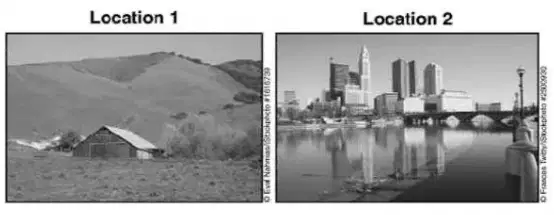
Which factor would persuade people to move from location 1 to location 2?
Religious freedom
Job opportunities
Smaller populations
Cleaner air
What did the U.S. Supreme Court rule in 1954 case Brown v. Board of Education?
All schools should continue to separate black and white students.
Each state had the right to segregate public schools.
"Separate but equal" public schools were unconstitutional.
States could choose who was allowed to attend school.
Oliver W. Hill, Sr. was a lawyer and civil rights leader who played an important role in the court decision -
Plessy v. Ferguson
to segregate Virginia schools
Brown v. Board of Education
of Massive Resistance
What was the Great Depression?
A federal government program to ease hardships
A Virginia's policy resisting desegregation
A period of harsh economic conditions worldwide
A lack of trade relationships with other countries
Which governor of Virginia appointed more African Americans and women to positions in state government than previous governors had?
A. Linwood Holton
L. Douglas Wilder
Harry S. Byrd, Sr.
Oliver W. Hill, Sr.

Barbara Johns
A
B
C
D

Maggie L. Walker
A
B
C
D

Harry F. Byrd, Sr.
A
B
C
D

L. Douglas Wilder
A
B
C
D
Which of the following is true of coal today?
Its current success is due to the expansion of the railroads.
It is less crucial to virginia's economy because people are using other energy sources.
It is Virginia's most important manufactured product.
It continues to spur growth in Virginia.
Which two factors make agriculture an important industry in Virginia?
Fertile Soil
Transportations Systems
Favorable Climate
Tourism
Currently, what is Virginia's most valuable source of agricultural income?
Tobacco
Chemical goods
Apples
Livestock and Livestock products
The following characteristics best describe which branch of Virginia's government?
Carries out state laws
Governor
Executive Branch
Legislative Branch
Judicial Branch
Constitutional Branch
The following characteristics best describe which branch of Virginia's government?
Decides cases about people accused of breaking state laws
State Court System
Executive Branch
Legislative Branch
Judicial Branch
Constitutional Branch
The following characteristics best describe which branch of Virginia's government?
General Assembly
Makes state laws
Executive Branch
Legislative Branch
Judicial Branch
Constitutional Branch

