
 Worksheets
Animal Kingdom Basics
Total questions: 10
Worksheet time: 7mins
Read the statement carefully and select the correct combination.
(a) Some members of Kingdom Animalia are unicellular.
(b) Tissues are grouped together to form organs system each specialised for a particular function.
(c) For the first time Triploblastic condition was seen in Phylum Platyhelminthes.
(a) and (b) are correct
(a) and (c) are correct
(b) and (c) are incorrect
(a) and (b) are incorrect
1. Organ level is exhibited by members of Platyhelminthes.
2. In sponges, the cells are arranged as loose cell aggregates.
1 is true and 2 is false
1 is false and 2 is true
Both are true
Both are false
Any plane that passes through the centre does not divide the organism into equal halves. This statement is valid for -
Coelentrates
Porifera
Platyhelminthes
Ctenophora
Select the correct combination of Phylum having triploblastic , bilateral symmetry and organ system level of organisation.
Cnidaria, Platyhelminthes, Arthopoda
Platyhelminthes , Aschelminthes, Chordates
Annelida, Arthopoda, Aschelminthes
Ctenophora, Aschelminthes, Annelida
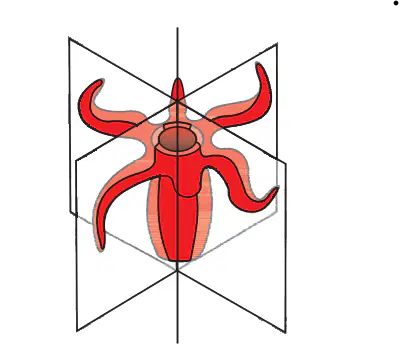
This diagram represents-
Bilateral Symmetry
Radial Symmetry
Asymmetrical
none
A -The Organ system level is lower than Organ level of organisation.
B- Few Sponges are not asymmetrical
A is correct only
B is correct only
A and B both are correct
A and B both are incorrect
Mesoglea is -
jelly like, cellular layer
jelly like, acellular layer
combination of ectoderm and endoderm
Modification of mesoderm
1st time Triploblastic and organ system level of Organisation was found in -
Platyhelminthes
Annelida
Arthopoda
Aschelminthes
Assertion - Coelenterata have Diploblastic organisation.
Reason - They contain ectoderm ,endoderm and mesoderm.
Both A and R are true and R is the correct explanation of A
Both A and R are true and R is not the correct explanation of A
A is true but R is false
A is false but R is true
1 - Without any exception Triploblastic organisation is present from Phylum Platyhelminthes to Phylum Chordates
2 - Echinodermata larva is bilateral symmetrical and Echinodermata adult is radial symmetrical.
Both are correct
Both are incorrect
Only A is true
Only B is true

