
 Worksheets
Quadratic Functions
Total questions: 165
Worksheet time: 6hrs 10mins

x = 2
x = 3
x = 4
y = 3

Vertex is (-2, -3) and the axis of symmetry is x = -2.
Vertex is (-2, -3) and the axis of symmetry is y = -2.
Vertex is (-3, -2) and the axis of symmetry is y = -2.
Vertex is (-3, -2) and the axis of symmetry is x = -2.

What are the roots of the function?

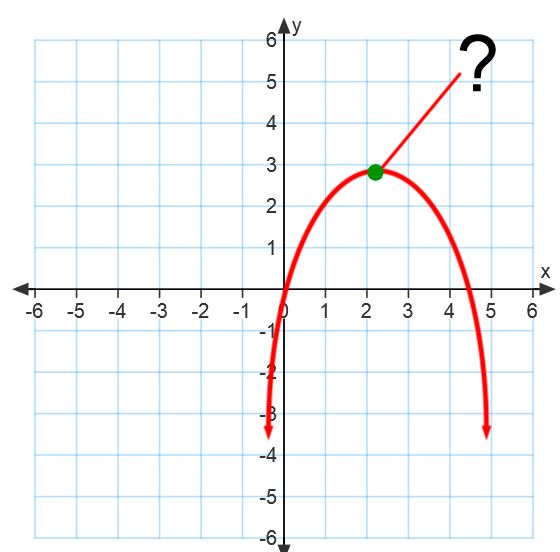
vertex
x-intercept
y-intercept
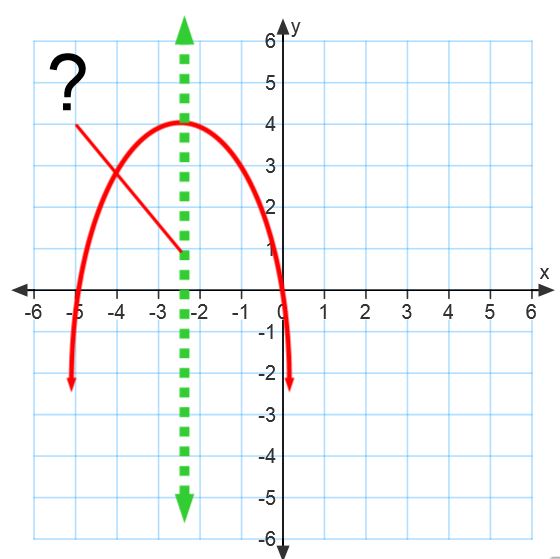
Where is the axis of symmetry?

What is the green dashed line called?
roots or x-intercepts
parabola
axis of symmetry
y intercept

What is the opening of the given quadratic function?
(a)
f(x)=x2+5x−6
Determine the value of f(x) if x = 1.
(a)

What is the domain of the function?
{x ≥ 3}
{x ≤ 3}
All real numbers
{-1 ≤ x ≤ 5}
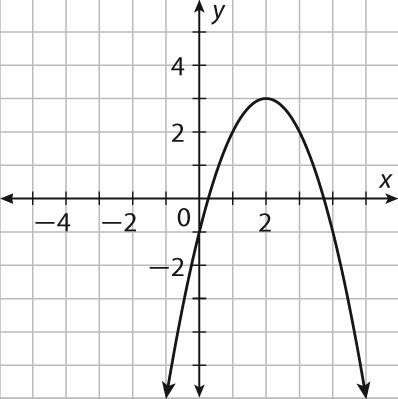
What is the range of the function?
{y ≤ 3}
{−3≤y}
All real numbers
{-6 ≤ y ≤ 3}

Identify the domain and range of the function.
D: {-6 ≤ x ≤ 2}
R: {-3 ≤ y ≤ 5}
D: All real number
R: {-3 ≤ y ≤ 5}
D: All real numbers
R: {y ≤ 3}
D: All real numbers
R: {3 ≤ y}
Given f(x) = x2 - 1, what is the value of f(10)?
100
19
99
9
Fred X
If a question asks you to find f(2), what does that mean?
Let x = 2
Let y = 2

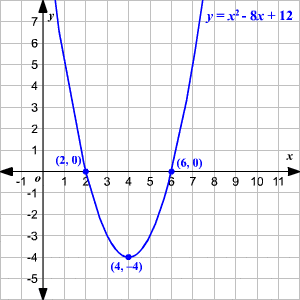


Which letter determines if a parabola opens up or down?
a
h
k

The equation for the axis of symmetry line is x = -b/(2a)
true
false
Y = -3x2 +7x - 2
y = 2x2 + 7x + 5
The equation for the axis of symmetry line is
x=2a−btrue
false

Identify the y-intercept
(0, -3)
(0, 1)
(0, 3)
(2, 1)


Range : 0 ≤ y ≤ 4
Range : -2 ≤ y ≤ 2
Range : y ≤ 4
Range : y ≤ 4


What is the significance of the ordered pair (2, -4) to the graph?
It is the vertex
It is an x-intercept
It is the y-intercept
It is the axis of symmetry
Determine the domain and range of the function
Domain: All real numbers, Range: All real numbers
Domain: x ≥ -4, Range: All real numbers
Domain: All real numbers, Range: y ≥ -4
Domain: -1 ≤ x ≤ 5, Range: y ≥ -4
What is the significance of the ordered pair (0, -2) to the graph?
It is the vertex
It is an x-intercept
It is the y-intercept
It is the axis of symmetry
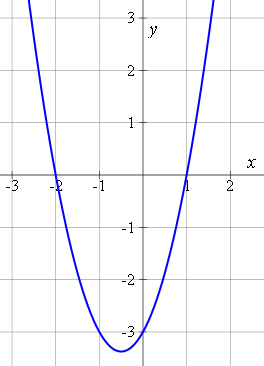
Does this graph open up or down?
y= −3x2 +7x + 1,000,000up
down
f(x) = x2 - 8x + 15.
f(x) = -x2 - 4x + 12.
In the function
y = 7x2 +8x − 10 ,the vertex is a ......
minimum
maximum
What is the vertex of the quadratic below:
Leave NO spaces in your answer and include parentheses.
(a)
What is the vertex of the function
y = −4(x +7)2 − 8 ?
(a)
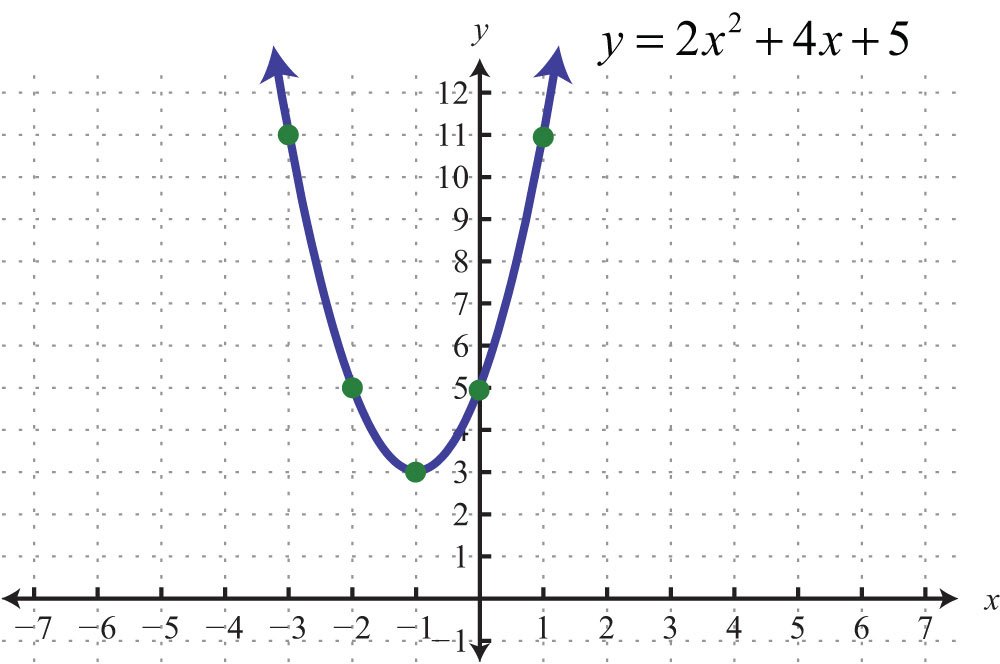
y = 3x2 - 6x + 4
Find the Vertex: y= -5x2 -20x - 26
(-2, -6)
(2, 6)
(6,2)
(3, 6)
The vertex of parabola y = - 2x2 - 4x + 1 is
(1, 3)
(- 1, 3)
(- 1, -5)
(- 1, 5)
The parabola y = x2 - 2x + 4
will have a minimum vertex.
will have a maximum vertex.
Where is the axis of symmetry?

Select the equation that would graph the parabola.
y = x2 + 10x + 21
y = x2 - 10x + 21
y = -x2 - 10x + 21

What are the x-intercepts of the quadratic?
(2, 0) and (4, 0)
(-2, 0) and (-5, 0)
(2, 0) and (5, 0)
(-2, 0) and (-4, 0)
Which equation matches the x-intercepts x=5,-7 ?
(x+5)(x-7)=0
(x-5)(x+7)=0
(x+5)(x+7)=0
(x-5)(x-7)=0
What are the x-intercepts:
(x - 5)(x - 1) = 0
{ 5, 1 }
{ 5, -1 }
{ -5, 1 }
{ -5, -1 }
What are the x-intercepts:
(x - 3)(x + 6) = 0
{ -3, -6 }
{ 3, -6 }
{ -3, -6 }
{ 3, 6 }

What is the axis of symmetry for this parabola?
x = 2
x = - 8
x = -1
y = -1
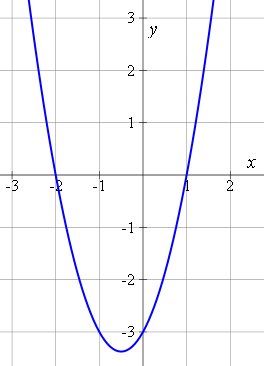
Which direction does the following equation open? y=−3(x+3)(x−2)
Down, because the 'a' value is positive.
Up, because the 'a' value is negative.
Down, because the 'a' value is negative.
Up, because the 'a' value is positive.
What are the x intercepts of: y=(3x−5)(x+2)
(5,0) and (-2,0)
(-5,0) and (2,0)
(5/3, 0) and (-2,0)
(3,0) and (-2,0)
y = (x - 8)(x + 2)

What is the vertex of the function?
(-3, -16)
(3, 20)
(-6, -7)
(0, -7)
y = 3(x + 5)2 - 4,
what is the vertex of the parabola?
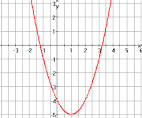
f(x)=4(x-2)2 + 3


Which equation is graphed above?
y=−(x−1)2+4
y=(x−1)2+4
y=−(x−4)2+1
y=(x−4)2+1

Which equations matches the graph above?
h(x)= (x+1)2−4
h(x)=−(x+1)2−4
h(x)=(x+4)2−1
h(x)=−(x+4)2+1

Which equation matches the graph above?
r(x)=−(x+4)2−1
r(x)=(x+4)2−1
r(x)=−(x−4)2+1
r(x)=(x−4)2+1
f(x) = x2 + 12x - 2
written in vertex form?
f(x) = x2 - 8x + 1
written in vertex form?
y = x2 - 6x + 10?
x2-12x+40
into vertex form
Convert the equation y= x2 + 4x + 11 into vertex form.
y = (x + 2)2 - 4
y = (x + 2)2 + 7
y = (x + 2)2
y = (x - 2)2 - 7
(2x−1)(3x+4)
Find the equivalent expression.
6x2−5x−4
6x2+5x−4
6x+11x+4
6x+5x−4
6x2−11x−4
Change the quadratic equation from factored form to standard form:
(x + 3)(x - 2)
x2 + 6x + 5
x2 -5x + 6
6x2+ 6
x2 + x - 6
Change the quadratic equation from factored form to standard form:
(x + 6)(x +5)
x2 + 6x + 5
x2 +11x + 30
x2+ 30x+11
x2 + x - 6
Change the quadratic equation from factored form to standard form:
(x - 2) (x+ 3)
x2 + 1x - 6
x2 +1x + 6
x2 - 1x - 6
x2 + 2x - 6
Change the quadratic equation from factored form to standard form:
(x - 3) ( x + 3)
x2 + 9
x2 +1x + 6
x2 - 9
x2 + 2x - 6
Change the quadratic equation from factored form to standard form:
(2x + 4) (2x + 9)
4x2+36x+36
4x2+18x+36
x2+36x+36
4x2+18x+13
Change the quadratic equation from factored form to standard form:
(3m + 5) (2m - 3)
5m2+19 − 15
6m2+10m +15
6m2+1m−15
5m2+19m − 15
Change the quadratic equation from factored form to standard form:
(4p+5) (6p+8)
24p2+60p+40
24p2+62p+40
6p2+62p+13
5m2+19m − 15
Change the quadratic equation from factored form to standard form:
(6a+1) (6a-1)
12a+1
12a2−1
36a2−1
12a2+12a−2
Change the quadratic equation from factored form to standard form:
(4c - 2) (2c - 5)
8c2+24c+10
8c2+10
8c2−24c+10
8c−24c+10
Which of the following is Standard Form?
y=ax2+bx+c
y=a(x−p)(x−q)
y=a(x−h)2+k
Which of the following is Vertex Form?
y=ax2+bx+c
y=a(x−p)(x−q)
y=a(x−h)2+k
Which of the following is Factored Form?
y=ax2+bx+c
y=a(x−p)(x−q)
y=a(x−h)2+k
Convert to Vertex Form:
f(x) = x2 +8x +14
f(x) = (x - 4)2 + 2
f(x) = (x - 4)2 - 2
f(x) = (x + 4)2 + 2
f(x) = (x + 4)2 - 2
Convert to standard form:
f(x) = x2+3x-18
(x-6)(x+3)
(x+6)(x+3)
(x+6)(x-3)
(x-6)(x-3)
Convert to Standard Form:
f(x) = (x+7)(x-3)
f(x) = x2 +10x +21
f(x) = x2 -10x -21
f(x) = x2 +4x -21
f(x) = x2 +4x +21
Convert to standard form: y=(x+5)2−15
y=x2+10
y=x2+10x +10
y=x2+25
y=x2+10x+25
Convert to standard form: y=−2(x−3)2+6
y=−2x2+12x−12
y=−2x2+6x+15
y=−2x2+12x−18
y = −2x2−12
Convert to vertex form: y=x2−12x+30
y=(x−6)2+6
y=(x+6)2−36
y=(x−6)2
y=(x−6)2−6
Convert to Factored Form
x2 + 5x - 24
(x - 8)(x + 3)
(x + 8)(x - 3)
(x + 6)(x - 4)
(x + 12)(x - 2)
Convert to Factored Form:
x2 - 10x + 24
(x - 6)(x - 4)
(x + 6)(x + 4)
(x - 12)(x + 2)
(x - 8)(x - 3)
Convert to Factored Form:
3a2 + 4a + 1
(7a-10)(a-8)
Not factorable
(3a+1)(a+1)
(3a-1)(a-1)
Convert to Factored Form
(hint...take out the greatest common factor first)
2c2 + 2c - 84
(c-6)(2c+14)
(c+7)(2c-12)
(c-4)(2c+21)
2(c+7)(c-6)
Convert to Factored Form:
(hint: use slide n' divide)
4x2-16x-9
(2x-9)(2x+1)
(2x+9)(2x-1)
(4x-1)(x+9)
(x+1)(4x-9)
Determine the vertex of the parabola y=5(x-2)2–7
(5, -7)
(-2, -7)
(2, -7)
(-7, -2)
Convert to Vertex Form
y = x2 - 6x + 10
y = (x + 3)2 - 1
y = (x - 3)2 + 1
y = (x + 6)2 - 10
y = (x - 6)2 + 10
f(x)=2x2 + 4x + 6
What are the x-intercepts for the function?
f(x) = (x + 7)(x + 5)
(7 , 0) and (5 , 0)
(0 , 7) and (0 , 5)
(-7 , 0) and (-5 , 0)
(7 , 0) and (5 , 0)

Write the function in vertex form. f(x)=x2−10x+13
f(x)=(x−10)2−87
f(x)=(x−5)2−12
f(y)=(x−5)2−12
f(x)=x2−10x−12
Write the function in vertex form.
f(x)=3x2−15x+3
f(x)=3(x−463)2−25
f(x)=3(x−25)2−475
f(x)=3(x+25)2−463
f(x)=3(x−25)2−463
Write the function in vertex form.
f(x)=21x2+9x−3
f(x)=21(x+49)2−16195
f(x)=21(x+9)2−287
f(x)=(x+29)2−493
f(x)=(x+49)2−16195
What do you need to add to create a perfect square trinomial?
f(x)=x2−10x+?
5
10
25
100
What would you add to the quadratic to make it a perfect square?
f(x)=x2+11x+?
121
4121
211
−4121
f(x)=4(x-2)2 + 3
y=3x2+6x−5
Convert to vertex form.
y=3(x+1)2−8
y=3(x−1)2−8
y=3(x+2)2−8
y=3(x−2)2−8
f(x) = x2 - 8x + 1
written in vertex form?
Convert to Intercept Form. y=x2+14x+48
y = (x+8)(x+6)
y = (x+8)(x-6)
y = (x-6)(x-8)
y = (x-8)(x+6)
y=2(x+3)2+5
Convert to Standard Form.
y=2x2+12x+23
y=2x2+6x+23
y=2x2+12x+18
y=x2+6x+13
Which of the following is Standard Form?
y=ax2+bx+c
y=a(x−p)(x−q)
y=a(x−h)2+k
Which of the following is Vertex Form?
y=ax2+bx+c
y=a(x−p)(x−q)
y=a(x−h)2+k
Which of the following is Intercept Form?
y=ax2+bx+c
y=a(x−p)(x−q)
y=a(x−h)2+k
Convert
y=3x2−15x−42 to Intercept Form. (Try a GCF First!)
y = (3x - 21)(x + 2)
y = 3(x - 7)(x + 2)
y = (3x - 15)(x - 42)
y = 3(x + 7)(x - 2)
Convert
y = −2(x−3)(x+9) to Standard Form.y=x2+6x−27
y=−2x2+12x−54
y=−2x2−12x+54
y=−2(x+3)2+72
Convert to Intercept form:
f(x) = x2+3x-18
(x-6)(x+3)
(x+6)(x+3)
(x+6)(x-3)
(x-6)(x-3)
Convert to Standard Form:
f(x) = (x+7)(x-3)
f(x) = x2 +10x +21
f(x) = x2 -10x -21
f(x) = x2 +4x -21
f(x) = x2 +4x +21
Convert to standard form: y=(x+5)2−15
y=x2+10
y=x2+10x +10
y=x2+25
y=x2+10x+25
Convert to standard form: y=−2(x−3)2+6
y=−2x2+12x−12
y=−2x2+6x+15
y=−2x2+12x−18
y = −2x2−12
Convert to Factored/Intercept Form
x2 + 5x - 24
(x - 8)(x + 3)
(x + 8)(x - 3)
(x + 6)(x - 4)
(x + 12)(x - 2)
Convert to Factored Form:
3x2 + 4x + 1
(7x-10)(x-8)
Not factorable
(3x+1)(x+1)
(3x-1)(x-1)
Convert to Intercept/Factored Form
(Try a GCF First!)
2x2 + 2x - 84
(x-6)(2x+14)
(x+7)(2x-12)
(x-4)(2x+21)
2(x+7)(x-6)
The height of a water balloon that is launched into the air is given by h(t) = -5t2 + 40t + 2. From what height was the balloon released?
2 meters
5 meters
40 meters
20 meters
If a toy rocket is launched vertically upward from ground level with an initial velocity of 128 feet per second, then its height h after t seconds is given by the equation
h(t) = -16t2 +128t
When will the object reach its maximum height?
4 ft
0 seconds
0 ft
4 seconds

h = -16t2 + 64t + 960.
How many seconds did it take for the ball to reach its maximum height?
A dolphin jumps from the water at at initial velocity of 16 feet per second. The equation h = -8t2 + 16t models the dolphin's height at any given time, t. What is the maximum height the dolphin jumps?
1 foot
5 feet
7 feet
8 feet
12 feet
A frog is sitting on the ground when he is scared by a big dog. His movement is modeled by the equation h = -6t2 + 6t where h is the frog's height at any given time, t . How many seconds until the frog is back on the ground?
0.5 seconds
1 second
1.5 seconds
2 seconds
3 seconds
Your nephew is standing on his deck, which is 4 feet off the ground. He tosses his toy up into the air. The equation
h = -2t2 + 7t + 4 models the toy's height, h, from the ground at t seconds after he threw it. How high is the toy after 1 second?
2
4
9
10
15
Fireworks are fired from the roof of a 100-foot building. The equation h = -16t2 +84t + 100 models the height, h, of the fireworks at any given time, t. How high do the fireworks get?
2.625
6.25
100
200
210.25
Your friend passes you the ball during a soccer game. The height off the ground is modeled by the equation
h = -4t2 + 12t. How high did the soccer ball get?
1.5
3
5
9
15

A ball is thrown into the air from the edge of a 48-foot-high cliff so that it eventually lands on the ground. The graph below shows the height, y, of the ball from the ground after x seconds.
For which interval is the ball's height always decreasing?
0≤x≤2.5
0<x<5.5
2.5<x<5.5
x≥2
The height of a ball Doreen tossed into the air can be modeled by the function h(x) = −4.9x2 + 6x + 5, where x is the time elapsed in seconds, and h(x) is the height in meters. The number 5 in the function represents
the initial height of the ball
the time at which the ball reaches the ground
the time at which the ball was at its highest point
the maximum height the ball attained when thrown in the air
A ball is thrown straight up at an initial velocity of 54 feet per second. The height of the ball t seconds after it is thrown is given by the formula h(t) = 54t − 12t2 .
How many seconds after the ball is thrown will it return to the ground?
9.2
6
4.5
4
The height of a water balloon that is launched into the air is given by h(t) = -5(t +1)(t - 5). When will the balloon explode on the ground?
5 seconds
1 second
2 seconds
3 seconds
The height of a water balloon that is launched into the air is given by h(t) = -5(t +1)(t - 5). When will the balloon reach its maximum height?
2 seconds
1 second
5 seconds
3 seconds
The height of a water balloon that is launched into the air is given by h(t) = -5(t - 4)2 + 82. When will the balloon reach its maximum height?
4 seconds
82 seconds
5 seconds
16 seconds
The height of a water balloon that is launched into the air is given by h(t) = -5(t - 4)2 + 82. What is the maximum height of the balloon?
82 meters
4 meters
55 meters
99 meters
The height of a water balloon that is launched into the air is given by h(t) = -5t2 + 40t + 2. From what height was the balloon released?
2 meters
5 meters
40 meters
20 meters

