
 Worksheets
Network Protocol Quiz3
Total questions: 20
Worksheet time: 11mins
What is the purpose of the OSI physical layer?
transmitting bits across the local media
controlling access to media
performing error detection on received frames
exchanging frames between nodes over physical network media
Why are two strands of fiber used for a single fiber optic connection?
They allow for full-duplex connectivity.
They increase the speed at which the data can travel.
They prevent crosstalk from causing interference on the connection.
The two strands allow the data to travel for longer distances without degrading.
Which characteristic describes crosstalk?
the distortion of the transmitted messages from signals carried in adjacent wires
the distortion of the network signal from fluorescent lighting
the weakening of the network signal over long cable lengths
the loss of wireless signal over excessive distance from the access point
Which procedure is used to reduce the effect of crosstalk in copper cables?
twisting opposing circuit wire pairs together
requiring proper grounding connections
wrapping the bundle of wires with metallic shielding
designing a cable infrastructure to avoid crosstalk interference
A network administrator is measuring the transfer of bits across the company backbone for a mission critical financial application. The administrator notices that the network throughput appears lower than the bandwidth expected. Which three factors could influence the differences in throughput? (Choose three.)
the amount of traffic that is currently crossing the network
the type of traffic that is crossing the network
the latency that is created by the number of network devices that the data is crossing
the bandwidth of the WAN connection to the Internet
the reliability of the gigabit Ethernet infrastructure of the backbone
What are two characteristics of fiber-optic cable? (Choose two.)
It is not affected by EMI or RFI.
It is more expensive than UTP cabling is.
It typically contains 4 pairs of fiber-optic wires.
It combines the technique of cancellation, shielding, and twisting to protect data.
Each pair of cables is wrapped in metallic foil.
What is a primary role of the Physical layer in transmitting data on the network?
create the signals that represent the bits in each frame on to the media
provide physical addressing to the devices
determine the path packets take through the network
control data access to the media
With the use of unshielded twisted-pair copper wire in a network, what causes crosstalk within the cable pairs?
the magnetic field around the adjacent pairs of wire
the use of braided wire to shield the adjacent wire pairs
the reflection of the electrical wave back from the far end of the cable
the collision caused by two nodes trying to use the media simultaneously
In addition to the cable length, what two factors could interfere with the communication carried over UTP cables? (Choose two.)
crosstalk
electromagnetic interference
bandwidth
signal modulation technique
size of the network
Which two devices commonly affect wireless networks? (Choose two.)
cordless phones
microwaves
home theaters
incandescent light bulbs
external hard drives
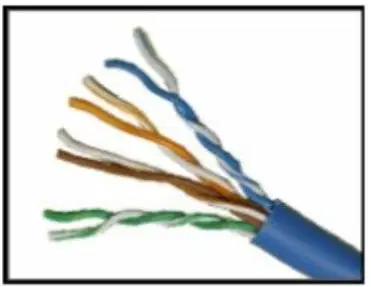
Refer to the graphic.
What type of cabling is shown?
UTP
STP
COAXIAL
FIBER
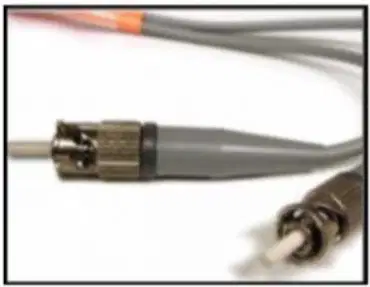
Refer to the graphic.
What type of cabling is shown?
UTP
STP
COAXIAL
FIBER
Decides which physical path the data will take.
Network layer
Physical layer
Transport layer
Data link layer
Transmit raw bit stream over the physical medium.
Network layer
Physical layer
Transport layer
Presentation layer
Maintains connections and is responsible for controlling ports sessions.
Network layer
Session layer
Transport layer
Presentation layer
Identifies network protocols, performs error checking and synchronizes frames
Internet Protocol
Logical Link Control
Media Access Control
Hypertext Mark-up Language
Maintains connections and is responsible for controlling ports sessions.
Network layer
Session layer
Transport layer
Presentation layer
MAC Address is found on what Layer of ISO?
Network layer
Data link layer
Transport layer
Presentation layer
UDP (User Datagram Protocol) is a protocol found on what layer?
Network layer
Data link layer
Transport layer
Presentation layer
What are three ISO layer which are considered as a Software Layer? (Choose three.)
Application layer
Session layer
Transport layer
Presentation layer
Physical layer

