Wayground logo

Free Printable Worksheets

Font size

S
M
L
XL
Worksheets

Ecosystems (SOL 4.3)

Total questions: 24

Worksheet time: 32mins

Name
Class
Date
1.
A place where an organism lives.
a)
Terrain
b)
Habitat
c)
Community
d)
Population
2.
A collection of organisms that belong to different populations but all live in the same area and interact with one another.
a)
Population
b)
Ecosystem
c)
Community
d)
Ecosphere
3.
A collection of organisms that make up a community as well as all of the nonliving aspects of the environment.
a)
Population
b)
Community
c)
Habitat
d)
Ecosystem
4.

What are the living factors in this image?

a)

sunlight, elephants, and grasses

b)

sunlight, water,  and air

c)

elephants, plants, trees 

5.

What are the non-living factors in this image? 

a)

water, sunlight, dirt, air

b)

birds and plants

c)

water, plants, and birds 

6.
What is it called when a group of the same organisms living together in the same place at the same time?
a)
An organism
b)
A population
c)
A community
d)
A biome
7.

The original source of energy for all organisms in a food web is...

a)

plants

b)

sun

c)

producers

d)

decomposers

8.

Producers are ...

a)

plants

b)

animals

c)

also called decomposers

d)

all of these are true

9.

Arrows in a food web show

a)

eating

b)

sunlight

c)

energy flow

d)

matter

10.

An organism that gets energy from eating other organisms is a ______________

a)

producer

b)

consumer

c)

decomposer

11.

An animal that gets energy from eating both plants and animals is a(n)

a)

herbivore

b)

carnivore

c)

omnivore

12.
The shrew provides energy for the _______?
a)
cricket
b)
grasshopper
c)
frog
d)
snake
13.
Which of the following is a herbivore?
a)
cricket
b)
frog
c)
hawk
d)
shrew
14.

An organism’s habitat provides _____________________.

a)

food, water, shelter, and space.

b)

food, water, and clothes.

c)

only food.

d)

video games, ninjas, and baked beans.

15.

When habitats and niches overlap, animals compete for...

a)

nothing

b)

resources

c)

everything

d)

habitat

16.

Every organism has body parts that help it fit its ______; a duck has webbed feet to help it swim.

a)

Ecosystems

b)

Organisms

c)

Niche

d)

Life Cycle

17.
Which best describes how decomposers help support life in an ecosystem?
a)
Decomposers add nutrients to the soil.
b)
Decomposers provide a habitat in the ecosystem.
c)
Decomposers add producers to the ecosystem.
d)
Decomposers provide energy for consumers.
18.
Which is an example of a decomposer?
a)
a hawk
b)
a mouse
c)
a flower
d)
a mushroom
19.
Which describes a decomposer?
a)
an organism that eats only plants
b)
an organism that makes its own food
c)
an organism that breaks down dead matter
d)
an organism that receives energy from the sun
20.

What is monster # 1 ?

a)

Alienus quadlegicus

b)

Alienus haircus

c)

Alienus Tritoothicus

d)

Alienus Blobicus

21.

What is monster # 3 ?

a)

Alienus Fuzzicus

b)

Alienus Stripicus

c)

Alienus Tritoothicus

d)

Alienus Blobicus

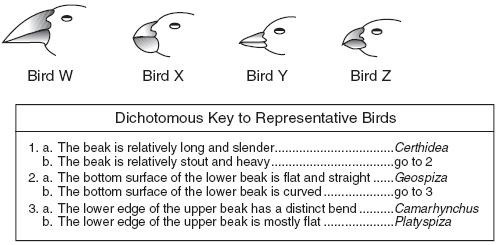
22.
What is the name of bird W?
a)
Certhidea
b)
Geospiza
c)
Camarhynchus
d)
Platyspiza
23.
Using this dichotomous key, identify the name of the circled Fish, J.
a)
peacock flounder
b)
band-tail puffer
c)
trumpet fish
d)
spotted goat fish
24.
When using a dichotomous key to identify organisms, what do we look at?
a)
physical features
b)
weather patterns
c)
environment
d)
diet