Wayground logo

Free Printable Worksheets

Font size

S
M
L
XL
Worksheets

earth science

Total questions: 73

Worksheet time: 37mins

Name
Class
Date
1.
What is molten rock that has formed deep within the Earth?
a)
Hot Spot
b)
Magma
c)
Lava
d)
Volcano
2.
What is molten rock that has reached the Earth's surface?
a)
Aa
b)
Lava
c)
Magma
d)
Pahoehoe
3.
What factor(s) determine(s) whether an eruption will be explosive?
a)
The amount of gases in the magma
b)
The amount of silica in the magma
c)
The amount of gas and silica in the magma
d)
None of these affect the explosiveness of the volcano
4.
As magma rises towards the surface it collects in a 'room' called a _____ _____ . 
a)
magma chamber
b)
side vent
c)
main vent
d)
lava chamber
5.
Vocanoes are found...
a)
on land
b)
under water
c)
on islands
d)
all of the above
6.
The difference between magma and lava is _____
a)
where it is found (above or below the surface)
b)
how hot the molten rock is (lava is hotter than magma)
c)
 the type of boundary where it forms
d)
the viscosity of the molten rock (lava has a lower viscosity)
7.
Volcanoes that have recently erupted are known as:
a)
Extinct Volcano
b)
Dormant Volcano
c)
Active Volcano
d)
What's a volcano?
8.
__________ volcanoes are usually steep sided. They are formed from layers of ash and lava.
a)
Shield
b)
Cone
c)
Dormant
d)
Extinct
9.
__________ volcanoes are formed from fast flowing, lava which flows easily over the surface, forming larger volcanoes with gentle sides.
a)
Cone
b)
Composite
c)
Angel
d)
Shield
10.
A subduction zone is...
a)
plates pull apart.
b)
the continental plate slides under the oceanic plate.
c)
where the oceanic plate slides under the continental plate.
d)
plates slap each other a high five.
11.

Lava that is very thin and runny probably

a)

has low silica content

b)

is high in silica

12.

Where are volcanoes most likely to form?

a)

along plate boundaries

b)

near the center of continents

c)

near water

d)

on the moon

13.

One major belt of volcanoes that surrounds the Pacific Ocean

a)

Ring of Fire

b)

Ring of Asia

c)

Ring o' earthquakes

d)

Ring a ding ding

14.

A bowl shaped area that may form at the top of a volcano around the central vent

a)

crater

b)

vent

c)

tube

d)

leftovers

15.
Lakes that form near volcanoes considered to be....
a)
Craters
b)
Conduits
c)
Vents
d)
Calderas
16.
What is letter B in the picture?
a)
Magma Chamber
b)
Crater
c)
Vent
d)
Conduit
17.
What is letter C in the picture?
a)
Vent
b)
Crater
c)
Caldera
d)
Tephra
18.
What is letter D in the picture?
a)
Crater
b)
Vent
c)
Conduit
d)
Tephra
19.
What is letter E in the picture?
a)
Tephra
b)
Pyroclastic Flow
c)
Magma Chamber
d)
Vent
20.
What is letter F in the picture?
a)
Pyroclastic Flow
b)
Crater
c)
Vent
d)
Tephra
21.
The closer you live to an ocean the more likely your climate will be?
a)
maritime
b)
continental
c)
tropical
d)
polar
22.
The biggest factor in determining climate is?
a)
elevation
b)
an ocean
c)
latitude
d)
mountain
23.
A tropical climate in the US would be?
a)
Virginia
b)
New York
c)
California
d)
Florida
24.
A polar climate in the US?
a)
Virginia
b)
New York
c)
Maine
d)
Alaska
25.
The temperature of a tropical climate is?
a)
consistently warm
b)
consistently cool
c)
consistently moderate
d)
warm and cool
26.
A polar climate is?
a)
warm and cool
b)
consistently moderate
c)
consistently cool
d)
consistently warm
27.
A temperate climate is?
a)
consistently cool
b)
consistently warm
c)
consistently moderate
d)
warm and cool
28.
What is the climate of the top of a mountain like as compared to the bottom of the mountain?
a)
warmer
b)
cooler
c)
drier
d)
wetter
29.
The gradual increase in the temperature of the atmosphere is known as ___________________.
a)
greenhouse effect
b)
global warming
c)
fossil fuels
d)
ice ages
30.
What is the difference between climate and weather?
a)
 Climate averages the weather conditions in a specific place over a long period of time, while weather describes the state of the atmosphere at a specific moment in time.
b)
 Weather averages the weather conditions in a specific place over a long period of time, while Climate describes the state of the atmosphere at a specific moment in time.
c)
Climate describes the weather conditions at night, while weather describes the conditions during the daytime.
d)
 There is not a difference between climate and weather.
31.
Which of these is NOT a factor that determines the climate of a place?
a)
latitude
b)
wind patterns
c)
longitude
d)
elevation
32.
Which sentence best describes the relationship between elevation and air temperatures?
a)
 LOWER elevation = COLDER temperatures
b)
HIGHER elevation = COLDER temperatures
c)
HIGHER elevations = WARMER temperatures
d)
There is no relationship
33.
What are the 3 major climate zones in order from equator to the poles?
a)
polar, temperate, tropical
b)
tropical, temperate, polar
c)
temperate, polar, tropical
d)
temperate, tropical, polar
34.
Climates are classified according to which two major factors?
a)
elevation & precipitation
b)
latitude & temperature
c)
elevation & latitude
d)
precipitation & temperature
35.
Virginia is ?
a)
polar
b)
temperate
c)
tropical
d)
desert
36.

What is the difference between climate and weather?

a)

climate happens in that moment, weather happens over time

b)

weather happens in that moment, climate happens over time

c)

No difference, they mean the same thing.

37.

Because water ___________, ocean currents have a great effect on climate.

a)

cannot hold heat

b)

hold large amounts of heat

c)

moves more slowly than air

d)

stays colder than air

38.

The pattern of _______________ determines Earth's precipitation pattern

a)

volcanic eruptions

b)

solar activity

c)

global atmospheric circulation

d)

all of the above

39.

The climate in the tropical zone is...

a)

Extremely cold

b)

Short summers

c)

Long winters

d)

Hot and humid

40.

Which type of climate can we find in deserts?

a)

Arid and dry

b)

Extremely cold

c)

Cooler and wetter

d)

Hot and humid

41.

In the Mediterranean climate we have...

a)

Hot dry summers

b)

Exytemely cold

c)

Arid and dry

d)

Short summers

42.

Which of these pictures show us the polar zone?

a)
b)
c)
d)
43.

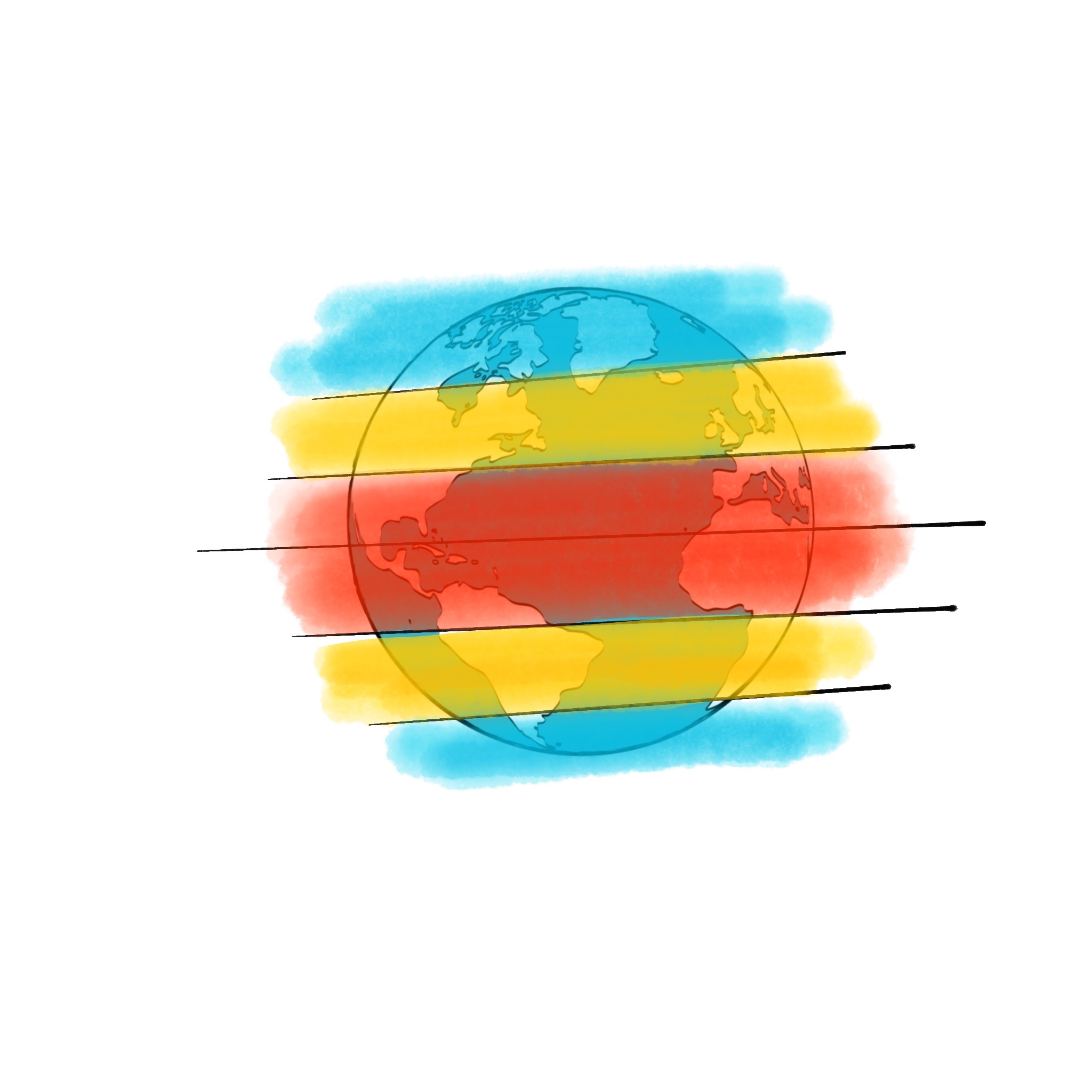
Look at the picture, which climate zone is in red?

a)

Temperate zone

b)

Polar zone

c)

Tropical zone

44.

Antarctica is cold all year. Its climate is...

a)
Tropical
b)
Polar
c)
Temperate
45.

Which climate is cold and dry all year?

a)

Polar

b)

Mountainous

46.

Which climate is hot and wet all year?

a)

Temperate

b)

Tropical

c)

Arid

47.
What are characteristics of Dry Climates?
a)
Annual precipitation is more the the potential loss of water by evaporation
b)
The annual precipitation is less every year.
c)
The annual precipitation is less than the potential loss of water by evaporation.
d)
The annual precipitation is more every year.
48.
What are the two main factors that determine the climate of an area?
a)
precipitation and humidity
b)
temperature and air pressure
c)
wind conditions and humidity
d)
temperature and precipitation
49.
In _________ the average temperature of the warmest month is below 10 degrees Celsius.
a)
Arctic
b)
Polar
c)
Temperate
d)
Mid-Latitude
50.

Why are tropical climates so wet?

a)

The sunlight is very direct & strong

b)

High pressure zones

c)

Low pressure zone

d)

The sunlight is very indirect & weak

51.

Why are dry climates so dry?

a)

The sunlight is very direct & strong

b)

High pressure zones

c)

Low pressure zones

d)

The sunlight is very indirect & weak

52.
a)

Taurus

b)

Cancer

c)

Aries

d)

Libra

53.

a)

Taurus

b)

Sagittarius

c)

Capricorn

d)

Aquarus

54.

a)

Leo

b)

Virgo

c)

Cancer

d)

Pisces

55.

a)

Sagittarius

b)

Scorpio

c)

Virgo

d)

Gemini

56.

a)

Leo

b)

Aquarius

c)

Virgo

d)

Taurus

57.
a)

Ursa Major (Big Dipper)

b)

Cassiopea

c)

Ursa Minor (Little Dipper)

d)

Aries

58.

a)

Cassiopeia

b)

Libra

c)

Ursa Minor (Little Dipper)

d)

Ursa Major (Big Dipper)

59.

a)

Aries

b)

Leo

c)

Ursa Minor

d)

Ursa Major

60.

Are these two constellation the same?

a)

Yes

b)

No

61.

a)

Taurus

b)

Pisces

c)

Virgo

d)

Leo

62.

Which one has Polaris (North Star) as part of its constellation?

a)
b)
c)
d)
63.

Which constellation points to the Polaris (North Star)?

a)
b)
c)
d)
64.
A constellation is a group of visible ____ that form a pattern when viewed from Earth.  
a)
planets
b)
stars
c)
patterns
d)
creatures
65.
The stars we see in each constellation are very close to us.
a)
True
b)
False
66.
What constellation is this?
a)
Orion
b)
Taurus
c)
Canis Major
d)
Gemini
67.
People in the Northern Hemisphere do see the same constellations as the people in the Southern Hemisphere.
a)
True
b)
False
68.
Polaris always points
a)
East 
b)
West
c)
North
d)
South
69.
Constellations may be only visible during certain seasons due to the Earth’s orbit around the____.  
a)
Earth
b)
Mars
c)
Planets
d)
Sun
70.
Ursa Major is also called “Larger Bear” and is one of the largest constellations.  
a)
True
b)
False
71.
The term Zodiac refers to ...
a)
the light from Saturn's rings
b)
the head of the Celestial Empire
c)
a method for making astrological predictions
d)
a group of constellations lying near the ecliptic
72.

Why does Polaris not seem to move during the night?

a)

Because it is located directly above the North Pole

b)

Because it is fixed in the sky

c)

Because Ursa Minor does not move

d)

Because it revolves around the Sun with Earth

73.

Number of constellations

a)

12

b)

72

c)

88

d)

1