
 Worksheets
APUSH Unit 8
Total questions: 99
Worksheet time: 1hrs 27mins
What were causes of the Cold War?
Ideological (capitalist vs communist)
Expansionist Practices (USSR vs USA)
Tensions after WW2 especially with weakened Europe
Stalin
What influenced US suspicion of communist-USSR BEFORE the Cold War?
Stalin attempting to invade weaker European countries and violated agreement for self-government.
Soviets attempt to keep Germany weak after WW2 + receive reparations (go against agreement to "rebuild" Germany)
Bolshevik Revolution in the USA in 1917-Communist is evil + spreading
Ideological differences (communism=evil)
Why did stalin want to invade weaker european nations after ww2?
Spread Communism + Socialism
Provide a "buffer-zone" between the USSR and Germany
To build his army to take over the world
To intimidate the USA
Before the Cold War, Winston Churchill's _ _ speech reflected the DIVIDE between capitalist countries and communist countries.
(a)
Capitalist/Democratic Countries joined NATO and the Communist countries joined the _ pact.
(a)
President Harry Truman's Truman Doctrine essentially advocated against the spread of communism through the practice of _, and lending support to countries threatened by communism.
(a)
The Truman Doctrine,
Was a response to Soviet aggression towards Turkey and Greece.
Congress spends 400 Million in economic and MILITARY aid to stop Soviet expansion into weaker european countries.
Inspired the Marshall Plan
Continued the practice of Containment rather than defeat Communism
The Marshall Plan
Resulted in more stable and prosperous Western European nations
Justified current price because if nations had a stable economy they would prefer democracy> communism
Allocated over 13 BILLION to rebuild european countries
Provided MILITARY aid to weaker countries
When western nations (such as the USA0 attempted to keep Western Berlin alive, with the hope of inspiring democracy, Stalin...
Blocked roads, railways, canals etc. In an attempt to absorb West Berlin as a Communist territory.
Supplied goods to West Berlin bypassing the Berlin Wall (created by NATO)
The US organized the Berlin _ which involved allied planes carrying supplies into western berlin.
(a)
The US formation of the North. Atlantic. Treaty. Organization (NATO)
The countries entered a military alliance to resist soviet aggression.
Inspired the Soviet formation of the Warsaw Pact
Was the first peace-time military alliance for the US (outside of the western hemisphere)
Showed American strength and choice to be involved in worldly-affairs (unlike the US and the league of nations after WW1)
Nuclear Proliferation and the Arms Race...
Was a result of Soviet's-ATOMIC BOMB in 1949
Inspired Truman to create a more deadly HYDROGEN BOMB (1952)
Increased the possibility that the 2 superpowers would DESTROY the war with their nuclear weapons
Both sides needed the most nuclear weapons, but using them would result in MUTUAL ASSURED DESTRUCTION (everyone dies)
The Cold War had many _ wars ( USA+USSR use 3rd party countries to fight indirectly) such as the Vietnam War and the Korean War.
(a)

The Korean War....
Korea was divided along the 38th parallel after WW2.
Soviets controlled Northern Korea + USA controlled Southern Korea
1950-North Korea invades South Korea, resulting in UN sending troops, until China sent troops, keeping the 38th parallel divide
Was a DIRECT result of Trumans Containment policy
The SECOND Red Scare involved mass suspicion as a result of the US attempting to RID the US of Communism by...
Required people to swear loyalty to the US and swear they weren't communists. Especially labor union leaders
Resulted in the Taft-Hartley act made it more difficult for workers to strike (response to labor unions)
Truman passing the Federal Employee Loyalty and Security Program which made federal employees swear they weren't communist and allowed investigations into their lives.
Un-American Activities Committee searched for communism in every aspect of American Society (Especially Hollywood)
Investigation Senator McCarthy claims (wrongly) that he had 205 names of communists in the State Department (Mass hysteria and suspicion)

The _ Trials were a result of Soviet's new atomic-bomb, and the US investigated people who may have aided Soviets. Rosenbergs were accused + executed (members of communist party)
(a)
Truman placed General MacArthur in charge of Japanese control and resulted in a New Japan where...
Japan adopted a new constitution
Created a democratic government
Rebuilt factories with American aid
Helped save the US economy and established the US and Japan as allies
How did China grow after WW2
A civil war divided China between Nationalists and Communists
Nationalist forces fell and their leader Chiang fled to Taiwan
Communist leader Mao announced the birth of the People's Republic of China
Mao signed a treaty with the Soviet Union (represented an end to US Cold War democracy)
Truman viewed the government of Taiwan as the representative of ALL China
The _ War expanded American involvement in Asia and Containment became a GLOBAL struggle, and sent a precedent for US involvement in the Vietnam War.
(a)
The _ War boosted economic growth, but led to an informal alliance of the US military/defense industries. ("military=industrial complex")
(a)
During the _ War in 1948, President Truman ordered the racial-desegregation of US armed forces (repealed segregated units)
(a)
Compare/Contrast the First + Second Red Scares
The 1st red scare lasted 1 year but the 2nd one lasted about 10 years.
The 1st red scare was a result of the Bolshevik's creating a communist dictatorship which threatened US society.
The 2nd red scare was a response to cold war tensions, nuclear threats and communist infiltration of american society.
Paranoia stopped as a result of Palmer raids inspiring protests in the 1st red scare, but stooped after McCarthy's trial. Americans turned to new cars and suburban pleasures after both.
General Palmer + Senator McCarthy ignored civil liberties to expose socialists/communist evils.
The _ era lasted from 1952-1960
(a)
The American citizens in the 1950's enjoyed the highest standard of living because of...
Cold War defense spending (defense budget 13 billion-> 50 billion in less than 4 years)
Baby Boom as a result of thriving economy + hope for the future (open market on baby-products)
Consumer Spending (credit cards used for shopping and "borrowing" money) Increased shopping centers + suburban homeowners gained new technology (refrigerators, washing machines, televison)
BUT poverty was ignored (25% of nation lived in poverty)
How did suburban society grow during the 1950's.
Mass production of affordable homes (through assembly line production)
Cheap housing for WW2 veterans (1 million men
Interstate Highways 42k mile system (commuters + on the road culture)
Revival of the Cult of Domesticity (3/4 of American Women between 20-244 are married) Suburban happy kitchen moms)
By 1959 200 corporations controlled _ percent of the nation's business assets.
(a)
Noncomformists "_'s" preferred to live in urban enclaves and focus on personal freedom, spontanuity,+ happiness. Foreshadowing the hippie movemnet in the 1960's.
(a)
The music style of "rock and roll" embodied by singers such as _ challenged beliefs about sex, race, and work. Shaping and re-defining the new teenage culture.
(a)
Thurgood Marshall and the NAACP adopted the legal strategy to gain equality, they
Used 5 cases to attempt to integrate into segregated schools
Brown wanted his daughter to attend the all-white school and Marshall argued segregated schools violated "equal protection of the laws" and separate education is unequal.
The Brown decision opened a new movement or black citizens. "Freedom Now!!"
9 Black students were supposed to integrate Little Rock's High School (mobs emerged and threatened the "little rock 9")
Eisenhower believed he had a constitutional duty to enforce the Brown decision
Although the Brown decision initially was resisted it aided the struggle for legal equality. And the modern civil rights movement began as a direct result. The initial goal for school desegregation became a campaign for social _ for all minorities.
(a)
The Brown VS Board of Education ruling inspired the Civil Rights movement beginning in 1956 in which...
Rosa Parks inspired Dr. King to boycott public busses until it ended 15 months later with the Supreme Court ruling it was unconstitutional to segregate public buses.
MLK inspired his followers with nonviolent civil disobediance (echoing Thoreau's essay "Resistance to Civil Government)
MLK inspired 4 black college students in Greensboro North Carolina to stage a sit-in at a local lunch counter until the restaraunt desegregated its counter.
The Greensboro sit-in inspired "watch-ins" at movie theatres, "read-ins" at local libraries and "wade-ins" at beaches to desegrgate businesses.
The Student Nonviolent Coordinating Committee was formed to facilitate student activism.
What increased American fears during the mid-fifties?
Fear of international communism
Fear of domestic subversion
Fear of nuclear annihilation (hydrogen bombs in both US + USSR)
Eisenhower + Secretary of State announced "US will no longer become involved in expensive limited wars" Declares new strategy of MASSIVE RETALIATION (US could use nuclear weapins to stop Soviets)
After WW2 France tried to regain control over French Indochina but became entangled with communist forced in _
(a)
The French defeat at the Battle of Dien Bien Ph resulted in an agreement with Vietnam known as the _ Accords and Vietnam was divided at the 17th parallel.
(a)
The French defeat in Vietnam resulted in President _ refusing to abandon South Vietnam to communist Vietnam, and sponsored guerrilla war to overthrow communist Vietnam.
(a)
In 1957, the USSR sent the Sputnik satellite, and the US believed that they had been surpassed in STEM by the Russians. The US created _ to compete with the Soviet space program.
(a)
In 1958 Congress passed the National Defense Education Act to fund accelerated _ programs to compete with the USSR.
(a)
Compare technology in the 1920's VS the 1950's.
The 1920's had advances in silent and sound movies, airplanes, telephones, and consumer appliances, and AUTOMOBILE. (Henry Ford's mass production)
The 1950's had advances in jet aircrafts, kitchen applicances, antibiotics and vaccines. Television and mass production of houses (William Levitt) and interstate highways.
Compare intolerance during the 1920's vs the 1950's.
The 1920's had widespread intolerance, 1st red scare against radicals, jim crow laws were in the south, and blacks were disenfranchised and a re-surgence of the KKK, and highly restrictive Immigration act of 1924.
The 1950's also had widespread intolerance, 2nd red scare against federal communists, McCarthy required loyalty oaths, Jim Crow segregation remained although a growing Civil Rights in boycotts and Brown V Board of Ed.
Compare Literature in the 1920's vs the 1950's.
The 1920's had literacy activity through the Harlem Renaissane, gaining pride in African American culture. Lost Generation writers criticized American society and materialistic culture.
The 1950's had works challenging the conformity and materialistic culture of the decade.
President Nixon was seceeded by President _
(a)
JFK pledged to lead the US into a "New _" planning to fight poverty, support civil rights, aid education, and provide health insurance for the elderly.
(a)
Kennedy enacted many innovative programs such as...
Peace Corps (sent idealistic volunteers to fight hunter, disease, and literacy)
Alliance for Progress (use USA economic strength to fight poverty in Latin America)
New Deal-providing direct relief to struggling Americans
Space Race (Kennedy promises to put a man on the moon)
Soviet leader Krushchev threatened to isolate and control West Berlin, when Kennedy refused to surrender, Krushchev constructed a concrete wall along the border between East + West Berlin. This was known as the _ _ and would cut the flow of refugees and would end the Berlin crisis.
(a)
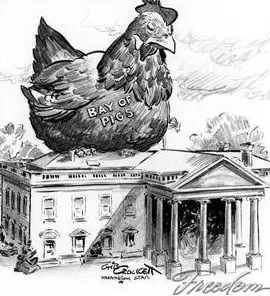
The Bay of Pigs Invasion:
Began when Fidel Castro led a revolution to overthrow Cuban's dictator-Batista
Castro seized US-owned businesses and established close ties with the Soviet Union
Kennedy learned of the CIA planned 1,400 invasion of Cuban exiles to overthrow Castro
Cubans overwhelmed the exile force and JFK's credibility was damaged
The Cuban Missile Crisis:
Believing Kennedy was inexperienced and weak, Russians built 42 missiles in Cuba pointed at the US
US spy plains found the missiles and Kennedy announced a "quarantine" or naval blockade of Cuba and demanded the removal of missiles
Increased the likelyhood of a nuclear war
Krushchev removed the missiles in return for the US promising not to invade Cuba
What were effects of the Cuban Missile Crisis:
Increased Kennedy's popularity and weakened + brought down Krushchev's power
Kennedy + Krushchev developed a better relationship (hotline between Washington + Moscow)
Kennedy shifted from confrontational Cold War tactics, to unity between nations.
The US + Soviets signed the Partial Test Ban Treaty (agree to forbid nuclear tests in the atmosphere)
JFK's Civil Rights strategy for African Americans was weak and as a direct result...
Kennedy failed to attack segregation in the South
Black activists turned to direct action (ban segregation on interstate bus terminals)
Civil Rights shifted to Alabama because Birmingham was the largest segregated city in the US ("Bull" Connor-safety commissioner arrested over 3k demonstrators including MLK)
"Bull" Connor used brutal tactics to stop a peaceful protest (USA saw sin of the nation)
Because of the events in _, Kennedy argued for racial justice and passed civil rights bills which prohibit segregation, catalyze school integration, and ban discrimination in hiring places.
(a)
MLK's "I have a dream" speech and his March on Washington showed public support for the new_ _ bill
(a)

Compare MLK and Malcom X
Dr. King advocated Non-Violent protests to challenge segregation
Dr. King worked to create a racially integrated society
Malcom X was the voice of a militant organization, using force when needed
Malcom X advocated Black Nationalism rather than peacefully-integration strategy
In 1963, Kennedy was assasinated by Lee Harvey Oswald and Vice President _ took the oath of office.
(a)
How did President Lyndon B Johnson aid the Civil Rights movement?
Passed the 1964 Civil Rights Act which gave all citizens rights to public facilities
Created the Equal Employment Opportunity Commission to prevent job discrimination
Title VII of the Civil Rights Act banned job discrimination based on sex
Passed Voting Rights Act of 1965 which abolished literacy tests and
Passes 24th Amendmnet to outlaw poll taxes
Although many people claimed the War on Poverty was a waste, it reduced the number of poor people by 10 million in 3 years. How did Johnson accomplish his goal of "war on poverty"
Believed he had a duty to create a "great society" and use the US's economic prosperity to improve everyone's quality of life.
1/5 of the nation earned less than 3k per year so Johnson declared an "unconditional war on poverty"
Congress passed federal programs to help the poor.
Created Job Corps for high-school dropouts
Head Start programs for preschoolers to prepare them for school
How did Immigration change from the 1960's on?
The Immigration Act of 1965 abolished national quotas of 1920's for immigration.
The Immigration Act of 1965 had a impact on America's demographic character, and family chain immigration.
Between 1990-2010 20 million immigrants entered the US.
Compare + Contrast FDR's New Deal and LBJ's Great Society...
The New Deal AND the Great Society used federal government to promote social justice and equality.
BOTH the New Deal and the Great Society led to an increase in federal spending for social services/citizen aid.
The New Deal AND the Great Society BOTH supported the arts, encouraged building houses, helped the elderly, and instituted government-sponsored employment programs.
The New Deal was a response to an economic depression, but the Great Society was created during a period of economic prosperity.
The Great Society included legislation protecting civil rights and liberties for African Americans
President Kennedy advocated for the Gulf of _ Resolution in order to repel armed attacks against the US after the sinking of 2 US ships by North Vietnamese.
(a)
What were examples of President Lyndon B Johnson's escalation in the Vietnam War?
Choosing to send combat troops to Vietnam
Sending over 500k troops to patroll and search-and-destroy missions
Dropping nuclear bombs onto Vietnamese military sites
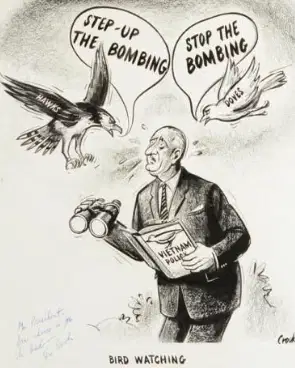
During the Vietnam War _'s were in FAVOR of the war, and believed that they needed to defend freedom in South Vietnam and prevent the spread of communism in Asia.
(a)

During the Vietnam War, _'s were critics of the war who argued the US couldn't win a guerilla war, and did more damage to South Vietnam than aid. Also they believed the cost would be more beneficial funding Johnson's Great Society.
(a)
What were examples of counterculture during the 1960's.
The New Left who argued liberals didn't do ENOUGH for racial/economic inequality.
Anti-war protests sparked by teachers influencing student views AGAINST the Vietnam War
Hippies (love not war) with a new alternative lifestyle, rejected typical values. (drugs, sexual freedom, communes)
What was the impact of counterculture in the 1960's.
Changed traditional values and redefined the culture (womens, gays, poc, etc.)
Those who disagreed with the counterculture formed a "silent majority" who rejuvenated conservative movement and elected President Reagan.
The US backed out of the Vietnam War and focused on internal improvements.
Riots in US cities sparked by civil unrest and focused attention on African Americans living in inter-city ghettos and focus on...
Poor daily lives of unemployed northeners
Deteriorating housing
Failing Schools
Voting Rights for Blacks
Civil Rights for Blacks
What did the Kerner Commission Report show the citizens?
Migration of middle-class families to suburbs left impoverished inner city neighborhoods.
There was a divide between middle-class whites and impoverished blacks in 2 different societies.
Hippies had infiltrated impoverished areas and established a mix of poor hippies + poor blacks.
A distinct culture had grown in inner city neighborhoods reflected by the riots and anger showing.
The Kerner Commission Report claimed to focus on enacting programs to fight poverty by building new houses, training workers, and improving schools. Were they successful?
Yes, these programs provided resources to improve communities.
No, these programs were enacted, but racist ideologies kept blacks in lower class communities across the nation.
Yes, these initiatives provided the frame-work for established communities focusing on students and education.
No, President Johnson refused to shift resources FROM the Vietnam War and ignored the report.
Following the assasination of Malcom X Stokely _ became the best known militant Black leader and called for "Black Power."
(a)
In 1968 President Johnson announced halting the bombing of Vietnam, rejected sending more troops, and announced the end of his future _.
(a)
The news of Dr. King's assassination sparked riots and civil unrest and these minority groups supported Robert _ for President. Although he was assassinated shortly after by an Arab nationalist.
(a)
Republican _ won the Presidency and assumed the burden of ending the Vietnam War and reuniting the divided country.
(a)
How did Native Americans demand that the US address their grievances?
In 1968, Indians embraced the concept of "Red Power" and formed the American Indian Movement (AIM)
Staged protests and 1 group occupied Alcatraz Island Prison.
Staged a dramatic takeover of the village of Wounded Knee while demanding change in Pine Ridge Reservation administration.
Infiltrated US government positions and secretly passed Indian support laws.
The Native American demonstrations gained publicity and results when President Nixon supported the Indian _ Act (IEA)
(a)
In 1962, Cesar _ co-founded the National Farm Workers Association, but later changed into the United Farm Workers
(a)
Cesar Chavez and Dolores Huerta began the _ Grape Strike AGAINST growers who didn't recognize the United Farm Workers. They followed Dr. King's non-violent tactics and held boycotts.
(a)
Mexican Americans redefined their strategies and became more militant and politically aggressive. They coined a new term "Chicano" to replace the term "mexican-americans." They also formed a new political party called La _ _ and promoted goals such as bilingual education + Chicano studies.
(a)
The _ Riots sparked the modern Gay Liberation Movement, and won many victories for LGBT individuals such as removing gay as a mental illness from the APA, and electing Harvey Milk-the first open gay person to hold public office.
(a)
Friedans book "The Feminine _" spoke of frustrated college educated housewives, and sparked a "second wave" of American feminism.
(a)
In 1966, women's rights activists created the National _ for Women (NOW) in order to bring US women into full societal participation.
(a)
What did the 1966 National Organization of Women focus on?
Challenging workplace sexual discrimination
Equal Wages
Advocated for company-provided day care for infant children.
End of hiring ads in sex-segregated newspaper columns.
Voting bias and expanding womens suffrage.
What were examples of success in the feminist movement during the 1970's-1980's.
Women break workplace barriers in male-dominated careers (governor, construction, pilots, firefighters)
1973-Roe v. Wade (protects abortion)
Dissolution of all-male colleges
Equal Payment for Men and Women
ALL Military Academies enrolling Women
The _ Rights Amendment was passed by congress in 1972, but opponents advocated against the amendment and the defeat of the ERA marked a significant setback for women's rights.
(a)
Compare and contrast women's rights in 1890-1920 vs in 1960-1980.
COMPARE;
In both periods middle-class white women dominated the movement.
COMPARE:
In both periods organizations were formed to promote agendas. (NAWSA and NOW both work to increase women's access to higher education.)
CONTRAST: During 1890-1920: womens rights was focused and gained suffrage and ratification of the 19th amendmnet, but in 1960-1980 womens rights failed to pass the ERA.
How did the Environmental Movement change?
Silent Spring-Carson showed how DDT + other chemicals had a bad effect upon wildlife.
Oil rig explosion in SOCAL killed birds and mammals, and oil slick in Ohio burned railroad bridges, and in 1970 EARTH DAY was established and citizens focused on saving the environment.
Congress passed the Clean Air Act, Water Pollution Control Act + Endangered Species Act
Nixon administration banned DDT + created EPA to enforce environmental guidelines.
Nixons "two-_" strategy to end US involvement in Vietnam by continuing peace negotiations and began a policy called "Vietnamization" where Nixon gradually withdrew US troops and left South Vietnam alone to fight.
(a)
When Nixon sent troops to Cambodia to protect Vietnamese citizens, college students protested, but in _ State, the national guard opened fire and killed 4 student bystanders and ignited protests at many more colleges.
(a)
The Paris _ Accords ended the war. The US withdrew its troops, the North Vietnamese released US POW's and left the South Vietnamese government in power BUT 150k North Vietnamese troops remained in South Vietnam.
(a)
The North Vietnamese recognized the disunion of the US and invaded _, threatening South Vietnam until they surrendered in 1975.
(a)
What were consequences of the Vietnam War?
Death Toll (2 million vietnamese citizens, 1.1 NV, 200k SV, and 58k US casualties.)
Nixon decided to replace the draft with a volunteer military force.
Bombing left Vietnam in ruins and herbicides devestated Vietnam environment
Pentagon Papers + Watergate created public distrust of the US gov.
US citizens questioned international involvemnets "Vietnam Syndrome" and advocated AGAINST foreign entanglements
Nixon believed in reshaping global politics and agreed to visit the People's Republic of _ which went against typical containment policies surrounding Communist nations.
(a)
The Shanghai _ promised new trade, travel, and cultural exchanges between the US and the People's Republic of China.
(a)
The US and China established full diplomatic relations in _, and even today friendship exists surrounding education (foreign exchange) economics (China holds the US debt) but tensions exist on other factors.
(a)
After returning from China, Nixon agreed to visit _ and focused on a joint space mission and signed a Strategic Arms Limitation Treaty which signaled a new period of relaxed tensions.
(a)
In 1973, Egypt + Syria attacked _ and Nixon's decision to help them angered oil-rich nations who put an embargo on oil to the US. The Arab Oil Embargo marked the END of the post-ww2 economic boom. And marked the beginning of mass inflation which plagues the US economy into 1980.
(a)
_ revealed that Nixon had ordered the CIA to "cover up" the break in at Washington DC. Congress recommended Nixon be impeached yet Nixon resigned in 1974.
(a)
What were the effects of Watergate?
Demonstrated constitutional checks and balances worked
Nixon was impeached and the republican party failed.
Undermined public confidence in American politics.
Created a demand for new leadership (Jimmy Carter fills in 1976)
Led to a revitalized conservative movement led by Reagan
The combination of high inflation and rising unemployment in the US economy was called _.
(a)
What were the 2 causes of Stagflation?
Johnson attempted to pay for the "great society" and the Vietnam War without raising taxes.
The US economy was dependent upon cheap imported oil, and the the organization of petroleum exporting countries (OPEC) drove up costs of everything.
Rising unemployment as a result of new industrialization jobs.
President Carter focused on patient negotiation and at Camp _ he reached a peace agreement between Egypt and Israel. This treaty ended 30 years of hostility, and Israel returned the Sinai Peninsula to Egypt.
(a)
In 1979, a mob stormed the US and kidnapped 50 hostages. President _ authorized a secret rescue mission but failed.
(a)
What weakened Carter's popularity and led to Reagan's election?
The Failed Iranian Hostage Crisis
Continued Rise in Energy Prices
Double-Digit Inflation (High)
The Camp David Accords

