
NEW
Font size
S
M
L
XL
 Worksheets
Magnetic Fields and Forces
Total questions: 20
Worksheet time: 12mins
Name
Class
Date
1.
Magnetic poles that are unlike ________and magnetic poles that are alike ___________.
a)
run; stay
b)
attract; repel
c)
stay; repel
d)
repel; attract
2.

Are the magnetic field lines in the picture correct?
a)
Yes, because they point from north to south.
b)
No, because they point from north to south (they're supposed to go the other way).
c)
Yes, because the North pole is on the left in all pictures.
d)
No, because the North pole is on the left in all pictures (it's supposed to be on the right).
3.
What does the following represent?
⊙⊙⊙⊙⊙⊙⊙⊙⊙⊙⊙⊙⊙⊙⊙
⊙⊙⊙⊙⊙⊙⊙⊙⊙⊙⊙⊙⊙⊙⊙
⊙⊙⊙⊙⊙⊙⊙⊙⊙⊙⊙⊙⊙⊙⊙
⊙⊙⊙⊙⊙⊙⊙⊙⊙⊙⊙⊙⊙⊙⊙
⊙⊙⊙⊙⊙⊙⊙⊙⊙⊙⊙⊙⊙⊙⊙
⊙⊙⊙⊙⊙⊙⊙⊙⊙⊙⊙⊙⊙⊙⊙
a)
A crowd with binoculars
b)
A bunch of coaxial cables
c)
Uniform magnetic field directed into the screen away from you
d)
Uniform magnetic field directed out of your screen at you
4.
What does the following represent?
⊗⊗⊗⊗⊗⊗⊗⊗⊗⊗⊗⊗⊗⊗⊗⊗
⊗⊗⊗⊗⊗⊗⊗⊗⊗⊗⊗⊗⊗⊗⊗⊗
⊗⊗⊗⊗⊗⊗⊗⊗⊗⊗⊗⊗⊗⊗⊗⊗
⊗⊗⊗⊗⊗⊗⊗⊗⊗⊗⊗⊗⊗⊗⊗⊗
⊗⊗⊗⊗⊗⊗⊗⊗⊗⊗⊗⊗⊗⊗⊗⊗
⊗⊗⊗⊗⊗⊗⊗⊗⊗⊗⊗⊗⊗⊗⊗⊗
a)
Multiplied by a billion
b)
A piece of modern art
c)
Uniform magnetic field directed into the screen away from you
d)
Uniform magnetic field directed out of your screen at you
5.
What is the shape of a magnetic field around a wire?
a)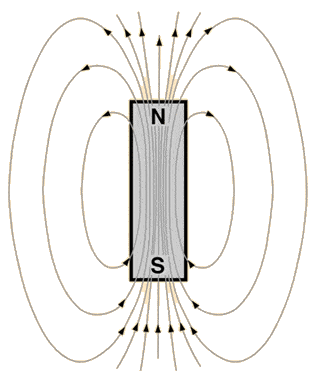
b)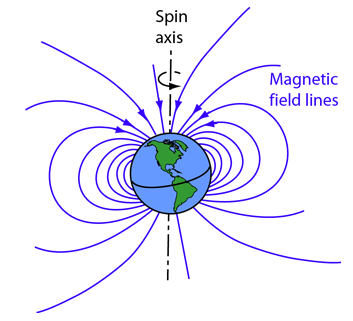
c)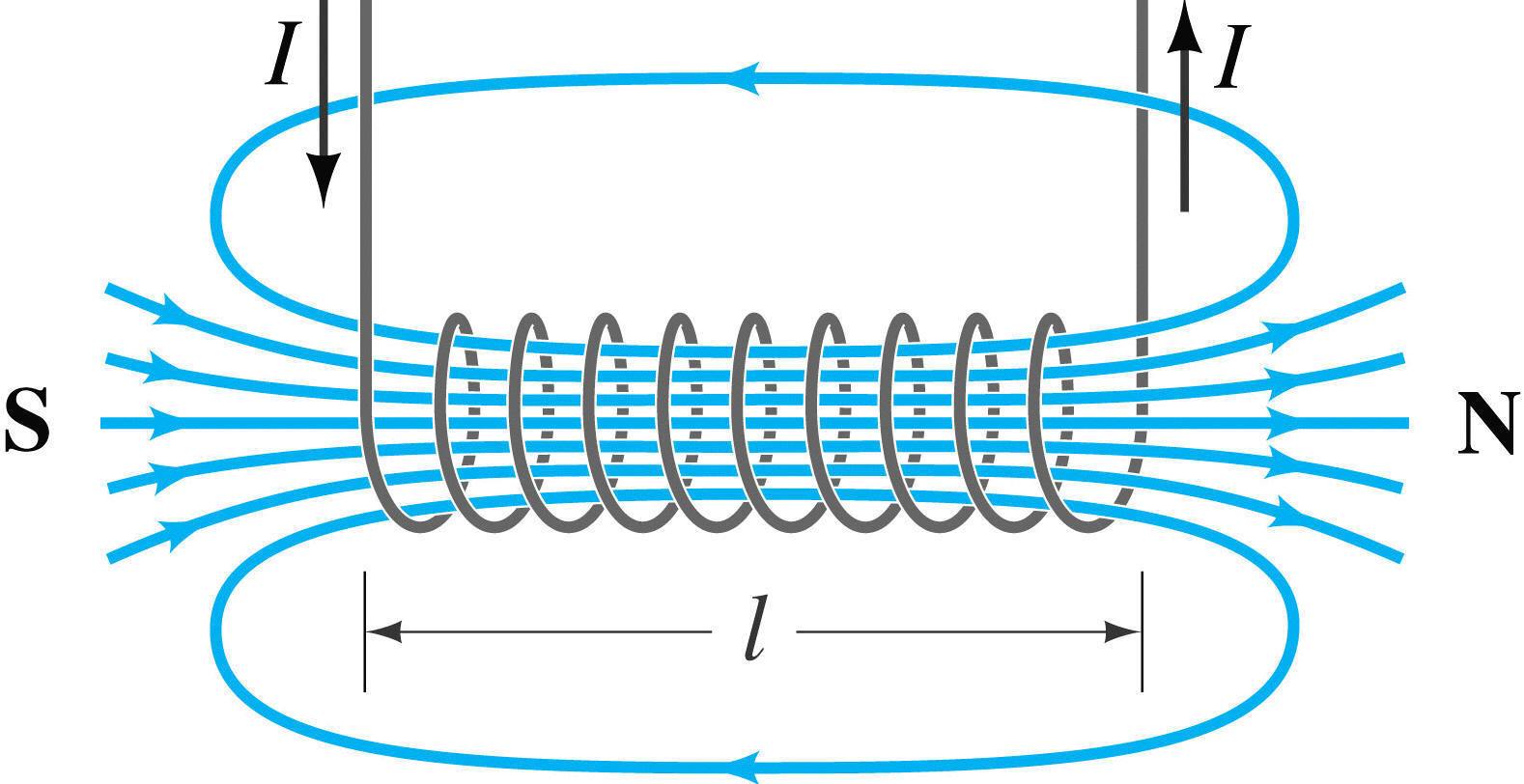
d)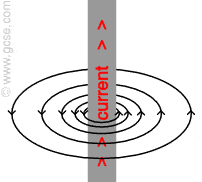
6.
What is the shape of a magnetic field around a solenoid?
a)
b)
c)
d)
7.

What is the direction of the current in the wire?
a)
up
b)
down
c)
left
d)
right
8.

What is direction of the magnetic field around the wire?
a)
clockwise
b)
counterclockwise
9.

What is the direction of the force?
a)
into the page
b)
out of the page
c)
left
d)
right
10.

What is the direction of the force acting on the wire?
a)
into the page
b)
out of the page
c)
up the page
d)
none
11.

Using the right hand grip rule, A represents the direction of the
a)
current
b)
magnetic field
12.
Using the right hand rule, B represents the direction of the
a)
current
b)
magnetic field
13.
Which equation describes the strength of the magnetic force exerted on a current-carrying wire?
a)
Σ F=ma
b)
FB=qvBsinθ
c)
FE=qE
d)
FB=ILBsinθ
14.
What is the symbol for magnetic field?
a)
I
b)
B
c)
M
d)
F
15.
What is the UNIT for magnetic field?
a)
T
b)
A
c)
B
d)
unitless
16.
Which equation describes the strength of a magnetic field produced by a solenoid (current-carrying loops of wires)?
a)
B=2πRμoI
b)
B=ILsinθFB
c)
B=qvsinθFB
d)
B=L μoIN
17.
Which variable describes the number of loops in a solenoid?
a)
L
b)
B
c)
N
d)
R
18.
A magnetic field exerts a force on a charged particle:
a)
always
b)
never
c)
if the particle is moving across the field lines
d)
if the particle is moving along the field lines
19.
An electron travels due north through a vacuum in a region of uniform magnetic field that is also directed due north. It will:
a)
be unaffected by the field
b)
speed up
c)
slow down
d)
follow a right-handed corkscrew path
20.
An electron and a proton are both initially moving with the same speed and in the same direction at 90˚ to the same uniform magnetic field. They experience magnetic forces, which are initially:
a)
identical
b)
equal in magnitude but opposite in direction
c)
in the same direction and differing in magnitude by a factor of 1840
d)
in opposite directions and differing in magnitude by a factor of 1840
Reset

