

wayground logo

Free Printable Worksheets

Font size

S
M
L
XL
Worksheets

8th Grade Science Chemistry STAAR Review

Total questions: 66

Worksheet time: 1hrs 1mins
Name
Class
Date
1.

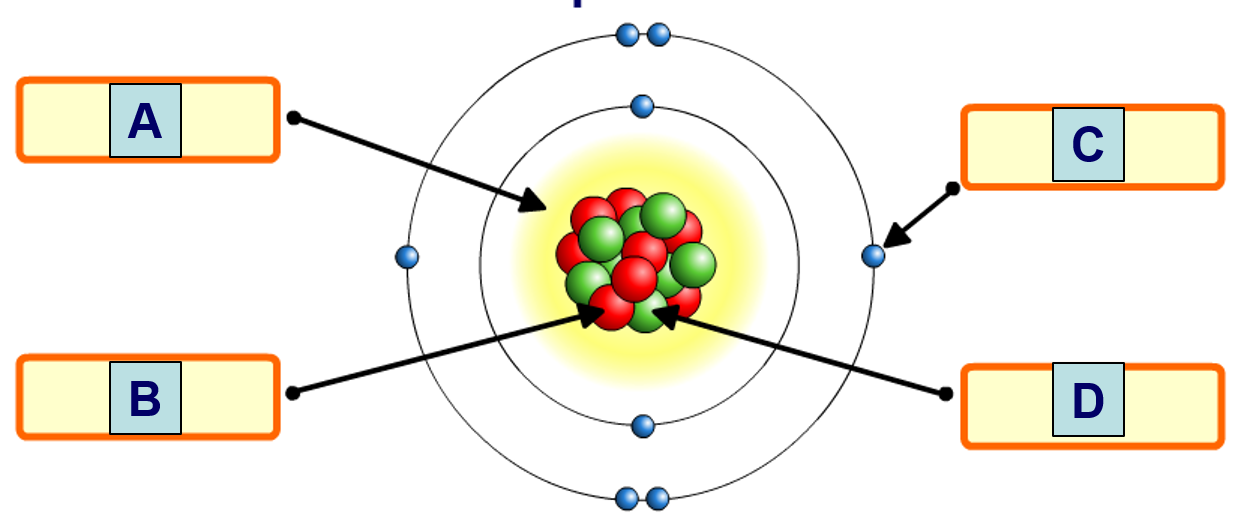
Which of the following is the nucleus?

a)

A

b)

B

c)

C

d)

D

2.

If B is proton, so what is D then?

(a)  

3.

One particle in an atom is electron, which one is it?

a)

A

b)

B

c)

C

d)

D

4.

Which of the following have their relative mass as 1?

a)

Proton

b)

Electron

c)

Neutron

5.

Particles with no charge?

(a)  

6.

What is the charge of a proton?

a)

Negative

b)

Positive

c)

Neutral

7.
Which statement best describes the locations of the subatomic particles?
a)
The protons and electrons are found in the nucleus, while neutrons are in the cloud outside the nucleus
b)
The neutrons are in the nucleus, while the protons and electrons are in the cloud outside the nucleus
c)
The protons and neutrons are in the nucleus, while the electrons are in the cloud outside the nucleus
d)
The electrons and neutrons are in the nucleus, while the protons are in the cloud outside the nucleus
8.
The mass of one proton is equal to the mass of one...
a)
neutron
b)
electron
9.
The mass of one proton is greater than the mass of one...
a)
neutron
b)
electron
10.
All of the mass of an atom comes from what location?
a)
nucleus
b)
electron cloud
11.
True or False - Protons and Neutrons have about the same mass.
a)
True - They have about the same mass
b)
False - They do not have about the same mass
12.
Which subatomic particle has a negative (-) charge?
a)
Proton
b)
Electron
c)
Neutron
13.
An atom's mass number equals the number of...
a)
protons plus the number of electrons
b)
protons plus the number of neutrons
c)
protons
d)
neutrons
14.
Describe an Electron Cloud?
a)
the mist outside of an atom
b)
home of the protons
c)
where electrons are located
d)
nucleus
15.
What is the atomic mass of the atom pictured? 
a)
9
b)
10
c)
18
d)
19
16.
What is atomic number?
a)
Number of protons in an atoms 
b)
Number of neutrons in an atom
c)
Mass of an atom
d)
Charge on an atom
17.

At the atomic level, what makes elements reactive?

a)

having a filled outer level

b)

exchanging or sharing valence electrons

c)

having the same number of electrons

d)

having the same number of protons

18.

An atom has 12 protons, 14 neutrons, and 12 electrons. What is the atomic number of this element?

a)

24

b)

26

c)

12

d)

38

19.

An atom of which element has 37 protons, 48 neutrons and 1 valence electron?

a)

Neon (Ne)

b)

Carbon (C)

c)

Rubidium (Rb)

d)

Sodium (Na)

20.

An atom of which element is represented by this model?

a)

Neon (Ne)

b)

Boron (B)

c)

Nitrogen (N)

d)

Carbon (C)

21.

What part of the atom determines the chemical properties or reactivity?

a)

Protons

b)

Electrons

c)

Valence Electrons

d)

Energy levels

22.

A chemist is identifying the elements present in a sample of seawater. What characteristic of an element's atoms always determines the element's identity?

a)

The number of electrons

b)

The number of neutrons

c)

The number of protons

d)

The number of valence electrons

23.

An atom of which element is represented by this model?

a)

Carbon (C)

b)

Neon (Ne)

c)

Sodium (Na)

d)

Boron (B)

24.

An atom has 11 protons, 12 neutrons, and 11 electrons. What is the identity of the element?

a)

Sodium

b)

Titanium

c)

Vanadium

d)

Magnesium

25.

Four students were asked to name the parts of an atom that determine the atom’s identity and chemical properties. The students’ responses are shown in the table below.

a)

Student 1

b)

Student 2

c)

Student 3

d)

Student 4

26.
All of these properties describe metals except...
a)
malleable
b)
conductors
c)
brittle 
d)
shiny
27.
Which element is least likely to conduct heat and electricity? 
a)
O
b)
Si
c)
Po
d)
Ca
28.
Which of the given choices correctly shows the three main groups of elements listed from least conductivity to greatest conductivity?
a)
Metals, Nonmetals, Metalloids
b)
Nonmetals, Metalloids, Metals
c)
Metalloids, Metals, Nonmetals
d)
Nonmetals, Metals, Metalloids 
29.
A substance that is shiny and a good conductor would be classified as a
a)
nonmetal
b)
metalloid
c)
metal
d)
metallica
30.
A substance that is dull, brittle, and a nonconductor would be classified as a
a)
metal
b)
nonnmetal
c)
metalloid
d)
metallica
31.
Aluminum can be hammered into different shapes or rolled into flat sheets. This means Aluminum is 
a)
ductile
b)
malleable
c)
lustrous
d)
high density
32.

Type of element is a semiconductor

a)

metal

b)

nonmetal

c)

metalloid

33.

Metals can be drawn into thin wires. This property is known as being

a)

malleable

b)

ductile

c)

conductive

d)

lusterous

34.
A student is given a sample of an unknown substance. He is asked to determine if it is classified as a metal, a metalloid, or a nonmetal. He discovered that the unknown element conducted some heat and electricity, had a shiny luster, and broke easily. This element is most likely a 
a)
metal
b)
nonmetal
c)
metalloid
d)
cannot be determined
35.
Anytime you see the word SEMICONDUCTOR - what substance do you have?
a)
Metal
b)
Nonmetal
c)
Metalloid
36.

UP and DOWN columns on the periodic table are

a)

groups

b)

periods

37.

SIDE TO SIDE rows on the periodic table are

a)

groups

b)

periods

38.

Which elements have properties in common?

a)

elements in a group

b)

elements in a period

39.

The group number tells you the number of

a)

protons

b)

valence electrons

c)

energy levels

40.

The period number tells you the number of

a)

protons

b)

energy levels

c)

valence electrons

41.

Which two elements have properties in common?

a)

Nitrogen and Phosphorous

b)

Oxygen and Nitrogen

c)

Sulfur and Nitrogen

42.

How many protons does Lithium have?

a)

3

b)

4

c)

7

43.

These elements are in a:

a)

group

b)

period

44.

Do these elements have properties in common?

a)

yes

b)

no

45.

These elements are in a:

a)

group

b)

period

46.

Do these elements have properties in common?

a)

yes

b)

no

47.

Which elements are stable?

a)

Group 1

b)

Group 8

c)

Group 18

48.

Which elements have 1 valence electron?

a)

period 1

b)

group 1

c)

group 4

49.

which elements have 4 valence electrons?

a)

group 3

b)

group 4

c)

group 14

50.

Chlorine is a halogen - which means it is a nonmetal that forms a "salt" when chemically combined with metals. What other elements have this property in common with chlorine? Use the periodic table.

a)

Fluorine, Bromine, Iodine

b)

Sulfur, Oxygen, Boron

c)

Neon, Argon, Krypton

d)

Hydrogen and Helium

51.

Elements in the same __ have the same number of energy levels.

a)

group

b)

period

c)

row

d)

chart

52.

What are the starting substances (reactants) in this equation?

a)

H2H_2   O2O_2  

b)

H2OH_2O  

53.

This is a (a)   change

54.

Which of the following examples shows that a chemical reaction has occurred?

a)

A rock breaks into smaller pieces when it is struck with a hammer.

b)

Rust forms on a hammer that has been left outside to long.

c)

A cup of water turns pink when a few drops of red food coloring are added.

d)

A solid is formed when heat is removed from a sample of water.

55.
A student places a piece of a potato into a container of hydrogen peroxide. One observation the student makes is that bubbles form around the potato. The presence of bubbles might indicate the formation of a new substance because bubbles - 
a)
could show that a gas is forming
b)
always rise to the top of a liquid. 
c)
are almost always perfectly spherical.
d)
usually burst after a few minutes.
56.
Hydrogen peroxide breaks down to form water and oxygen gas. Which observation is evidence that a chemical reaction has occurred?
a)
The mass of the solution remains the same.
b)
 Phase changes are observed.
c)
 The color of the solution remains clear.
d)
The temperature of the solution increases. 
57.
A clear liquid from a flask is poured into another clear liquid in a beaker. Which of the following results of this procedure would indicate a new substance was formed?
a)
The level of the substance in the beaker is higher after the other liquid is added.
b)
A yellow solid forms and then settles to the bottom of the beaker.
c)
Small white crystals are left behind in the flask that held the first liquid.
58.
Which of the following is an example that includes evidence of a chemical reaction?
a)
A sample of zinc is placed in water and it settles to the bottom
b)
A solid block of ice is heated and it completely melts into a liquid. 
c)
Sugar that is burned gives off an odor and turns brown and then black.
d)
A tomato is placed into a blender and chopped up into smaller pieces.
59.
Evidence of a chemical reactions is anything that shows - 
a)
a new substance has formed
b)
a solid dissolved in a liquid
c)
interaction between 2 gases
d)
a change in the state of matter
60.
How many elements does PbNO3 have?
a)
2
b)
3
c)
4
d)
5
61.
How many nitrogen atoms does NH3 have?
a)
1
b)
2
c)
3
d)
4
62.
What is the reactant in the following equation?
2NaHCO3  -> Na2CO3  +  CO2  + H2O
a)
NaHCO3
b)
Na2CO3
c)
CO2
d)
H2O
63.
Which  of the following is a balanced equation?
a)
Na   +   Cl2   -->  NaCl
b)
H2  +  O2  --> H2O
c)
Ca   +   Br  -->  CaBr2
d)
Na   +  F  -->  NaF
64.
Question Image

Match the following

a)

Reactant

Element

1.

2C2

b)

Reactant

Compound

2.

CH4

c)

Product

Compound

3.

CO2

65.
The number to the lower side of an element is a 
a)
Subscript
b)
Superscript
c)
Coefficient
d)
Charge
66.
The number in front of a compound or element is a 
a)
Subscript
b)
Coefficient
c)
Superscript
d)
Charge
