wayground logo

Free Printable Worksheets

Font size

S
M
L
XL
Worksheets

04/26/23

Total questions: 117

Worksheet time: 2hrs 33mins

Name
Class
Date
1.

Match the following

a)

Multicellular, does not have a cell wall

1.

animal cell

b)

Multicellular, has chloroplasts

2.

plant cell

c)

Unicellular, has a flagella to help it move

3.

bacteria cell

2.

The ​ (a)   are responsible for converting glucose (food) into ​ (b)   for the cell.

Choose from the below words
mitochondria
energy
nucleus
DNA
ribosome
3.

Reorder the following from simple to complex

a)

Cell

b)

Tissue

c)

Organs

d)

Organ systems

e)

Organism

1)
2)
3)
4)
5)
4.

Cyclins signal cells to progress through stages of cell replication. Uncontrolled production of cyclins will most likely result in (a)  

Choose from the below words
the formation of haploid cells
transfer of cyclins to other cells
formation of tumors
death of the cell
5.
What is one way that a lysogenic infection differs from a lytic infection?
a)
A lysogenic virus does not act on bacteria as a lytic virus does.
b)
A lysogenic virus can remain in the host DNA for a longer period without becoming active.
c)
A lysogenic virus contains RNA instead of DNA.
d)
A lysogenic virus directs the production of new viruses right away.
6.

Cell have several mechanisms for regulating their internal environments. Which of these mechanisms involved in maintaining homeostasis requires energy? (a)  

Choose from the below words
osmosis
diffusion
active transport
passive transport
7.

This diagram shows the cell cycle.Which of the following activities occur in the S phase? (a)  

Choose from the below words
Replication of the DNA
Growth of the cell
Formation of the mitotic spindle
Breakdown of the nuclear membrane
8.

a)

F

b)

G

c)

H

d)

J

9.

a)

F

b)

G

c)

H

d)

J

10.

a)

F

b)

G

c)

H

d)

J

11.

a)

F

b)

G

c)

H

d)

J

12.

a)

F

b)

G

c)

H

d)

J

13.
a)

F

b)

G

c)

H

d)

J

14.
a)

F

b)

G

c)

H

d)

J

15.
a)

A

b)

B

c)

C

d)

D

16.
a)

A

b)

B

c)

C

d)

D

17.
a)

A

b)

B

c)

C

d)

D

18.
a)

F

b)

G

c)

H

d)

J

19.
a)

F

b)

G

c)

H

d)

J

20.
Which illustration of transport across the membrane requires energy?
a)
A
b)
B
c)
C
d)
D
21.
The  movement of water from a high concentration to a low concentration is called
a)
diffusion
b)
osmosis
c)
facilitated diffusion
d)
active transport
22.
In this situation, where the solute is illustrated by red dots, predict if will WATER move into or out of the cell, and how that will affect the cell.
a)
Water will move into the cell and the cell will expand.
b)
Water will move into the cell and the cell will shrink.
c)
Water will move out of the cell and the cell will expand.
d)
Water will move out of the cell and the cell will shrink.
23.
Semi-permeable mean to allow
a)
all materials across the membrane
b)
only some materials across the membrane
c)
no material to cross the membrane
d)
to allow only water across the membrane
24.

When the concentration of solutes on both sides of a membrane is the SAME, the solution is

a)
isotonic
b)
hypertonic
c)
hypotonic
25.

Match the following

a)

Simple Diffusion

1.

When molecules passively cross the plasma membrane through the phospholipid bilayer

b)

Facilitated Diffusion

2.

When molecules passively cross the plasma membrane through a channel protein

c)

Osmosis

3.

The movement of water across the cell membrane

d)

Endocytosis

4.

Bringing in large materials through the cell membrane into a vacuole.

e)

Exocytosis

5.

Moving larger amounts or large quantities of materials through the cell membrane
26.
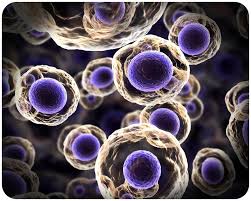
The two kinds of cells are Prokaryotes and Eukaryotes. How are they different?
a)
Prokaryotes have a nucleus.
b)
Eukaryotes have a nucleus.
c)
Prokaryotes are plant cells.
d)
There is no difference.
27.

What distinguishes a plant cell from an animal cell? (How do you tell them apart) Hint: There's 3 ways (Check all 3)

a)

Central Vacuole

b)

Mitochondria

c)

Cell Wall

d)

Ribosomes

e)

Chloroplasts

28.

Stem cells are ____________________.

a)

cells that grow uncontrollably

b)

undifferentiated cells that can turn into other types of cells

c)

the first cells of a new living organism (fertilized egg)

d)

specialized cells that do one job

29.

Match the following

a)
1.

Control center of the cell.

b)
2.

Makes energy for the cell.

c)
3.

Site of photosynthesis.

d)
4.

Site of protein synthesis.

e)
5.

Controls what goes in/out of the cell.

30.

Label the phases of Mitosis on the image shown. They are NOT in order.

31.
32.

Match the following

a)
1.

Prophase: Chromatin condenses.

b)
2.

Interphase: Resting phase between mitosis cycles.

c)
3.

Metaphase: Chromosomes align in the middle.

d)
4.

Anaphase: Chromosomes are pulled apart.

e)
5.

Telophase: Chromosomes are pulled to opposite end and two nuclei form.

33.
A process for removing large quantities toxins and waste from the cell is
a)
exorcism
b)
exocytosis
c)
endocytosis
d)
endoplasmic reticulum
34.
Which type of Passive Transport is being represented in this picture?
a)
Passive Diffusion
b)
Simple Diffusion
c)
Active Diffusion
d)
Facilitated Diffusion
35.
Which form of transport is being shown in the diagram.
a)
diffusion
b)
osmosis
c)
facilitated diffusion
d)
active transport
36.
A living relationship between two species in which one organism is harmed is called...
a)
mutualism
b)
commensalism
c)
parasitism
d)
niche
37.
symbiotic relationship in which both organisms benefit
a)
competition
b)
Mutualism
c)
nitrogen fixation
d)
energy pyramid
38.
A collection of organisms that belong to different populations but all live in the same area and interact with one another.
a)
Population
b)
Ecosystem
c)
Community
d)
Ecosphere
39.
A collection of organisms that belong to different populations but all live in the same area and interact with one another.
a)
Population
b)
Ecosystem
c)
Community
d)
Ecosphere
40.
A collection of organisms that make up a community as well as all of the nonliving aspects of the environment.
a)
Population
b)
Community
c)
Habitat
d)
Ecosystem
41.
A pond ecosystem is shown in the diagram below. Which statement describes an interaction that helps maintain the dynamic equilibrium of this ecosystem?
Which statement describes an interaction that helps maintain the dynamic equilibrium of this ecosystem?
a)
The frogs make energy available to this ecosystem through the process of photosynthesis.
b)
The algae directly provide food for both the rotifers and the catfish.
c)
The green-backed heron provides energy for the mosquito larvae.
d)
The catfish population helps control the populations of water boatman and waterfleas.
42.
According to the food web, which of these supply energy for all the other organisms?     
a)
snakes
b)
insects
c)
grasses
d)
cougars
43.
Striped fish are affected by abiotic and biotic factors in the environment.  Which of these factors is biotic?
a)
water temperature
b)
mineral nutrients
c)
algae
d)
sediment
44.
Refer to the illustration above. Level “A” is composed of
a)
secondary consumers
b)
primary consumers
c)
producers
d)
predators
45.
When an organism dies, the nitrogen in its body
a)
can never be reused by other living things.
b)
is immediately released into the atmosphere.
c)
is released by the action of decomposers.
d)
None of the above
46.
In going from one trophic level to the next higher level,
a)
the number of organisms increases.
b)
the amount of usable energy increases.
c)
the amount of usable energy decreases.
d)
diversity of organisms increases.
47.
The diagram represents a food chain. The arrows in the diagram indicate the  
a)

return of chemical substances to the
environment
b)
order of importance of the various organisms.  
c)
direction of energy flow through a series of organisms
d)
direction in which organisms move in the environment. 
48.
Deforestation by burning has been described as a "double whammy" to the environment, meaning it has 2 negative impacts. Why is this description accurate? 
a)
Forest burning releases CO2 while decreasing oxygen, which disrupts cycles
b)
Deforestation reduces the amount of oxygen in the atmosphere, which depletes the ozone layer
c)
Forest clearing is often followed by land development, which often leads to increased noise pollution
d)
Deforestation increases the number of plant and animal species by destroying habitat
49.
Deforestation by burning has been described as a "double whammy" to the environment, meaning it has 2 negative impacts. Why is this description accurate? 
a)
Forest burning releases CO2 while decreasing oxygen, which disrupts cycles
b)
Deforestation reduces the amount of oxygen in the atmosphere, which depletes the ozone layer
c)
Forest clearing is often followed by land development, which often leads to increased noise pollution
d)
Deforestation increases the number of plant and animal species by destroying habitat
50.
The amount of energy that usually transfers from one trophic level to the next...
a)
10%
b)
20%
c)
80%
d)
50%
51.
The fox in this food web would be considered a:
a)
Tertiary Consumer
b)
Producer
c)
Secondary Consumer
d)
Primary Consumer
52.
largest number of individuals of a population that the environment can support  
a)
carrying capacity
b)
primary succession 
c)
denitrification
d)
mutualism
53.
The number of species within a specific habitat.
a)
Conservation
b)
Sustainable development
c)
Biodiversity
d)
Preservation
54.
What is the correct order?
a)
Biosphere, ecosystem, Biome
b)
Biospere, community, niche
c)
Community, Population, Species
d)
Community, Biome, species
55.
A fox stalks a duck and eats it.  This is an example of ?
a)
competition
b)
predation
c)
parasitism
d)
mutualism
56.
What type of succession would first develop on a newly formed volcanic island?
a)
primary 
b)
secondary
c)
tertiary
d)
climax
57.
Water lilies cannot grow in the desert because the amount of water is a?
a)
limiting factor
b)
competitive factor
c)
carrying factor
d)
none of these
58.
Ecosystem are different from communities because ecosystems contain?
a)
plants
b)
animals
c)
nonliving things
d)
decomposers 
59.
Grass>>>>>mouse>>>>>cat>>>>>coyote.  The coyote is a
a)
primary consumer
b)
producer
c)
second level consumer
d)
tertiary consumer
60.
Mistletoe absorbs nutrients meant for a tree.  This is ?
a)
mutualism 
b)
parasitism
c)
communalism 
d)
predation
61.
Most food chains have no more that 5 levels.  Why is this?
a)
They run out of energy.
b)
False statement.  Most food chains have 6-8 levels.  
62.
Which of these is an abiotic factor?
a)
soil
b)
grass
c)
trees
d)
animal
63.
A certain bird eats the parasites off of an antelope.  This is ?
a)
mutualism
b)
commensalism 
c)
predation
d)
parasitism
64.
All energy originates from ?
a)
food
b)
the sun
c)
mitochondria
d)
consumers
65.
Area with all living (biotic) and non living (abiotic) entities.  
a)
population
b)
ecosystem
c)
communities
d)
biome
66.
A tick on a dog is an example of ?
a)
predation
b)
competition
c)
parasitism
d)
mutualism 
67.
What is happening at 1?
a)
respiration: releasing CO2
b)
decomposing CO2 in the soil
c)
photosynthesis: absorbing CO2
d)
turning CO2 from the atmosphere into organic molecules
68.
Photosynthesis
a)
absorbs CO2
b)
releases CO2
69.
Which of the following is a herbivore?
a)
cricket
b)
frog
c)
hawk
d)
shrew
70.
Which organism recieves the least amount of energy from the producer?
a)
Owl
b)
Grasshopper
c)
Lilypad
d)
Mouse
71.
In a food chain or energy pyramid, there are different feeding levels (producer, primary consumer...). What do we call these feeding steps?
a)
communities
b)
levels of energy
c)
trophic levels
d)
food web
72.
The recycling of matter in ecosystems requires the breakdown of dead organic matter. This is accomplished by
a)
decomposers
b)
primary consumers
c)
secondary consumers
d)
primary producers
73.
What approximate percent of the energy found in a trophic level is lost as heat and is unavailable to the next trophic level?
a)
10%
b)
90%
c)
100%
d)
50%
74.
Which organisms in the food chain have the least available energy?
a)
large fish
b)
algae
c)
shark
d)
small fish
75.
In the food chain, how much energy will make it to the trophic level of the sharks if the producers have 100,000 calories?
a)
10 calories
b)
1 calorie
c)
100 calories
d)
1,000 calories
76.
A collection of populations of different species that interact is called a(n)
a)
organism
b)
population
c)
community 
d)
ecosystem
77.
What is the recycling of chemical elements throughout an ecosystem called?
a)
energy
b)
phosphorus cycle
c)
biogeochemical cycle
d)
trophic level
78.

Put each label in the correct location in the Venn Diagram. (Make sure to put answers in DESCENDING number order.)

79.

Explain two main differences between DNA and RNA. (Must use complete sentences.)

4 lines
80.
81.
82.

Which part is the building block of DNA?

83.

Which part is responsible for the genetic diversity of life?

84.

Which part is the backbone of DNA?

85.

Match the following

a)

DNA

1.

Holds the genetic information of all living things.

b)

mRNA

2.

Carry protein information from the DNA in a cell's nucleus to the cell's cytoplasm.

c)

rRNA

3.

Major constituent of ribosomes.

d)

tRNA

4.

Brings the amino acids and places them in the correct potsition to create the desired protein

86.

When DNA splits into single strands to act as a template for a new strand of complementary DNA, it is called ​ (a)   . ​ The process by which ​ DNA is copied to ​ (b)   , which carries the information needed for protein synthesis is called ​ (c)   . The mRNA formed in transcription is transported out of the ​ (d)   , into the cytoplasm, to the ribosome (the cell's protein synthesis factory). With the help of tRNA the protein chain is assembled in a process known as ​ (e)   .

Choose from the below words
replication
mRNA
transcription
nucleus
translation
87.

What type of RNA is shown?

a)

mRNA

b)

tRNA

c)

rRNA

88.

A nucleotide from DNA and RNA are shown in the image, what is the difference between them regarding the sugars involved?

a)

DNA and RNA have the same sugar

b)

DNA has a ribose sugar while RNA has a deoxyribose sugar

c)

DNA and RNA have no sugar

d)

DNA has a deoxyribose sugar while RNA has a ribose sugar

89.

Which statement correctly describes the sequence of bases found in DNA?

a)

It changes every time it replicates

b)

It is exactly the same in all organisms

c)

It directly controls the synthesis of starch within a cell

d)

It determines the characteristics that will be inherited

90.

Which processes occurs in the nucleus? (two answers)

a)

DNA replication

b)

transcription

c)

translation

d)

digestion

91.

If a portion of a mRNA molecule contains the base sequence A-A-U, the corresponding tRNA base sequence is

a)

T-T-C

b)

G-G-T

c)

U-U-A

d)

A-A-U

92.

The picture shows a nucleotide. What could the green box represent?

a)

adenine

b)

phosphate

c)

deoxyribose

d)

ribose

93.

What is Phe in this picture represent?

a)

the codon

b)

the anticodon

c)

a polypeptide

d)

an amino acid

94.

What molecule is represented by #6 in the picture?

a)

tRNA

b)

mRNA

c)

DNA

d)

protein

95.

In a portion of a gene, the nitrogenous base sequence is T-C-G-A-A-T. Which base sequence would normally be found bonded to this section of the gene?

a)

A-G-C-T-T-A

b)

U-G-C-A-A-U

c)

A-C-G-T-A-A

d)

A-C-G-U-U-A

96.

Use your codon chart to match the DNA sequence GAA to the correct amino acid

a)

VAL

b)

TYR

c)

LEU

d)

PHE

97.

Use your codon chart to match the DNA sequence TGA to the correct amino acid.

a)

Thr

b)

Ala

c)

Val

d)

Gly

98.

Use your codon chart to find the amino acid that codes for AGU

a)

Tyr

b)

Gly

c)

Arg

d)

Ser

99.
How can a person's muscle cells have the same exact DNA sequences as their nerve cells even though the look and perform completely different?
a)
The two different cells become mutated
b)
The proteins expressed in each cell are different
c)
They actually have different DNA in the two types of cells.
d)
The genome of the different cells changes
100.

The Himalayan rabbit's habitat has cold, snowy winters and mild summers. The body is typically covered in white fur except for the nose, feet, tail, and ears, which are covered in black fur.

A scientist shaved an area of white fur on the back of a Himalayan rabbit and placed an ice pack over the shaved area . The shaved area grew black fur.

Which of these best explains why the hair that grew back where the Ice pack was placed was black and not white?

a)

The white hair mutated to black hair as the rabbit's body temperature decreased.

b)

The coat color changed from white to black with the age of the rabbit.

c)

The genes for black hair were activated by specific temperatures.

d)

White hair only grows during certain times of the year.

101.

CRISPR-Cas9 is a genetic modification technique that edits parts of the genome of an organism . Using this technique scientists can add, remove, or modify sections of the DNA sequence.

How can scientists use this technique to control gene expression?

a)

By determining the number of chromosomes in an organism

b)

By identifying how closely related one individual is to another

c)

By calculating the number of genes different organisms produce

d)

By activating or deactivating specific genes

102.

What type of mutation is this?

a)

Substitution

b)

Deletion

c)

Insertion

103.

According to the Punnett square in basic mendelian genetics: B reprepsents the dominant gene for blue feathers and b represents the recessive gene for red feathers. Two heterozygous birds have one offspring. What percent chance does it have for red feathers?

a)

0%

b)

25%

c)

75%

d)

100%

104.

Study the Punnett Square. What is the probability of a dominant trait showing up?

a)

0%

b)

25%

c)

50%

d)

100%

105.

Study the Punnett Square. What is the probability of having heterozygous dominant traits?

a)

0%

b)

25%

c)

50%

d)

75%

106.

Study the Punnett Square. What is the probability of having a recessive trait?

a)

100%

b)

50%

c)

25%

d)

0%

107.

What is the final result in meiosis?

a)

Two new daughter cells with the exact same chromosomes.

b)

Four new cells, each with half the chromosomes.

c)

Four new cells, each with twice the chromosomes.

108.

HOW MANY CHROMOSOMES DO HUMAN GAMETES HAVE?

a)

46

b)

23

c)

47

d)

22

109.

Red is incompletely dominant to white in snapdragons. Which cross would result in 100% pink flowers?

a)

RR x rr

b)

rr x rr

c)

Rr x Rr

d)

RR x RR

110.
AB blood type is an example of what type of inheritance?
a)
complete dominance
b)
incomplete dominance
c)
codominance
d)
polygenic inheritance
111.

Mama Suga has a blood type of AB. What are Papa Daichi's possible blood types if their son has a blood type of B? Select all that applies.

a)

A

b)

B

c)

AB

d)

O

112.

What type of non-mendelian inheritance does the picture show?

a)

codominance

b)

multiple alleles

c)

incomplete dominance

d)

polygenic inheritance

113.

What type of inheritance pattern does the diagram represent?

a)

Incomplete Dominance

b)

Codominance

c)

Multiple Alleles

d)

Polygenic Inheritance

114.

What is the mode of inheritance shown here?

a)

Recessive because it "skips" a generation

b)

Dominant because it shows up in every generation

115.
Is this trait (the shaded individuals) dominant or recessive?
a)
dominant
b)
recessive
116.

If this pedigree shows a recessive disorder, what MUST the genotype of individual 4 be?

a)

HH

b)

Hh

c)

hh

117.

Colorblindness is more common in males than in females because......

a)

fathers pass the allele for colorblindness to their sons only

b)

the allele for colorblindness is located on the Y chromosome

c)

the allele for colorblindness is recessive and located on the X chromosome

d)

males who are colorblind have two copies of the allele for colorblindness