
Font size
 Worksheets
EOC Quizizz# 2 - Properties of Water
Total questions: 24
Worksheet time: 28mins

The relatively weak bonds that form, break, and reform between various water molecules and are responsible for the different phase changes in water are called:
Covalent bonds
Ionic bonds
Polar bonds
Hydrogen bonds

Which end of the water molecule has a slightly negative charge?
oxygen
hydrogen
both ends are slightly positive
water is nonpolar

What word describes when water is attracted (sticks) to other substances?
cohesion
adhesion
capillary action
surface tension

Water is called a universal solvent because it...
it can be found anywhere
it freezes when it gets cold
solves all of our problems
dissolves all ionic compounds and all polar molecules
dissolves everything! Polar & Non-polar

Large bodies of water, such as lakes and oceans, do not quickly fluctuate in temperature. What is the reason for this phenomenon?
Water is an acid.
Water is a universal solvent.
Water has a high heat capacity.
Water acts as a pH buffer

Small insects can walk across the surface of calm water. Their feet push the surface of the water down slightly. What is the best explanation for why this happens?
They carefully step from one molecule to the next.
The insects actually use their wings to hover slightly above the water's surface and they only skim it with their feet
The insects are using their legs to swim.
They are light enough to not break the surface tension created by cohesion.

How does water move from the roots to the leaves of plants?
Evaporation
Capillary action
Gravity
Osmosis

What property of water makes it a great solvent, and allows for cohesion, adhesion, and capillary action?
Water is transparent.
Water is tasteless.
Water is less dense when it freezes.
Water is polar.
Water has a high heat capacity

all substances dissolve easily in water because water is a universal solvent

cohesion
adhesion
capillary action
hIgh specific heat
cohesion & adhesion (they both mean the same thing)

When a molecule has an opposite slight/partial electrical charge on each end, the molecule is said to be a ?
non-polar molecule
Ionic molecule
The purpose of a buffer is to ___________.
Neutralize an acid or base and maintain pH within a narrow range
Make your car's new wax look shiny.
Add volume to your hair.
All of the above.
What is pH a measure of?
Density
Mass
Hydrogen Ion Concentraion
Polarity
Hydrogen bonds

The table shows the pH of several solutions. Which solution has the greatest concentration (amount) of H+ ions?
vinegar
milk
water
bleach

Tomato juice is ____ times more acidic than pure water.
10
1,000
30
100
3

Hand soap is ___ times more ___ than egg.
10, acidic
2, basic
100, basic
100, acidic
20, basic

Water has a high specific heat . This means the temperature of water inside our bodies and on earth changes...
Rapidly, needing a little energy
Slowly, and needing much energy
Rapidly, needs no energy

Water dissolves many substances. This is important to living things because
Water changes to ice when cold
Water floats when it is ice.
Water transports dissolved nutrients into our cells.
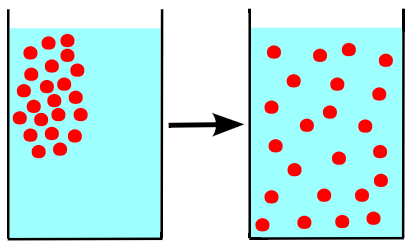
You can make a solution more concentrated by adding more __________.
solution
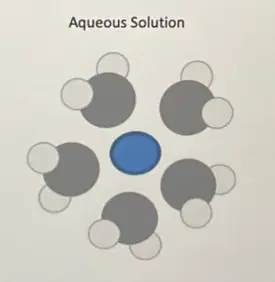
What is the charge of the blue ionic solute being dissolved?
Positive charge
Negative charge
Slight Positive charge
Slight negative charge
Compare acids, bases and salts by sorting their properties into the correct categories
pH lower than 7
pH higher than 7
pH = 7
HIgh H+ ion concentration
Low H+ ion concentration
H+ concentration = OH- concentration
pH = 2
pH = 9
H2O
In the context of water molecules, what does the term "hydrogen bonding" specifically refer to?
The bond between two hydrogen atoms
The bond between a hydrogen atom and an oxygen atom within the same molecule
The attractive force between a hydrogen atom of one water molecule and an oxygen atom of another water molecule
The repulsive force between hydrogen atoms of adjacent water molecules

Which numbered arrow in the image above points to a hydrogen bond?
1
2
3
4

