
 Worksheets
5th Grade AdVENTURE CAASPP Practice Part 4
Total questions: 105
Worksheet time: 53mins

This chart shows the current weather data for four cities.
Which city is most likely to experience precipitation?
City W
City X
City Y
City Z
On a hot summer day, cumulus clouds grow taller and darker. Which type of weather will most likely occur?
clear skies
a hurricane
a thunderstorm
several snowy days
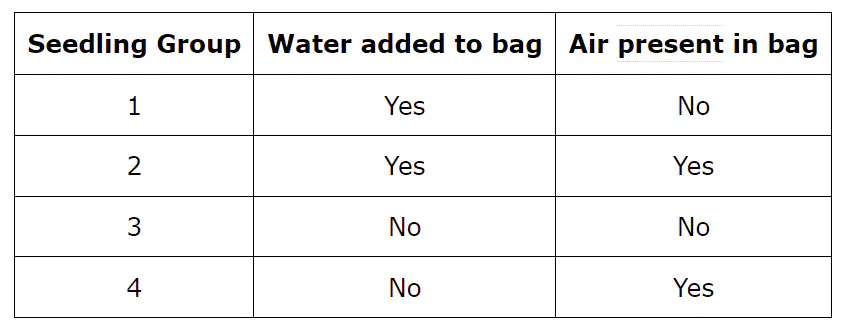
Students study the best way to grow bean seedlings. The students measure and record the mass of 12 seedlings. Then they divide the seedlings into four groups. All of the groups of seedlings are placed on paper towels. Some of the paper towels are wet. Each paper towel is placed in a bag and sealed. Students press the air out of some bags.
The students measure and record the mass of each seedling after five days. which of these describes the group of seedlings that most likely gained the greatest mass?
Group 4 seedlings gained mass from carbon dioxide gas in the air and were dry and likely to rot.
Group 3 seedlings gained mass because there was no watr to rot the plants or air to dry them out
Group 2 seedlings gained mass from both water on the paper towel and carbon dioxide gas in the air
Group 1 seedlings gained mass from water and did not dry out since no air was present.
Students observe two hills, Hill A and Hill B. After a heavy rainstorm, the students observe that Hill A has more loose soil at the bottom than Hill B.
Which sentence best describes what most likely caused the loose soil?
Hill A receives less average rainfall than Hill B
Hill A has a slope not as steep as Hill B
Hill A erodes more slowly than Hill B
Hill A has fewer plants than Hill B
Which conditions are needed for a hurricane to form?
warm, dry air rising over warm areas on the land
warm, dry air rising over warm areas in the ocean
warm, moist air rising over warm areas on the land
warm, moist air rising over warm areas in the ocean
A rabbit depends on various plants in an ecosystem to survive. Which would most likely happen if a drought decreased the plant population?
The rabbit population would increase.
The rabbit population would decrease.
The rabbit population would remain the same
The rabbit population would increase, then decrease quickly.

The diagram is an aquatic food chain. Which will most likely occur if there is overfishing and a loss of clams?
The amount of algae would increase and the number of bass would increase.
The amount of algae would decrease and the number of bass would increase.
The amount of algae would increase and the number of bass would decrease.
The amount of algae would decrease and the number of bass would decrease.
This diagram shows a simple ocean food chain.
algae → fish → seal
Which will most likely occur if the fish population decreases?
The algae and seal populations will increase.
The algae and seal populations will decrease.
The algae population will increase, and the seal population will increase.
The algae population will increase, and the seal population will decrease.

This food chain shows organisms in a classroom aquarium.
Which would benefit if the snail living in the aquarium were removed?
algae
crayfish
fish
plant
The diagram below is a simple grassland food chain.
grass → mouse → snake
If a predator of the snake were introduced to the ecosystem, which would most likely happen?
The grass population would increase.
The snake population would increase.
The mouse population would increase.
The mouse population would decrease.
Why are animals like deer, raccoons, bears, and coyotes sometimes seen in neighborhoods?
because it is easier to find food
because they can escape predators
because their habitats are increasing
because their habitats are decreasing
Which best describes heat transfer due to convection?
It occurs with direct contact.
It occurs only during the day.
It occurs with movement of a fluid.
It occurs only when something is burning.
How does the sun warm a person’s face?
through evaporation
through conduction
through convection
through radiation
Which causes surface water in a lake to heat up during the hot summer?
conduction
convection
evaporation
radiation
Which best describes an example of heat transfer through radiation?
getting warm in front of a portable heater
burning your finger on a curling iron
ironing a dress shirt and tie
cooking soup on the stove
Why is copper often used to line the bottom of cookware?
Copper cools quickly.
Copper is inexpensive.
Copper is a good insulator.
Copper is a good conductor.
William and Owen are brothers who have blond hair, green eyes and freckles. They both are skilled basketball players and play the guitar. Which two characteristics are most likely learned?
eye color and hair color
freckles and ability to play the guitar
eye color and ability to play basketball
ability to play the guitar and ability to play basketball
Which is an example of a learned behavior?
a dog scratching an itch
a fish breathing through gills
a kitten having whiskers on its face
a cheetah successfully hunting prey
Which characteristic of a puppy is learned?
size
fur color
floppy ears
following commands
Jane has brown wavy hair, works hard in school, plays soccer, and enjoys flying kites. Which characteristic is inherited?
wavy hair
flying kites
playing soccer
working hard in school
.
Why does Katie look like her father?
She wanted to look like her father.
Mothers do not pass along character traits.
She inherited characteristics from both parents.
Girls only inherit characteristics from their father.

This graph shows the movement of an object.
When is the biggest decrease in movement?
between seconds 0 and 1
between seconds 1 and 2
between seconds 2 and 5
between seconds 5 and 6
John pushed two identical toy cars across the same flat smooth floor. Why did both cars travel the same distance?
because he pushed the cars at the same time
because he pushed the cars at different times
because he applied different forces to the two cars
because he applied the same force to each of the two cars
Which item will require the most force to move?
an empty wagon
a wagon full of bricks
a wagon full of apples
a wagon full of feathers
Macie’s job at the bookstore requires her to move several heavy boxes of books. How can Macie use the least amount of force to move the boxes?
by packing the books in larger boxes
by packing the books in smaller boxes
by stacking the boxes and pulling them out of the storage room
by stacking the boxes and pushing them out of the storage room
How will the force needed to move an object be affected if the mass of the object changes from 100 kilograms to 200 kilograms?
The force needed to move the object would be tripled.
The force needed to move the object would be doubled.
The force needed to move the object would remain the same.
The force needed to move the object would be reduced by half.
How does a decrease in temperature turn water vapor back into a liquid?
through condensation
through transpiration
through precipitation
through evaporation
How would water vapor cooling and forming clouds impact the water cycle?
by increasing runoff
by increasing evaporation
by increasing precipitation
by increasing transpiration
After a hot sunny day, a plant withers and dries up. Which explains how this happens?
The hot sun causes respiration of the plant’s water.
The hot sun causes precipitation of the plant’s water.
The hot sun causes transpiration of the plant’s water
The hot sun causes condensation of the plant’s water.
How does water from the ocean return to lakes in the mountains?
Rivers bring water away from the oceans and to the mountains.
Underground water reservoirs move water from the ocean to the mountains.
The rotation of the Earth causes evaporation of the ocean’s water, which allows the winds to blow the moisture to the mountains.
The sun’s energy causes evaporation of the ocean’s water, which condenses into clouds, precipitates, and refills bodies of water in the mountains.
Jamal filled his swimming pool in the middle of his backyard. He observed the water level for several weeks and found it decreased over time. Which explains why the water level most likely decreased?
The volume of water changed because the air temperature cooled.
Plants near the pool used the water via transpiration.
Precipitation caused runoff in the pool area.
There was evaporation caused by the sun.
Which is the order of cellular organization from least to most complex in multicellular organisms?
cell, tissue, organ, organ system, organism
tissue, cell, organ, organ system, organism
cell, organ, tissue, organ system, organism
cell, organ, tissue, organ system, organism
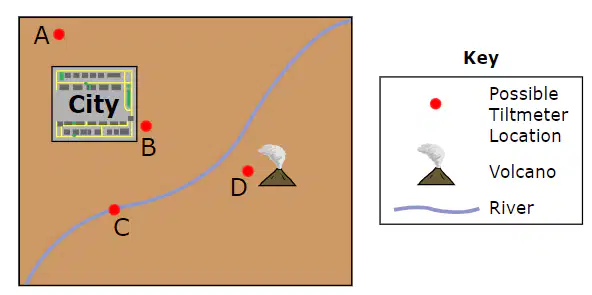
A tiltmeter is an instrument that is used to emasure changes in the tilt on the ground. the ground near volcanos moves before a volcano erupts, so scientists use tiltmeters to try to predict when a volcano might erupt. The map shows a city near a vocano.
Scientists want to place a tiltmeter in a location where people can be quickly alerted when a volcano is going to erupt. which location for the tiltmeter is pest and why?
Location D, since it will beasure movements closest to the volcano
Location C, since it will measure movements along the river that separates the volcano from the city
Location B, since it will measure volcano movements closest to the city
Location A, since it will measure only the strongest movements from the volcano
Which is an example of a single-celled organism?
acorn
amoeba
honey bee
Which is a multi-cellular organism?
algae
cricket
bacteria
A student rolls a ball down a smooth wooden ramp and observes what happens. Then he puts sandpaper on the ramp and rolls the ball again. What is the student most likely investigating?
the effect of a change on friction on the ball's motion
the effect of a change in gravity on the ball's motion
the effect of a change in mass on the ball's motion
the effect of a change in a ball's motion on the ramp
Four shoppers are pushing identical shopping carts at the same speed. Each cart contains a different object. Which cart will require the least force to stop it's motion?
the cart containing an object with a mass of 530 g
the cart containing an object with a mass of 180 g
the cart containing an object with a mass of 310 g
the cart containing an object with a mass of 700 g

Kendra is riding her skateboard on her driveway. She starts at her door and finishes at the end of the driveway.
Then Kendra gets back on her skateboard and begins to move again. The distance/time graph below shows Kendra's motion in relation to her door.
Kendra is riding down a hill.
Kendra's speed is decreasing.
Kendra is moving at a constant speed toward her door.
Kendra's speed is increasing.

Who ran at the greatest speed?
Frank
Brett
Clay
Patricia
Paco throws a ball. What force pulls the ball down toward
the ground?
friction
gravity
inertia
momentum
A soccer ball is rolling across the grass. It begins to slow down. Then it stops. What force caused the motion to stop?
pull
push
friction
gravity
Which of the following shows decreasing speed?


Look at the diagram of the water cycle. Which step of the water cycle is missing from the diagram?
evaporation
condensation
precipitation
radiation

The picture shows how one material is recycled in ecosystems. This material is _______.
water
food
nitrogen
carbon

Which step of the water cycle is described below?
The water in the air cools off and becomes small droplets of water which stick together to make clouds.
photosynthesis
condensation
evaporation
precipitation
Which step of the water cycle is described below?
Energy from the Sun heats up water on Earth's surface, and the water goes into the air as water vapor.
precipitation
condensation
evaporation
reflection
A teacher adds 2 g of chalk to 25 g of vinegar in a tightly sealed jar. The chalk and vinegar react, and gas bubbles form. What is the total mass of the jar’s contents after the reaction takes place?
23 g
25 g
27 g
50 g
Which example shows a new substance being formed?
a candle burning
a shoelace being tied
a pipe being cut in half
a block of ice melting
A boy touches a stove and gets burned. What transfer of heat caused his hand to get burned?
radiation
conduction
convection
combustion
Which is an example of convection?
the heat coming from a campfire
a spoon in a bowl of soup becoming warmer
warmer water at the surface of a swimming pool
getting a sunburn at the beach
How does heat energy from the sun reach Earth?
conduction
convection
insulation
radiation
Which best describes how heat is transferred?
Heat only flows within individual substances.
Heat flows from a warmer substance to a cooler substance.
Heat flows from a cooler substance to a warmer substance.
Heat flows in many different directions between substances.
Why is it better to have a cooking pot with a plastic handle instead of a metal handle?
Plastic looks better than metal.
Plastic washes easier than metal.
Plastic is less expensive than metal.
Plastic is not a good conductor of heat.
Which type of weather would most likely accompany dark
cumulonimbus clouds?
massive tornado
severe hailstorm
steady rain showers
dangerous thunderstorms
Which type of weather most likely occurs in a high pressure area?
clear
foggy
rainy
snowy
Which weather condition will most likely occur when the
atmospheric pressure in an area begins falling?
dry
cold
rainy
sunny
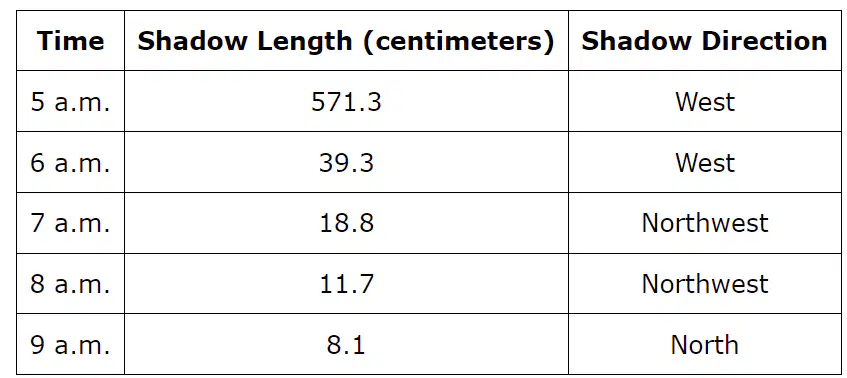
An upright stick casts a shadow over flat ground. A student records the direction and length of the shadow hourly, starting at 5 a.m. This table shows the data collected by the student.
Which statement best decribes what the student will find at 10 a.m.?
The shadow will be the same length at 10 a.m. as it was at 9 a.m., and its direction will be Northwest
The shadow will be longer at 10 a.m. than it was at 9 a.m., and its direction will be North
The shadow will be shorter at 10 a.m. than it was at 9 a.m., and its direction will be East.
The shadow will be shorter than it 10 a.m. than it was at 9 a.m., and its direction will be North

Which factor is most responsible for the movement of the airshown in the sea breeze diagram?
uneven heating of the air
imbalance in organisms breathing the air
sunlight getting blocked by the land
different levels of liquid in the air
Glaciers are large sheets of ice found in areas where the air temperature remains cold most of the year. Students use a compouter model to study how glaciers can affect land and living things. The students also study data that show glaciers are melting rapidly.
Which changes to the computer model should the students make to show the most likely effect of melting glaciers?
cover some coastal lands with water
make the oceans more salty
decrease the amount of water in the atmosphere
move animals living at the poles closer to the equator
When the Pacific Ocean near South America warms due to decreased tradewinds, it is called _____.
El Niño
La Niña
the jet stream
the Gulf Stream
Greater wind speeds are caused by ____
low temperatures
warm temperatures
differences in air pressure
differences in precipitation
How are estuary and ocean ecosystems similar?
They both have rich soil.
They both contain salt water.
They both support a lot of plant life.
They both have extremely cold temperatures.
An organism that feeds upon another organism is known as a _______.
consumer
producer
decomposer
messenger
An organism that makes its own food is known as a _______.
carnivore
decomposer
consumer
producer
Decomposers are organisms that
use sunlight to produce food.
break down matter from dead plants and animals.
feed upon living organisms.
can only be seen using a microscope.

Micah's teacher asks him to fill out the following chart with examples of terrestrial and aquatic ecosystems.
Which of the following should Micah list in the 'terrestrial ecosystems' column?
ocean
deciduous forest
estuary
salt marsh
Which organism performs all life processes in one cell?
grass
bacteria
butterfly
mushroom
Melissa accidentally touches a hot surface and then quickly pulls her hand away. Which two systems in the human body were involved with her action and reaction?
nervous and muscular
skeletal and circulatory
nervous and respiratory
muscular and respiratory
What role does the circulatory system provide to the digestive system?
It transports nutrients to cells.
It releases waste into the blood.
It moves food through the intestines.
It transports food particles to the muscles.
Which is a learned trait?
writing
dimples
tongue rolling
freckles
Which of these is an inherited trait?
dimples
long hair
favorite color
driving ability
Resources that are not able to be reproduced as quickly as they are used are called _____.
renewable resources
replaceable resources
non renewable resources
non replaceable resources
Coal is burned to heat water so that the _______ can turn turbines.
fire
steam
water
heat
Renewable resources ...
are not replaceable
are used more frequently than non renewables
are never going to run out
going to run out
Petroleum is mainly used in the United States for...
gasoline for cars
running coal burning power plants
making windmills turn
burning for heat
Fossil fuels are
always available for consumption
only used after millions of years.
made up of living plants and animals.
Water, .solar and ____________ are renewable energy resources
oil
Natural gas
Wind
Hydrogen
If we keep using non renewable energy , we will not be able to
sustain life on earth
produce more mater
visit another planet
cook a meal
People can save the earth from global warming by doing which one of these things.
stop using the sun for resources.
recycling products made from carbon.
putting more natural gas in their vehicles.
using more energy that makes a carbon copy.
Geothermal energy uses heat from ____ to produce electricity.
the earth
coal
oil
natural gas
__________ is a resource that WILL run out in the next several hundred years.
Renewable resource
Non-renewable resource
Which of the following is a renewable resource?
Sunlight
Oil
Coal
Natural gas
Which of the following is a non-renewable resource?
Coal
Water
Sunlight
Wind
Oil, coal and natural gas are considered non-renewable resources because people use them faster than they can form.
True
False


Mitch and Shawn are practicing tossing a ball at PE. They both toss a baseball straight up in the air and prepare to catch it. What will change during the time that the ball is in the air?
the ball's color
the ball's size
the ball's shape
the ball's position
A mom is rolling a ball to her child in the park. When the child rolled the ball back, the ball changed direction and didn’t make it to the mom. When they looked to see what caused the ball to go a different way, they saw that the ball hit a toy someone must have left behind. Which of these caused the ball to change direction?
A change in speed.
A change in mass.
A change in force.
A change in gravity.

The moment the bat touches the ball, energy from the moving bat is transferred to what?
The baseball player
The ball
The bat
The field
An encounter between two objects. After the encounter, there is a change in energy.
Transformation
Energy
Collision
Friction
The transfer of energy from a warm object to a cooler one.
Heat Energy
Sound Energy
Light Energy
Friction
In a collision, some kinetic energy that is transferred is converted to _________ and ________ energy.
light
heat
sound
electric
The amount of kinetic energy in an object depends on that object's ________ and ________.
speed
light
mass
force

A car traveling at a slow speed runs into a stopped car. A car moving at a fast speed runs into a stopped car. Which one would cause the most damage?
The damage would be the same
The fast-moving car would cause more damage
The slow moving car would cause more damage
Which has more kinetic energy, a fast horse or a stopped horse?
Neither has kinetic energy
They have the same kinetic energy
The fast horse
The stopped horse

If a 7 pound ball and a 1 pound ball are rolling along at the same speed, which ball has more kinetic energy?
The 7 pound ball
The 1 pound ball
They have the same amount of kinetic energy
There is not enough information to answer this question

If two basketballs are rolling at different speeds, does the faster one or the slower one have more kinetic energy?
Faster
Slower
They have the same kinetic energy
There is not enough information to answer
Which of the following is an example of a collision that does not cause damage?
A truck stopped in traffic
A ball resting on the grass
A pencil writing on a piece of paper
None--all collisions cause damage
During a collision, energy is _________.
Lost by the system
Gained by the system
Conserved
Either a or b
A basketball and a bowling ball are moving at the same speed. What will happen when the two balls bump together?
The motion of the ball will change in the exact same ways
The motion of the bowling ball will change more than the motion of the basketball
The motion of the basketball will change more than the motion of the bowling ball
There will be no change to the motion of the balls

