wayground logo

Free Printable Worksheets

Font size

S
M
L
XL
Worksheets

Semester 2 Review

Total questions: 250

Worksheet time: 61hrs 33mins

Name
Class
Date
1.
A cone is placed inside a cylinder.  The two figures have the same base area and the same height.  What is the volume of the cylinder that is not taken up by the cone?
a)
314.16
b)
471.24
c)
235.62
d)
157.08
2.
A spherical Christmas ornament is filled halfway with snow.  The ornament has a diameter of 4 inches.  What is the volume of snow in the ornament?
a)
33.51
b)
10.67
c)
16.76
d)
8.38
3.
A FedEx truck has three cargo trailers attached to the back of the cab.  If each trailer is 20 feet by 7 feet by 8 feet, how much capacity does the triple trailer have?
a)
1120
b)
30240
c)
3360
d)
Not here
4.
The coaches have a ball cage that is 3 feet in width, 4 feet long, and 2 feet tall.  If the radius of a basketball is 6 inches, and all of the basketballs are similar, how many basketballs can fit in the cage?
a)
41472
b)
904
c)
2
d)
45
5.

How would you define the surface area of a rectangular prism?

a)

The area of the two bases and two sides.

b)

The area of the three sides.

c)

The area of the base times how tall the rectangular prism is.

d)

The total area of all six sides.

6.

The picture shown is the net of a square pyramid. What is the surface area of the square pyramid?

7.

The picture shows the net of a square pyramid.

Find the surface area of the square pyramid.

8.
a)
b)
c)
d)
9.
a)
b)
c)
d)
10.
Which cylinder will have a larger volume?
a)
Cylinder A
b)
Cylinder B
11.
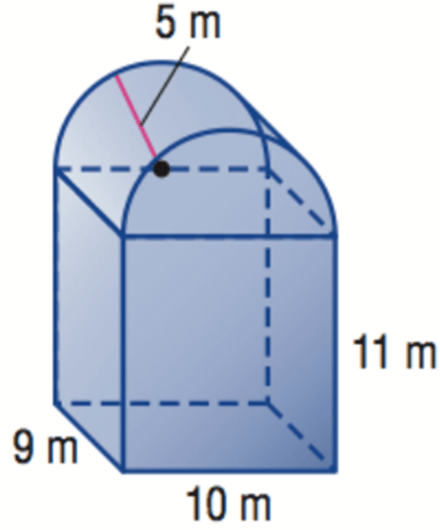
Find the volume.
a)
1112.3
b)
1343.4
c)
1423.2
d)
1500.6
12.

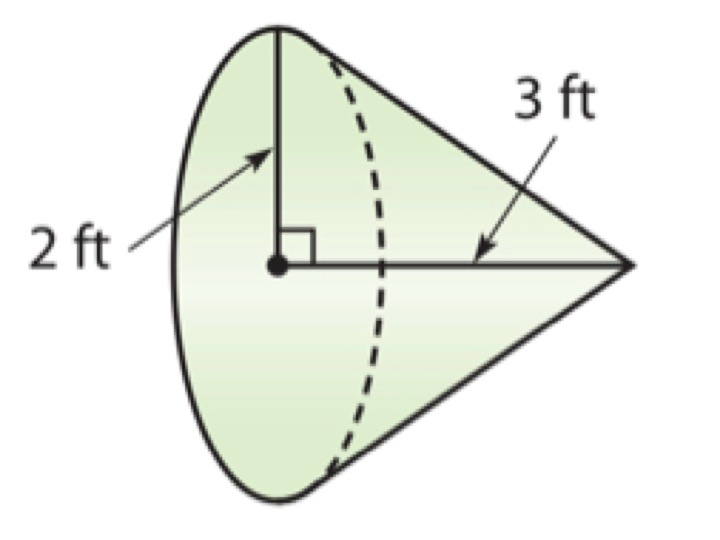
Find the volume of this solid to the nearest hundredth.

a)

12.57 ft3

b)

37.68 ft3

c)

18.84 ft3

d)

6.28 ft3

13.

What is surface area?

a)

The distance around the outside of a two-dimensional figure

b)

The number of square units in a two-dimensional figure

c)

The number of cubic units needed to fill a three-dimensional figure.

d)

The sum of the areas of all surfaces on a three-dimensional figure

14.

A paper party hat, like the one shown, has a slant height of 6 inches and a radius of 5 inches. How many square inches of cardboard would be needed to create this hat?

a)

94.3 in.2

b)

172.8 in.2

c)

50 in.2

d)

22.5 in.2

15.
a)
922.9
b)
836
c)
835.6
d)
922.4
16.
a)
1400
b)
280
c)
4200
d)
2100
17.
a)
820
b)
1304
c)
980
d)
835
18.
a)
1150.3
b)
575.2
c)
88.5
d)
574.9
19.

Which scatterplot suggests a linear relationship between x and y?

a)
b)
c)
d)
20.

Ben collected data from a group of 12 people. He measured each person's resting heart rate and recorded the average number of hours each person exercised per week. He created a scatterplot to show the data he collected.


Based on the scatterplot, what is the best prediction of the resting heart rate, in beats per minute, of a person who exercises an average of 8 hours per week?

a)

30 beats per minute

b)

50 beats per minute

c)

58 beats per minute

d)

40 beats per minute

21.

The scatterplot shows the average number of hours each of 13 people spends at work every week and the average number of hours each of them spends on recreational activities every week.


Based on the scatterplot, what is the best prediction of the average number of hours a person spends at work every week if that person spends an average of 10 hours on recreational activities each week?

a)

34 h

b)

78 h

c)

55 h

d)

65 h

22.

Which scatterplot suggests a linear relationship between x and y?

a)
b)
c)
d)
23.

Which scatterplot does NOT suggest a linear relationship between x and y?

a)
b)
c)
d)
24.

Julie made 25 international long-distance phone calls to London last month. The scatterplot below shows the length and cost of each phone call she made. Which conclusion is best supported by the scatterplot?

a)

As the length of a call increases, the cost of the call increases.

b)

As the length of a call increases, the cost of the call remains the same.

c)

As the length of a call increases, the cost of the call descreases.

d)

There is no relationship between the length of a call and the cost of a call.

25.

Which scatterplot does NOT suggest a linear relationship between x and y?

a)
b)
c)
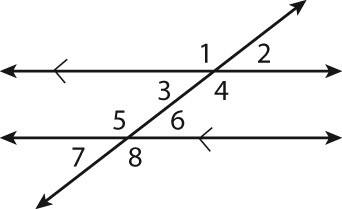
d)
26.

Consider the two variables: the temperature outside (x) and the number of visitors at the beach (y). Which type of scatterplot would you expect to see when graphing?

a)
b)
c)
27.

A math teacher observed that as the number of hours students studied their multiplication facts increased, the number of errors the students made on their multiplication tests decreased. Which scatterplot could support this teacher's observation?

a)
b)
c)
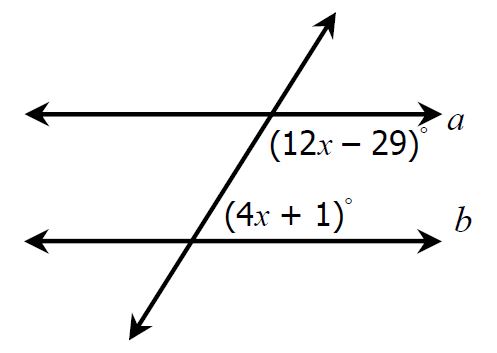
d)
28.

Choose ALL graphs that have a non-linear trend.


YOU WILL HAVE MORE THAN ONE ANSWER CHOICE SELECTED.

a)

1

b)

2

c)

3

d)

4

e)

5

29.
The scatter plot shows the relationship between the number of chapters and the total number of pages for several books.  Use the trend line to predict how many chapters would be in a book with 180 pages. 
a)
12 chapters
b)
15 chapters
c)
18 chapters
d)
21 chapters
30.
What percentage of girls have blonde hair?
a)
30%
b)
32%
c)
29%
d)
40%
31.
What percentage of SUV's are driven by women?
a)
56.25%
b)
75%
c)
83.25%
d)
86.5%
32.

What number should go in the blue box?

a)

21

b)

135

c)

19

d)

22

33.

How many total have no cell phone?

a)

13

b)

9

c)

22

d)

100

34.

How many boys were surveyed?

a)

13

b)

2

c)

15

d)

7

35.
The graph above shows a line of best fit for data collected on the distance bicyclists have remaining in relation to the amount of time they have been riding.  What is the equation of the line of best fit?
a)
y = -25x + 170
b)
y = 25x + 170
c)
y = -(5/8) x + 170
d)
y = (5/8) x + 170
36.
The graph above shows a line of best fit for data collected on the amount earned by waiters and waitresses last week in relation to the number of tables they served.  What is the equation of the line of best fit?
a)
y = (5/3) x + 375
b)
y = (1/3) x + 475
c)
y = (5/3) x + 475
d)
y = (1/3) x + 375
37.
A small theme park is trying to determine the number of guests they should expect on a weekend, based on the temperature outside.  Based on the trend line, about how many guests should be expected if the temperature is around 80°?
a)
8,300
b)
8
c)
7,300
d)
9,300
38.
Looking at the graph, what is the correlation between the x and y variables?
a)
y increases as x increases
b)
y is constant
c)
y decreases as x descreases
d)
y decreases as x increases
39.
Which of the following lines represents the line of best fit for the scatter plot?
a)
A
b)
B
c)
C
d)
D
40.
the slope is -5/7, what does that mean?
a)
gain 5 hour of sleep for 7 cups of coffee
b)
lose 5 hours of sleep for 7 cups of coffee
c)
lose 7 cups of coffee for 5 hours of sleep
d)
lose 5 cups of coffee for 7 hours of sleep
41.

The scatter plot shows the relationship between the number of chapters and the total number of pages for several books. Use the trend line to predict how many pages would be in a book with 19 chapters.

a)

150 pages

b)

170 pages

c)

190 pages

d)

210 pages

42.

What is the equation of the line of best fit?

a)

y= 12x + 6-\frac{1}{2}x\ +\ 6

b)

y= 12x +6\frac{1}{2}x\ +6

c)

y= 6x + 2

d)

y = -2x +6

43.
Which best describes the form of this scatterplot?
a)
linear
b)
nonlinear
c)
scattered
44.
Which graph shows a line of best fit for the scatter plot?
a)
Graph A
b)
Graph B
c)
Graph C
d)
Graph D
45.

What is the equation of the line of best fit?

a)

y = -25x + 170

b)

y = -5/8x + 170

c)

y = 25x + 170

d)

y = 5/8x + 170

46.
Identify the transformation from ABC to A'B'C'.
a)
90o clockwise rotation
b)
90o counter clockwise rotation
c)
Reflection across the y-axis
d)
Reflection across the x-axis
47.
Identify the transformation.
a)
Reflection across y-axis
b)
90 Rotation counter clockwise
c)
Translation 5 units left, 1 unit up.
d)
Translation 5 units right, 1 unit down
48.
Identify the transformation from ABCD to A'B'C'D'.
a)
Translation
b)
Reflection across the y-axis
c)
Reflection across the x-axis
d)
90o counter clockwise Rotation
49.
Write a rule for the translation.
a)
 (x -1, y  + 2)
b)
 (x -2, y  + 1)
c)
 (x +2, y  - 1)
d)
(x +1, y  -  2)
50.
Reflect Point C over the y-axis:
a)
(-3, 2)
b)
(3,2)
c)
(-2,3)
d)
(3,0)
51.
If you were to rotate ABCD 90° counterclockwise about the origin, what would the coordinate of A' be?
a)
(-5, 5)
b)
(-3, 5)
c)
(-5, 3)
d)
(-3, 3)
52.
If you were to rotate ABCD 180°  about the origin, what would the coordinate of A' be?
a)
(-5, 5)
b)
(-3, -5)
c)
(-5, 3)
d)
(-3, 3)
53.
Find K' if the figure is reflected across the x-axis
a)
(4, 1))
b)
(-1, -4)
c)
(1, -4)
d)
(1, 4)
54.
The point Z(4, -2) is rotated 180 degrees about the origin.  What is the image of Z?
a)
Z'(2, 4)
b)
Z'(-4, 2)
c)
Z'(-2, -4)
d)
Z'(-4, -2)
55.
Translate the point A (-3, 4) right 5 and up 1
a)
(-2, 9)
b)
(-8, 5)
c)
(8, 3)
d)
(2, 5)
56.
When a dilation has a scale factor greater than one, the dilation is an enlargement.
a)
True
b)
False
57.

State the coordinate of the image of the given point B (4,9) under a dilation with center at the origin with the given scale factor of 2.

a)

B' (2 , 4.5)

b)

B' (-8 ,-18)

c)

B' (8 ,18)

d)

B' (9 ,4)

58.
The point (8, 12) was dilated to become point (2, 3). What was the scale factor?
a)
½
b)
¼
c)
4
d)
2
59.
State the coordinate of the image of the given point B (-10,-6) under a dilation with center at the origin with the given scale factor k = 1/2.
a)
(5,3)
b)
(20,12)
c)
(-20,-12)
d)
(-5,-3)
60.
Choose the correct scale factor:
a)
2
b)
3
c)
1/3
d)
1/2
61.
Dilate the figure by a scale factor of 3 with the origin as the center of dilation. What are the coordinates of the image?
A(3,3) B(6,6) C(9,3)
a)
A'(9,9) B'(18,18) C'(27,9)
b)
A'(6,6) B'(9,9) C'(12,6)
c)
A'(0,0) B'(3,3) C'(6,0)
d)
A'(1,1) B'(2,2) C'(3,1)
62.
Is the picture being reflected in the y-axis or x-axis?
a)
y-axis
b)
x-axis
63.
 Describe the Transformation
a)
Translation
b)
Rotation
c)
Reflection
64.
 Describe the Transformation
a)
Translation
b)
Rotation
c)
Reflection
65.

What type of transformation is this?

a)

rotation

b)

translation

c)

reflection

d)

dilation

66.

What type of transformation is this?

a)

rotation

b)

translation

c)

reflection

d)

dilation

67.

Translated figures are always __________________.

a)

Congruent

b)

Bigger

c)

Smaller

d)

Rotated

68.

After a transformation, your new vertices should have what symbol on them?

a)

$

b)

#

c)

'

d)

&

69.
Same shape but different size
a)
Congruent
b)
Vector
c)
Line of Reflection
d)
Similar
70.

What kind of transformation is this?

a)

Reflection

b)

Translation

c)

Rotation

71.

What kind of transformation is this?

a)

Rotation

b)

Reflection

c)

Translation

72.
If the quadrilateral is translated 4 units to the left and 5 units down what is the coordinates for Point A'?
a)
(4,0)
b)
(0,4)
c)
(-1,5)
d)
(5,-1)
73.
When quadrilateral PRST is translated to create quadrilateral P'R'S'T', which statement is true?
a)
The side lengths of quadrilateral P'R'S'T' are twice the side lengths of quadrilateral PRST
b)
The angle measures of quadrilateral P'R'S'T' are equal to the corresponding angle measures of quadrilateral PRST
c)
The side lengths of quadrilateral P'R'S'T' are 9 units longer than side lengths of quadrilateral PRST
d)
The angle measures of quadrilateral P'R'S'T' are greater than the angle measures of quadrilateral PRST
74.
A dilation with a scale factor less than 1 but greater than 0 is a(n) _____.
a)
Enlargement
b)
Reduction
75.
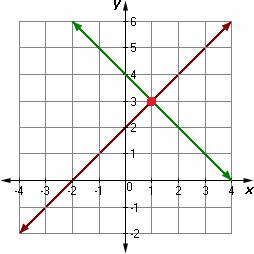
What is the solution to the system?
a)
(0, 3)
b)
(1, -1)
c)
(-3, 1)
d)
(1, 3)
76.
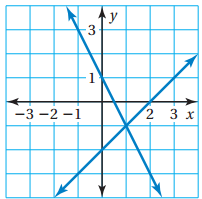
What is the solution? 
a)
1
b)
-2
c)
(1, 2)
d)
(1, -1)
77.
What is the solution?
a)
(6, 3)
b)
(3, 6)
c)
(-6, 3)
d)
No solution
78.
Parallel Lines never intersect because...
a)
they have the same slopes. 
b)
they have the same y-intercept.
c)
they have different slopes.
d)
they have different y-intercepts. 
79.
Does the system have one, none or infinite solutions?
8x + 4y = 12
y = -2x + 3
a)
(0,3)
b)
(3,0)
c)
No solution(parallel lines)
d)
Infinitely many solutions
80.

2x - y = 0

4x - y = 0

a)

(1,2)

b)

(0,0)

c)

No Solutions

d)

Infinite Solutions

81.


How many solutions?
a)
One Solution
b)
No solution
c)
Infinitely Many Solutions
82.
Solve for x and y.
y = 2/3x - 2
y = -x + 3
a)
(0,3)
b)
(0,-3)
c)
(3,0)
d)
(-3,0)
83.
Solve for x and y
3x + 2y = 16
7x + y = 19
a)
(-2,5)
b)
(-2,-5)
c)
(2,-5)
d)
(2,5)
84.

2x - y = 0

4x - y = 0

a)

(1,2)

b)

(0,0)

c)

No Solutions

d)

Infinite Solutions

85.
The equations of two lines are:
 2x-y=4 and y=-2x+8.
What is the value of x in the solution for this system?
a)
x=8
b)
x=3
c)
x=11
d)
x=5
86.
If a system of equations has no solution, what does the graph look like? 
a)
intersecting lines
b)
parallel lines
c)
skew lines
d)
intersecting lines
87.
What is the value of the y-coordinate of the solution to the system of equations 
x-2y=1
x+4y=7 
a)
1
b)
-1
c)
3
d)
4
88.
What is the solution?
a)
One Solution
b)
No solution
c)
Infinitely Many Solutions
89.
What is the solution?
a)
(1, -1)
b)
(-1, 1)
c)
(0, -2)
d)
(2, 0)
90.
Solve the following system by setting the two equations equal to each other.  What is the solution?
HINT:  - 1/3x + 4 = 2/3x + 1 and then solve for x.  Once you find x go back and find y.
a)
Infinite number of solutions
b)
(3, 3)
c)
(3, -3)
d)
(-3, 3)
91.
Solve:
3x + 2y = 16
7x + y = 19
a)
(-2,5)
b)
(-2,-5)
c)
(2,-5)
d)
(2,5)
92.

2x - y = 0

4x - y = 0

a)

(1,2)

b)

(0,0)

c)

No Solutions

d)

Infinite Solutions

93.
Which of the following is not a method to solve systems?
a)
Elimination
b)
Difference of Squares
c)
Substitution
d)
Graphing
94.
Solve for x and y
3x + 2y = 16
7x + y = 19
a)
(-2,5)
b)
(-2,-5)
c)
(2,-5)
d)
(2,5)
95.

What is the solution to the systems of equations?

a)

(-7, -9)

b)

(-10, 5)

c)

No Solution

d)

Infinitely Many Solutions

96.

What is the solution to the system of equations?

a)

No Solution

b)

Infinitely Many Solutions

c)

(7, -2)

d)

(-5, -5)

97.

What is the solution to the system of equations?

a)

(-3, 1)

b)

(1, -3)

c)

(3, -1)

d)

(-1, 3)

98.

What is the solution to the system of equations?

a)

(3, 4)

b)

(-3, -4)

c)

(-4, -3)

d)

(4, 3)

99.

What is the solution to the system of equations?

a)

(2, -2)

b)

(2, 2)

c)

No Solution

d)

(-2, -2)

100.

What is the solution to the system of equations?

a)

(-1, -3)

b)

(3, 1)

c)

(1, 3)

d)

(-3, -1)

101.

What is the solution to the system of equations?

a)

No Solution

b)

(2, 0)

c)

Infinitely Many Solutions

d)

(0, 2)

102.

How many solutions are there in the system of equations?

a)

No Solution

b)

Infinitely Many Solutions

c)

One Solution

d)

Two Solutions

103.

What is the number of solutions to the system of equations?

a)

No Solution

b)

Infinitely Many Solutions

c)

One Solution

d)

Two Solutions

104.

What is the solution to the system?

a)

(-1, 3)

b)

(-3, 1)

c)

(3, -1)

d)

(-3, -1)

105.
If a system of linear equations has one solution, what does this mean about the two lines? 
a)
Parallel lines
b)
the same line 
c)
Intersecting lines
106.
Solve the system of equations.
y = 4x+1
3x + 2y = 13
a)
(1, 5)
b)
(5, 1)
c)
(0.25, 2)
d)
107.
Solve the system of equations by elimination.
-x + y = -13
-8x - 4y = -8 
a)
(5, 8)
b)
(5, -8)
c)
(-5, -18)
d)
(-5, 8)
108.
Determine if (4, 1) is a solution for the system of equations.
y = -x + 5
y = 2x - 7
a)
yes
b)
no
109.
Solve the following system
x + 9y = 8
-6x - 9y = -3
a)
(1,-1)
b)
(1,1)
c)
(-1,1)
d)
(-1,-1)
110.
Find the slope
a)
-5/3
b)
-3/5
c)
5/3
d)
3/5
111.
Find the slope of the line that passes through:
(6,7) and (4,2)
a)
2/5
b)
-5/2
c)
5/2
d)
-1/2
112.

What is the slope of the line that passes through the points (-4, -1) and (-2, -5)?

a)

1/2

b)

-1/2

c)

2

d)

-2

113.
5x - 4y = =-16
x+ 2y = -6
a)
(-4,-1)
b)
(5,-1)
c)
(-5,-1)
d)
(4,1)
114.
2x - 3y = 6
7x - 3y = -9
a)
(-3,-4)
b)
(3,4)
c)
(-4,-3)
d)
(4,3)
115.
x = - 3
2x + 3y = 6
a)
(4,3)
b)
(-4,3)
c)
(-3,4)
d)
(3,-4)
116.
A REPEATING decimal is what type of number?
a)
Rational 
b)
Irrational
117.
Is -5/8 a rational number?
a)
yes
b)
no
118.
Is 3.74 a rational number?
a)
yes
b)
no
119.
What kind of number is -3?
a)
rational
b)
irrational
c)
whole
d)
natural
120.

Which of the following number is rational?

a)

127\sqrt{127}

b)

π\pi

c)

2.52.5

d)

8.98763...8.98763...

121.

Which of the following numbers is irrational?

a)

50\sqrt{50}

b)

36\sqrt{36}

c)

169\sqrt{169}

d)

225\sqrt{225}

122.

Determine which of the following examples is irrational.

a)

A fraction whose denominator is larger than its numerator

b)

A decimal that never ends but repeats

c)

A perfect cube root

d)

A decimal that never ends and never repeats

123.

Select ALL numbers that are irrational.

a)

10

b)

-21

c)

π\pi

d)

102\frac{10}{2}

e)

10\sqrt{10}

124.

Which of the following is an irrational number?

a)

0\sqrt{0}

b)

3\sqrt{3}

c)

1.361\overline{.36}

d)

0.19-0.19

125.

Which of the following numbers is rational?

a)

7\sqrt{7}

b)

23\frac{2}{3}

c)

3.1456289...

d)

π\pi

126.

Determine whether π\pi  is rational or irrational.

a)

Rational

b)

Irrational

127.

Is the number rational or irrational?

a)

Rational -

b)

Irrational

128.

Is the number rational or irrational?

a)

Rational

b)

Irrational

129.

Is the number rational or irrational?

a)

Rational

b)

Irrational

130.

Is the number rational or irrational?

a)

Rational

b)

Irrational

131.

Is the number rational or irrational?

a)

Rational

b)

Irrational

132.

Is the number rational or irrational?

a)

Rational

b)

Irrational

133.

-6


Rational or Irrational?

a)

Rational

b)

Irrational

134.

10\sqrt{10}  

Rational or Irrational? 

a)

Rational 

b)

Irrational 

135.

π\pi  

Rational or Irrational? 

a)

Rational 

b)

Irrational

136.

1.4325674454354245.......

a)

Rational

b)

Irrational

137.

12\frac{1}{2}  

Rational or Irrational? 

a)

Rational 

b)

Irrational 

138.

2


Rational or Irrational?

a)

Rational

b)

Irrational

139.

50\sqrt{50}  

Rational or Irrational?

a)

Rational 

b)

Irrational 

140.

200\sqrt{200}  

Rational or Irrational? 

a)

Rational 

b)

Irrational 

141.

25\sqrt{25}  

Rational or Irrational? 

a)

Rational 

b)

Irrational 

142.

THE PRODUCT RULE FOR EXPONENTS YOU....

a)

subtract

b)

add

c)

multiply

d)

divide

143.

QUOTIENT RULE FOR EXPONENTS YOU....

a)

add

b)

divide

c)

multiply

d)

subtract

144.

The power rule for exponents you....

a)

divide

b)

multiply

c)

subtract

d)

add

145.

53545^3\cdot5^4  

a)

525^2  

b)

575^7  

c)

565^6  

d)

5105^{10}  

146.

5352\frac{5^3}{5^2}  

a)

55  

b)

555^5  

c)

525^2  

d)

585^8  

147.

73710\frac{7^3}{7^{10}}  

a)

777^7  

b)

177\frac{1}{7^7}  

c)

7137^{13}  

d)

1713\frac{1}{7^{13}}  

148.

515^{-1}  

a)

15\frac{1}{5}  

b)

15100\frac{1}{5^{100}}  

c)

153\frac{1}{5^3}  

d)

152\frac{1}{5^2}  

149.

(73)4\left(7^3\right)^4  

a)

7127^{12}  

b)

777^7  

c)

717^1  

150.

(143)5\left(\frac{1}{4^3}\right)^5   CHALLENGE PROBLEM. THINK DISTRIBUTE THE FIVE!!!!

a)

1415\frac{1}{4^{15}}  

b)

148\frac{1}{4^8}  

c)

142\frac{1}{4^2}  

151.

(877237646642375623646237)0\left(877237646642375623646237\right)^0  

a)

1

b)

DON'T KNOW

c)

YOU SHOULD KNOW THE ANSWER

d)

THINK OF THE LONELIEST NUMBER!

152.
For 353, what do you do with the exponents?
a)
multiply them
b)
add them
c)
square them
d)
can't simplify
153.
For 44÷ 4, what do you do with the exponents?
a)
multiply them
b)
divide them
c)
subtract them
d)
add them
154.
For (83)3 , what do you do with the exponents?
a)
multiply them
b)
add them
c)
subtract them
d)
divide them
155.
For 46 + 45 , what do you do with the exponents?
a)
add them
b)
multiply them
c)
subtract them
d)
can't simplify
156.
For 3− 35 , what do you do with the exponents?
a)
can't simplify
b)
subtract them
c)
divide them
d)
can't subtract 5 from 2
157.
For 5-3 , what is the correct expression?
a)
-15
b)
-125
c)
-1/125
d)
1/125
158.
For (1/2)4 , the correct expression is 
a)
2
b)
1/16
c)
-1/32
d)
1/8
159.
(*tricky one!) For (1/4)-2 , the correct expression is 
a)
1/16
b)
-1/16
c)
-16
d)
16
160.
Solve:
3-5÷33×32×34
a)
3
b)
314
c)
3-2
d)
33
161.
Good ol' PEMDAS:
4− (−12) + (−17) + 1-1
a)
4
b)
-6
c)
12
d)
29
162.

Simplify the following:

x2  x4x^2\ \cdot\ x^4

a)

x6x^6

b)

x8x^8

c)

x16x^{16}

d)

x2x^2

163.

Simplify the following:

3x2  2x43x^2\ ⋅\ 2x^4

a)

6x66x^6

b)

5x85x^8

c)

6x86x^8

d)

9x69x^6

164.

Simplify the following:

(x3)4(x^3)^4

a)

x12x^{12}

b)

x7x^7

c)

x1x^1

d)

x81x^{81}

165.

Simplify the following:

(5x5)2(5x^5)^2

a)

25x1025x^{10}

b)

25x725x^7

c)

10x1010x^{10}

d)

10x710x^7

166.

Simplify the following:

x12x2\frac{x^{12}}{x^2}

a)

x10x^{10}

b)

x6x^6

c)

x14x^{14}

d)

x24x^{24}

167.

Simplify the following:

10x152x3\frac{10x^{15}}{2x^3}

a)

5x125x^{12}

b)

5x55x^5

c)

5x185x^{18}

d)

8x128x^{12}

168.

Simplify the following (CAREFUL!!!):

x12x2\frac{x^{12}}{x^{-2}}

a)

x14x^{14}  

b)

x6x^{-6}  

c)

x10x^{10}  

d)

1x6\frac{1}{x^6}

169.

Simplify the following:

x5  x5x^5\ \cdot\ x^{-5}

a)

1

b)

x10x^{-10}

c)

x25x^{-25}

d)

x5x^5

170.

Simplify the following:

(c5)(c3)(c3)\left(c^5\right)\left(c^3\right)\left(c^3\right)

a)

c45c^{45}

b)

3c113c^{11}

c)

c11c^{11}

d)

3c453c^{45}

171.

Simplify the following:

(2x4y7)3(2x^4y^7)^3

a)

6x7y106x^7y^{10}

b)

6xy326xy^{32}

c)

8x12y218x^{12}y^{21}

d)

8x7y108x^7y^{10}

172.

Simplify the following:

x5x^{-5}

a)

x5x^{-5}

b)

1

c)

1x5\frac{1}{x^5}

d)

5x

173.

Simplify the following:

Your answer must be expressed as a positive exponent

k3k7\frac{k^3}{k^7}  

a)

k4k^4  

b)

1k4\frac{1}{k^4}  

c)

k21k^{21}  

d)

k4k^{-4}  

174.

Simplify the following:

(x3x2)4\left(\frac{x^3}{x^2}\right)^4  

a)

x4x^4

b)

x20x^{20}

c)

x8x^8

d)

x10x^{10}

175.

Match the following.

a)

Add the exponents

1.

x3x6x^3\cdot x^6

b)

Subtract the exponents

2.

z8z4\frac{z^8}{z^4}

c)

Multiply the exponents

3.

(y2)4\left(y^2\right)^4

176.

Match the following.

a)

Add the exponents

1.

(w2)2\left(w^2\right)^2

b)

Subtract the exponents

2.

v3v5v^3\cdot v^5

c)

Multiply the exponents

3.

b2b4\frac{b^2}{b^4}

177.

Simplify the following:

  (4)2(-4)^2

a)

-8

b)

16

c)

-16

d)

8

178.

Simplify the following:

7p07p^0

a)

7

b)

1

c)

simplified

d)

7p

179.

Simplify the following:

(53x2y4)0(5^3x^2y^4)^0

a)

5xy

b)

1

c)

0

d)

5

180.

Simplify the following:

y4x8\frac{y^{-4}}{x^{-8}}

a)

x8y4\frac{x^8}{y^4}

b)

Can't be simplified

c)

xy2

d)

xy4

181.

Simplify the following:

4n2  n4n^2\ \cdot\ n  

a)

4n34n^3  

b)

4n4n  

c)

(4n2)2\left(4n^2\right)^2  

d)

4n\frac{4}{n}  

182.

How would you write 4.3756 x 10⁴ in standard form?

(a)  

183.

How would you write 0.0005 in scientific notation?

a)

50 x 10-5

b)

5 x 10⁻⁴

c)

5 x 10³

d)

.5 x 103

184.

How would you write -5.6 x 10⁻³ in standard form?

(a)  

185.
Scientific Notation is made up of two number parts. The first part should be a number between 1 and 100.
a)
True
b)
False
186.

Scientific Notation is made up of two number parts. The second part is a power 10.

a)

True

b)

False

187.

How do you write 8.317 x 10⁶ in standard form?

(a)  

188.

Which of the following numbers is written in scientific notation?

a)

20.35 x 10⁴

b)

.2035 x 104

c)

2035 4

d)

2.035 x10⁴

189.

Express the following in scientific notation:


.000457

a)

457 x 106

b)

457 x 10-6

c)

4.57 x10⁴

d)

4.57 x 10⁻⁴

190.

Convert to scientific notation:


520,000,000

a)

52 x 107

b)

5.2 x 10⁻⁷

c)

5.2 x 10⁸

d)

0.52 x 10⁹

191.

What is scientific notation?

a)

A long way to write really short numbers

b)

A short way to write really large or really small numbers

c)

I don't know...

d)

None of the above

192.

If the exponent is a positive number the original number was...

a)

a really big number.

b)

a really small number.

193.

If the exponent is a negative number the original number was...

a)

a really large number.

b)

a really small number.

194.

Convert this number to standard notation:


7.1 x 10⁴

(a)  

195.

Convert this number into scientific notation:


0.068

a)

6.9 x 10⁶

b)

6.8 x 10⁻⁹

c)

6.8 x 10⁻²

d)

None of the above

196.

Convert this number to standard notation:


1.4 x 10⁻²

(a)  

197.

Convert this number into scientific notation:


950,000

a)

9.5 x 10⁵

b)

9.5 x 10⁻⁹

c)

9.5 x 10²

d)

None of the above

198.

Which value is the greatest?

a)

5.0 x 10⁻⁹

b)

5.0 x 10⁻⁴

c)

5.0 x 10⁶

d)

5.0 x 10⁸

199.

Which number is the least in value?

a)

5.0 x 10⁻⁹

b)

5.0 x 10⁻⁴

c)

5.0 x 10⁶

d)

5.0 x 10⁸

200.
If the exponent on your power of 10 is positive, is your number larger or smaller than 10?
a)
Larger
b)
Smaller
201.
7.82 x 10⁻⁶ is an example of scientific notation. The exponent of -6 tells you your number will be very ________.
a)
Large
b)
Small
c)
Basic
202.
7.82 x 10⁻⁶ is an example of scientific notation. The exponent of -6 tells you your number will be very ________.
a)
Large
b)
Small
c)
Basic
203.
Change from standard form to scientific notation: 12,000,000
a)
12.0  x  107
b)
0.12  x  107
c)
1.2  x  106
d)
1.2  x  107
204.
Change from standard form to scientific notation:  450,000
a)
4.5  x  105
b)
45  x  105
c)
4.5  x  104
d)
4.5  x  106
205.
Change from standard form to scientific notation:  0.000398
a)
39.8  x  10-5
b)
3.98  x  10-5
c)
3.98  x  10-4
d)
39.8  x  10-6
206.
Change from standard form to scientific notation: 0.004078
a)
4.078  x  10-3
b)
4.078  x  103
c)
40.78  x  10-4
d)
.4078  x  10-2
207.
125,678,000: Change to scientific notation
a)
1.25678  x  1012
b)
.125678  x  10-9
c)
12.5678  x  108
d)
1.25678  x  108
208.
Try to change the number back to standard form:  6.79  x  104
a)
679,000
b)
6,790
c)
67,900
d)
6,790,000
209.
Try to change the number back to standard form: 3.97  x  10-2
a)
0.000397
b)
0.0397
c)
0.0000397
d)
0.397
210.
The factor multiplied by a power of 10 in scientific notation needs to be greater than or equal to one but less than ___________?
a)
1
b)
10
c)
100
d)
1,000
211.
How would you write 0.0005 in scientific notation?
a)
50 x 105
b)
5 x 10⁴
c)
5 x 10³
d)
.5 x 103
212.
How would you write -5.6 x 10⁻³ in standard form?
a)
0.0056
b)
-5,600
c)
0.00056
d)
-0.0056
213.
The rule of scientific notation is to write all exponents with a base of ____.
a)
50
b)
5
c)
100
d)
10
214.
Which of the following in the LARGEST number?
a)
9 x 10⁶
b)
8 x 10¹⁰
c)
1.3 x 10¹²
d)
5.3 x 10³
215.
Which of the following numbers is the SMALLEST?
a)
8.7 x 10³
b)
3 x 10⁴
c)
1.3 x 10⁸
d)
9 x 10²
216.
∠1 and ∠3 can best be described as -
a)
complementary angles
b)
supplementary angles
c)
vertical angles
d)
adjacent angles
217.
What are supplementary angles?
a)
Angles that add up to 180°
b)
Angles that add up to 90°
c)
Angles that are equal to each other
d)
Angles that are opposite of each other when lines intersect
218.
If ∠BPD and ∠DPC have a sum of 72°. What is ∠APC?
a)
18°
b)
90°
c)
108°
d)
180°
219.
Solve for x
a)
6
b)
140
c)
20
d)
90
220.
Find the measure of angle 1.
a)
28o
b)
136o
c)
44o
d)
6o
221.
Which pair of angles are alternate exterior angles?
a)
Angle 7 and Angle 4
b)
Angle 2 and Angle 6
c)
Angle 8 and Angle 1
d)
Angle 2 and Angle 8
222.
Which of these angles is NOT congruent to angle 5?
a)
Angle 6
b)
Angle 8
c)
Angle 1
d)
Angle 4
223.
What is the value of x?
a)
-6
b)
22
c)
16
d)
21
224.
What is the measure of ∠ABC?
a)
25°
b)
75°
c)
108°
d)
150°
225.
Which is a pair of corresponding angles?
a)
∠4 and ∠3
b)
∠4 and ∠1
c)
∠4 and ∠2
d)
∠4 and ∠8
226.
WHAT IS THE CORRECT EQUATION TO FIND THE VALUE OF X?
a)
X=12
b)
8X - 17 + 5X +19 = 180
c)
8X - 17 = 5X +19
d)
X= -12
227.
WHICH IS THE CORRECT EQUATION TO SOLVE FOR X? 
a)
16X+180 = 90
b)
12X - 19 = 4X +1
c)
12X - 19 + 4X +1=90
d)
12X - 19 + 4X +1=180
228.
Name the alternate interior angle to angle 3.
a)
4
b)
5
c)
6
d)
8
229.

What is the measure of the missing angle?

a)

40

b)

130

c)

50

d)

120

230.

The measure of angle 1 is 60 degrees. What is the measure of angle 5?

231.

You know the measure of angle 5 because of what relationship to angle 1?

a)

complementary

b)

vertical

c)

corresponding

d)

alternate interior

232.

The measure of angle 1 is 60 degrees. What is the measure of angle 8?

233.

You know the measure of angle 8 because of what relationship?

a)

supplementary to angle 6

b)

corresponding to angle 4

c)

supplementary to angle 7

d)

vertical to angle 5

234.

The measure of angle 1 is 60 degrees. What is the measure of angle 2?

235.

Angle 1 and angle 2 have a ​ (a)   relationship.

Choose from the below words
supplementary
complimentary
vertical
alternate interior
alternate exterior
236.

What is the measure of angle x?

237.

What is the measure of the missing (?) angle?

238.

What is the measure of angle x?

239.

Match the following

a)
1.

Supplementary

b)
2.

Alternate Interior

c)
3.

Alternate Exterior

d)
4.

Corresponding

e)
5.

Vertical

240.

What is the value of x?

241.

What is the value of x?

242.
Find the missing angle in the following figure.
a)
A
b)
B
c)
C
d)
D
243.
Which is a pair of corresponding angles?
a)
∠4 and ∠3
b)
∠4 and ∠1
c)
∠4 and ∠2
d)
∠4 and ∠8
244.
Determine the missing angle.
a)
47
b)
57
c)
53
d)
133
245.
The Triangle Sum Theorem states that the sum of all angles in a triangle is ______. 
a)
45°
b)
90°
c)
180°
d)
360°
246.
Which of these angles is NOT congruent to angle 5?
a)
Angle 6
b)
Angle 8
c)
Angle 1
d)
Angle 4
247.

A student is trying to construct triangles using four different sets of angles. The angles in each set are given below. Which set will form a triangle?

a)

45°, 65°, 70°

b)

150°, 110°, 100°

c)

50°, 50°, 50°

d)

90°, 90°, 90°

248.
What is the measure of angle b?
a)
36o
b)
56o
c)
63o
d)
117o
249.
Find the measure of the missing angle (?).
a)
95
b)
113
c)
76
d)
85
250.
What is the supplement angle to 42°?
a)
48°
b)
138°
c)
100°
d)
Not possible