
Font size
 Worksheets
Unit 4 Exam Prep
Total questions: 20
Worksheet time: 21mins
Which of the following is true for electromagnetic waves but NOT for mechanical waves?
Can travel through gas, liquid, and solid
Can travel through vacuum
Transfer energy
Can be transverse
Which term refers to the time required for one complete wave?
period
frequency
wavelength
wavespeed
Which is NOT a part of a transverse wave?
Crest
Trough
Equilibrium
Principal Axis
Which of the following DOES NOT result in a wave with a lower energy?
higher wavelength
lower wavelength
lower frequency
lower amplitude
Which statement about sound waves is false?
The human ear typically hears frequencies between 20 Hz and 20,000 Hz
Higher amplitudes sound louder
Sound waves transfer energy through vacuum
Sound waves transfer energy through vibration
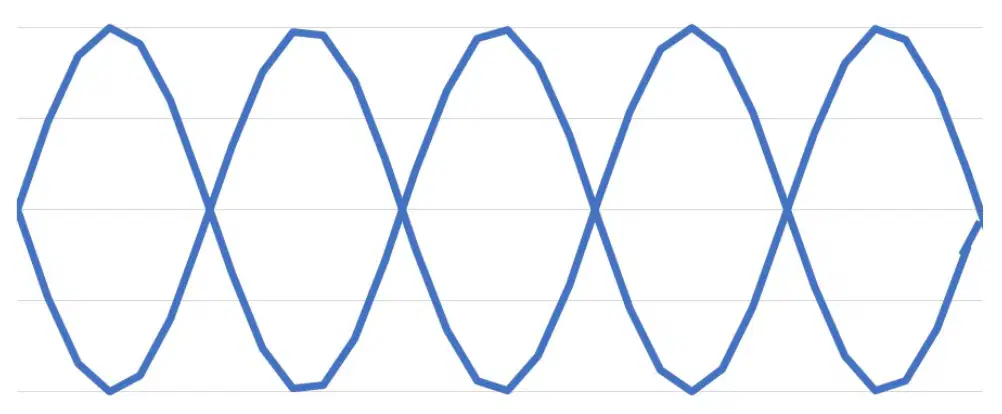
The image shows standing waves in a rope that is fixed at both ends. Which harmonic is depicted?
Second Harmonic
Fourth Harmonic
Fifth Harmonic
Sixth Harmonic
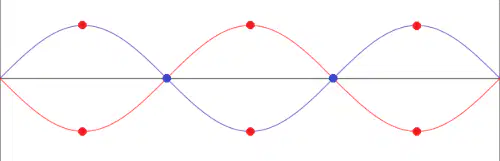
The image is of standing waves in a closed tube. The red dots are called what?
(a)
An older lady pulled up to Kroger on Saturday in a Slingshot, bumping some oldies. When she passed, it seemed like the pitch of her music changed because the frequency of her music was higher as she was getting closer than when she was getting further away. What is this effect known as?
(a)
Which of the following statements about the electromagnetic spectrum is false?
Radio waves have the greatest wavelength.
Gamma rays have the greatest frequency
Infrared waves have more energy than visible light.
Ultraviolet rays have more energy than visible light.

A light is shown on a mirror at an angle of incidence of 40 degrees. What is its angle of reflection?
40 degrees
50 degrees
140 degrees
20 degrees
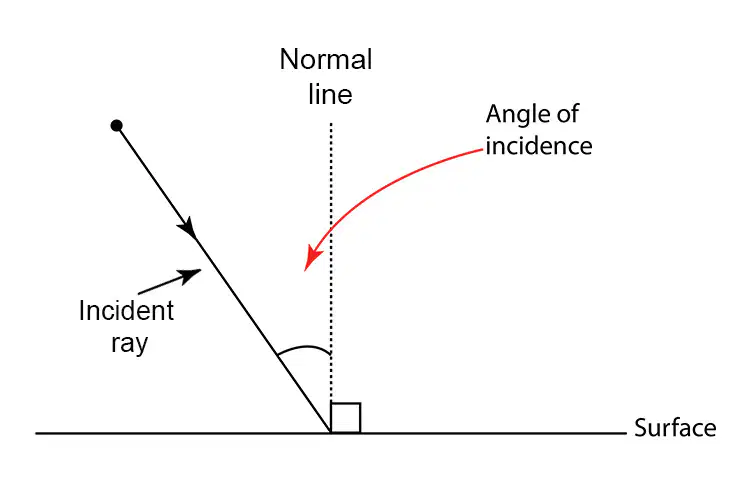
A light is pointed at a reflective surface, making a 20 degree angle with the surface. What is the angle of reflection?
20 degrees
70 degrees
110 degrees
160 degrees
An object is placed in front of a concave mirror with a focal length of 15 cm. If the image is the SAME SIZE as the object, what is the location of the image?
Cannot be determined
15 cm
7.5 cm
30 cm

An object is placed in front of a convex mirror with a focal length of 10 cm. If the object is 10 cm away from the mirror, where is its image?
No image
5 cm
10 cm
20 cm
Which of the following will produce a real image?
An object between the focal point and a concave mirror
An object at the center of curvature of a concave lens
An object at the focal point of a convex mirror
An object past the center of curvature of a convex lesn
What are the secondary colors of light?
(What you get when you add to primary colors)
cyan
magenta
yellow
green

A red light is shown on a blueberry. What happens?
The berry will appear black because the red light is reflected.
The berry will appear black because the red light is absorbed.
The berry will appear blue because the red light is absorbed.
The berry will appear black because it was eaten too quickly.
Why is it not advisable to wear black on a sunny afternoon in June?
Black absorbs all light.
Black repels all light.
Black absorbs all heat.
Black repels all heat.
A student shakes the end of a rope with a frequency of 1.5 Hz, causing waves with a wavelength of 0.4 m to travel along the rope. What is the velocity of the waves in m/s?
3.75 m/s
1.9 m/s
6 m/s
0.6 m/s
The speed of sound in a particular gas is 300 m/s. A sound wave propagating in this material has a wavelength of 15 m.
What is the frequency of this sound in hertz?
4,500 Hz
450 Hz
20 Hz
.05 Hz

The pictures shows a ray diagram of an object reflected in a convex mirror. The tiny red arrow that you can barely see represents the image. Select all of the correct characteristics of this image.
The image is smaller than the object.
The image distance is greater than the object distance.
The image is upright.
The image is real.

