wayground logo

Free Printable Worksheets

Font size

S
M
L
XL
Worksheets

Whole Class STAAR Review

Total questions: 64

Worksheet time: 52mins

Name
Class
Date
1.

Why did European explorers search for the Northwest Passage?

a)

To find the legendary Seven Cities of Gold

b)

To discover new technology for crossing the Atlantic Ocean

c)

To find the legendary waters of the Fountain of Youth

d)

To discover a new sea route to Asia

2.

What was the INITITAL reason many European explorers sailed to the Americas?

a)

To find new trade routes to Asia

b)

To form military alliances

c)

To spread Christianity to Africa

d)

To find new sources of cheap labor

3.

Which of these describes the primary reason for French colonization?

a)

To convert American Indians in the Southwest to Catholicism

b)

To cultivate cash crops in the Chesapeake Bay area

c)

To extract precious metals from mines in present-day Mexico

d)

To profit from fur trading in the Great Lakes region

4.

Spanish colonists...

a)

organized utopian societies

b)

established Catholic missions

c)

promoted political freedom

d)

became commercial shipbuilders

5.

Locate where the Spanish colonized America at St. Augustine, Florida.

6.

Locate where the English colonized America at Jamestown, Virginia.

7.
Under the Articles of Confederation, the government consisted of _______________ branch of government.
a)
3
b)
2
c)
1
d)
4
8.
The New Jersey Plan was supported by _____ states and the Virginia Plan was supported by _____ states
a)
northern; southern
b)
large; small
c)
southern; northern
d)
small; large
9.

Why was "The Great Compromise" so important?

a)

It created the Senate and the House of Representatives.

b)

Smaller states seceded.

c)

Larger states had all the power in the government.

d)

People never argued again.

10.
Free Speech is found in which Amendment?
a)
First Amendment
b)
Second Amendment
c)
Third Amendment
d)
Fourth Amendment
11.

Police must get a warrant to search citizens' property

a)

1st

b)

2nd

c)

8th

d)

4th

12.
What is federalism?
a)
The people vote for their leaders who then represent them. 
b)
The people have individual rights. 
c)
There are three branches of government. 
d)
The state and national government share power. 
13.
Which group of people wanted the Constitution to include a Bill of Rights?
a)
Federalists
b)
Anti-federalists
c)
Democrats
d)
Northerners
14.

What is the principle of republicanism?

a)

Government should be split into three branches.

b)

The people create the government.

c)

The power of government should be limited.

d)

The people elect representatives to make laws.

15.

The biggest issue between the Federalist and the Anti-Federalist was

a)

Expanding slavery

b)

Ratification of the Constitution

c)

Choosing a lead actor for the Hamilton musical

d)

Changing the boundary of the US

16.

The American continents, by the free and independent condition which they have assumed and maintain, are henceforth not to be considered as subjects for colonization by any European powers.

-​ (a)  

Choose from the below words
Monroe Doctrine
Northwest Ordinance
Washington's Farewell Address
17.

“History and experience prove that foreign influence is one of the most baneful foes of Republican government.... It is our true policy to steer clear of permanent alliances.

-​ (a)  

Choose from the below words
Washington's Farewell Address
Monroe's Doctrine
Northwest Ordinance
18.

Click on the person who is most likely a supporter of free enterprise.

19.

What was the purpose of the Northwest Ordinance?

a)

to control Indians in the Northwest Territory

b)

to set a path to statehood and establish rights for settlers

c)

to convince more colonists to fight for independence

d)

to give states a process for collecting taxes

20.

Which of the following is NOT a warning/piece of advice that Washington gave to the people of the United States in his farewell address?

a)

Stay united

b)

Avoid political parties

c)

Avoid alliances with other countries

d)

Focus on manufacturing and commerce

21.

How did southern states respond to the ratification of the Fifteenth Amendment?

a)

By creating a segregated public education system

b)

By shutting down all remaining offices of Freedmen's Bureau

c)

By imposing requirements designed to deny African Americans the right to vote

d)

By forcing African Americans to work as tenant farmers and sharecroppers

22.

What outcome best completes this diagram?

a)

American Revolution

b)

Popular Sovereignty

c)

Manifest Destiny

d)

Civil War

23.

For what reason did a group of colonists agree to this compact?

a)

To declare independence from all European nations

b)

To form a social contract among themselves

c)

To demonstrate goodwill toward local American Indians

d)

To establish trade relations with other colonies

24.

Which reason best completes the diagram?

a)

Requirements of an alliance with France

b)

Interest in conquering territories in South America

c)

British impressment of US sailors

d)

Abolition of state militias

25.
The U.S. foreign policy illustrated in this cartoon was intended to 
a)
prevent further European colonization in the Western Hemisphere
b)
deter Spain from inciting revolution in former U.S. colonies
c)
encourage European powers to invest in Latin America
d)
keep the war between France and Spain from spreading to Latin America
26.
The Fifteenth Amendment was ratified in order to
a)
establish legal requirements for the education of former slaves
b)
mandate fair labor contracts between African American workers and plantation owners
c)
abolish the institution of slavery
d)
protect the voting rights of African American men
27.
Which group was among the first to call for an end to slavery?
a)
American Indians, because they viewed the plight of slaves as similar to their own
b)
Quakers, because slavery contradicted their religious beliefs
c)
British loyalists, because Great Britain had ended the slave trade
d)
Puritans, because the New England economy did not rely on slavery
28.
Patrick Henry was criticizing which aspect of the Constitution in this excerpt?
a)
The eligibility requirements for congressional office
b)
The power granted to the central government
c)
The establishment of a separate judicial branch
d)
The difficulty of the amendment process
29.
The United States acquired the Oregon Territory when
a)
a treaty divided U.S. and British claims to the land
b)
Mexico sold the territory to the United States for $10 million
c)
the territory’s settlers voted for annexation by the United States
d)
Russia sold the land to the United States for $7.2 million
30.
What was one major effect of the Second Great Awakening?
a)
Churches turned away from public politics and focused on internal religious issues.
b)
People were inspired to join reform movements to address social problems.
c)
Religious leaders petitioned legislatures to extend suffrage to women.
d)
Politicians were encouraged to promote states’ rights rather than federal unity
31.
The abolitionist movement achieved its goal with the passage of which amendment?
a)
Twelfth Amendment
b)
Thirteenth Amendment
c)
Fourteenth Amendment
d)
Fifteenth Amendment
32.
What party formed because they opposed Jackson's ideas?
a)
Whigs
b)
Republicans
c)
Federalists
d)
Democrats
33.

Some white voters benefited from the expansion of voting rights in the 1820's.

a)

TRUE

b)

FALSE

34.

A law that made slaves available to count for state taxes and for representation in state population.

a)

The Great Compromise

b)

3/5'ths Compromise

c)

4/6's Compromise

d)

The Missouri Compromise

35.
The Louisiana Purchase
a)
paid all of debts from the French and Indian War and the American Revolution
b)
cancelled the XYZ Affair and Alien and Sedition Acts
c)
helped Thomas Jefferson get elected, and caused Hamilton to get into a duel with Burr
d)
doubled the size of the United States and gave the government control of the Mississippi River
36.
The precedent that federal courts would determine whether or not a law is constitutional was decided by
a)
Adams v. Jefferson
b)
The Judicial Act of 1789
c)
The Monroe Doctrine
d)
Marbury v. Madison
37.
In the 1840s, Seneca Falls, New York, became the scene of an important convention for -
a)
women's rights
b)
labor union organization
c)
temperance reform
d)
prison reforms
38.

Who was Horace Mann?

a)

leader of abolitionism

b)

leader of the temperance movement

c)

leader of the evil empire

d)

Leader of the education reform movement

39.

What was the abolition movement?

a)

A movement to abolish sales and consumption (drinking) of alcoholic beverages

b)

A reform movement to end slavery

c)

A reform movement to improve education

d)

Immigrants who came to America to build the railroad

40.

Dorothea Dix:

a)

was a leader of the prison reform movement and improved care for the mentally disabled.

b)

helped in education reform.

c)

was an abolitionist

d)

was a student at the Hudson River School of Art

41.
What battle was the turning point in the American Revolution? It convinced the French to join us.
a)
Yorktown
b)
Saratoga
c)
Lexington
d)
Antietam
42.
What was the battle in the Civil War that gave the Union control of the Mississippi River, splitting the Confederacy in half?
a)
Antietam
b)
Gettysburg
c)
Vicksburg
d)
Yorktown
43.
What is the type of economy called in which the colony exists to make money for the mother country?
a)
Free Enterprise
b)
Mercantilism
c)
Socialism
d)
None
44.
Which invention by Robert Fulton helped transport goods more quickly?
a)
Railroad
b)
Steamboat
c)
Mechanical Reaper
d)
Cotton Gin
45.
The era in which a change from household industries to factory production using powered machinery took place.
a)
American Revolution
b)
Industrial Revolution
c)
Technological Innovations
d)
Boom and Bust
46.

___________ was a document written by Thomas Jefferson, declaring the colonies free from Britain and setting out grievances against the King.

a)

Magna Carta

b)

Constitution

c)

Mayflower Compact

d)

Declaration of Independence

47.

The _____________ Treaty ended the American Revolution and forced Britain to recognize the United States as an independent nation.

a)

Treaty of Ghent

b)

Treaty of Guadalupe Hidalgo

c)

Treaty of Paris 1763

d)

Treaty of Paris 1783

48.
The Compromise of 1850 kept the north happy by admitting California as a free state. What law did it create to make the south happy?
a)
Missouri Law
b)
Cotton Law
c)
Great Compromise
d)
Fugitive Slave Law
49.
Former slave who became the best-known black abolitionist in the country.
a)
Frederick Douglass
b)
Martin Luther King Jr.
c)
Harriet Beecher Stowe
d)
William Lloyd Garrison
50.
An escaped slave who became a Conductor on the Underground Railroad and helped over 300 slaves to freedom in the North.
a)
Frederick Douglass
b)
Harriet Beechers Stowe
c)
Harriet Tubman
d)
William Lloyd Garrison
51.
Was the Supreme Court decision that said slaves were property and not citizens.
a)
Marbury vs. Madison
b)
Worcester vs. Georgia
c)
Dred Scott Case
d)
McCullough vs. Maryland
52.
An invention by Eli Whitney that speeded the cleaning of cotton fibers and in effect, increased the need for slaves.
a)
Steamboat
b)
Mechanical Reaper
c)
Steel Plow
d)
Cotton Gin
53.

Who invented the telegraph in 1840 (which made communication over long distances much faster)?

a)

Eli Whitney

b)

John Deer

c)

Samuel Morse

d)

Robert Fulton

54.

Which of the following best completes the diagram above?

a)

Boston Tea Party

b)

War of 1812

c)

American Revolution

d)

Civil War

55.

What did Eli Whitney invent that made mass production possible?

a)

Interchangeable Parts

b)

Cotton Gin

c)

Mechanical Reaper

d)

Telegraph

56.
What would make the best title for this image?
a)
Monroe Doctrine
b)
The Industrial Revolution
c)
Attack of the 50 foot Woman
d)
Manifest Destiny
57.

What does Sectionalism mean?

a)

A loyalty to a belief in one's section/region of the U.S.

b)

A loyalty to a belief in one's house.

c)

An opposition to a belief in one's section/region of the U.S.

d)

A disagreement to a living in one's section/region of the U.S.

58.

Who was the Confederate general that surrendered to General Grant at Appomattox Courthouse in 1865 ending the Civil War?

a)

Stonewall Jackson

b)

Robert E. Lee

c)

Winfield Scott

d)

Abraham Lincoln

59.

This Freedmen's Bureau was created after the Civil War to...

a)

establish churches to provide aid in the Southern states.

b)

reunify the former Confederate States and to craft a plan to readmit them to the Union.

c)

establish schools and provide job training to former slaves in the South.

d)

abolish former Confederate governments and to punish former Confederate leaders.
60.

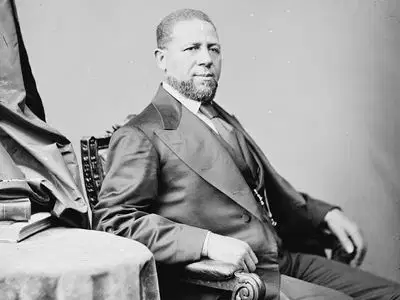
Who was the First African American to become a Senator from Mississippi?

a)

Harriet Tubman

b)

Hiram Rhodes Revels

c)

William Carney

d)

Phillip Bazaar

61.

During the Civil War: factories, larger population, access to the telegraph, and a better navy

a)

Southern advantages

b)

Northern advantages

c)

Reasons for  Southern victory

d)

Cause of the battle of Gettysburg

62.

Which of the following was one of the effects of the Kansas-Nebraska Act?

a)

Kansas and Nebraska were united into one territory

b)

Residents could vote on the issue of slavery

c)

Banned slavery in both Kansas and Nebraska

d)

Allowed slavery in both Kansas and Nebraska

63.
The Hudson River School artists created paintings that reflected national pride and an appreciation for 
a)
Buildings 
b)
Politicians
c)
War
d)
Nature
64.
Ralph Waldo Emerson
*Popular essayist and author
*Promoted individualism and self-reliance
*Works included "Nature" and "The American Scholar"
Which movement did Emerson lead?

a)
Temperance
b)
Abolition 
c)
Second Great Awakening
d)
Transcendentalism