
NEW
Font size
 Worksheets
Unit 8 Review P1-3
Total questions: 34
Worksheet time: 2hrs 42mins
Nutrient runoff can cause algal blooms in waterways. Which genetically modified organisms could help reduce algal blooms?
pigs that are modified to have more fat
cows that are modified to require less feed
corn that is modified to be resistant to herbicides
soybeans that are modified to make their own insecticide
Embryo transfer is a type of biotechnology. It is used in the breeding of cattle, sheep, and goats. It allows an embryo to be transferred from the natural mother to a different female. This allows the natural mother to produce many more offspring than she otherwise could. What is the most likely reason that a particular female would be selected to be the natural mother that produces many embryos to be transferred to other females?
She has a desirable trait.
She has had other offspring.
She has recovered from an illness.
She has donated other tissues successfully.
Bacillus thuringiensis (Bt) is a soil bacterium that is toxic to certain insects. Genes from this bacterium have been inserted into cotton to make Bt cotton. Farmers that use Bt cotton would most likely use less of which of the following?
water
fertilizer
herbicide
insecticide
Some varieties of soybeans have been genetically modified. They have been changed so that they do not die when a particular herbicide is sprayed on a field. How would this genetic modification improve the soybean crop?
It would enable the crop plants to kill nearby weeds directly.
It would protect the crop when farmers sprayed for harmful insects.
It would allow farmers to eliminate weeds that compete with the crop.
It would increase the fitness of the crop plants and improve their growth.
A transgenic organism is one that contains genes from a different species. Research scientists create transgenic organisms, but do not usually decide whether or not they can be released into nature. Those decisions are usually made by government officials. Which statement BEST explains why government officials have this responsibility?
Government officials are often required to get feedback from the public before making these types of decisions.
Government officials are usually more knowledgeable about the science behind these types of decisions.
Research scientists seldom consider how decisions about transgenic organisms might affect natural ecosystems.
Research scientists are only concerned about how transgenic organisms will affect the environment, not how they will affect humans.
Golden rice is a transgenic plant that produces rice with high levels of vitamin A. The rice would help people improve the nutrition in their diets. However, some people are concerned about the effects the transgenic rice might have on native plants. Which words best characterize these concerns?
practical and economic
economic and ecological
ecological and ethical
ethical and practical
Scientists have been able to insert genes from a spider into the genome of a domestic goat. When the goat matures, it produces milk that contains a protein found in spider webs. This protein can then be extracted and used to make strong but lightweight materials for bulletproof vests, automobiles, and aircraft. The change does not cause the goat any pain, but some people think that it is not right to add genes from the genome of one animal to another. Which word best describes this concern?
economic
Biological
ethnical
practical
By inserting a gene from a firefly into a plant, scientists have made a plant that glows in the dark. This practice raises some concerns about transgenic organisms. Which of the following is an ethical concern?
Genes from these plants may be transferred to native plants through pollination.
Genes from these plants may not be fully functional over the lifetime of the plant.
These plants may not live as long as natural garden plants.
These plants may cost more than natural garden plants.
Which statement correctly describes a way that bacteria are used in biotechnology?
Bacteria make human cells that make insulin.
Human insulin made by bacteria is injected into humans.
Bacteria that make insulin are implanted in humans.
Human insulin coding bacterial genes are spliced into human cells.
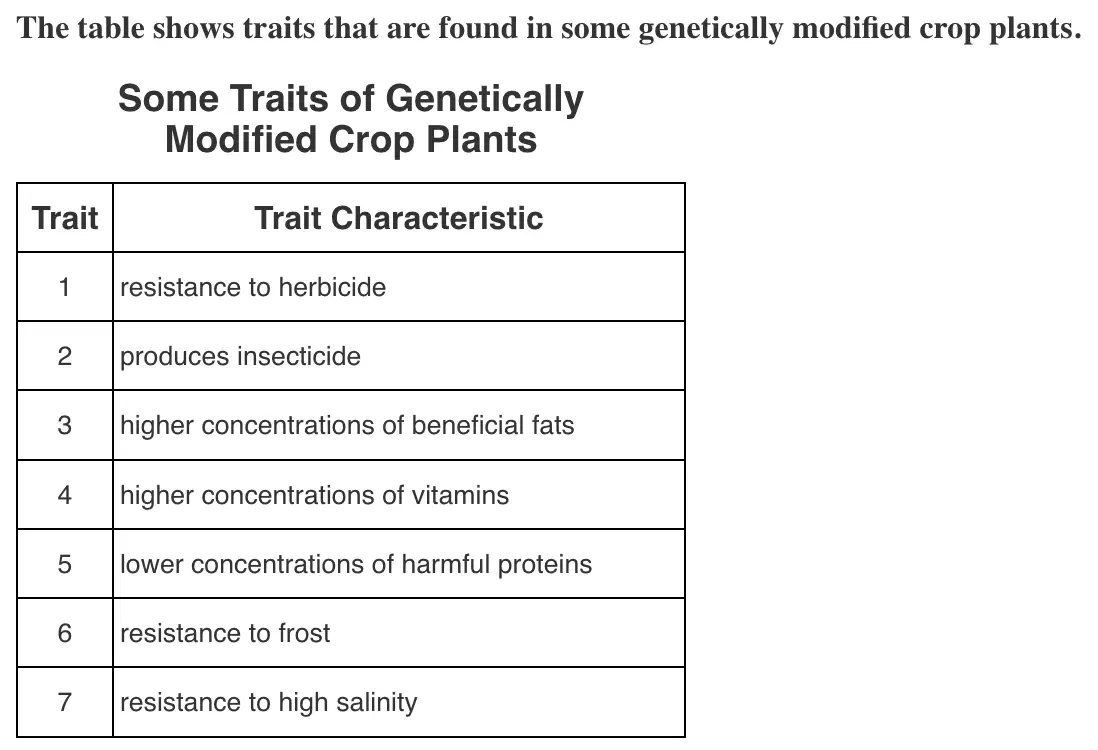
A farmer who lives in a cold northern climate would like to plant a genetically modified crop. She is interested in producing a high-nutrition crop. She also wants to reduce her use of pesticides. Which of the following combinations of traits listed in the table would BEST meet the farmer’s needs?
Traits 1, 3, and 5
Traits 1, 2, and 4
Traits 3, 4, and 7
Traits 2, 4, and 6
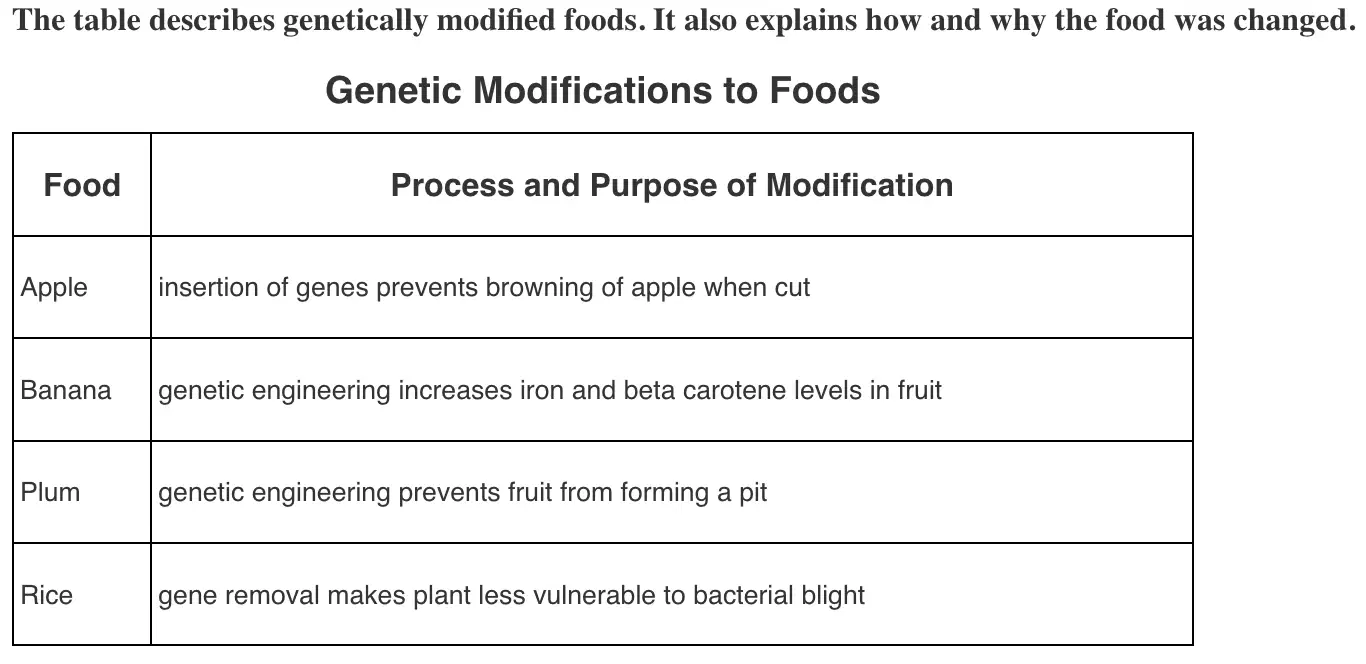
Which of the foods was modified to increase its nutritional content?
Apple
Banana
Plum
Rice
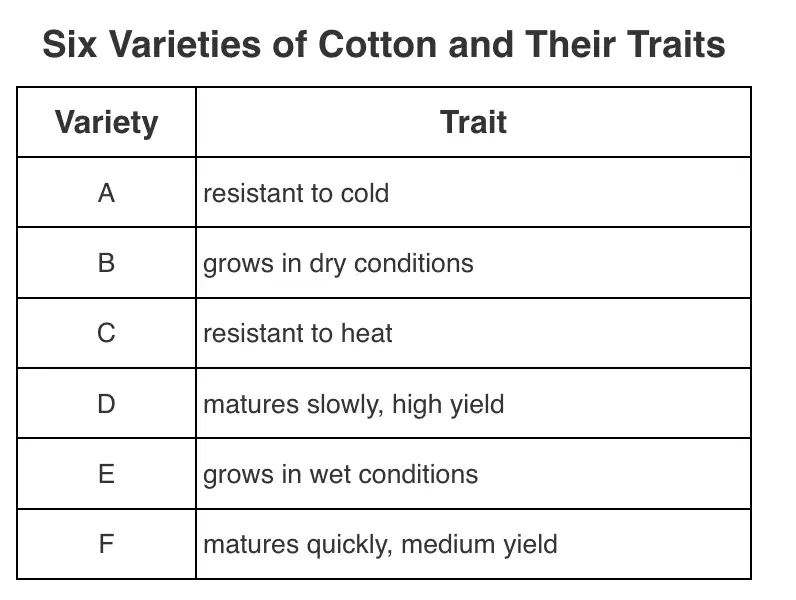
A farmer in India is trying to decide which type of cotton to plant. He is examining the traits of six varieties of genetically engineered cotton. These traits are shown in the table. The upcoming growing season is predicted to start later than usual, due to a colder than normal spring. The growing season is predicted to be drier than normal. Which two varieties are likely to give the farmer the best results, given the predicted weather conditions?
varieties A and D
varieties E and A
varieties B and F
varieties C and B
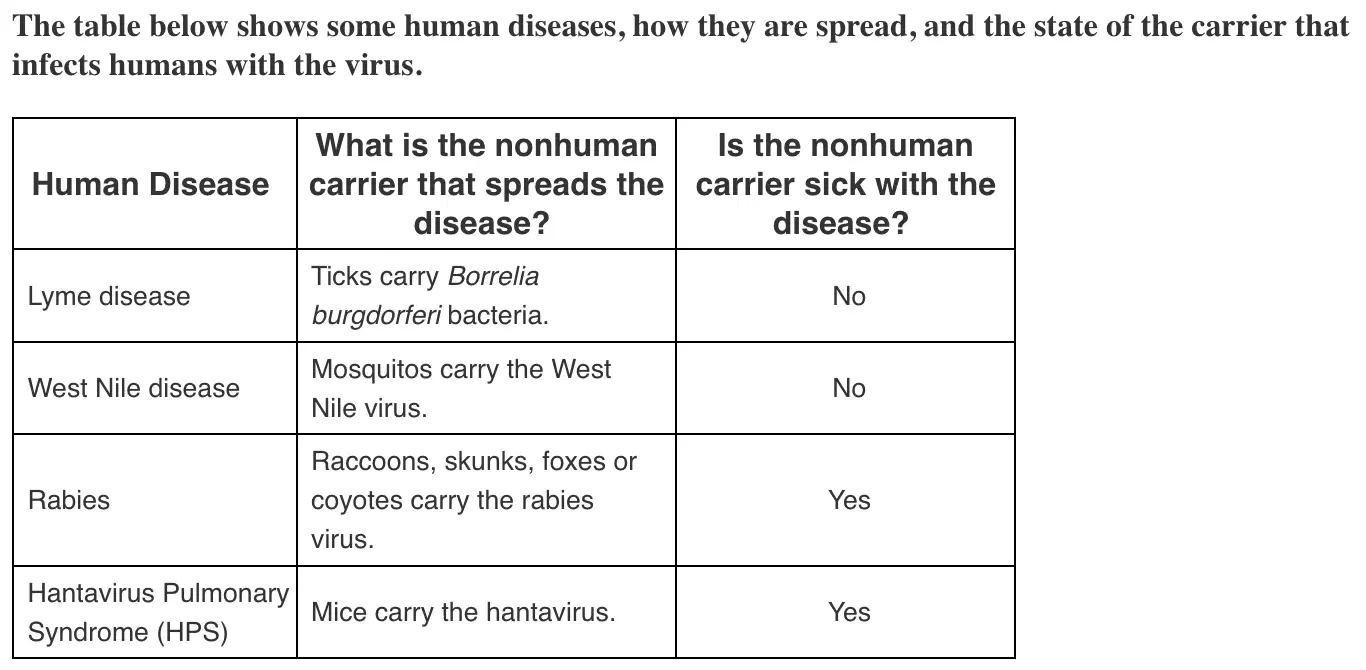
Which diseases are transmitted to humans by vectors?
Lyme disease and West Nile disease
West Nile disease and Rabies
HPS and Lyme disease
Rabies and HPS
The bacteria B. anthracis causes the deadly disease anthrax. Here is one way humans can contract the disease:
1.The bacteria form tough endospores that rest in soil indefinitely.
2.Grazing animals, such as sheep, inhale endospores from the soil through the air.
3.Once inside the sheep, the spores reactivate and cause infection.
4.Meat from infected sheep passes spores to humans and causes the humans to become infected.
What is the vector for anthrax when humans are infected in this scenario?
air
soil
sheep
endospores
What is the distinction between an epidemic & pandemic?
the symptoms of the disease
the geographical area affected
the species of organisms infected
the season in which the disease spreads
In 1918, an outbreak of influenza infected 500,000 people all over the world. Tens of millions of those infected died. In 1994, an outbreak of pneumonic plague spread quickly through the city of Surat in India, killing 52 people. Which statement best describes the two events?
Both outbreaks were pandemics.
Both outbreaks were epidemics.
The influenza outbreak was a pandemic. The plague outbreak was an epidemic.
The influenza outbreak was an epidemic. The plague outbreak was a pandemic.
The discovery of penicillin helped in the
treatment of infections.
healing of bones.
discovery of viruses.
search for diseases.
What reason best explains why more people get colds in colder temperatures?
Viruses need colder temperatures to survive.
Viruses need colder temperatures to infect people.
Colder temperatures lower a person's body temperature.
Colder temperatures cause people to stay inside, closer together.
Diseases that can be transmitted between organisms are
infectious.
inherited.
environmental.
congenital.
Which characteristic of viruses prevents them from being used as evidence to support cell theory?
Viruses do not have nuclei.
Viruses cannot move by themselves.
Viruses replicate only inside host cells.
Viruses can have glycoproteins on their surfaces.
Which is one possible human benefit from biotechnology research?
producing crops that can grow in areas where they normally do not grow
producing new types of disease-causing viruses
increasing the ability to turn ocean water to freshwater
creating new types of buildings that can withstand hurricanes
How has genetic engineering helped farming?
by developing better fertilizer for crops
by creating crops that resist some diseases
by producing soil that makes crops grow better
by producing faster ways to harvest crops
How can biotechnology help farmers overcome sudden changes in the global climate?
by changing the types of soil in which the crops are planted
by developing crops that are resistant to adverse weather
by rotating the crops within the same field
by only planting crops in the winter
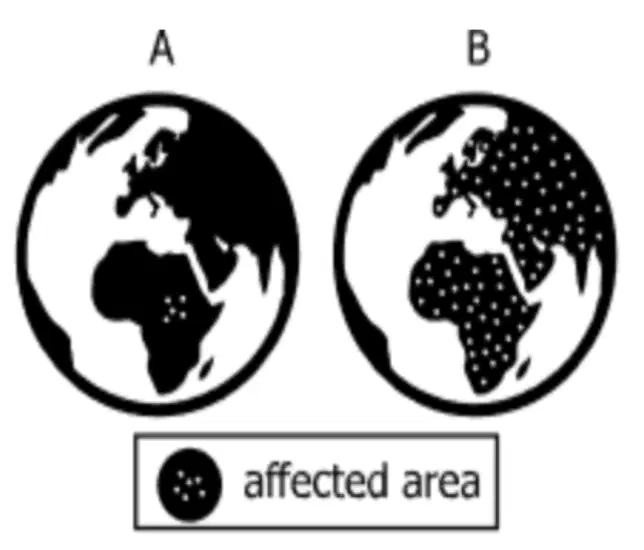
There is a sudden increases in disease A and disease B. The diagram shows the different geographic areas where diseases A and B are found. Which is the correct statement?
Disease A - Pandemic
Disease B - Epidemic
Both Disease A & B are Pandemics
Disease A - Epidemic
Disease B - Pandemic
Both Disease A & B are Epidemics
A dairy cow typically produces 6-7 gallons of milk per day. A scientists extracts the gene responsible for producing growth hormone in cattle and inserts it into bacteria for cloning. The hormone obtained from the bacterium is then purified and inserted into dairy cows in the form of an injection. This increases the milk productivity by 10% in the cows. Which statement describes how the scientists increases milk production?
Genetic modification of dairy cows causes them to release more growth hormone to increase milk production
Genetic modification of bacteria allows them to make growth hormone that is used to increase milk production
Selective breeding of bacteria allows them to make growth hormone that is used to increase milk production
Selective breeding of dairy cows causes them to release more growth hormone to increase milk production
In 2021, over 730 biotechnology were based in North Caroline, employing more than 66,000 people. This represents an increase of 25% compared to 2010. Which statement best describes a future impact based on this information?
the biotechnology industry will continue to shrink and by 2030, it will employ very few people
The biotechnology industry will become more automated and no longer hire people to complete the work
Biotechnology is no longer growing in North Caroline and fewer new companies will open in North Carolina in the future
Biotechnology is a quickly expanding industry in North Caroline and will continue to be important to the economic future of the state
Aspergillosis is a fungal infection caused by Aspergillus, a type of spore-forming mold. The spores are found both indoors and outdoors. Aspergillus can grow on decaying plant materials outside, materials with dust, stored grains, or some food inside. Individuals with weak immune systems or long-standing lung problems are easily affected by this mold. The infection causes allergy0like symptoms in the infected people. What can be done to prevent aspergillosis the best?
Avoid activities like gardening and lawn mowing to reduce contact with spores
Increase lung health by taking long walks in forests or other natural areas
Eat a healthy diet to prevent the spores from causing infection
using ceiling fans to minimize the amount of dust that collects on materials insides
Heartworm is a disease caused by mosquitos that carry Dirofilaria parasites infecting dogs that the mosquitos bite. Which action will best reduce heartworm infection?
Injecting dogs with chemicals designed to treat viral infections
feeding dogs treats that contain medicine that kills many kinds of parasites
encouraging infected dogs to eat healthy foods and get plenty of exercise
minimizing the contact between infected dogs and healthy dogs
A group of researchers create a strain of corn with a gene that naturally produces pesticides. A recent study shows that pollen from the genetically modified corn can land on milkweed plants. The genetically modified corn's pollen is toxic to the caterpillars that feed on milkweed. What is a likely ethnical issue with planting the modified corn?
the genetically modified corn harms human health
the genetically modified corn plants will grown due to decreased crop loss form insects
the genetically modified corn plants can harm the ecosystem where they grow
the genetically modified corn will become popular and create pesticide industry to grow
Rabbits in a region of Australia were exposed to a virus. The virus spread to the rabbits beyond the region and more than 90% of infected rabbits in Australia died from the disease. When the disease reinfected rabbit populations a year later in Australia, fewer rabbits died after exposure. Which statement describes the disease affecting the rabbits?
the disease was an epidemic because more than 90% of the infected rabbits died from the disease
the disease was a pandemic because reinfected populations were less likely to die from the disease
the disease was an epidemic because it began and stayed limited to Australia
the disease was a pandemic because the virus spread beyond the initially affected region
Using biotechnology, a substance is developed and then baked into bread to slow the growth of mold. Which statement best describes how the substance can benefit society?
the substance lets consumers have fewer choices of bread at the grocery store
the substance will increase the amount of time required to make the bread
the substance will keep the bread from being digested if it is consumed by pests
the substance slows bread to be transported greater distances with less risk of spoiling
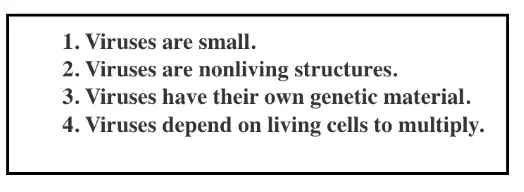
The table lists some basic characteristics of viruses. A student claims that viruses are infectious agents. Which characteristic supports the student's claim?
1
2
3
4
Which characteristic of bacteria allows them to spread a disease in a human's body?
They are prokaryotic
They can reproduce rapidly
They cover most things on Earth
They are made up on a single cell
CRISPR-Cas9 is a technology that uses a protein called Cas9. Cas9 allows scientists to separate DNA then change the genetics of an organism. Which is a likely application of this technology in medicine?
correcting and treating genetic disorders
increasing the infection rate of diseases
reducing the need for medicine or treatment after an injury
producing proteins in the body to reduce the intake of food for nutrition

