
 Worksheets
PS Unit 10 Review
Total questions: 154
Worksheet time: 4hrs 36mins
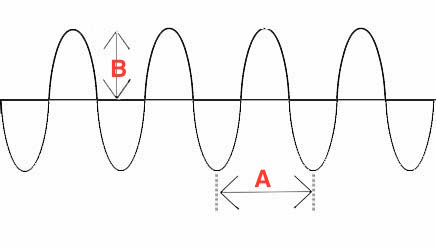
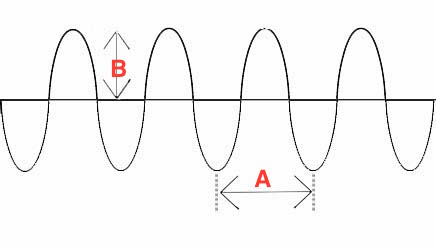


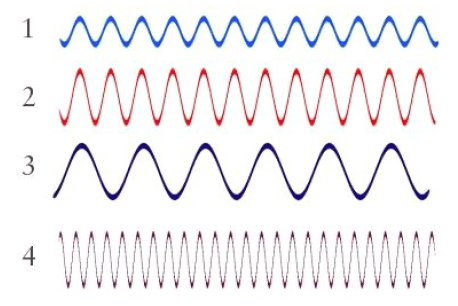


Identify E
Crest
Trough
Rest position
Amplitude

Identify A
Crest
Wavelength
Aplitude
Frequency

Identify the amplitude of the wave
A
B
C
D
E
What mediums can a Longitudinal wave pass through?
Solid, Liquid, Gas
a vacuum, Solids
Sound
Fluids
What wave has particles that move perpendicularly to the direction of the wave?
Transverse waves
Longitudinal waves
Sound waves
Light waves

How does the density of an object impact the speed of a sound wave?
Sound travels the fastest in gas mediums
The less dense the medium, the faster it travels
The density of the medium does not affect the speed of sound
The denser the medium, the faster it travels
A sound wave travels at a speed of 352 m/s. What is its wavelength if it has a frequency of 880 Hz?
(a)
What is the speed of light in a vacuum if its frequency is 5.0 × 10^14 Hz and its wavelength is 600 nm? (a)
A guitar string vibrates at a frequency of 100 Hz. What is the wavelength of the sound wave if the speed of sound is 150 m/s?
(a)
A guitar string vibrates with a frequency of 320 hz. If the wavelength of the vibration is 0.23 meters what is the speed of the wave?
320.23 m/s
1391.3 hz
73.6 m/hz
73.6 m/s
Which equation can be used to calculate the speed of a wave?
v = fλ
f = v/λ
λ = v/f
v = λ/f
What does the "v" represent in the equation v = fλ?
Frequency of the wave
Wavelength of the wave
Velocity of the wave
Amplitude of the wave
If the wavelength of a wave is increased while its velocity remains constant, what happens to the wave's frequency?
The frequency also remains constant.
The frequency increases.
The frequency decreases.
There is no relation between frequency and wavelength.
A wave with a frequency of 20 Hz has a wavelength of 4 meters. What is its speed?
5 m/s
16 m/s
80 m/s
240 m/s
A wave with a wavelength of 0.5 meters is traveling through a medium with a velocity of 20 m/s. What is its frequency?
0.025 Hz
10 Hz
20 Hz
40 Hz
What is the wavelength of a wave with a frequency of 100 Hz and a velocity of 340 m/s?
0.34 m
3.4 m
34 m
340 m

absorption
diffraction
reflection
refraction
transmission

absorption
diffraction
reflection
refraction
transmission
Refraction occurs when waves enter a new (a) and change (b) .


What is the definition reflection?
The bending of waves as they enter a new medium
Bouncing back of waves from a surface that it can’t pass through
The bending of waves as they pass through openings or around corners
When two interfering waves have a displacement in the same direction, two crests and two troughs overlap. Increased amplitude.
This is the term that describes when light passes through matter.
Transmission
Transparent
Translucent
Opaque

This image depicts which of the following wave behaviors?
Reflection
Refraction
Diffraction
Resonance

The image depicts which of the following wave behaviors?
Resonance
Doppler Effect
Interference
Polarization

The two blue and purple waves will undergo _________________ when they meet.
Constructive interference
Destructive interference

The image of the two waves depicts
Constructive interference
Destructive interference
Definition: the change in direction of a wave passing from one medium to another
Reflection
Refraction
Diffraction
Polarization
Definition: The spreading out of waves as they pass through an opening or around objects.
Reflection
Refraction
Diffraction
Resonance
Two waves that undergo constructive interference must be...
In phase
Out of phase
Two waves that undergo destructive interference must be...
In phase
Out of phase
Light waves and sound waves are similar in that...
They are both longitudinal waves
They are both transverse waves
They both transmit energy
They both can travel through space.

Which of the pictured is responsible for our sky being blue?
Transmission
Reflection
Refraction
Scattering
Absorption
Which of the pictured is responsible for black pavement being hot?
Transmission
Reflection
Refraction
Scattering
Absorption
Which of the pictured is responsible for us being able to see objects?
Transmission
Reflection
Refraction
Scattering
Absorption

Which type of interaction is this?
reflection
refraction
diffraction
Which of the following is the bending of a wave, as it changes its speed moving from one medium to another.
Reflection
Diffraction
Refraction
Frequency
When a wave bends or spreads past a barrier or opening, this is referred to as
Reflection
Refraction
Radiation
Diffraction


Which type of interaction is this?
reflection
refraction
diffraction
interference

Which type of interaction is this?
reflection
refraction
diffraction
interference

Which type of interaction is this?
reflection
refraction
diffraction
interference

Which type of interaction is this?
reflection
refraction
diffraction
interference

Which type of interaction is this?
reflection
refraction
diffraction
interference
Which type of interaction is this?
reflection
refraction
diffraction
interference

Which type of interaction is this?
reflection
refraction
diffraction
interference
What is the angle of incidence if a reflected wave bounces off a mirror at an angel of 65 degrees?
25 degrees
65 degrees
90 degrees
115 degrees
Reflection occurs when a wave
bends due to a change in speed
hits a surface and bounces back
passes through an opening
bends around a barrier

refraction
diffraction
angle of reflection
angle of incidence

refraction
diffraction
angle of reflection
angle of incidence

Which diagram represents specular reflection?
A
B

Which diagram represents diffuse reflection?
A
B
C
D
What is the saying that can help you remember the order of the visible spectrum?
ROYGBIV
RYOBIVG
ROYBVIG
RIBYOVG

We see an apple as being red because ________________________________.
All of the colors are absorbed except for the color red. Red is being reflected in to our eyes.
All of the colors are being reflected except for the color red. Red is being absorbed.
Which of the following types of electromagnetic radiation has the shortest wavelength?
Infrared light
Radio waves
Visible light
X-rays
Gamma rays
Which of the following is NOT an example of an electromagnetic wave?
Microwaves
Sound waves
X-rays
Visible light
Radio waves
Which of the following statements about light is TRUE?
Light has properties of neither particles nor waves.
Light can be described exclusively as a particle.
Light can be described exclusively as a wave.
Light exhibits properties of both particles and waves.
There is always a 50/50 chance of light being measured as a wave or a particle.
What is the term for the number of oscillations per unit time of any wave or repeating event?
Frequency
Spacing
Wavelength
Period
Separation
What is light composed of?
air molecules
charged particles
oscillating electric fields
oscillating magnetic fields
electric and magnetic fields oscillating together

Which EM waves have the longest wavelength?
radio
x-rays
ultraviolet
gamma rays

Which EM waves have the shortest wavelength?
radio
x-rays
ultraviolet
gamma rays

Which EM waves are have the lowest frequency?
radio
none
infrared
x-rays

Which EM waves are have the highest energy & are the most dangerous?
radio
gamma rays
infrared
x-rays

Which wave has the highest frequency?
A
B
C
None (same frequency)
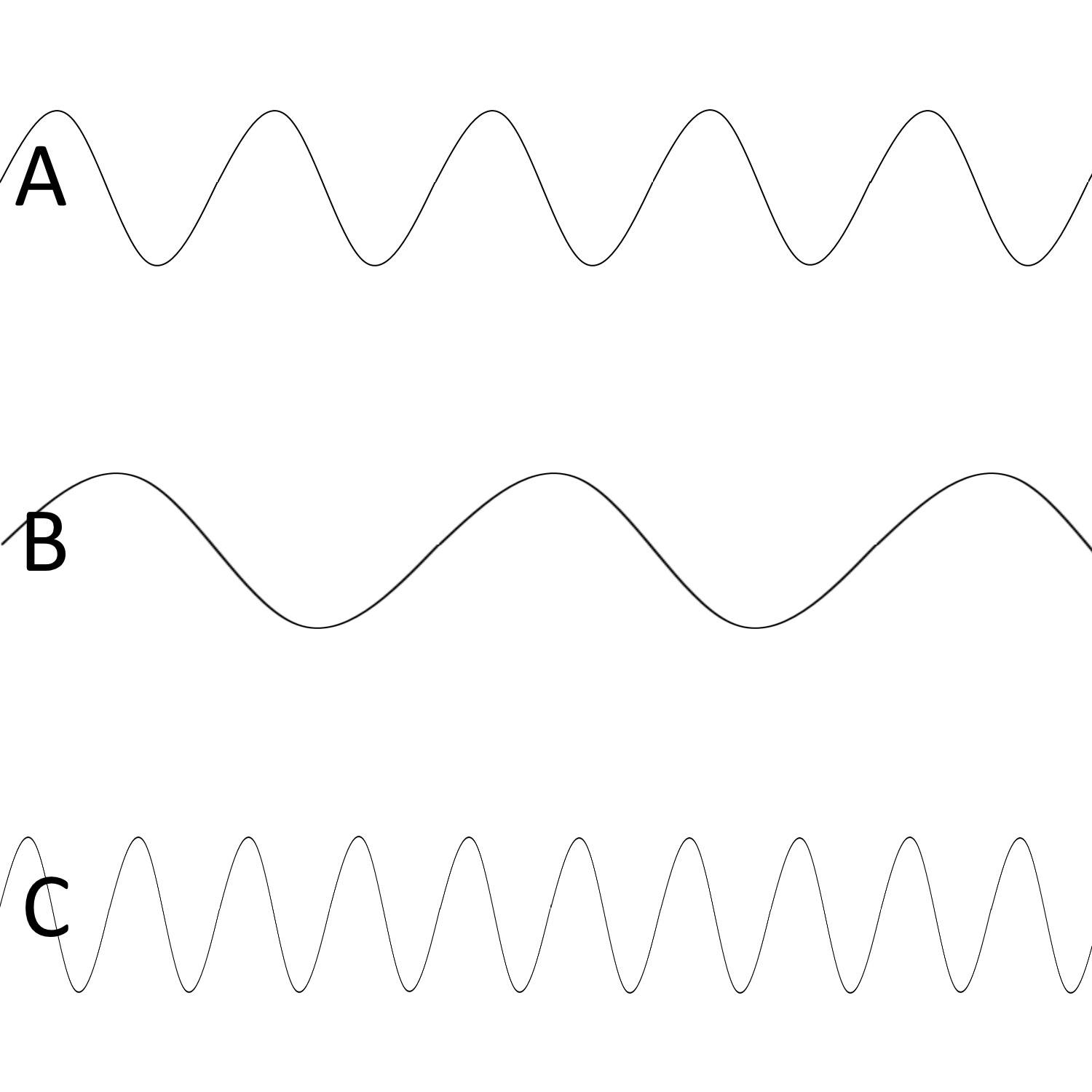
Which wave has the longest wavelength?
A
B
C
None (same wavelength)
how fast do electromagnetic waves travel through the vacuum of space?
they don't
250,000,000 m/s
the speed of light
100mph
as the wavelength of a wave increases its frequency also increases
true
false
Select all that are TRUE about Reflection & Refraction.
Refraction is when light strikes & bounces off an object
Reflection is when light strikes & bounces off an object
Reflection is when light bends as it passes through a substance
Refraction is when light bends as it passes through a substance
Match the following terms of Light Properties.

Refraction

Reflection of all visible light

Absorption of all visible light
How does light travels?
In a straight line
in a curved path
in a zig-zag path
Sound waves cannot travel through which of these?
paper
milk
outer space
hydrogen
Match how sounds travels through various types of media.
solid
Sound travels the fastest
liquid
Sound travels at a medium speed
gas
Sounds travels the slowest
vacuum
Sound CANNOT travel though the vacuum of space.

Which Electromagnetic waves help doctors detect a broken bone inside your body?
UV light
Gamma ray
X ray

A leaf is green because
All colors are reflected except green
The light is not part of the EM
All colors are absorbed except green
The sun light shining on the leaf is green
Match these
sound
mechanical energy
light
radiant energy
travels in waves
both

Match these parts of a light wave
Amplitude
height of the wave
wavelength
distance from crest to crest or trough to trough
crest
top
trough
bottom
frequency
how often waves occur
Order these colors from least energy to most energy
red
orange
green
blue
violet
Order these radiant energy forms from least energy to most energy
radio
microwave
infrared
visible
match these types of energy with how they can be used
Infrared
"seeing" the heat of a person or animal in the dark
Radio
music, communication
Microwaves
cooking
Ultraviolet (UV)
growing plants, tanning, cleaning
X-Rays
"seeing" inside the body (bones)

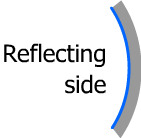
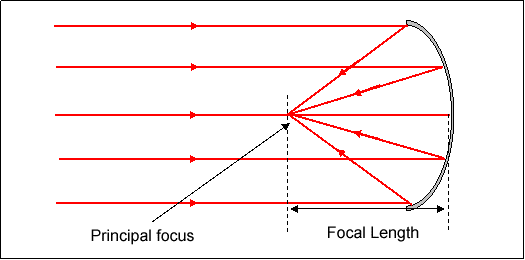
If the angle of incidence between the incident ray and the normal line is 25 degrees, what is the angle of reflection?
65 degrees
45 degrees
35 degrees
25 degrees
Which lens is used to magnify objects and refract light? This type of lens is curved outward.
concave lens
convex lens
parabolic lens
plane lens
Which describes a concave lens?
more transparent in the middle
thinner in the middle than on the edges
thinner on the edges than in the middle
triangular in shape
When light waves move from passing through air to passing through a glass lens when happens to them?
They slow down and change direction
They speed up and change direction
They maintain the same speed and change direction
They maintain their same speed and direction
What type of lens do you have in your eye?
Concave
Prismatic
Objective
Convex
Rays of light from a point object, after refraction through the lens actually meet to form an image.
real image
virtual image
actual image
erect image
When an object is placed between the focal point and the optical centre of the convex lens, the image produced is ___.
real, diminished, and inverted
real, enlarged, and inverted
virtual, enlarged, and erect
virtual, diminished and erect

The point where the rays meet is known as....
first focal point
second focal point
focal plane
real image
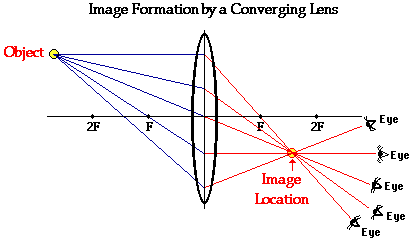
This image is.....
inverted and smaller
inverted and larger
not inverted and smaller
not inverted and larger
A real image...
is produced by virtual rays and can be projected on a screen
is produced by real rays and cannot be projected on a screen
is produced by virtual images and cannot be projected on a screen
is produced by real rays and can be projected on a screen

The above lens is a type of ___.
diverging lens
converging lens
divergent lens
convergent lens
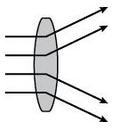
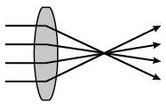
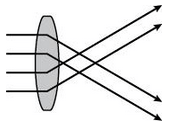
Which lens represents the path light takes through a diverging lens?


Which figure represents the path light takes through a converging lens?
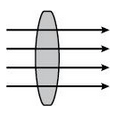

What type of lens is used in the shown instrument?
concave lens
convex lens
reflection lens
reduction lens
The image formed of an object at the center of curvature of concave mirror. The object is placed at?
Focal length
Twice of focal length
Between pole and focus
Beyond center of curvature
1. Focal length of a concave mirror is:
negative
positive
depends on the position of object
depends on the position of image

