
NEW
Font size
 Worksheets
Recent Topics for Senior Review
Total questions: 10
Worksheet time: 5mins
Where can the entire genome of an organism be found?
In the DNA present in plasmids of a bacterial cell
In the DNA present in the nucleus of a eukaryotic cell
In the DNA present in the nucleus and chloroplasts of a plant cell
In the DNA present in the nucleus and mitochondria of an animal cell

The graph shows the proportion of a bacterial population of Neisseria gonorrhoeae, displaying resistance to the antibiotic tetracycline. What can be deduced from this graph?
Bacteria with beneficial adaptations survive and pass on their genes.
Immunity to tetracycline is triggered by over-use of the antibiotic.
Genetic variation in this bacterial population is increasing.
Use of tetracycline inhibits the growth of antibiotic-resistant N. gonorrhoeae.
Which process occurs in meiosis but not in mitosis?
Attachment of spindle fibres to the centromeres of each chromosome
Movement of homologous chromosomes to opposite ends
Replication of DNA prior to the start of cell division
Separation of sister chromatids during anaphase

Which encircled area shows a clade?
A
B
C
D
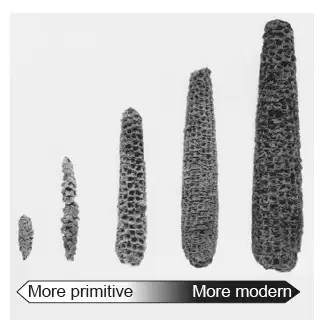
Humans have been improving crop species for thousands of years by cross-breeding plants with desirable characteristics. The photograph shows the changes in dry cobs of corn (Zea mays) over 10 000 years.
Selective breeding
Adaptive radiation
Discontinuous variation
Natural selection

The pedigree chart shows the inheritance of hemochromatosis, a genetic disease which causes an excessive accumulation of iron in the body. What can be deduced about this genetic disease from the pedigree chart?
It is sex-linked.
It is autosomal dominant.
It is autosomal co-dominant.
It is autosomal recessive.
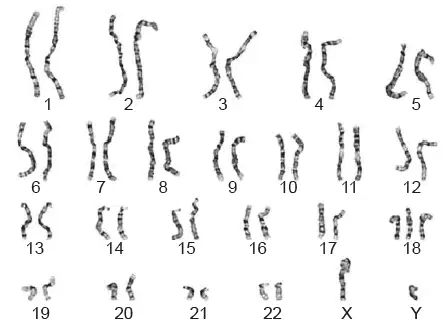
The karyogram shown belongs to a human being. What can be deduced from this karyogram?
The person is a male with Down syndrome.
The person is a female with Down syndrome.
The person is a male with a genetic disorder.
The person is a female with a missing chromosome.
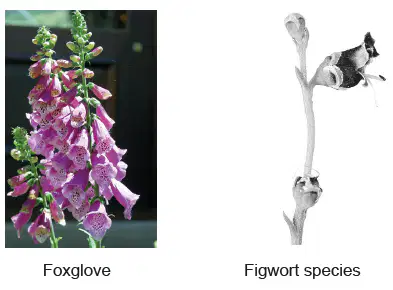
The foxglove, Digitalis purpurea, was once classified in the figwort family. The figwort family has been reclassified and is now much smaller. Why were species such as the foxglove moved into other families?
The appearance was too dissimilar.
The plants are found in different locations.
The genera were different.
The DNA sequences indicated different ancestry.

What is a recognition feature for both of the plant phyla indicated?
A
B
C
D
Which statement defines alleles?
They are the different forms of a gene that have the same effect on the phenotype.
They are the similar forms of a gene in different positions of a chromosome.
They are the various forms of a gene with slight differences in their base sequences.
They are the different forms of a gene coding for identical polypeptide chains.

