
 Worksheets
S6 Geography Graduation Exam Revision
Total questions: 66
Worksheet time: 41mins
(a) radiation is the energy transmitted from the sun to the earth in the form of electromagnetic waves. It is mainly composed of short wave radiation (< 4 µm in wavelength).
When the angle of the sun is 90°, it is known as the (a) sun.
Some of the radiation is (a) by certain materials, which increase in temperature as a result.
Some objects (a) the radiation back without absorbing or allowing it to pass through.
When the reflected radiation travels in different directions, it is called (a) .
Heat is transferred through contact, from a hotter object to a cooler one.
Convection
Conduction
Radiation
Evaporation
Heat is transferred in the air by vertical circulation. Air heats up, expands and rises. Cold air from above contracts and sinks, replacing the rising air.
Convection
Conduction
Radiation
Evaporation
Heat is transferred to the atmosphere from the earth’s surface through long wave __________.
Convection
Conduction
Radiation
Evaporation
Latent heat is absorbed and stored in the water vapour when water changes its state from liquid to vapour during _____________.
Convection
Conduction
Radiation
Evaporation
The larger the angle of the sun, the _________ concentrated and the ___________ intense the insolation.
more, less
less, more
more, more
less, less
The angle of the sun is (a) in high-latitude regions than in low-latitude region.
In June, Topic of (a) is experiencing the most intense insolation of the year. This shows the time of summer solstice.
At the winter solstice, the overhead sun is located at the Tropic of Capricorn. Areas north of the Arctic Circle receive 0 hours of daylight.
True
False
At the spring _______ (21 or 22 March) and the autumnal ________ (22 or 23 September), the overhead sun is at the two poles. Therefore, both hemispheres receive roughly equal amounts of insolation.
(a)
The annual variation of insolation decreases with increasing latitude.
True
False
Dust particles, gas molecules and clouds in the atmosphere reflect, absorb or scatter solar radiation. At higher latitudes, the sun’s rays have to travel a ________ distance through the atmosphere. This results in a _______ loss of insolation.
longer, greater
shorter, greater
longer, fewer
shorter, fewer
The degree of reflection of a surface, known as the (a) , affects the amount of insolation being reflected.
The ________ the colour of the earth’s surface, the higher the albedo, and the smaller the amount of insolation absorbed by the earth’s surface.
lighter
darker
In January, air temperature over the land is lower than that over the ocean along the same latitude in the Northern Hemisphere.
True
False
Temperature variation across latitudes is more marked in January in the Northern Hemisphere. This is shown by the ________-spaced isotherms.
closely
widely
The relationship between air temperature and __________ are inversely related.
Altitude
Insolation received
Duration of daylight
Distance from the sea
Which of the following physical characteristics of the land and the sea are correct:
Land is opaque so that insolation can only concentrate in a shallow layer. This causes a rapid rise of temperature.
Water is transparent so that insolation can penetrate deeper into the sea. This leaves the surface layer cool.
Land is mobile so there’s lots of mixing of warm and cool layers.
Water is mobile so that cool water is mixed with warm water. This keeps the sea cool.
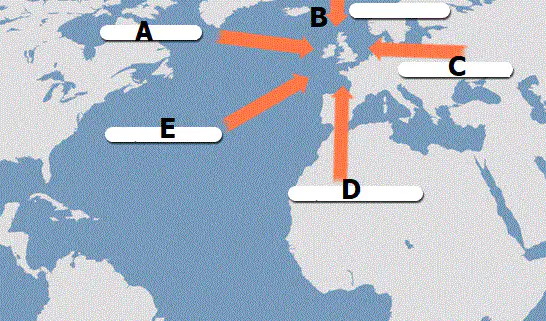
The UK is affected by 5 different air masses. A represents (a) maritime air mass.
The UK is affected by 5 different air masses. B represents (a) maritime air mass.
The UK is affected by 5 different air masses. C represents polar (a) air mass.
The UK is affected by 5 different air masses. D represents (a) continental air mass.
The UK is affected by 5 different air masses. E represents tropical (a) air mass.
The UK is affected by 5 different air masses. A refers to ________.
mP
Mp
Pm
pM
The UK is affected by 5 different air masses. B refers to ________.
mA
Ma
Am
aM
The UK is affected by 5 different air masses. C refers to ________.
cP
Cp
pC
Pc
The UK is affected by 5 different air masses. D refers to ________.
Tc
cT
Ct
tC
The UK is affected by 5 different air masses. E refers to ________.
Tm
mT
Mt
tM
The source of Polar Maritime air mass is _________.
North Atlantic Ocean
Greenland and Arctic Ocean
Central Europe
North Africa
The source of Arctic Maritime air mass is _________.
North Atlantic Ocean
Arctic Ocean
Central Europe
North Africa
The source of Polar continental air mass is _________.
North Atlantic Ocean
Arctic Ocean
Central Europe
North Africa
The source of Tropical maritime air mass is _________.
North Atlantic Ocean
Arctic Ocean
Central Europe
North Africa
The source of Tropical continental air mass is _________.
North Atlantic Ocean
Arctic Ocean
Central Europe
North Africa
The properties of Polar Maritime air mass is _________.
hot and dry
warm and moist
hot summer and cold winter
wet and cold
The properties of Arctic maritime air mass is _________.
hot and dry
warm and moist
hot summer and cold winter
mostly wet and very cold
The properties of Polar continental air mass is _________.
hot and dry
warm and moist
hot summer and cold winter
mostly wet and very cold
The properties of Tropical maritime air mass is _________.
hot and dry
warm and moist
hot summer and cold winter
mostly wet and very cold
The properties of Tropical continental air mass is _________.
hot and dry
warm and moist
hot summer and cold winter
mostly wet and very cold
Which of the following air mass A - E will cause a mild in winter, cloudy and rainy weather?
Polar maritime
Polar continental
Tropical maritime
Topical continental

With an (a) front, a warm air mass becomes trapped between two cold air masses. The warm air is lifted up above the cold air as shown in the diagram. Cloudy weather and precipitation along the front are typical.


What country is in green?
Ghana
Chad
Ethiopia
South Africa

What country is in green?
South Africa
Chad
Sudan
Kenya

What country is in green?
Ghana
Cote D'Ivoire
Chad
Ethiopia


What African nation is this?
Morocco
Libya
Chad
Sudan

What African nation is this?
Morocco
Libya
Chad
Sudan

Where are the Atlas Mountains?
A
B
C

Where is the Sahara Desert?
A
B
C

Where is Liberia?
Red
Yellow
Purple

Where is Angola?
Red
Yellow
Purple

Where is Zimbabwe?
Red
Yellow
Purple

Where is Uganda?
Yellow
Red
Purple

Where is Senagal?
Purple
Red
Yellow
Green
The equatorial regions will never get overheated because ...
When the earth’s surface absorbs insolation, the heat energy is transferred to the atmosphere above by conduction, convection, radiation and evaporation
Winds from the warm air mass over the equatorial regions carry heat and moisture to higher-latitude regions
Hadley cell helps redistribute heat by air movement and heat is also redistributed by ocean currents
cold currents from low-latitude regions flow towards the equatorial regions, bringing warmth to the equator

